Tuesday, December 7, 2010

What's for Breakfast: Turkey & Cheese Muffin

By Ed Bruske
aka The Slow Cook

Chartwells calls this "toasty turkeyham and cheddar on a whole wheat muffin."

Our kitchen ladies did a good job of keeping the sandwich warm and I like the turkey ham. Not only was it toasty, but it really tasted like ham.

There's not much you can do with the cheddar. It's grated cheesed that gets piled onto the bread, then melts into a pretty nasty looking coating. I tried to eat it, but I couldn't pull it away from the muffin, which I wouldn't eat on account of the carbs, which I avoid at all costs.

A plan to close a $188 million budget gap here in the District of Columbia would eliminate the extra funding for school meals that had gone into effect this year by way of our Healthy Schools Act. That could spell the end of local fruits and vegetables on kids' trays. The law had provided an extra 5 cents for every lunch meal that contained a locally grown component.

Sunday, December 5, 2010

What's for Lunch: Black Bean Burger

By Ed Bruske
aka The Slow Cook

No, this isn't a hamburger, although it looks very much like one. Chartwells at its menu website called it a "spicy black bean burger on a whole wheat roll."

I would love to know where the black been burger came from. I guess I'll have to do some snooping around to find out, since the info isn't posted by Chartwells or the schools.

But here's where it gets even more interesting. What looks like a salad of romaine lettuce and tomato on the side is actually intended as a topping for the burger. And in that plastic cup--what the kids throught was salad dressing--was actually an "ancho sauce" that was supposed to be spread on the burger as well.

I didn't see any of the kids using the salad or the sauce the way. This is where parent volunteers in the cafeteria could help out: coaching the kids on the food and how to eat it. But that doesn't seem to be a particular priority at the moment.

The vegetable on the tray is "herb-roasted potato wedges with shredded carrot." The potatoes, of course, arrive frozen. I didn't see a lot of shredded carrot. Have you ever heard of shredding carrots on roasted potatoes? That's a novel concept, I think.


Here's what the burger looked like with the top down.

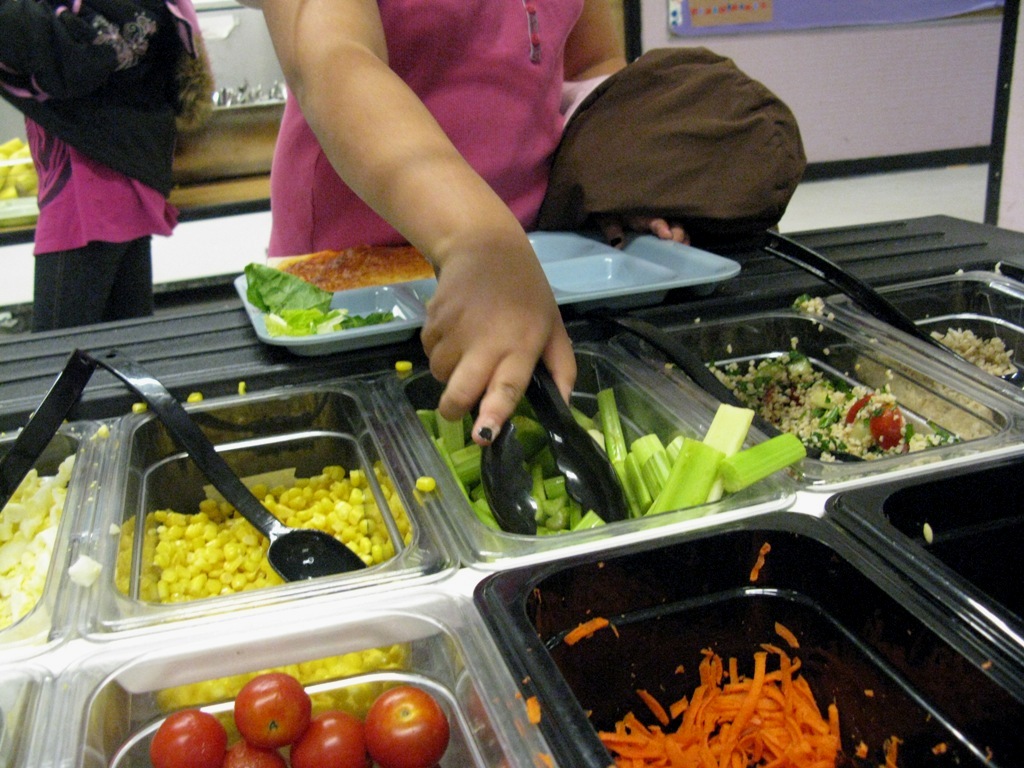
USDA Rmoves Roadblock to Michelle Obama's Salad Bar Initiative

Lunch at Columbine Elementary School, Boulder

The U.S. Department of Agriculture has removed a serious hurdle confronting Michelle Obama’s campaign to place 6,000 salad bars in the nation’s schools after advocates expressed alarm over a government memo indicating that self-serve salad bars would not be permitted in elementary schools.

Backers of the Let's Move Salad Bars to Schools campaign said local health inspectors already were citing the October 8 memo from the USDA’s Child Nutrition Division as a reason for declaring self-serve salad bars a potential food safety hazard and not allowing them around small children.

The memo, signed by Cindy Long, director of the Child Nutrition Division, and circulated nationwide, described only two options for salad bars in elementary schools: salads must be pre-assembled and pre-wrapped, or they must be served by an adult working behind a barrier separating children from the food.

After being questioned by me on these points, Jean Daniel, spokesperson for the USDA’s Food and Nutrition Services (FNS) division, which governs the national school lunch program, said there was a third option not contained in the memo: elementary school children could serve themselves salad as long as the salad bar was designed specifically for small children with a plastic barrier or “sneeze guard” positioned at an appropriate height.

The FNS later issued a written statement, saying, “USDA does not prohibit self service salad bars, and they may be used in elementary schools. USDA encourages the use of fresh fruits and vegetables in school meals. Self service salad bars are one approach that can be successfully included in the meal service when monitored closely to ensure safety.”

An alliance of produce industry, school food professionals, health advocacy groups and government agencies has formed under the first lady’s Let’s Move banner with a goal of placing 6,000 salad bars in schools around the country over the next three years at an estimated cost of $15 million.

Organizers hope to fund the effort through a combination of corporate and private donations, and by creating a website where schools will have individual accounts where they can direct donors from their own communities to make contributions as large or as small as the like.

Ann Cooper, director of nutrition services for Boulder, Co., schools, said she sees “micro-philanthropy” aided by social networking tools on the internet as the cutting edge for funding food improvements in local school districts.

“It’s still a work in progress,” Cooper said. “There’s still a long way to go.” But the project is scheduled to begin accepting applications from individual schools on Jan. 1, 2011. “We’re expecting thousands and thousands of applications,” said Cooper, who estimated there are at least 80,000 schools in the U.S. without salad bars.

The salad bars in question, made of polyvinyl and chilled with ice packs, cost $2,500 each. “If a school found 500 people to each donate $5, they could have a salad bar,” Cooper said. Any school that participates in the national school lunch program is eligible to apply. They must show that the local schools superintendent, the school principal and the food services director are committed to using a salad bar on a daily basis. Preference will be given to schools with large numbers of low-income students, and those that have achieved at least the bronze level in the HealthierUS Schools Challenge.

"The coalition is absolutely raising money to donate salad bars and we fully expect to raise a significant amount of funds," said Cooper. "We assume that all schools will have some amount of money donated directly from the coalition and some schools will have their salad bars fully funded."

Cooper recently was involved in a similar campaign in which Whole Foods garnered $1.4 million in donations from its customers in order to donate salad bars to schools. Cooper's Food, Family, Farming Foundation, based in Boulder, will be in charge of managing the application process for the Let's Move campaign.

Another principal partner in the Let’s Move alliance is United Fresh, a produce industry trade group, that began its own salad bar campaign two years ago backing legislation sponsored by U.S. Rep. Sam Farr (D-Calif.) that called on the USDA to increase fruits and vegetables in school meals. Farr represents the produce-rich Salinas Valley.

Ray Gilmer, spokesman for United Fresh, said the legislation “never got much traction,” but generated some buzz around salad bars. A year ago, United Fresh began soliciting donations from its corporate members to purchase salad bars and place them in schools. “A lot of companies want to place them in the communities where they operate, a sort of ‘good neighbor’ thing,” Gilmer said.

Gilmer said the United Fresh campaign was low-key, conducted mostly by word of mouth and through internet chatter. To date they’ve given away 60 salad bars and plan to donate a undetermined amount of cash to the Let’s Move campaign. "We're going to New Orleans for a convention, and we’ve already placed 10 salad bars in schools there," Gilmer said.

A third partner in the White House effort is the National Fruit and Vegetable Alliance, composed of the USDA, the U.S. Centers for Disease Control and Prevention (CDC) and such disparate groups as the American Cancer Society and the California Department of Public Health.

The CDC has emerged as a leader of the group, taking up fruits and vegetables as a key ingredient to preventing diet-related diseases such as obesity and Type 2 diabetes.

The salad bar effort still faces some obstacles. Some schools don’t want salad bars. Montgomery County, just outside the nation’s capitol, does not permit salad bars for food safety reasons. Philadelphia schools similarly do not offer salad bars, but serve salad in the regular food line instead.

“Self-serve brings a number of management issues that we’d have to look at,” said Philadelphia schools spokesman Fernando Gallard. “Basically, you’d have a salad bar in an open area where people are going to walk around it. That’s something we still have to consider, the sanitation issues.”

Ann Cooper has complained about USDA regulations that require students who use the salad bar as a component of a reimbursable meal to pass a cashier or point of sale station where a trained cafeteria worker would inspect the student’s tray and confirm that the student had taken the required items in the correct portion sizes. Cooper said such rules can create a logjam in the cafeteria.

Here in the District of Columbia, many food service areas are not designed to accommodate a salad bar. Installing one would require rethinking how students pass through the meal line and where the cashier is situated.

Kate Adamick, a school food consultant and fervent salad bar advocate, said those obstacles can be overcome without too much difficulty. "I don’t think there’s any other way to serve produce in school," she said. Most cafeteria vegetables are cooked to death or come out of a can and kids either refuse them in the service line or throw them in the trash. Adamick believes children eat more vegetables when they're allowed to serve themselves from an array of fresh choices. "When kids get to make their own decisions, they’re much more likely to try things."

Saturday, December 4, 2010

Kids Make Portuguese Salt Cod Casserole

Salt cod from China? A tradition lives on....

By Ed Bruske

aka The Slow Cook

Before refrigeration, fisherman plying the rich Atlantic waters off Canada dried and salted their harvest of cod. The cod are mostly gone, but the tradition lives on, nowhere more so than in Portugal, where there are said to exist at least 1,000 recipes for preparing salt cod.

Salt cod isn't exactly a convenience food. You have to soak it at least 24 hours in several changes of water to remove the salt and rehydrate the flesh. But I couldn't very well take my food appreciation classes to Portugal on our virtual world culinary tour without sampling at least one salt cod dish, and this casserole--simple as it is--remains a classic.

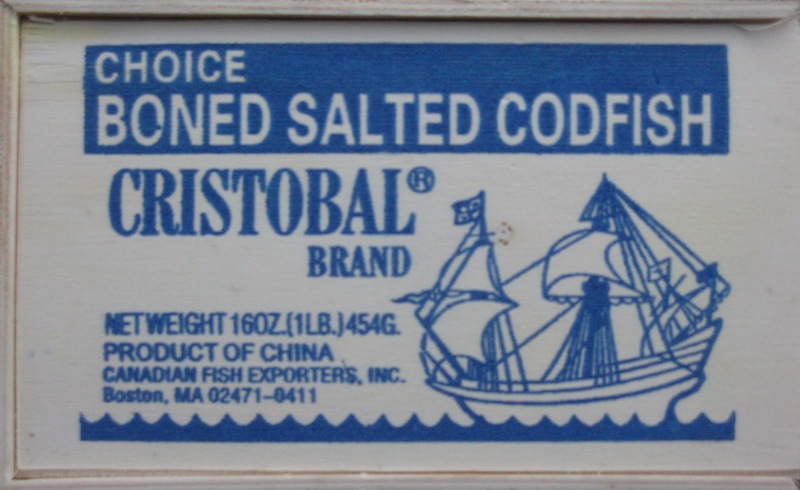
The first order of business is finding the salt cod. I purchased mine at our neighborhood Harris Teeter where it comes pre-boned in this nifty wooden box. I'd never heard of salt cod from China before. But perhaps that's where they're sending the fish these days to be processed. You can also find it in ethnic groceries, any catering to Latin, African or southern European clientele are a good bet. Normally I wouldn't think of eating Atlantic cod. It's been so overfished, the Monterey Bay Aquarium's Seafood Watch program advises consumers to stay away from it. But you can't very well make a traditional Portuguese salt cod dish without it.

To make enough to feed a family of four, soak 8 ounces salt cod in a covered container, refrigerated, for 24 hours, changing the water three times. Remove the cod and place it in a heavy pot, cover it with boiling water and cook over moderately low heat for about 10 minutes, or until the fish flakes apart with a fork. Drain the fish and when it is cool enough to handle, break it into small pieces with your fingers, removing any bones and skin. Set aside.

Meanwhile, peel 1 pound boiling potatoes, such as Yukon gold. Cut the potatoes into quarters lengthwise, then cut these pieces into 1/4-inch slices. Cook the potato slices in plenty of salted, boiling water until just tender. Drain well in a colander.

While the potatoes are draining, brown one yellow onion, cut in half and sliced thinly, in extra-virgin olive oil at the bottom of a heavy, oven-proof skillet. When the onions have caramelized and smell quite delicious, remove them from the skillet and brown the potatoes in the same fashion, adding more olive oil as needed.

Remove potatoes from the heat. Add the browned onions back to the skillet along with the flaked fish and a small handful of chopped fresh parsley leaves. Toss everything together and place in a 350-degree oven for about 20 minutes, or until the fish has lightly browned and the casserole is sizzling hot. Garnish with pitted, oil-marinated black olives, chopped hard-boiled egg and a little more chopped parsley.

This makes a simple supper, but oh so good. And there's plenty of handwork-slicing onions and potatoes, flaking fish, pulling parsley leaves--for the kids to do. Just be sure to have extra olives on hand. The kids really go for those.

Friday, December 3, 2010

Help Save Healthy Schools Funding

Looking for something you can do to save the $4.7 million outgoing D.C. Mayor Adrian Fenty is trying to cut from school meals funding? Read on:

As you probably know, the landmark DC Healthy Schools Act was unanimously passed into law earlier this year, and fully funded with a 6% sales tax on soda. But Mayor Fenty proposed in his Budget Gap-Closing Plan to eliminate $5.2 million in the FY 2011 budget for the DC Healthy Schools Act, and to delay implementation of the Act indefinitely.

We need your help! Please take a moment to join the D.C. Farm to School Network in telling the DC Council to reject the Mayor’s proposal, and ensure that the Healthy Schools Act is fully funded in the current Fiscal Year budget.

Just take these three, easy steps:

1) Sign-on as an individual or organization to our letter urging Councilmembers to fully fund the DC Healthy Schools Act.

2) Call your Councilmember during our Phone-In on Monday December 6th, between 2:00 and 4:00 p.m.

a. Share how you have been affected by the DC Healthy Schools Act, and why you think it’s important. For example, you can say: “I am a resident of Ward X, and I ask that the Councilmember ensure the full funding of the DC Healthy Schools Act in the Fiscal Year 2011 budget.” Follow this link to find your ward.

b. Tell them: “I also believe that DC Council should take a balanced approach to closing the budget gap – it should choose to raise revenue rather than cut the Healthy Schools Act and other vital programs like Temporary Assistance to Needy Families (TANF), Adult Job Training, Grandparent Caregiver, Childcare Subsidies, Interim Disability Assistance, and the Local Rent Supplement Program. As a taxpayer in the District, I encourage the Council to vote for a one percent income tax increase on income above $200,000 to help fund these programs.”

3) Email your Councilmember directly to tell him or her you fully support the Healthy Schools Act and a balanced approach to closing the budget gap.

Share this Action Alert with your networks. We must act now! The Council will vote on the Budget Gap-Closing Plan on Tuesday, December 7.

Thank you for your continued efforts and support.

Thursday, December 2, 2010

Child Nutrition Act Passes, But Don't Expect Better School Food

By Ed Bruske

aka The Slow Cook

On Thursday afternoon, the House approved the "Healthy, Hunger-free Kids Act," also known as the child nutrition reauthorization (CNR) bill. Having already cleared the Senate, the bill is ready for approval by President Obama, who has long supported it (along with Michelle Obama, who's made kids' health her policy focus). This broad piece of leglslation, which Congress has to reauthorize every five years, controls funding for all child nutrition and women, infant, and children (WIC) programs, including school lunches.

The reauthorization had been dogged by delays. The Senate passed it by unanimous consent in August. In the House, the bill bogged down recently because some Democrats recoiled from funding the school lunch budget increase with money taken from the Supplemental Nutrition Assistance Program (SNAP): in effect, adding money to low-income children's lunches by taking it from their home meal budgets. But then the White House promised to find a way to replace the money taken from SNAP, and the way was cleared for the successful vote.

Approximately 31 million children participate in the subsidized school meal program, with the federal government giving schools $2.72 for a fully subsidized lunch. According to the School Nutrition Association, the average school loses 35 cents on every lunch it serves.

Unfortunately, while the bill's long-delayed passage is being lauded by sustainable-food advocates, it provides just 6 cents in extra funding. Worse, it calls for new school-food standards that seem destined to jack up costs in the nation's cash-strapped cafeterias while consigning tons more cooked-to-death broccoli, canned green beans, and other vegetables to the trash heap. Meanwhile, the puny 6-cent boost in federal payments for school lunches is conditioned on schools adopting those very same standards.

The extra money for school lunches won't buy better nutrition.That's right: The money widely hailed as the first real (inflation-adjusted) increase in school meal funding in recent memory is only available to schools that demonstrate they are meeting standards that will probably force them to shell out more money for food that won't be eaten.

Sure enough, the Institute of Medicine, in issuing its recommended standards in October 2009 at the USDA's behest, called for precisely the kinds of things kids like to eat least: bigger servings of whole grains and vegetables. The standards would even make it more difficult for schools to substitute fruits or fruit juices for vegetables, on the theory that kids really need more greens and orange-colored vegetables in their diet.

The IOM panel that made the recommendations said the requirements would certainly raise the price of ingredients for school meals, with no guarantee kids would actually eat the food. Kids have a long history of either refusing vegetables in the food line, or just dumping them uneaten. School kitchens have an equally long history of serving vegetables that are anything but palatable.

So much for Congress coming to the rescue of school food.

On the plus side, the IOM standards would lower the number of calories schools must offer kids in subsidized meals, which could mean fewer sugary options in the cafeteria. Up to now, schools have been using sugar to jack up the calories in their meals in order to comply with outdated USDA requirements.

The IOM panel said it hoped the new standards would help squeeze sugar off school menus. But it tried to leave plenty of room for sugar-laden chocolate milk. They wouldn't want to cross the dairy industry, after all.

With all the hullaballoo over the $4.5 billion cost of the legislation, and whether it would have to be paid for with some $2 billion in funds previously designated for food stamp benefits (it will), the best part of the bill was nearly lost from the discussion. That's a provision calling on the USDA to develop within two years yet another set of standards, these for foods sold in schools but outside the federally subsidized meal line, meaning through vending machines, school commissaries, and cafeteria a la carte lines that dish out junk like they're corner convenience stores.

For years, healthier food advocates have been trying to get candy, chips, sodas, and other junk food out of schools, to no avail. The USDA now has authority to banish any foods (with the exception of those sold at fundraisers) that do not comport with the Dietary Guidelines for Americans, which means limits on fat, sugar and salt.

Does that mean vending machines with baby carrots, not Doritos and Sprite, in every public school? Not necessarily. The fight now shifts to the inner sanctum of the USDA secretary's office, where it is yet to be seen what kind of influence the powerful food industry lobby will wield.

Another large chunk of change in the bill -- $375 million -- is designated to fund grants at the state level for nutrition education and anti-obesity efforts. There's $40 million to study the causes of hunger, obesity, and Type 2 diabetes in children, and a token amount -- $5 million -- allotted for grants to promote farm to school programs, especially in schools with large numbers of low-income students.

Congress also calls on the USDA to study ways of using Medicaid and census data to allow large blocks of children to become eligible for free school meals without filling out cumbersome applications, meaning easier access to food. The bill also orders cafeterias to make water freely available.

This story orginially appeared at Grist.

Wednesday, December 1, 2010

Testifying for Healthy Schools

Given before the D.C. Council yesterday, as it considers removing funds for better school food in the District as part of a plan proposed by outgoing Mayor Adrian Fenty to close a $188 million budget gap.

My name is Andrea Northup and I coordinate the D.C. Farm to School Network, a program of the Capital Area Food Bank. The Network aims to improve child health in the District by increasing access to healthy, local food in school meals.

My message for you today is that the Council must maintain funding in the Fiscal Year 2011 budget for the Healthy Schools Act. Specifically, I urge you to reject the section of the Mayor’s Gap-Closing Plan that calls for elimination of funding and FTE’s for Healthy Schools Act initiatives in the Office of the State Superintendent of Education and the Office of Public Education Facilities Management.

The Healthy Schools Act has attracted national recognition for its comprehensive approach to improving child health and wellness. The Act sets high standards for school nutrition, expands access to school meals, increases physical and health education requirements, and more. For the more than 70,000 children currently attending D.C. Public and public charter schools, the proposed $5.2 million in cuts to Healthy Schools Act implementation would be a major step backward, just as the city is making real strides in its struggle against the rising tides of childhood obesity and hunger.

Half of Washington, DC youth are at risk of hunger, a third live in poverty and over a third of all District youth are obese or overweight. Most get their main meals each day at school, especially during these tough economic times. Hunger and malnutrition have serious effects on child health, cognitive function, growth and development. If left underserved, these at-risk youth will become drains on the District’s dime as unhealthy, unproductive adults. It’s shortsighted not to see the costs that will accrue down the road if we don’t act to address the epidemics of child hunger and obesity NOW.

In May 2010, the Council unanimously enacted the Healthy Schools Act, then approved a 6 percent sales tax on soda to secure an estimated $8 million to fund the Act. We must NOT allow the Mayor to take away this funding that was promised specifically for the health and well-being of schoolchildren in the District of Columbia. Difficult choices must be made in this harsh economy, but the health of vulnerable children in the District must NOT be compromised.

Doing so would counter the recent momentum of Healthy Schools Act implementation. Schools have made serious investments in order to comply with the Act’s strong nutrition requirements, banking on funding incentives in the Act. Healthier, tastier meals are being served in cafeterias city-wide. Schools have re-written contracts with their food service vendors. Jobs have been created as schools replace processed convenience food with from-scratch meals using high quality ingredients. More students are participating in school meals, and parents and students are behind the reforms. Schools CAN NOT sustain changes like these without Healthy Schools Act funding, even though healthier meals been overwhelmingly well-received.

The rest of the nation is watching these changes taking place in the District with a critical eye. Will the Council step up and fully fund the Healthy Schools Act, and prove that we can reverse some of the nation’s highest child poverty and obesity rates? Or will the Council sit idly by as funding promised to D.C. children gets absorbed into the city coffers? Thank you for the opportunity to testify today, and feel free to contact me with further questions.