Sunday, March 25, 2012

Kids Make Pierogies


Pierogies lightly browned in the skillet

By Ed Bruske

aka The Slow Cook

Call them dumplings. Call them Polish pot stickers. Call them whatever you like. Pierogies are just plain delicious, and kids have a blast making them.

This is the first time we've attempted a stuffed dumpling in our food appreciation classes and pierogies--a huge favorite in Eastern Europe--do take a bit of practice. The trick is getting just the right amount of stuffing onto a circle of pasta dough so that when you fold the dough closed, the stuffing doesn't ooze out the edges. Then you have to pinch the edge several times all around to make sure the dumpling doesn't open up when you boil it and spill its contents into the water.

Otherwise, there's nothing terribly complicated about making the components for pierogies: along with a pasta dough much as you would use for Italian pasta, there's a stuffing, in this case a very traditional potato and cheese mix. Pierogies can also be filled with sauerkraut, mushrooms or other savory items.

We chose to roll our dough flat with a rolling pin, but if you have a pasta machine, you might want to use it instead. Eventually, you want your dough to be on the thin side of 1/8 inch. A thinner dough makes more delectable pierogies--plus the thinner you roll the dough, the more pierogies you'll have.

Start by making your dough. You'll want it to rest an hour or even overnight before using. In a large mixing bowl, mix together 2 cups all-purpose flour and 1/2 teaspoon salt. In a separate bowl, beat 1 large egg, then whisk in 1/2 cup water. Add the egg mix to the flour and mix thoroughly. If it's too sticky at this point, add more flour. Use your hands to shape the dough into a ball, then pour it out onto a floured work surface and knead the dough about five minutes, or until it is smooth and elastic. Cover with plastic and allow to rest.


Cutting circles of dough for pierogies

While the dough is resting, peel 1 large Russet potato and cut it into 1-inch dice. Cook the potato in a large kettle of salted water. (This will later become your water for cooking the pierogies.) When the potato is cooked through and soft, remove it from the water and drain in a colander. Place the potato in a mixing bowl and mash thoroughly. When it is cool enough to handle, add a like amount of farmer's cheese (or substitute cottage cheese or ricotta) and mix thoroughly with your hands.

On a floured work surface (or in your pasta machine), roll the dough to a thickness of 1/8 inch or even a bit less. As you're rolling the dough, you might want to flip it over from time to time and dust it with flour to make sure it doesn't stick to your work surface. When you have finished rolling it, cut the dough into circles with a 3-inch biscuit cutter. Save the scraps--they can be rolled again to make a few more pierogies. You should end up with about 30 in all.

Use your hands or a mechanical scoop to place a small ball of filling on one of the discs of dough. Holding the disc in one hand, use the thumb of the other hand to press the dough into place as you fold the disc in half to close the dumpling, making a half-circle.


Placing filling on the pasta dough

The trick at this point is not getting any of the filling onto the edges of the pasta disc, which means practicing a bit until you get a feel for how much filling each dumpling requires and carefully pressing the filling with the side of your thumb into the crease as you close the dumpling.

Now, while continuing to hold the dumpling in one hand, use the thumb and forefinger of the other hand to pinch the edge closed. Don't be afraid to pinch fairly hard, pushing the filling back toward the crease. Once you've pinched the edge closed, go back around and pinch it a couple more times to make sure the seal is good and tight. (You can find videos of this process at YouTube.)


Pinching the pierogie closed

Once you have your pierogies assembled, you can cook them in the same kettle of salted water you used for cooking the potatoes. Use a large amount of salted water for this. It should be at a rolling boil before you add the pierogies. Cook them in batches, perhaps 10 at a time. After you've added the pierogies to the water, give them a stir to make sure they don't stick to the bottom of the pot. Make sure the water returns to a boil. The dumplings will be done in about three minutes, when they are all floating at the surface. Use a slotted spoon or other tool to drain the dumplings well as you remove them from the pot and place them on a sheet pan to cool.

You can hold the pierogies for several hours after they've boiled. Just cover them with plastic. (They could also be frozen before boiling for use later). The final step, just before serving, is to fry the pierogies to a delicate crispness in butter. Again, do this in batches using plenty of butter (at least 2 tablespoons) in a heavy skillet or saute pan over moderately high heat. You don't want to burn the butter or the pierogies. When the dumplings are lightly browned on one side, flip them over and brown the other.

Serve with plenty of sour cream, either as an appetizer or as a side dish with your favorite Polish sausage and sauerkraut.

Pierogies are not the easiest assignment for an elementary school cooking class. But the kids in my classes really impressed me with how well they followed each of the steps. They did a great job folding the dumplings. And of course they were crazy about the final result. They were dying for seconds.

Tuesday, March 20, 2012

D.C. Schools Chancellor Set to Ax Food Services Team?

D.C. Public Schools Chancellor Kaya Henderson: Hot over cafeteria deficits

By Ed Bruske

aka The Slow Cook

Hinting at a major shakeup in D.C. Public Schools' cafeteria operations, Chancellor Kaya Henderson says she does not believe food services chief Jeffrey Mills and his staff are capable of getting multi-million-dollar deficits under control.

In a recent letter to D.C. Councilmember Mary Cheh (D-Ward 3), Henderson rejected suggestions that D.C. schools run their own food services, rather than outsourcing those operations to contractors, saying, "I do not have confidence that my current food service staff has the capacity to manage a self-run food service program, even at a small scale."

Cheh, author of the city's "Healthy Schools Act," had suggested that Henderson undertake a pilot program to test the in-house approach. But Henderson wrote, "To date, we have had significant challenges managing the few contracts we have in place. Our team has not demonstrated proficiency in human capital management or project management."

Apparently, Henderson has lost patience with Mills, who was hired little more than two years ago amid high hopes that DCPS could vastly improve the quality of school meals while also bringing the food service budget more into balance. Saying food service was "not a core competency" of the schools, former Chancellor Michele Rhee ordered cafeteria operations outsourced to a large food service management company. Chartwells won the bidding and under Mills' direction food quality markedly improved. But deficits once again soared out of control, creating $14 million in red ink at last count.

Mills has tried to blame the huge budget shortfalls on waste and inefficiency on Chartwells part, as well as a weak contract. He has argued that the schools could do better by ditching Chartwells and bringing food service operations back in-house. But Henderson and her top echelon of managers have refused to give Mills' plan an audience. Instead, Henderson ordered Mills to put the contract up for bid again.

The latest proposal foresees dividing the district's 121 schools among several different contractors with strict provisions for food quality. Currently, Chartwells serves most of the district's schools, but caterer Revolution Foods has been providing meals to seven schools, while another seven get their food scratch-cooked by chefs from D.C. Central Kitchen.

Mills has pointed out that most of the nation's large school districts manage their own cafeteria operations. Experts agree that providing meals in-house also is more economical than outsourcing those services to for-profit corporations--in theory at least.

For instance, Chartwells’ average cost per meal here is $4.21, compared to $3.06 for D.C. Central Kitchen and $2.87 per meal for Revolution Foods, according to Mills. Officials said Chartwells runs up the cost with numerous contractor fees, and by paying inflated prices for many supplies and ingredients. Mills’ plan called for severing ties with Chartwells and eliminating food service deficits by 2016.

In addition to Cheh, many parents and food activists support Mills' vision of a school district that makes its own meals. An on-line petition to that effect recently gathered more than 200 signatures. It was delivered to Henderson this week. Henderson has agreed to meet with a committee of parents and food access organizations that currently advises Mills' staff.

But Henderson sounds like she's already looking for someone to replace Mills. "Before I am willing to in-source food service, even as a pilot, I must have complete confidence that the team I have in place puts DCPS in the best position to be successful," Henderson wrote Cheh. "Along with monitoring our new food service contracts, my efforts in food service will be devoted to ensuring we have solid management in place in the coming year."

Friday, March 16, 2012

Kids Make Kielbasa

First step to sausage: grinding pork

By Ed Bruske

aka The Slow Cook

Our food appreciation classes continue on their world culinary tour, landing this week in Northern Europe and specifically Poland. And what would dinner in Poland be without kielbasa--Polish for sausage.

Making sausage is one sure way to get kids' attention. In short, it's a blast, from cutting and grinding the meat, to adding herbs and spices, squishing everything between your fingers and finally stuffing the mix into hog casings.

There's a hygiene lesson here, of course. We teach the kids to wash their hands frequently when handling raw meat and not to touch anything else--like tabletops, tools, door handles--before washing to avoid cross-contamination.

Normally we don't use electric gadgets in our classes. I like the kids to do everything by hand, like cooks would have done in the old days. They get a better sense of their ingredients and the process that way. But I do not own a manual meat grinder, so in this case we used my electric grinder/stuffer. As you might imagine, the kids were fighting for their chance to push the meat through the grinder every step of the way.

Traditional kielbasa are normally cold-smoked, but that wouldn't work for our classes. So we'll just make do with fresh kielbasa, which are also delicious, especially when you've just made them yourself with the finest quality pork and seasonings.

I've adjusted this recipe to call for two pounds of meat--plenty for the average family. In fact, you might want to freeze some for future use. The original formula called for a certain amount of fat back. But fat back--literally, fat from the back of the pig--is getting more and more difficult to find. So I simply look for a fatty piece of pork shoulder (aka pork butt). You want plenty of fat in your sausage or it will taste dry.

Also, when making sausage, you want to keep your cutting blades and meat well chilled whenever they are not in use. Things can get sloppy as the fat warms.

Is this fun, or what?

First, slice two pounds of fatty pork shoulder--the best you can find--into 1-inch dice (or a little larger). Run the meat through your grinder and into a mixing bowl using the largest cutting die you have. Then add 1/3 cup cold, 1 1/3 tablespoons finely chopped garlic, 2/3 tablespoon kosher salt, 1 1/3 teaspoons dried marjoram, 1 1/3 teaspoons ground black pepper, 2/3 teaspoon dried mustard, 1/3 teaspoon ground coriander. Mix well (this is where the kids got to squish everything together with their hands.)

Run the mix through the grinder two more times using successively smaller die, or until the mix is rather finely ground to your taste. At this point, you can taste for seasoning by frying some of your mix in a skillet. If necessary, adjust the seasoning, then stuff the mix into hog casings, twisting into individual links about five inches long. (Hog casings can be purchased online, or often from your neighborhood butcher. We got our at the Eastern Market on Capitol Hill, where a couple of old-fashioned butchers sell all sorts of pork products.)

Stuffing sausages works best with two people, one to push the meat through the stuffer and the other to handle the links. Try to pack the meat so there are no air pockets, but these are almost unavoidable. When you've finished stuffing, prick the sausages all over with a needle or poultry skewer (there is a special tool made for this). Doing this give the air a chance to escape and helps prevent the sausages from bursting open when you cook them.

We're saving ours for the parents night dinner in May. Stay tuned!

Friday, March 9, 2012

Brussels Sprouts Kids Crave


Sweet & sour Brussels sprouts are the best

By Ed Bruske


aka The Slow Cook


After our food appreciation classes on Wednesday I got wind of a parent spreading the word that she had witnessed our kids fighting for helpings of Brussels sprouts.


Imagine, kids actually loving Brussels sprouts!


Well, the moral to this story is that sometimes food is all about the preparation, not necessarily the ingredients. Many vegetables, cooked badly, are simply unpalatable. And I suspect that badly is how most people cook Brussels sprouts. But not us. We have a special preparation that's darn near irresistible. Here's how it goes:


For a pound or more of sprouts, trim away the stem ends and cut the sprouts in half lengthwise, removing any loose leaves. Cook the sprouts until barely done in a large pot of salted water. Drain the sprouts into a bowl of cold water to stop the cooking process, then dry the sprouts thoroughly on sheets of paper towel.


For the next step you'll need a heavy skillet liberally greased with olive oil over moderately high heat. When the oil begins to smoke, cover the bottom with sprouts laid flat-side-down. You'll need to do this in batches. Allow the sprouts to brown, then turn them over with a pair of tongs or simply toss in the skillet. Douse liberally with red wine vinegar--you'll get a burst of steam and noise--and toss again. Season with granulated sugar, salt and black pepper to taste. Continue cooking another 30 seconds, or until most of the liquid in the skillet has evaporated. Set aside and continue with the next batch of sprouts.


You might not believe it, but our kids could not get enough of these sweet and sour sprouts. Maybe it was the excitement of seeing that cloud of steam when we added the vinegar to the hot skillet, the popping and sizzling, or even the brief flames as we tossed the sprouts in the oil. Whatever--this is one way you definitely can get children to eat their vegetables.


Note: I neglected to take photos of this week's classes and for some reason don't have any pictures of sweet and sour Brussels sprouts in my files. The photo I've shown here is the closest thing--the carrots are an extra bonus.

Wednesday, February 29, 2012

Time to Take a Stand for Better D.C. School Food


What's for lunch these days? Tilapia

By Ed Bruske

aka The Slow Cook

Here's one thing for sure: Lining the pockets of big corporate vendors is not a path to a sustainable school food system. D.C. officials made that mistake four years ago when they opted to hire Chartwells to run the city's cafeterias. Now D.C. Public Schools are staring at a $14 million hole in their budget. The problem Chartwells was supposed to solve has only gotten worse.

But schools Chancellor Kaya Henderson would continue down that path. She refuses to listen to a plan to bring school meal production back in-house where it belongs. Instead, she's ordered her staff to put meal service out for bid again. That may work temporarily, but concerned parents and food activists across the city are asking Henderson to think again and start the process of building a self-operating meals program.

D.C. is one of only a few large school districts nationwide that outsource their food service to companies like Chartwells, Sodexo and Aramark. Most districts know that the only way to feed kids well economically is by running their own kitchens. But making the switch takes lots of planning. It takes an entire community rallying around the important business of how we feed out kids.

That's where you come in. Add your voice to those demanding that we keep the momentum going behind the recent improvements we've seen in D.C. school meals. Sign this petition and send Chancellor Henderson a message: We want our dollars used to put better food on kids' plates, not for shareholder profits.

You can read more about this issue here and here. Details about the new DCPS school meals "mega contract" is contained in the recently published "request for proposal."

Sunday, February 26, 2012

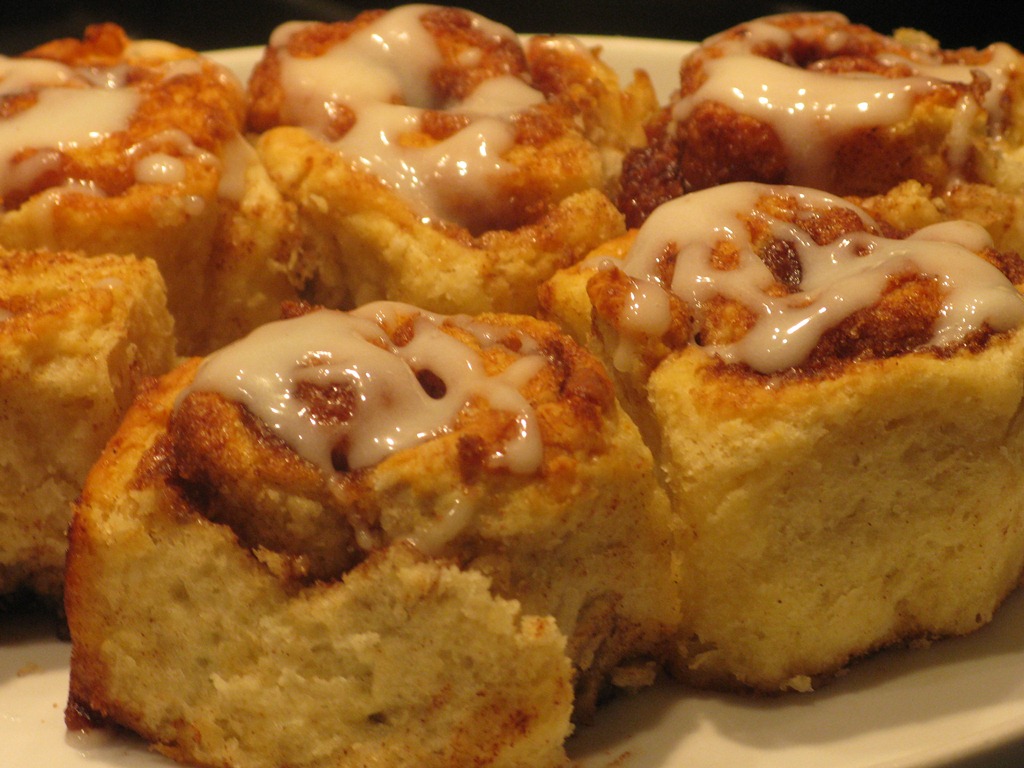
Kids Go Wild for Cinnamon Buns


Cinnamon buns don't get much better than this

By Ed Bruske

aka The Slow Cook

We had a near-riot on our hands this week when we made cinnamon buns in our food appreciation classes. Apparently word traveled fast around the campus how good they were. Kids crowded into our kitchen area. I had to send some of them back onto the playground so that we could actually conduct classes.

Even I was a bit surprised that a simple biscuit dough wrapped around some sugary cinnamon could taste so good. These buns were light and tender--but with a hint of cloves in the filling, they packed a powerful flavor punch.

The one tool you will find essential for this is a pastry scraper. That's to get under the dough and roll it into a log. Pry, lift, roll: that's the motion you want, all along the edge of a rather long rectangle, creating a pinwheel log, after you've pressed the filling onto the sheet of dough. If you don't have a traditional pastry scraper, you could substitute an extra-wide paint scraper or a drywall finishing tool. Just make sure it's very clean. You don't need any paint or drywall in your cinnamon buns.

Start by melting 11 tablespoons of butter (1 stick plus 3 tablespoons). The original recipe called for melting various quantities of butter at different stages of the production. But I think it's much easier just to melt all of the butter at once in a small sauce pan. Set it aside to cool.

Meanwhile, in a medium bowl, mix the filling by whisking together 3/4 packed dark brown sugar (we used light brown sugar), 1/4 cup granulated sugar, 2 teaspoons ground cinnamon, 1/8 teaspoon ground cloves and 1/8 teaspoon salt. Stir in 1 tablespoon melted butter, using your fingers to break up any clumps, until the mix looks like wet sand. Set aside.

In a separate, large mixing bowl, whisk together 2 1/2 cups unbleached all-purpose flour, 2 tablespoons granulated sugar, 1 1/4 teaspoons baking powder, 1/2 teaspoon baking soda and 1/2 teaspoon salt.

In a liquid measuring cup, stir together 1 1/4 cups buttermilk and 6 tablespoons melted butter.

Pour the buttermilk mix into the flour mix and stir with a rubber spatula, scraping the bottom and sides of the bowl and pressing the liquid and dry ingredients together until a shaggy dough forms. Pour the dough onto a floured work surface and press it together as you would for biscuits, kneading it a few times. Press the dough into a rectangle with your hands, making sure both sides are dusted with flour. Then use a floured rolling pin to roll the dough into a larger rectangle--about 15 inches long by 12 inches wide. The dough should be about 1/4-inch thick or a bit more.

Rub about 1 tablespoon melted butter over the dough, then pour on the cinnamon mix, spreading it all over the surface of the dough and patting it lightly with your hands. Then at the near edge of the dough use your pastry scraper to lift the dough and roll it over onto itself to form a log. When you are finished rolling, you can squeeze and pat the log along its length to make it a bit more uniform.

Grease a 9-inch metal cake pan with 1 tablespoon melted butter. Use a serrated knife to cut the log into 1 1/2-inch rounds, patting each piece lightly to flatten it a bit, then transferring into the cake pan, packing them as tightly as necessary. Don't worry, they will separate easily after they've been baked.

Pour the remaining melted butter over the top of the buns, then place the cake pan on the middle rack of a pre-heated 425-degree oven for 25 minutes.

While the buns are in the oven, you can make an icing if you like. Stir together until very smooth 1 tablespoon soften cream cheese, 1 tablespoon buttermilk and 1/2 cup sifted confectioner's sugar.

When the buns have finished baking, set the cake pan on a wire rack to cool. When the buns are cool enough to handle, use a pointed knife to gently cut around the edges of each bun and remove them to the wire rack or a sheet pan to cool further. Before serving, drizzle some icing over each bun and watch them disappear.

Friday, February 24, 2012

It's Time for the Inspector General to Investigate D.C. School Food


Why do D.C. cafeterias consistently lose money?

By Ed Bruske
aka The Slow Cook

Was former D.C. schools Chief Operating Officer Anthony Tata pulling our leg when he told a room packed with parents and other concerned citizens in August 2010 that school cafeterias had been losing $11 million to $14 million every year on food service?

I was there, and I distinctly remember Tata saying school officials had "found a sweet spot" by hiring Chartwells, a giant food service company, to manage the cafeterias. Sitting next to him was the newly hired DCPS food services manager, Jeffrey Mills, who had spent his first months forcing Chartwells to radically overhaul its menus, ditching Pop-Tarts, chicken nuggets and strawberry milk in favor of chicken on the bone, homemade lasagna and locally-sourced broccoli.

Now comes Mills saying deficits have only gotten worse under Chartwells--a whopping $14.35 million in the current school year. But wait: According to figures Mills recently supplied to D.C. Council Member Mary Cheh, budget overruns in food service have ranged widely. In school year 2006-2007, when DCPS was running its own food service--meaning purchasing ready-made meals packed in a suburban factory--the deficit was $10.8 million. The following year, when food service was still self-operated, the flow of red ink increased to $11.6 million. In 2008-2009, after Chartwells took over, the deficit swelled to $14.4 million. But the following year it shrank to $13, million and fell a whopping 30 percent in 2010-2011--the year D.C. hired D.C. Central and Revolution Foods to serve the food in 14 schools as part of a pilot program.

So why is the budget shortfall back with a vegeance this year--40 percent larger, in fact, at $14.35 million?

Out of control deficits have prompted schools Chancellor Kaya Henderson to demand that her food service team immediately advertise a new "mega-contract" for outsourced cafeteria operations. A request for proposal is scheduled to be published in this Sunday's Washington Post. The last such RFP was published four years ago and led to the hiring of Chartwells. The only other company to bid was Sodexo, one of Chartwells main competitors.

Both companies are part of huge, foreign-based conglomerates. Sodexo is French, Chartwells, which manages food service in more than 500 U.S. school districts, is just a small part of the $14 billion Compass Group, based in Great Britain.

There's no reason to suspect that Chartwells won't bid on the new contract. Or that it might not just win the bidding again and continue under some new terms. That's the last thing Mills would want to see. He wants Chartwells out now so that he can run his own system in-house. But that has put him at odds with Chancellor Henderson, who won't even listen to Mills' proposal and prefers to rule over DCPS cafeterias in typical D.C. fashion--with an iron fist.

Apparently, one thing Mills hasn't learned in his two years on the job is how to navigate the schools bureaucracy. It will be a miracle if he keeps his job. And that would be a shame, since he really has presided over some dramatic improvements. The vastly more appetizing menu-- minus the flavored milk and other processed junk foods--was a great starter. But he also has incorporated lots of locally-sourced produce, taking advantage of extra funding made available in the Healthy Schools Act approved by the D.C. Council two years ago. He started a school breakfast program that has been named the best in the country, along with a new "supper" program that ensures kids don't go home in the evening with empty stomachs. And he's installed salad bars in a number of schools, which has been credited with increasing student participation in the meals program across the board.

That's why it's so important now to ask the city's inspector general to finally untangle the messy finances in DCPS food services. Please tell us why the schools consistently lose so much money every year feeding our kids. We need this kind of baseline information--some real straight talk--so that we can make important decisions in the future about how school cafeterias should be run.

In my reporting on school food, I've chosen to look on these deficits in D.C. as a subsidy for the meals program. For sure, all that red ink helps pay for some of the best school food in the country. But is it also subsidizing too much waste and inefficiency? Do we just pay a lot more for cafeteria worker salaries? Or is too much money simply lining the pockets of Chartwells and its Compass Group shareholders?

If the schools were running deficits before, when they were just ordering the equivalent of factory-made airline meals, how different are the deficits now, when we have a professional food service company making the meals in school kitchens using individual components? These are the kinds of questions the inspector general could answer so that we as a community do not continue to trip over ourselves trying to decide what kind of food service the schools should have, so that we aren't trying to chose a winner between the chancellor and her food services director.

I'm told that asking the inspector general to get involved now really wouldn't help much--it takes a year or two to conduct an investigation and generate a report. But here's the kicker: building a successful food program in a district the size of D.C. is a multi-year process. In Boulder, for instance, where I spent a week observing the results of a dramatic overhaul, Ann Cooper and her team of experts spent a year just studying the local cafeteria operation and devising a plan to change a menu of processed junk to meals prepared by teams of professional chefs. In Berkeley, parents spent years organizing and agitating before they got their vaunted cafeteria overhaul.

Changing school food service in any meaningful way requires political change as well. Butting heads in the D.C. Council chamber, as May Cheh did with Kaya Henderson yesterday, may provide drama and grist for reporters, but it doesn't result in clarity or the unity of purpose we need to move the school food program together. But one thing the Council could do now that would help is ask for a formal investigation by the inspector general. That at least would explain why school food service budgets don't balance, and give us a common reference point with which to hold a civilized conversation down the road.