Showing posts with label bread. Show all posts

Friday, February 17, 2012

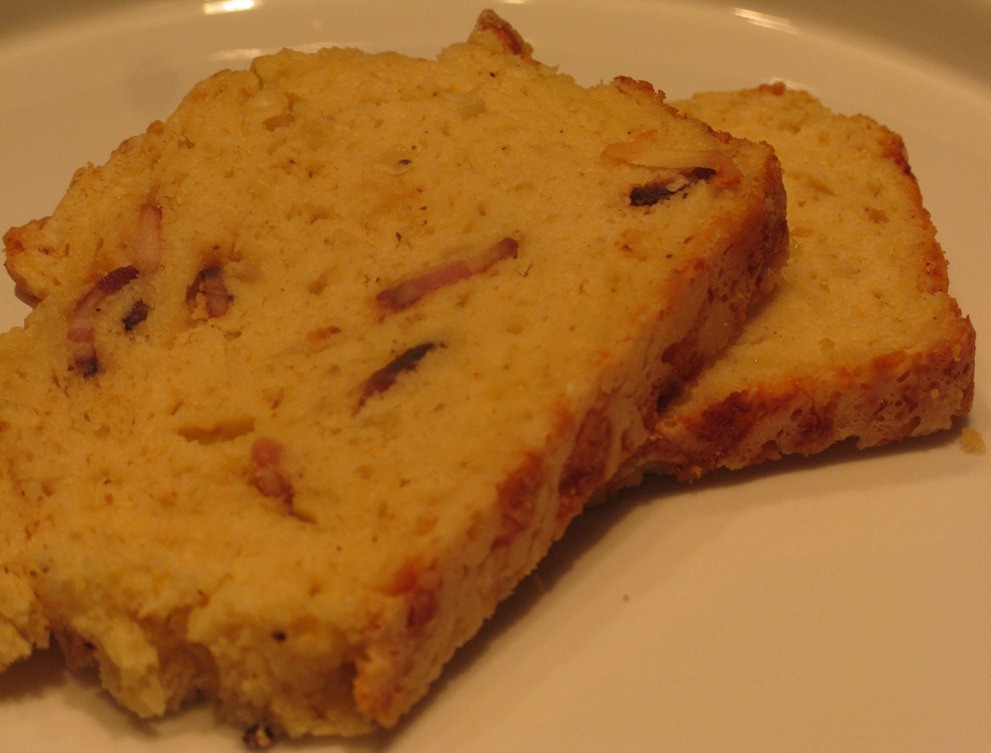
Kids Make Bacon Cheese Bread


Is there anything bacon can't make better?
By Ed Bruske

aka The Slow Cook

One of the adults at our school asked if we were using turkey bacon to make bacon cheese bread in our food appreciation classes.

"Heck, no!" I replied. "We do not use fake bacon in our classes!"

We teach kids to make traditional foods using traditional tools and techniques. Modern "healthy" alternatives, such as substituting a processed turkey product for real pork bacon, is an entirely different lesson But you could certainly opt for the ersatz bacon when making this bread at home.

And believe me, you will want to make this bread.

We love to torture the rest of the school with our cooking aromas. The smell of bacon sizzling on the stove top--followed by sauteed onions--started mouths watering all over campus. Add to the bread heaps of Parmesan and Gruyere cheese and you practically have a stand-alone meal that any southern chef would be proud to put on the menu. In fact, this bread would be even more perfect slathered with pimento cheese, another southern specialty.

And it's not at all difficult--or time consuming--to make. This is a quick bread, after all, where baking powder is the principle rising agent.

Start by grating 3 ounces Parmesan cheese over the large holes of a box grater. Set aside. Then grate 4 ounces Gruyere cheese and reserve separately.

Next, cut five slices of thick bacon into 1/4-inch pieces. Sautee these until almost crispy in a heavy skillet over moderately high heat, then drain the bacon onto paper towels, reserving 3 tablespoons of bacon grease in the pan. Next, sautee 1/2 medium onion, chopped fine, until lightly browned. Set aside.

For the wet ingredients used in this bread beat 1 large egg in a medium mixing bowl, then whisk in 1 1/4 cups milk, 3/4 cup sour cream and 3 tablespoons melted butter.

For the dry ingredients, whisk together in a large mixing bowl 3 cups all-purpose flour, 1 tablespoon baking powder, 1 teaspoon salt, 1/8 teaspoon ground black pepper and 1 pinch cayenne pepper. Using a spatula, mix in the 4 ounces grated Grueyer cheese, tossing and stirring until the cheese is completely coated with the flour mix, breaking up any clumps of cheese as you go.

Grease a 9-inch by 5-inch loaf pan with cooking spray. We had some issues with the bread sticking to our pan, especially on the bottom. You might want to line the bottom of the pan with a piece of parchment paper and spray it well. Dust the bottom of the pan with 1/2 the reserved grated Parmesan cheese.

Pour the wet ingredients into the flour mix and mix well with a rubber spatula, scraping the sides and bottom of the bowl until all of the ingredients are incorporated. Scrape the batter into the prepared load pan, smooth out the top and dust it with the remaining grated Parmesan cheese.

Place in a 350-degree oven for 50 minutes, or until the loaf is golden brown and a toothpick inserted into the middle comes out clean. Allow the loaf to cool in the pan for about 15 minutes, then invert and place the loaf on a wire rack to cool further.

Make sure to get a slice for yourself. This bread does not last long!

Friday, February 10, 2012

Kids Make Cranberry Nut Bread


A quick bread loaded with fruit

By Ed Bruske

aka The Slow Cook

The original recipe for this delicious quick bread originally called for fresh cranberries. But with cranberries out of season, we had a choice to make and opted to use sweetened dried cranberries instead. The result is perhaps more like a fruit cake than a bread. So much the better. The kids couldn't get enough.

The kids in my baking classes know by now what a chemical rise is, as opposed to a rise created with yeast. Baking soda and baking powder react with acidic liquids to make dough expand, giving us a tender bread or biscuit instead of a cracker. In this case, we use both baking powder--which contains both alkaline and acidic ingredients--and baking soda to create the rise when combined with orange juice and buttermilk, both of which bring an acid to the equation.

Lots of orange zest, in addition to the juice, also lends a ton of fruit flavor to the bread, complementing the cranberries nicely. Heck, you could serve this bread as a replacement for your traditional cranberry mold. It would be delicious toasted and slathered with cream cheese.

Start with your dry ingredients, whisking together in a large mixing bowl 2 cups all-purpose flour, 1 cup granulated sugar, 1 teaspoon salt, 1 teaspoon baking powder and 1/4 teaspoon baking soda. To this add 1/2 cup coarsely chopped and toasted pecans (we skipped the toasting part) and 1 1/2 cups coarsely chopped cranberries, or dried cranberries.

Meanwhile, in a separate bowl, beat one egg, then the grated zest and the juice of 1 large orange, plus 2/3 cup buttermilk and 6 tablespoons melted butter.

Pour the wet ingredients into the dry ingredients and mix well with a rubber spatula, scraping the sides and bottom of the bowl. When all of the ingredients are incorporated, scrape the batter into a 9-inch by 5-inch loaf pan greased and dusted with flour (we sprayed with Baker's Joy).

Pay careful attention to the baking instructions. Place the loaf in a pre-heated 375-degree oven for 20 minutes, then lower the temperature to 350 degrees and bake an additional 45 minutes, or until the top of the loaf is mahogany brown and a tooth pick inserted into the middle comes out clean.

Allow the bread to cool in the pan 10 minutes, then invert onto a wire rack.

Friday, January 27, 2012

Kids Make Zucchini Bread


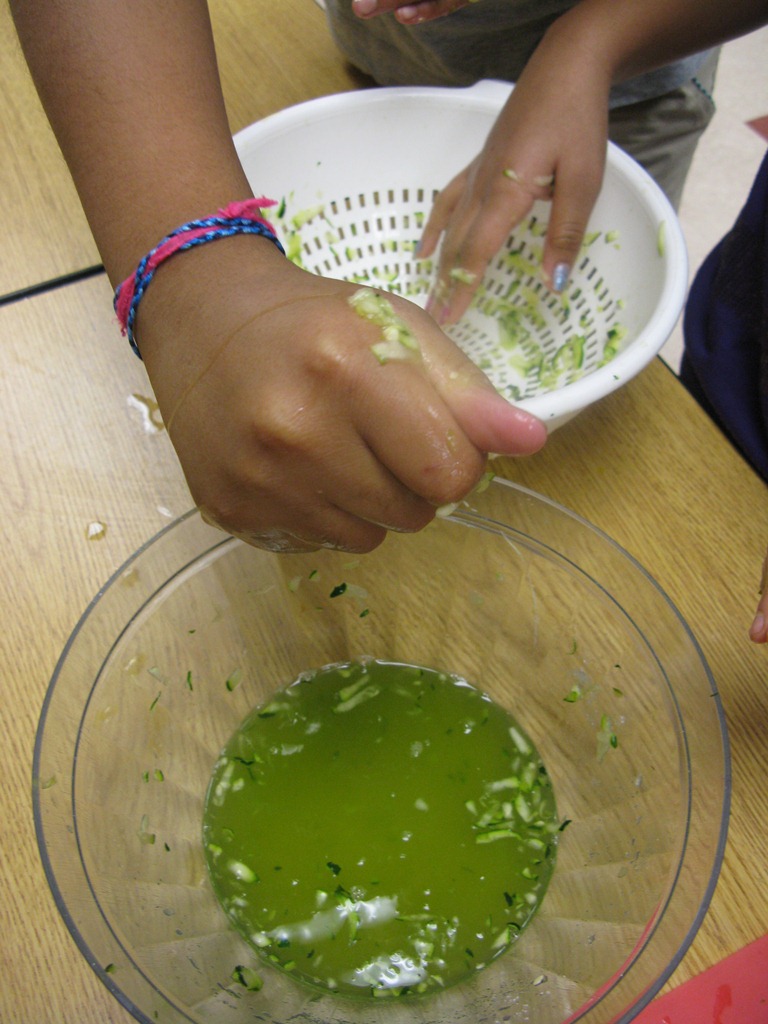
Squeezing water out of zucchini

By Ed Bruske

aka The Slow Cook

The secret to a great zucchini bread, apparently, is getting the water out of the zucchini.

You don't want a wet, leaden bread. And as the kids in my food appreciation classes learned, squash--like most vegetables--is mostly water. Salt or sugar added to grated zucchini penetrates the cell walls on a molecular level, drawing out copious amounts of liquid. Left standing in a colander over a bowl for an hour (or overnight) will produce a cup of water or more from a pound of squash. You can then squeeze out even more with your hands, or by twisting the zucchini in batches in a tea towel.

(One of the kids wanted to taste the water after we'd given the sugar treatment. We did. Not bad! Green and sweet.)

So start your zucchini bread with a pound of squash. Trim off the ends, cut into manageable pieces and grate using the large holes of a box grater. Placed the grated zucchini in a colander set over a bowl and toss in 2 tablespoons sugar. Allow to sit at least an hour--or overnight--then squeeze as much of the remaining liquid out of the zucchini as you can. Set aside.

Meanwhile, whisk together 2 cups all-purpose flour, 1 teaspoon baking powder, 1 teaspoon baking soda and 1/2 teaspoon salt. These are your dry ingredients for the bread.

In a separate bowl, beat two eggs. Add 1/4 cup plain yogurt, the juice from 1/2 lemon (strain out the seeds), 1/2 cup plus 2 tablespoons sugar and 6 tablespoons melted butter. Combine well. These are your wet ingredients. Stir in the grated zucchini.

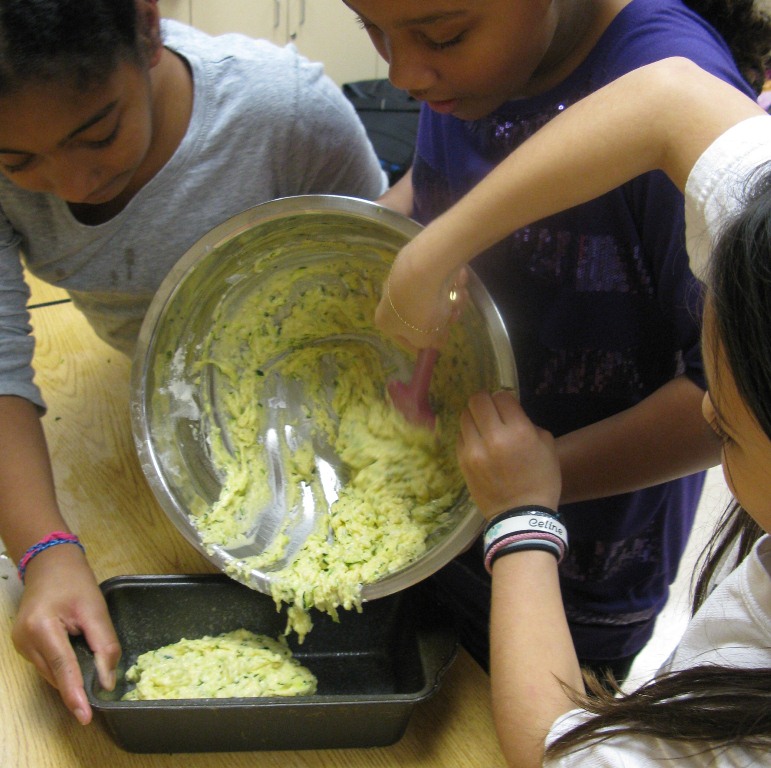
Add the wet ingredients to the flour mix and gently combine with a rubber spatula, scraping the sides and bottom of the bowl. Pour the mix into a 9-inch by 5-inch loaf pan that has been greased and dusted with flour. (We sprayed with Baker's Joy).

Place the loaf pan in a 375-degree oven and bake for 55 minutes, or until the top is nicely browned and a toothpick inserted into the middle comes out clean. Invert the pan to remove the loaf and allow to cool on a wire rack.


Scraping batter into the load pan takes teamwork

Our kids loved the zucchini bread just as it was. In truth, even though the bread is flaked with zucchini, making it quite pretty, you can't really taste the vegetable. In an ideal world, you would serve the bread warm, slathered with cream cheese and washed down with a tall glass of cold buttermilk.

Saturday, January 22, 2011

Kids Bake Banana Bread with Cocoa Nibs

Banana bread: it's so darn irresistible

By Ed Bruske

aka The Slow cook

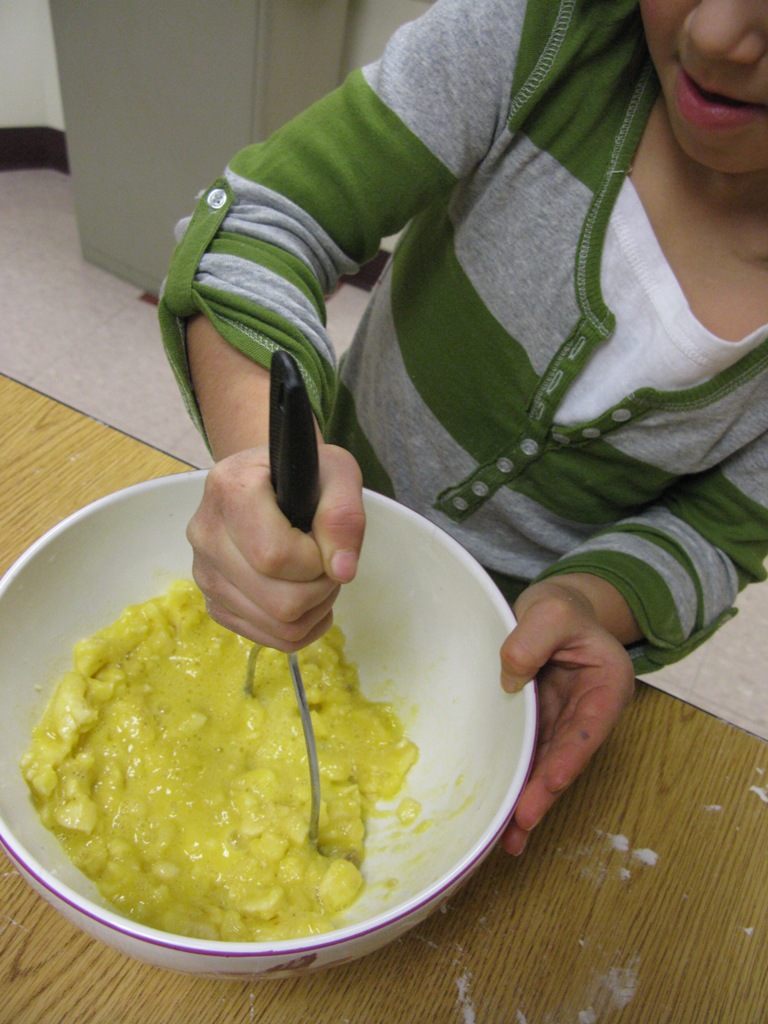
Is there anything more fun than smashing bananas with a potato masher?

My wife, who hates bananas but loves banana bread, urged me to try this recipe with the kids in my food appreciation classes because "it's so easy." I suppose you could say that about banana bread in general. This is how we dispose of our over-ripe bananas. If they get too ripe and we don't have a spare second to make banana bread, we put them in the freezer for later.

Kids who wouldn't touch a banana with a brown spot on it are still mad for banana bread. Bananas just keep getting sweeter as they get older. (Not necessarily true of people, eh?)

This is another example of a delicious treat made with a chemical rise--baking soda combined with a bit of tangy yogurt. I also used this as an opportunity to introduce the kids to something called "cocoa nibs." Are you familiar? These are bits of unprocessed, unsweetened cocoa beans. Whole Foods carries them. They're not cheap. But they help produce a banana bread that's not so sweet it sets your teeth on edge like some do, and they give the bread a nice toothsomeness. Otherwise, you could substitute chopped walnuts if you prefer.

Smashing bananas is great fun

As always, we mix the dry and wet ingredients separately. In a large mixing bowl, stir together 2 cups unbleached all-purpose flour, 1/2 cups cocao nibs, 3/4 cup sugar, 3/4 teaspoon baking soda, 1/2 teaspoon salt.

In a second bowl, beat two eggs, then add 3 very ripe bananas (peeled, of course). Crush the bananas with a potato masher until they are almost liquid. Stir in 1/4 cup plain yogurt, 6 tablespoons melted butter and 1 teaspoon vanilla extract.

Pour the wet ingredients into the dry mix and stir just until everything is completely incorporated. Grease a 9-by-5-inch loaf pan and dust it with flour. Then pour the batter into this and place on a rack set in the lower-middle of a 350-degree oven. Bake until a toothpick inserted into the middle of the bread comes out clean, about 55 minutes.

Remove the loaf from the pan and set on a wire rack to cool. Personally, I like my banana bread smeared with cream cheese. The kids had never heard of this, but once they tried it, I couldn't keep them away from the cream cheese.

Saturday, January 15, 2011

Kids Bake Soda Bread

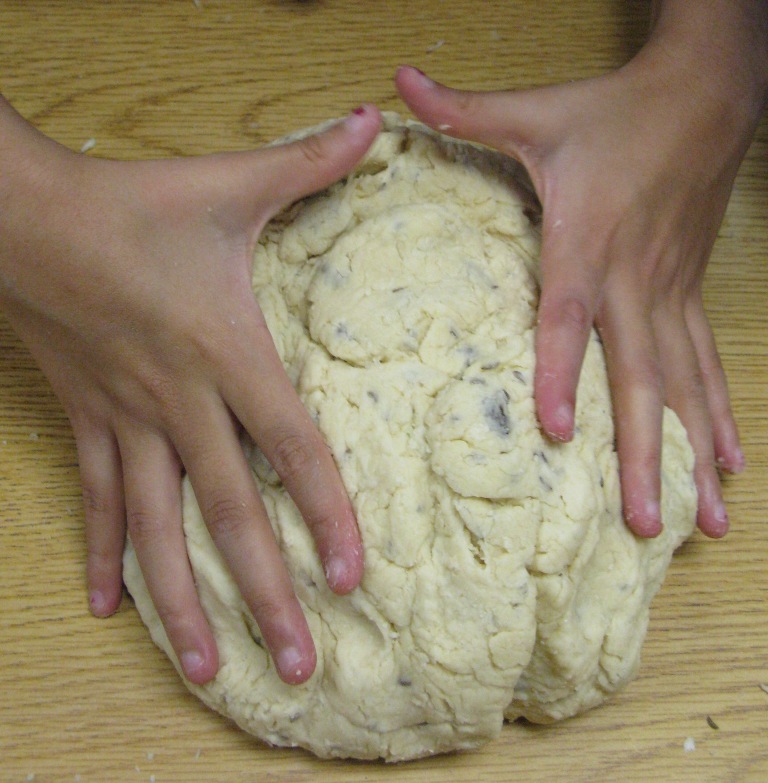
Just a little bit of kneading is all it takes

By Ed Bruske

aka The Slow Cook

I was looking forward to teaching the kids in my food appreciation classes about the simplest kind of Irish soda bread baked in a cast-iron pot. But then my wife steered me toward this recipe, which is a more Americanized take on the the classic, including two kinds of flour, a little egg, raisins and caraway seeds.

This is another lesson in quick breads, or those made with chemical rising agents--in this case baking soda and cream of tartar, mixed with buttermilk--instead of yeast. It makes a lovely loaf of semi-savory bread, well worth a little extra trouble. Serve it warm--fresh from the oven--with a pot of your favorite fruit preserves.

For dry ingredients, stir together in a large mixing bowl 3 cups (15 ounces) unbleached all-purpose flour, 1 cup (4 ounces) plain cake flour, 1/4 cup sugar, 1 1/2 teaspoons baking soda, 1 1/2 teaspoons cream of tartar, 1 1/2 teaspoons salt. Add 4 tablespoons (1/2 stick) room temperature butter cut into small pieces. Cut the butter into the flour until the mix resembles a loose grain. (We used our fingers for this, pinching the flour and butter together--a great activity for the kids.)

Meanwhile, in a separate bowl, beat 1 egg and stir in 1 1/2 cups buttermilk. Add 1 cup raisins and 1 tablespoon caraway seeds.

Pour the liquid into the dry ingredients and stir until everything is thoroughly incorporated. Pour the dough onto a work surface dusted with flour and knead just until the dough holds together in a soft ball. Place the ball onto a greased baking sheet, or a baking sheet lined with parchment paper, and pat it down until it is about eight inches around and two or three inches high. Score the top into a cross with a sharp knife.

Strawberry jam with your soda bread?

Place on the upper-middle rack of a 400-degree oven for 40 minutes, or until the internal temperature of the bread reads 170 degrees. Allow to cool for a bit before cutting into wedges. You can also brush the top with melted butter for a nicely burnished look.

Saturday, April 17, 2010

Kids Make Doro Wat

By Ed Bruske
aka The Slow Cook

The "food appreciation" classes I teach in a private elementary school here in the District of Columbia are on a virtual world culinary tour and we've been looking forward to the day when we could taste our own spicy Ethiopian food with injera bread. That day has finally arrived.

This dish, Doro Wat, features chicken and hard-boiled egg in a traditional berbere sauce. Here in D.C., we have a large Ethiopian population and I knew some of the local stores sell injera, the spongy flat bread that is essential to an authentic Ethiopian meal. The bread is used instead of cutlery--to pick up the food.

I found a store just a short walk from my home. Besides the injera--seven pizza-size loaves of it stacked one atop the other, but you can get taller stacks--I also found a selection of spices. The berbere, bright red with chili powder, came in a two-cup container. But it did not have the same aroma as the berbere we made last week in class. When I asked the woman at the cash register what was in it--if it contained the cinnamon and cloves, for instance, that we had used in class--she shook her head. "No cinnamon," she said. "This is the berbere we make at home, according to tradition."

She said she didn't know exactly what was in it. So, if you don't have an Ethiopian store where you can purchase berbere, make the version we made in class last week.

I explained to the store clerk what I planned to do with my purchases and she asked if I wouldn't be needing butter. Sure, I said. I planned to use butter to cook our Doro Wat. What she meant, though, was the seasoned butter the store sells from its refrigerator case. We opened a one-cup container and the butter smelled of cardamom. Well, I would need some of that as well, I suppose. And obviously these are exactly the ingredients they use to make Doro Wat in the Ethiopian restaurant, because the dish we made tasted for all world like it had been made in an Ethiopian restaurant.

In a heavy skillet over moderate heat, melt 1/2 Ethiopian butter (or use plain butter and 1/2 teaspoon ground cardamom). Add 2 medium onions, cut into small dice, and 3 cloves garlic, finely chopped. Cook until the onions are soft, about eight minutes. Add 2 tablespoons berbere spice, 1 cup diced tomatoes (or half a 14-ounce can), and 1.3 pounds chicken breast cut into bite-size pieces. (You could substitute boneless chicken thighs). Pour in 1/2 cup water and cook until the chicken is nearly cooked through. Add six hard-boiled eggs, peeled and lightly scored with a knife. Baste them with the sauce. Add more water if necessary to make a stew-like consistency.

Season dish with freshly ground black pepper. Ladle the stew over large slices of injera bread on plates. Alternately, you can place the injera on plates and present the stew in a family-size bowl so that people can serve themselves. Don't be afraid to use your hands.

The kids, by the way, were crazy for this dish.