Tuesday, December 14, 2010

Tax Breaks for Billionaires, Higher Lunch Prices for School Kids

Taking more from kids at school keeps taxes low
By Ed Bruske

aka The Slow Cook

Somehow Congress can find money to give tax breaks to billionaires. But in a little-noted provision of its reauthorization of child nutrition programs, signed into law yesterday by President Barack Obama as part of the Healthy, Hunger-Free Kids Act, lawmakers have told schools to raise lunch prices to at least cover what it views as the full cost of making a meal. Entitled "equity in school lunch pricing," the new mandate could, by increasing prices gradually for students whose families aren't low income, pump an additional $2.6 billion into the school meal program over the next 10 years, according to one estimate.

While that's a much-needed infusion of cash, school food services professionals say the move could have the side effect of driving hundreds of thousands of children from the federally subsidized school meals program. The School Nutrition Association (SNA), representing some 50,000 food service workers across the country, likens the new law to cuts in federal support for school meals enacted during the Reagan years, when participation in the National School Lunch Program plummeted 25 percent among full-price students because schools were forced to charge more -- and ketchup was declared a vegetable.

"When you raise prices, it has a real impact on participation," said SNA spokeswoman Diane Pratt-Heavner. "Our members tell us time and time again, even when they raise prices by just a dime, they see participation drop."

"The downside of raising meal prices during these tough economic times is that you run the risk of making the meals unaffordable for kids whose families just barely miss the financial eligibility cut-off," said Kate Adamick, a school-food consultant who has long complained about the pricing disparity. "This is a significant reality in lower-middle class communities, especially for schools located in parts of the country in which the cost of living is extremely high, such as New York City and San Francisco, to name just two. I think this is the right change that may be coming at the wrong time."

Federal subsidies for school meals are intended primarily to help feed low-income children, who receive meals either free or at a reduced price. Even kids who don't qualify and pay "full price" in the subsidized meal line are actually supported by federal funds to the tune of 26 to 34 cents per lunch. But what most schools charge for a full-price meal typically is less than the federal subsidy, currently $1.48 for breakfast and $2.72 for lunch. For instance, here in the District of Columbia, schools serve breakfast free to all students regardless of their ability to pay, while a full-price elementary school lunch is only $1.25, a high school lunch a mere $1.50.

Free breakfasts and underpriced lunches help explain why D.C. schools rack up $7 million in food service deficits every year, or 25 percent of the entire budget.

Critics argue that underpricing also helps explain why schools never seem to have enough money to improve the quality of the food they serve, and that low-income children should not be short-changed in order to support kids who come from wealthier homes, even though there is nothing in federal law to say that government subsidies can only be used to feed needy students. Food service professionals counter that lower prices attract more kids to the meal line, creating economies of scale and helping to lower the marginal cost of meals served in a program they contend is chronically underfunded.

"We all know the effect of higher prices on people's purchasing decisions, and this basic economics lesson applies to school meals as well," Pratt-Heavner said. The new rule, she said, is likely to fall heaviest on families in rural and economically depressed areas where parents "simply cannot afford to pay the higher school-lunch prices charged in wealthier suburban neighborhoods."

Under the formula approved by Congress, schools that are not charging the full cost for lunch would have to start raising their prices annually by an amount equal to the rate of inflation plus 2 percent. For some schools, getting their prices fully caught up could take 20 years.

A study released in January 2010 by the Center of Budget and Policy Priorities (CBPP), a nonprofit research organization focused on low-income Americans, noted that student payments for federally reimbursable meals account for only about one-quarter of school food-service revenues. The greatest share of income comes in the form of federal subsidies, with sales of competitive foods in á la carte lines (often unhealthy snacks like cookies and chips) and vending machines contributing about 16 percent, and state and local governments chipping in another 9 percent on average.

Adamick said most of the schools she visits underprice their meals. "The rationale usually given is that the board of education doesn't want to raise prices because it will be unpopular with parents and may drive down participation (not to mention the liklihood of a board member's re-election). In some districts, the meal prices haven't been raised in many, many years."

A study conducted during the 2005-2006 school year by the USDA, which oversees the school meals program, found that the prices schools charged for paid lunches varied widely, from 65 cents to $3, with the most common price being $1.50 -- well below cost. A more recent analysis by the CBPP of the nation's 20 largest school dischool districts found that the average charge for lunch was $1.80 in elementary schools and $2.14 in high schools, still far less than the federal reimbursement rate.

Houston schools this year experienced what they described as a grave development in their cafeterias. Because of "food prices soaring nationwide," the cost of a paid meal would have to go up: from $1.50 to $1.70.

"School districts generally want to set a price that is affordable for the wide range of families with incomes in the paid meal category," the CBPP concluded. "The disparity results in a revenue shortfall that undermines the goal of providing the highest quality meal possible to all students."

The Center on Budget and Policy Priorities cited a USDA study as showing that student participation in the subsidized lunch program was only 3 percent lower in districts that charged $2 per meal compared to $1.50 per meal. But in a program involving more than 31 million children nationwide, that 3 percent would represent nearly 1 million students.

Said the SNA's Pratt-Heavnery: ""Unfortunately, no one knows how severe the decline in participation will be as a result of [the new law], and that’s a risky gamble to play with a program that is vital to the nutrition and well-being of millions of school children."

This story originally appeared at Grist.

Monday, December 13, 2010

What's for Breakfast: Kix & Muffin

By Ed Bruske
aka The Slow Cook

Over the summer, the food services director for D.C. Public Schools decided to remove flavored milk and sugary cereal from school breakfast menus. The means no more Apple Jacks or Raisin Bran. Instead, the kids are served only cereals with six grams of sugar or less.

According to the General Mills website, these Honey Kix, made primarily of corn, contain six grams of sugar in a 1 1/4 cup serving. Next to it is an "apple cinnamon muffin," according to the Chartwells menu website. It doesn't have any packaging identifying the nutritional content. The Healthy School Act approved by the D.C. council earlier this year requires the schools to post the ingredients in school food. But a website containing that information and promised for November has now been delayed till next year.

Notice also the string cheese on this tray. That's also something new that began in the fall. All in all, this is a big change from the Apple Jacks, strawberry milk, Pop-Tart and Giant Goldfish Graham breakfast--often 15 teaspoons worth of sugar first thing in the morning--D.C. kids were getting as recently as last spring.

The big change had nothing to do with Congress or the USDA or even our own Healthy Schools Act, and everything to do with the bold action of our local food services director. Even though school meals are funded mostly by the federal government, it's much easier to make change at the local level than to wait for Uncle Sam.

Saturday, December 11, 2010

Kids Make Gingerbread Cookies

Just in time for the holidays

By Ed Bruske

aka The Slow Cook

Kids turned out in droves for the first of my new "baking appreciation" classes. They've longed for something sweet instead of those nasty old vegetables we usually cook all the time.

Since I'm not a professional baker, I was looking for something fairly simple but also seasonal and appropriate as a dessert for tonight's parents dinner, which has a Moroccan theme. Okay, so gingerbread cookies are exactly Moroccan (at least I don't think so). But spice-wise, they do have a passing affinity with North African cuisine. I'm referring to the cinnamon, of course.

One reason for baking with kids it to teach science and math. The components of baked goods often react with one another chemically in precise ways to yield the products we like so well. Also, we measure much more carefully when baking, hence the need to learn fractions and weights. In fact, weighing ingredients such as flour is more accurate than measuring in volume. So I brought along a scale as well.

Pretty soon, the aroma of our spicy cookies were drawing admirers from all over school.

This recipe comes from The New Best Recipes, from the same people who bring you Cook's Illustrated magazine. It's a big, thick book that's all about taking classic dishes and fiddling with them to come up with a recipe that produces the very best in its class. Thus, the authors discovered that the best gingerbread cookies require a little more fat (butter) than most traditional recipes call for. So we're going with that.

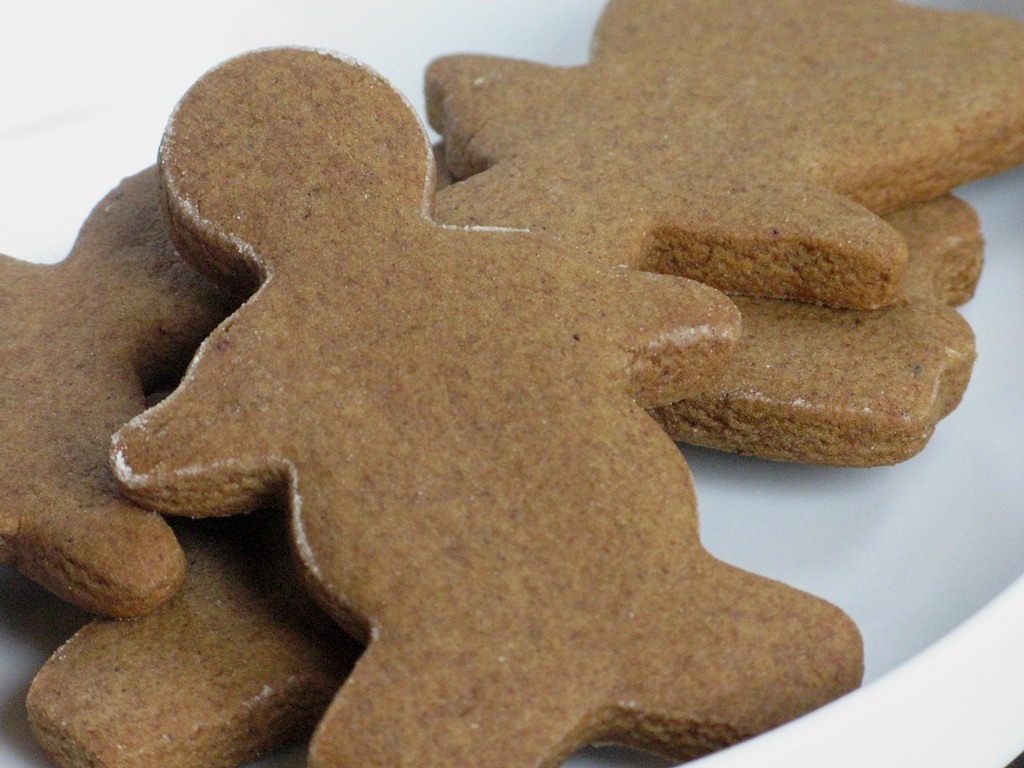
We've halved the published recipe and adapted it by hand, rather than with an electric food processor or blender. But you can certainly opt for one of those gadgets if you prefer. This recipe yields 40 cookies such as those you see above. To make ornaments suitable for hanging on your holiday tree, simply make a hole in the appropriate spot before the cookies go into the oven.

Preheat oven to 325 degrees.

Mix together 7.5 ounces (1 1/2 cups) unbleached all-purpose flour with 2.5 ounces dark brown sugar, 3/8 teaspoon baking soda, 1 1/2 teaspoons ground cinnamon, 1 1/2 teaspoons ground ginger, 1/4 teaspoon ground cloves and 1/4 teaspoon salt. We used a pasty cutter to break up the brown sugar, then crushed any reamaining sugar lumps with our fingers.

Dot the top of the flour mix with 6 tablespoons unsalted butter, cut into pieces. Cut the butter into the flour mix: We used a pastry cutter first, then finished the job with our fingers, rapidly pinching the butter and flour together until the mix resembles coarse sand.

Our pastry cutting tool

Use a greased measuring cup to add 3/8 cup dark molasses to the flour and butter mix. Add 1 tablespoon milk as well. Stir everything together with a wooden spoon. When all of the ingredients are incorporated, use your hands to form the dough into a ball, kneading it a few times if necessary to create a smooth mass.

Divide the dough in two. Place each half between sheets of parchment paper and roll the dough out to a thickness of 1/8 inch. Lay the dough packages on a sheet pan and place in a freezer for 20 minutes to stiffen, or in a refrigerator for at least a couple of hours or overnight.

When the dough is chilled, remove the top sheet of parchment paper from one piece and invert it onto a floured work surface. Remove the second sheet of parchment paper. Use lightly-floured cookie cutters to create the shapes you like and place them on a greased baking sheet, or on a sheet pan lined with parchment paper. Place in oven and bake until cookies are firm when pressed in the middle with a finger, about 20 minutes.

Use an small, offset spatula to remove the cookies from the pans. When they have cooled, store them in a cookie tin or sealed container, using parchment paper to separate each layer of cookies.

You could decorate these cookies if you like. We'd need another class for that.

Friday, December 10, 2010

What's for Breakfast: Biscuit & Pears


By Ed Bruske
aka The Slow Cook

I've published a photo like this before: canned pears on a whole wheat biscuit.

Something about this--the idea of placing pears on a biscuit--appeals to me. I'd never eat the biscuit myself, since I don't eat starchy foods. But if I were to eat it, I think I'd like it even better with some cream cheese spread on the biscuit. Perhaps even an herbed cream cheese. Or, better yet, and herbed goat cheese.

Am I getting carried away?

Yet, even though I like the concept, I'm not sure how appealing this particular item is. I wonder what readers think. Good idea, or thumbs down?

Thursday, December 9, 2010

What's for Breakfast: Waffles & Yogurt

By Ed Bruske
aka The Slow Cook

All these months I've been writing about the food in my daughter's elementary school and I have to admit, I don't actually taste the food that often. Not that I wouldn't, but the photos I take are of food the kids are eating. I don't have a tray of my own.

But every once in a while daughter comes back from the food line with things she has no intention of eating. For instance, for this breakfast--served free to all students, courtesy of D.C. Public Schools--the only thing my daughter really wanted was the juice. She may have eaten some of the canned peaches.

So I got to try the waffles and I must say they aren't nearly as good as they look. They're really crispy. They arrive pre-made and frozen. Then they're reheated. This year, instead of serving them with high-fructose corn syrup masquerading as maple syrup, the schools are offering yogurt, sometimes a flavored yogurt--such as raspberry--sometimes vanilla.

The yogurt's pretty sugary, but it's certainly better than high-fructose corn syrup. I'm not necessarily opposed to canned peaches either, as long as they're not swimming in a sugary syrup. But what's with the plastic cup? That's an expense the schools could save just by spooning the peaches onto the tray.

Sometimes they do spoon the fruit directly onto the tray. I'm mystified by the decisions food services makes.

Wednesday, December 8, 2010

Healthy Schools Act Saved

D.C. will continue serving fresh local produce

Word came yesterday that the D.C. Council had spared the Healthy Schools Act from the budget axe.

While a number of social programs weren't so lucky, D.C. Council Chairman and Mayor-elect Vincent Gray chose not to follow the suggestion of outgoing Mayor Adrian Fenty and use some $4.7 million intended for better school meals to help close a $188 million budget gap.

The money funds an extra 10 cents for breakfast meals, 10 cents for lunches and five cents for every lunch that contains a locally grown product. It also picks up the lunch tab for kids who otherwise are eligible only for reduced-price meals.

Along with the many menu improvements instituted by the D.C. Public Schools' new food services director, Jeffrey Mills, the Healthy Schools Act has helped make a noticeable improvment to kids' cafeteria trays this year.

An aide to D.C. Councilmember Mary Cheh (D-Ward 3) said an outpouring of support for the law helped save the day.

Lunch from Home: Chips

By Ed Bruske
aka The Slow Cook

Parents often say the food at school is so bad, they would much rather pack their kid's lunch at home.

From what I've seen, the lunch kids bring from home often is much worse than what the schools are serving. It's a funny thing what some parents think is appropriate lunch food.

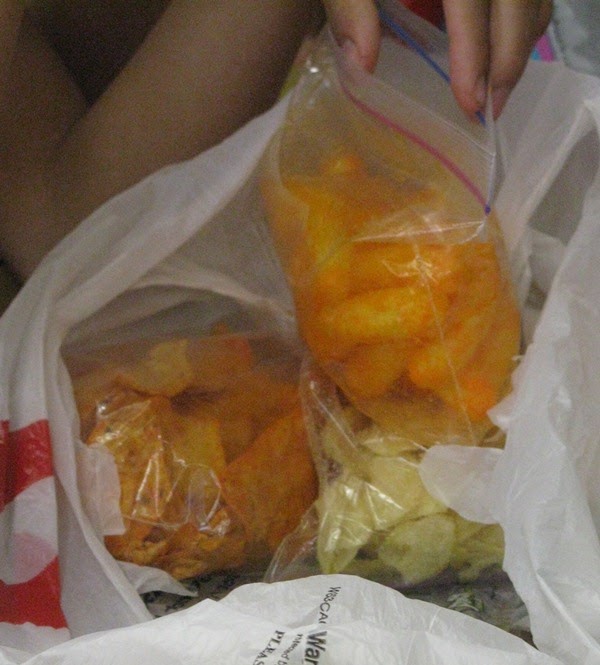
I couldn't help noticing this girl, for instance, who was diving into a plastic shopping bag crammed with an assortment of different chips and cheese puffs.

I suppose the trick is to pack enough different kinds of chips to maintain a child's interest.

Is this anything like what you call lunch?