Tuesday, June 7, 2011

What's for Lunch: Uneaten Rice & Beans

By Ed Bruske
aka The Slow Cook

Believe it or not, many kids go through the lunch line at school and then barely touch the food. It just gets tossed in the trash. I'm not sure how the children make it through the day, but so many of them just nibble.

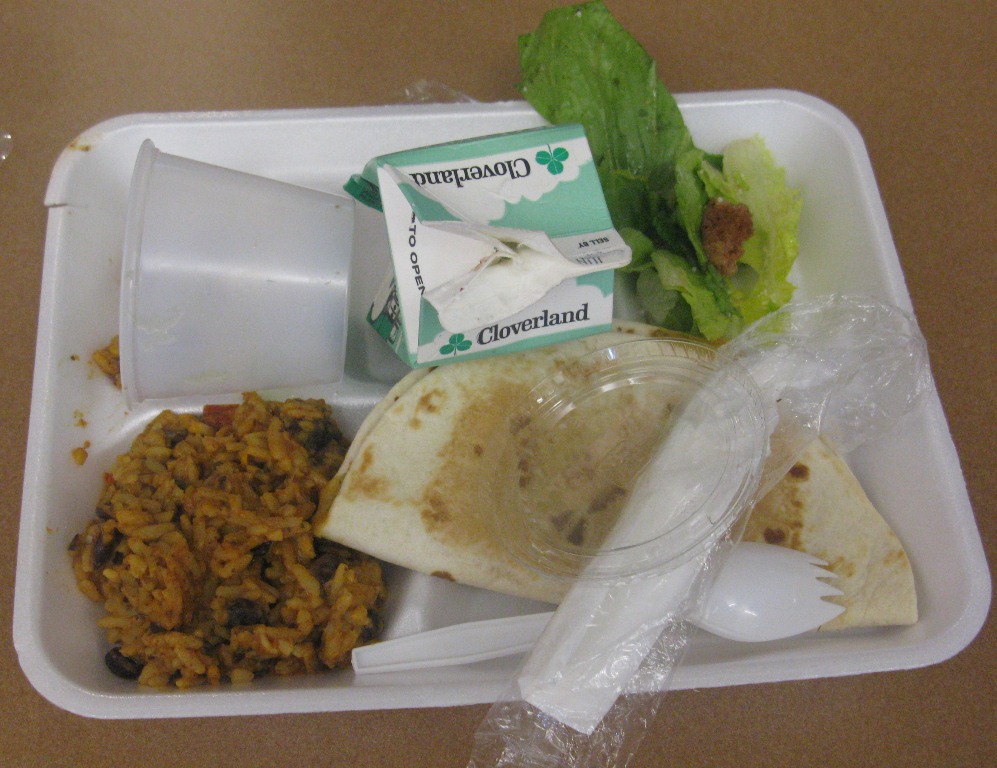
This is what one boy's tray looked like near the end of lunch hour. He didn't even take a bite out of the cheese quesadilla--nor the beans and rice, nor the salad. The only thing he ate was a little cup of apple sauce. But look! He drank his milk! Who says kids won't drink plain milk?

This tells me that kids are served way more food than they actually need. They typically ignore vegetables and anything else that looks suspicious--like brown rice mixed with beans and tomato sauce.

To make sure my eyes weren't deceiving me, I took a slow walk around the lunchroom and observed closely what the kids were doing with their rice and their salad. I counted exactly six kids eating the rice. Two of them were Hispanic, one Asian. My daughter, the carbohydrate hound, wolfed hers down and went back for seconds (she was denied).

Fewer still ate the salad. I don't understand that. It's Romaine lettuce with croutons, not that stale, commercial mix of iceberg and shredded carrots and cabbage the schools used to serve. All that salad, along with the rice and beans, simply gets dumped in the garbage.

The kids were a bit more enthusiastic about the cheese quesadillas. In fact, I'd say Mexican food is a pretty safe bet in school cafeterias.


Sunday, June 5, 2011

This Week in School Food News

By Ed Bruske
aka The Slow Cook

No, the sky isn't falling on the national school meals program, although you might be led to think so from some recent reports out of Congress.

The House Appropriations Committee released its markup [PDF] of agriculture spending for 2012 and left intact the reimbursement rate for school meals--including the six-cent raise Congress approved last December.

But in its report [PDF] on the spending legislation, the GOP-dominated committee made clear its unhappiness with proposed USDA nutrition guidelines that would raise the cost of school lunch an estimated 15 cents and cause a whopping 50-cent increase in the cost of providing breakfast.

The USDA has said these increases would be the result of requiring schools to serve lots more green and orange vegetables, more whole grains, fewer calories and half the salt currently used. Originally designed by the Institute of Medicine in a process that began well before Barack Obama was elected president, the guidelines deliver what many school food activists have been demanding for years: healthier meals using less processed foods and more whole ingredients cooked from scratch.

The GOP sentiments are more in line with those of the corporate food industry, which would prefer to keep things just the way they are. Reducing salt and calories and cooking from scratch can't be good for giant convenience food manufacturers such as Tyson, Kellogg's and Schwan Food. Industry, along with school food service companies such as Chartwells, and many of the nation's school food service directors, have been urging a "go slow" approach, or perhaps even pilot-testing the guidelines before mandating them nationwide.

This week's GOP broadside raises the volume of dissent over the proposed guidelines, which have also drawn congressional ire by calling for a sharp cutback on potatoes and other starchy vegetables in school meals. Potatoes have already been eliminated from the Women, Infants and Children (WIC) program.

In its report, the GOP states: "The Committee urges restraint and practical timelines for implementing new national nutrition standards in the school breakfast and lunch programs. As many of the representatives in states and local school districts have cautioned, an overly aggressive implementation schedule and unrealistic demands on changes in nutrient content can lead to burdensome costs, estimated to be about $7 billion over 5 years. Therefore, the Committee directs FNS to issue a new proposed rule that would not require an increase in the cost of providing school meals."

Congressional committees can't tell government agencies what to do. That's why we have an executive branch. So take this as bluster and grandstanding as the GOP tries to appease its base.

Still, the Republicans have a point. The USDA could hardly have picked a worse time to require state and local governments to fork over bundles of cash for school food. They're worse than broke. Most are cutting back programs--even school spending. And from where I sit--watching kids eat in the cafeteria on a daily basis for the better part of the last year--there's no guarantee that all these vegetables, whole grains and "healthier" foods won't end up in the trash.

Unfortunately, there's nothing about the new guidelines that really engages children in the act of healthier eating. And if experience teaches anything, it's that menu changes don't mean much unless adults are willing to work overtime marketing better food to kids.

These guidelines merely perpetuate misguided thinking that kids' eating habits can be legislated on a national level.

*****

It's hard to believe that serving breakfast to kids in the classroom has stirred up so much trouble in Chicago.

Schools in the Windy City this year embraced universal breakfast in the classroom as a way of guaranteeing that kids are all adequately fed when they start their lessons. Breakfast in the classroom has the added benefit of generating lots of federal reimbursement dollars, especially in districts with large numbers of needy children.

In other jurisdictions, breakfast in the classroom has been hugely successful, improving kids' ability to focus, reducing discipline problems and visits to the school nurse, getting children to show up on time, and creating more of a family atmosphere in the classroom.

Mrs. Q, the anonymous Chicago teacher who writes the Fed Up With Lunch blog, has been doing a great job lately documenting how breakfast in the classroom has unfolded there. According to her accounts, there have been few problems and many gains.

But many parents apparently are upset that they are losing control of what their kids are eating and that breakfast served in the classroom may be cutting into instruction time. (Chicago has the shortest school day in the country, I'm told. In other jurisdictions, schools simply start the day a little earlier to make room for breakfast.)

And now the head of Chicago schools--John-Claude Brizard--says he's got some issues, too. Especially those French toast sticks he says are being served "with an inch of syrup."

Well, food choices are a whole other kettle of fish. And that may just be Chicago's fault for choosing a flat-rate contract with its food service provider, Chartwells. In this case, Chartwells has very little incentive to serve better food and every reason to seek out the cheapest ingredients that deliver the most in rebates from manufacturers.

Note to Mr. Brizard: if you want better food, switch to a cost-reimbursable contract. Then you can tell Chartwells exactly what you want to see the kids eating and you can pay for it if it's more expensive.

*****

The American Academy of Pediatrics has issued a report saying that most children--including athletes--should not be consuming sports drinks and especially not energy drinks. They are better off rehydrating with plain water.

The AAP says many kids are confused about the significant differences between sports drinks, which contain carbohydrates and electrolytes, and energy drinks, which are loaded with caffeine and other stimulants.

But in either case, kids are better off avoiding them, especially in the middle of an obesity epidemic.

"Sports drinks can be helpful for young athletes engaged in prolonged, vigorous physical activities," says the AAP, "but in most cases they are unnecessary on the sports field or the school lunchroom."

Says one of the report's authors, Dr. Holly J. Benjamin, a member of the AAP's Council on Sports Medicine and Fitness: "For most children engaging in routine physical activity, plain water is best."

Benjamin continued: "Sports drinks contain extra calories that children don't need, and could contribute to obesity and tooth decay. It's better for children to drink water during and after exercise, and to have the recommended intake of juice and low-fat milk with meals. Sports drinks are not recommended as beverages to have with meals."

Meanwhile, the dairy industry, which frequently cites the American Academy of Pediatrics as supporting chocolate milk, has been heavily promoting the idea of sugary flavored milk as a way for athletes to rehydrate after a strenuous workout. Or does the AAP still think water is the better option?

*****

Are scratch-cooked meals always better than processed?

The Department of Education in Hawaii apparently thinks so. Beginning in August, a majority of all entrees in the state's schools--15 out of the 25-day menu cycle--will be made from scratch.

"The mission is to have less processed food and use basic ingredients instead of opening up a box and heating up something," said Glenna Owens, director of the school food services branch. The district, which makes 100,000 meals daily, already serves about 10 entrees from scratch but the new initiative moves toward making a majority of the meals that way.

"It's hard work, but I believe it's tastier when it's made from scratch," said Cindy Saffery, who manages three cafeterias on Oahu's Waianae Coast said. "It's like feeding our own children."

But Margo Wootan, the widely quoted school food lobbyist for the Center for Science in the Public Interest, doesn't seem very impressed. Wootan told the Associate Press that cooking from scratch doesn't automatically translate into better food.

"I don't know of any evidence that shows cooking from scratch is healthier than if you don't cook from scratch.," Wootan said.

She should probably stick to writing legislation.

*****

Finally, in the never-ending battle over flavored milk in school comes perhaps the most artfully written argument yet for ditching chocolate milk altogether. This post by Christina Le Beau at the Spoonfed blog, is chock-a-block with references and hits all the right notes.

"Flavored milk in schools isn’t good for kids, no matter how it’s justified," Le Beau writes. "It’s questionably nutritious, sugared-up, adulterated with thickeners and fake colors and flavors, and processed to within an inch of palatability. It’s the symbol of a system that feeds kids calories and chemicals sold as nourishment. And it’s the product of a spin machine that has too many people believing that milk is a magical calcium elixir and, thus, that any milk is better than no milk."

Indeed. Why cling to something that symbolizes the worst about our approach to feeding children: that there is a cheap and easy shortcut to good health. If kids are going to drink milk, adults need to man up and teach them to like milk without the sugar and phony flavorings.


Saturday, June 4, 2011

Kids Make Mushroom Omelets

Omelets made on the cassette feu

By Ed Bruske

aka The Slow Cook

This was our last week of food appreciation classes for the current school year. How tragic is that? It's also our final week in France on our virtual world culinary tour, so I picked something simple but classic to make with the kids: omelets.

I brought my cassette feu--or portable butane burner--to class so we could make the omelets at our usual work table, rather than at the stove, which is at the other end of the kitchen area. The work surface is also lower, which makes it easier for the kids to actually test their skill at making the omelets--meaning scraping around the edges of the eggs as they cook, tilting the pan to run the uncooked egg onto the surface of the pan, folding the omelet in half.

You don't want the pan too hot or the eggs will cook too quickly, brown too much, and possibly even burn. You also need to work fairly quickly so that you can add your filling--in our case sauteed onions and mushrooms--before the eggs are completely cooked. They should be still wet when you fold the omelet. The omelet will seal itself as it finishes cooking. I usually place a lid over the pan and lower the heat to assist in the process.

Preparing mushrooms for the saute

As always, the challenge is finding enough work for the kids to do. I had them slice cremini mushrooms and dice onions for the fillings. Half of a medium onion, cut into medium dice, plus a couple of handfuls of cremini mushrooms, thinly sliced, is enough for three omelets. We sauteed the onions and mushrooms together in some extra-virgin olive oil. Season with salt to draw out the liquid.

The kids also get to crack and whisk the eggs, one of their favorite kitchen tasks. They always leap at a chance to crack eggs. We added Roquefort cheese to our omelets, which works well with caramelized onions and presents an opportunity to talk about French cheese making and beneficial molds. After that, it's simply a matter of standing back and watching the kids gobble up the omelets.

This is one of those dishes that kids either love or hate. Some don't want the mushrooms. Others swoon over mushrooms. My own daughter won't eat eggs. But making omelets is one of her favorite kitchen activities. You just never know how kids are going to react to different foods. But I'd rank omelet making high on my list of essential kitchen skills.

Thursday, June 2, 2011

D.C. Mayor Orders Release of Secret School Food Rebate Data

Unveiling rebate secrets

By Ed Bruske

aka The Slow Cook

In a development that could finally crack the code of silence surrounding rebates in school food service, lawyers for D.C. Mayor Vincent Gray have reversed a longstanding decision by local school officials and ordered the release of data showing how much money food manufacturers pay in rebates in order to place their products on children's cafeteria trays in the nation's capitol.

The decision comes in response to an administrative appeal I brought before the mayor after attorneys for D.C. Public Schools denied access to the rebate information on grounds it constituted "trade secrets" that could, if disclosed, harm the competitive position of the schools' hired food service provider, Chartwells.

I originally had sought the information more than a year ago through the city's Freedom of Information Act in an effort to determine the extent to which rebates might influence the choice of food D.C. schools serve. As a result of my FOIA requests, I was able to determine that Chartwells had claimed receiving more than $1 million in rebates from food manafucturers during the second year of its contract with the schools. However, the schools, citing a "trade secrets" exemption to the FOIA law, refused to release an itemization of which manufacturers had paid the rebates. The schools also declined to release detailed contract proposals submitted by Chartwells and Sodexo in the original bidding process.

John F. Carroll, an assistant New York attorney general invesitigating rebates in that state, has said the manufacturer discounts pose an "inherent conflict of interest" in school food service because they provide a financial incentive to choose highly processed and often sugary products over healthier foods. They also encourage purchases of large, national brands over locally produced goods that might be less expensive and more healthful, but do not pay rebates.

My own investigaton of school food in the District of Columbia showed that children routinely were being served the equivalent of 15 teaspoons of sugar in the morning in the form of popular branded products such as Apple Jacks Cereal, Pop-Tarts, Giant Goldfish Grahams and Otis Spunkmeyer muffins, along with chocolate and strawberry milk. D.C. schools have since stopped serving those products, removed flavored milk from the menu and otherwise taken steps to lower the sugar in school food.

The rebating practice is pervasive in the food industry and in school food service, especially where large food service management companies such as Chartwells, Aramark and Sodexo are involved. But while rebating no doubt generates billions of dollars to grease the wheels of the processed food industry, precise information about the practice is a secret closely guarded by manufacturers as well as those who benefit from the cash it produces. Essentially, the manufacturers write checks to companies who purchase their products in large volumes. Chartwells' parent company, the $22 billion international conglomerate Compass Group, maintains an entirely separate entity called Food Buy solely to write purchase contracts and collect rebates generated by its many subsidiaries.

Under the federal school meals program, food service companies retained through "cost reimbursable" contracts must pass any rebates they receive to their school district clients. After I tallied the rebate amounts Chartwells had declared on its monthly invoices to D.C. schools, it was revealed that school officials had asked Chartwells for an itemized accounting of the rebates but had been waiting nine months to receive one. School food services Director Jeffrey Mills was said to be troubled by the rebates and their influence over Chartwells' food purchases.

As a result of the ongoing investigation in New York, Sodexo last year agreed to pay $20 million to settle claims that it had failed to reimburse schools and other government clients for the rebates Sodexo had received. Subsequently, D.C. Council member Mary Cheh (D-Ward 3), author of a "Healthy Schools Act," asked the city's then-attorney general, Peter Nickles, to assist the schools in recovering any rebate monies they might be owed. Cheh also oversees implimentation of the District's FOIA laws.

Information about rebates is so sensitive that the School Nutrition Association, which counts Chartwells and other food management companies as well as numerous manufacturers as members, removed from YouTube a taped version of a speech Carroll delivered to the group in March. In that speech, Carroll disclosed that rebates typically generate checks from manufacturers worth 10 percent to 15 percent of all food purchases. Some items are rebated up to 50 percent of the purchse price.

In Denver earlier this year, representatives of the Service Employees International Union were ejected from a conference held by the American Association of School Administrators because they were distributing information about school food rebates and planned to hold a workshop on rebates in school contracting. Aramark and Chartwells were both sponsors of the event, and Sodexo lists itself as one of the association's "strategic partners."

In a letter to me dated May 26, the mayor's deputy general counsel Donald S. Kaufman wrote that attorneys for D.C. schools had erred when they invoked the "trade secrets" exemption to my FOIA request without showing how releasing the rebate and contract information would "result in substantial harm to the competitive position" of Chartwells, a requirement of the D.C. FOIA law.

"DCPS has not pointed to any authority, nor are we aware of any, which holds that the amount or source of rebates or volume discounts is, as a matter of law, protected commercial or financial information for the purposes of FOIA, nor is it apparent that the disclosure of such information would result in competitive harm," Kaufman wrote.

"The response of DCPS is insufficient to justify the withholding of the documents," Kaufman wrote in this "final decision" of the mayor's office. "The documents must be provided to Appellant," meaning me.

Under the D.C. FOIA, decisions by individual city agencies can be challenged in court, or appealed administratively directly to the mayor. I chose to appeal to the mayor. I suspect that Chartwells may now be contemplating a court filing to block release of the rebate information.

Wednesday, June 1, 2011

What's for Lunch: Spinach-Pickin' Lasagna

By Ed Bruske
aka The Slow Cook

As I've written before, our local lunch ladies here in the District of Columbia have been making lots more food from scratch this year as part of a major overhaul of the Chartwells menu that began last summer under the direction of then-new food services Director Jeffrey Mills.

One of the featured items has been a spinach lasagna made by layering sheets of pasta with frozen spinach, tomato sauce and mozzarella cheese in stainless hotel pans. Some days it's better than others, but overall a great addition to the menu. Except the kids don't care for the spinach. Many of them go to great lengths to pick through the pasta and cheese to remove the spinach.

The version served yesterday at my daughter's elementary school seemed to have less spinach and more cheese, making the pickin' more difficult than usual. Still, some kids were determined not to eat the spinach. In this photo you see how one scoop of lasagna has been mined for pasta and cheese, leaving the spinach behind.

Another girl employed a different strategy, using her "spork" to pick out as much of the spinach as she was able, then dumping it on what appear to be strips of roasted sweet potato, which the kids didn't eat either.

The lesson, I think, is that you can make school food a whole lot better and still kids will only eat what immediately appeals to them and throw the rest in the trash. In fact, in my daughter's cafeteria at least, I'd say far more food gets tossed than actually eaten, including most of the vegetables, salads and rice side dishes.

While all of these positive changes to the menu and food preparation took place--including lots of fresh local vegetables and entrees cooked from scratch--there was no one in the cafeteria explaining to the kids what the new food items were.

So much work needs to be done coaching the children on what these unfamiliar foods are and why they should eat them. The quality of food in D.C. schools is astronomically better than the processed convenience foods that were served as recently as a year ago. Yet most of it is going to waste.

There should be adults in the cafeteria sitting with the kids, talking to them about the food, eating alongside them. In our school, teachers merely act as monitors, trying to maintain order. Sometimes I wonder why I am the only parent around at lunch.

Yesterday I got a bit of a shock from the cafeteria manager. She normally gives me a tray of food to photograph, but yesterday she would barely make eye contact and informed me that the only way I would get food was if my daughter, who had brought lunch from home, stood in line and paid for it.

I think the cafeteria manager may be angry about the post I wrote recently on the barbecued chicken. She brought it up with me the other morning, sounding upset that I would criticize the way the chicken was cooked.

What I had tried to convey in that piece was how badly mistaken my daughter was about the palatability of the chicken. She says she doesn't like it because it's either overcooked or covered with too much sauce. I meant to say how far off base she was: the chicken is really good. But I kind of mangled it.

I've since gone back and performed a little re-write to make that more clear.

Sunday, May 29, 2011

This Week in School Food News

By Ed Bruske
aka The Slow Cook

The USDA's proposal to cut back on potatoes in school lunches is kicking up a storm of protest.

Proposed school meal guidelines would permit just one cup of potatoes and other starchy vegetables per week. That includes corn, peas and lima beans as well. That got the attention of the Wall Street Journal, which found lots of potato growers and school officials who think limiting spuds on kids' cafeteria trays is unfair.

The New York Times picked up the story, rehashing the 60-day all-spud diet of one Chris Voigt, head of the Washington State Potato Commission, who was moved to protest the federal government's exclusion of potatoes from the Women, Infants and Children (WIC) program.

Some members of Congress are none too pleased. Forty of them penned a bi-partisan letter to USDA Sec. Tom Vilsack protesting the move against potatoes.

“It’s a great vegetable and I don’t know why we are picking on the potato,” said Rep. Jean Schmidt, R-Ohio, who signed the letter. “I think this is very much an overreach.”

Rep. Jean Schmidt (R-Ohio) took to the congressional blog to complain.

"To remove or limit vegetables from schools that our children and grandchildren actually like and will eat is simply misguided," Schmidt wrote. "But to make it more difficult for our schools to provide the best nutrition to those most in need of it is more than misguided, it is irresponsible."

Poor Margo Wootan. The stalwart school food lobbyist for the Center for Science in the Public Interest is left trying to explain that potatoes must go because kids need "more balance" in their diet. They should be eating more green vegetables, she says.

Wootan and the CSPI are so invested in the tired notion that fat is behind all of the nation's health problems she can't bring herself to mention the huge body of science implicating starchy, glycemic foods such as potatoes in obesity and other chronic dietary afflictions such as diabetes, hypertension and coronary artery disease.

Yes, Margo, there is a good reason to limit potatoes. You just need to start telling people what it is.

*****

Perhaps not surprisingly, food manufacturers are protesting efforts by the Obama administration to limit the way they advertise to children.

Ordered by Congress and written by a team at the Food and Drug Administration, the guidelines say foods that are advertised to children cannot exceed limited amounts of added sugars, saturated fat, sodium or trans fat. And they must include healthy ingredients, such as fruit and vegetables, low-fat dairy products or whole grains.

The sugar limits would pose a problem for many foods currently marketed to children. Under the guidelines, one serving of a food aimed at children could not exceed 8 grams of sugar. A single serving of Count Chocula cereal currently contains 12 grams of sugar; a serving of Frosted Flakes contains 11 grams.

“I can’t imagine any mom in America who thinks stripping tigers and toucans off cereal boxes will do anything to reduce obesity,” said Scott Faber, a vice president at the Grocery Manufacturers Association, which represents food makers and retailers.

The guidelines are voluntary, but manufacturers still protest. They says they're doing just fine with their own "voluntary guidelines."

“This is a classic case of backdoor regulation,” said Dan Jaffe of the Association of National Advertisers.

When it comes to our kids' health, we can trust America's corporate food industry. Can't we?

*****

On the subject of food marketers: Could Ronald McDonald be forced to retire?

A campaign started by the nonprofit watchdog group Corporate Accountability International has asked McDonald's to give Ronald his walking papers as a way of dialing back the marketing of junk food to kids.

A letter signed by more than 550 health professionals and organizations--among them the American Academy of Child and Adolescent Psychiatry, the Chicago Hispanic Health Coalition, and well-known nutritionists and doctors such as Andrew Weil--was scheduled to run in ads in the Chicago Sun-Times, New York Metro, Boston Metro, San Francisco Examiner, Minneapolis City Pages and Baltimore City Paper.

The letter asserts that "the contributors to today's (health) epidemic are manifold and a broad societal response is required. But marketing can no longer be ignored as a significant part of this massive problem."

But McDonald's corporate headquarters was having none of it.

"We are committed to responsible advertising and take our communications to children very seriously," McDonald's said in a statement. "We understand the importance of children's health and nutrition, and are committed to being part of the dialogue and solution. We serve high quality food, and our Happy Meals offer choice and variety in portions just for kids. Parents tell us they appreciate our Happy Meal choices."

Except, of course, in San Francisco, where Happy Meals are banned.

*****

What to do when good ol' American enterprise invades the school yard?

School officials in Novato, Calif., are wondering whether there should be some kind of law to deal with the food trucks selling ice cream, chips and soda right outside the schoolhouse door, reports the Wall Street Journal.

Novato schools banned junk food in 2007. Now as many as five food trucks park in front of Novato High School at lunch time and the kids swarm around.

The school's principal, Rey Mayoral, said fights have broken out between drivers over choice parking locations, forcing him to call the police on more than one occasion. And the scores of students flocking to the trucks sometimes snarl traffic, he said.

"These trucks are contradicting everything we are trying to teach the kids" about nutrition, said Mr. Mayoral. "And what makes matters worse is it's getting dangerous."

City officials have been hesitant to enact limits on the trucks, saying they would be costly to enforce at a time of deep financial strain. At a city council meeting earlier this month, after an hour-long presentation from school leaders, the council decided against passing an ordinance.

Mike Frank, Novato city manager, says the city will explore ways to rid the trucks from around the schools, but cautioned that he is reluctant to dedicate police officers to the issue.

"We'll find a creative solution to deal with the problem, but we cannot afford to have police officers sitting around schools," says Frank.

*****

Is there such a thing as cruel and unusual punishment for kids in the cafeteria?

Students in one school in Harrisburg, Pa., reportedly are served cold sandwiches instead of a hot meal "as punishment for acting up and being unappreciative of the hot meals being offered in the school’s cafeteria."

The Patriot-News reports a school administrator as explaining the move this way: “We created the opportunity where we could show them what the bare minimum would be,” adding that the bare minimum remained a balanced meal including fruit and vegetables.

The administrator, who did not want his name used, said that some parents and students did not understand the measures taken to correct behavior issues, such as students not cleaning up their eating area.

Since the corrective action was taken, the administrator said, student behavior has improved.

Meanwhile, eyebrows were being raised in Minnesota over the way schools were handling students unable to pay for their meals.

In some districts, students receive a bread and butter sandwich for a few days. Others receive no meal at all. In an effort to get parents to pay, many districts stamp children's hands, sometimes with a dollar sign or the words "lunch money."

Legal Aid surveyed 182 school districts, about half the districts in the state, to find out what schools do when students run out of money in their lunch accounts. The group found that 30 districts stop feeding children whose parents don't pay. Most districts do not provide the regular school lunch to children without money and instead offer an alternative lunch, often a sandwich and milk. Only 22 districts provide unlimited hot meals to all children.

Minnesota Public Radio in its own interviews found some school districts that said hand stamping was necessary, while others called the practice unacceptable. Most food nutrition directors said they have little choice but to deny the full lunch to students without money.

"There's a lot of people out there who think we should feed every kid, but that's not realistic," said Jason Forshee, the food nutrition services director for Waseca Public Schools. "My goal is not to lose $20,000 every year. My goal is to break even."

*****

Here's some better news coming out of Minnesota: Schools in Minneapolis beginning this summer will stop serving flavored milk.

"Consuming chocolate milk every day can train a child's palate toward sweetened foods," said Rosemary Dederichs, the district's director of nutrition services.

"While we recognize that some children may no longer choose to drink milk at school, we believe that the decision was made in the best interest of our students," said Dederichs. She noted that even skim chocolate milk has 8 grams more sugar per serving than 1 percent or skim cartons. The district's chocolate milk also contains high-fructose corn syrup.

In March, Minneapolis schools also removed sugary cereals from the menu as part of an effort to wean kids off sugar.

*****

Finally, some more brightness on the school food landscape: a long and detailed interview with advocate Debra Eschmeyer.

Vegetable farmer, former communications director for the National Farm to School Network, and recently a Food and Society Fellow, Eschmeyer has helped start a novel organization that puts youthful volunteers to work helping schools build food gardens and engage kids in the act of eating more healthfully in the cafeteria.

Food Corps, as the organization is called, has caught on like wildfire. It's already established in 10 states in its first year, having picked 50 members from 1,230 applicants. "The idea is to start with a strong cadre of 50 at the 10 host sites and then grow, so that in a decade we can have 1,000 members in all 50 states," Eschmeyer says.

Eschmeyer says, "I’ve never felt more confident about the future of our country when it comes to reversing childhood obesity."
Saturday, May 28, 2011

Kids Make Croque Monsieur

Unbearable deliciousness of croque monsieur

By Ed Bruske

aka The Slow cook

The French sure no how to gussy up a ham and cheese sandwich. It's called "Croque Monsieur," and if you were looking for the perfect late-night cafe food in Paris, this would be it.

Between these two slices of bread is a slice of ham and a heap of Gruyere cheese. But that's hardly what makes this sandwich special. The French, being in love with sauces, smother it with a Bechamel sauce also fortified with Gruyere and some Parmesan for good measure. The sandwich is then baked in the oven till the cheese melts, then broiled until the Bechamel is bubbling and beginning to brown.

The kids in my food appreciation classes were wild for it.

Perhaps the most important decision in making Croque Monsieur is which bread to use. I spent a good bit of time in the bread aisle considering my choices, and finally settled on a white bread from a local company that slices it more on the thick side. The bread itself is firm, not squishy.

To make four sandwiches, toast the bread by laying eight slices on a sheet pan and placing them in a 400 degree oven. When the tops begin to brown, flip the bread and continue toasting for another minute or two.

Spread Dijon mustard on four pieces of bread and on the other four lay a slice of ham--not too thin, not too thick. Sprinkle a generous amount of grated Gruyere cheese over the ham (you'll need a total of 2 cups for this recipe). Place the bread smeared with mustard over the ham and cheese.

Slathering Bechamel on top of the sandwich

Now for the sauce. Melt 2 tablespoons butter in a saucepan over moderate heat and whisk in 2 tablespoons all-purpose flour. When the flour begins to bubble, whisk frequently and cook a minute or two. Slowly add 1 1/2 cups warm milk, whisking continuously. As the sauce heats, it will thicken. The sauce should be rather thick, but not pasty. Add more milk if necessary.

Off the heat, stir into the sauce 1/2 teaspoon kosher salt, 1/4 teaspoon freshly ground black pepper, pinch nutmeg, 1/4 cup grated Gruyere cheese and 1/4 cup grated Parmesan. Slather the sauce over the tops of the sandwiches, then place in a 400-degree oven for six minutes. Turn on the broiler and monitor closely. Remove the sandwiches when the sauce is bubbling vigorously and just beginning to brown.

You'll probably want to allow the sandwiches to cool a bit before serving. They can be sliced in half, or even into quarters.