Showing posts with label dairy industry. Show all posts

Tuesday, September 6, 2011

Have Pediatricians Sold Out to Big Dairy?

Does your doc recommend chocolate milk?
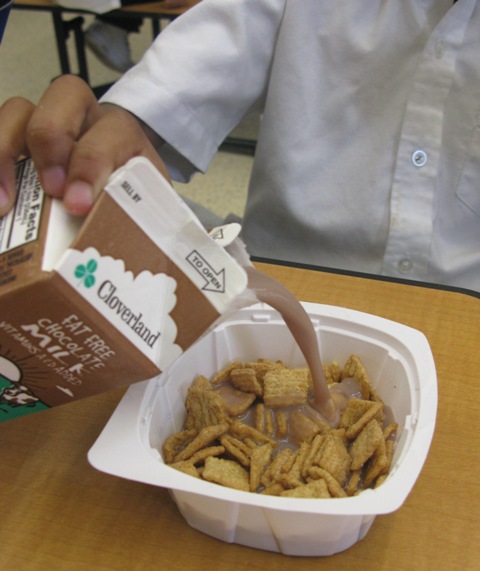
The Dairy Industry widely touts the nation’s pediatricians as supporting sugary chocolate milk for children. But when I went looking for the American Academy of Pediatrics’ policy on flavored milk in school, what I found was hardly a sweeping endorsement.

Instead, the group representing some 60,000 of the nation's pediatricians cites flavored milk along with plain milk, water, fruit and vegetable juices as “healthful alternatives” to the problem of sodas in school. But sodas aren’t served in most elementary schools, and are on the way out in many middle and high schools as well.

A 2010 report by the Institute for Health Research and Policy, University of Illinois, Chicago, found that only 17 percent of public elementary schools offer sugar-sweetened beverages such as sodas or sports drinks. The percentage of middle schools that offered sodas with meals shrank from 35 percent to 26 percent between 2007 and 2008. In high schools the decrease was from 46 percent to 36 percent.

When I pressed the head of the AAP’s nutrition committee to explain how pediatricians might continue to support chocolate milk if there were no sodas offered in schools, he abruptly ended our interview.

“I think we are belaboring the issues and I do not have any answers to address your concerns,” said Jatinder Bhatia, chief of neonatology at the Medical College of Georgia in Augusta.

So what explains the cozy relationship between the American Academy of Pediatrics and Big Dairy.

Bhatia acknowledged that he serves as an “unpaid advisor” to the National Dairy Council. And as I would later learn, the American Academy of Pediatrics receives funding from dairy interests, although it refuses to say how much.

The AAP issued a statement saying: “The American Academy of Pediatrics receives grants and contributions from the federal government and foundations as well as from a number of corporations. These contributions help support the AAP's mission to promote the health and wellbeing of all children. In the 2009-10 fiscal year, just 7 percent of the AAP’s income came from corporate support. This includes contributions from the National Dairy Council and MilkPEP. “

(MilkPEP--or Milk Processors Education Program--is an industry group funded through a congressional mandate that promotes dairy with media campaigns such as “Got Milk?” and “Raise Your Hand for Chocolate Milk!”)

The AAP statement goes on to say: “Safeguards and disclosure procedures are in place to protect against conflict of interest by either the AAP or its physician members who develop policy for review and approval by the AAP. The AAP conforms with all industry standards for disclosure of financial relationships…Outside funding has no effect on the AAP's policies, guidelines or messaging on any aspect of child health.”

If dairy money has no influence on AAP policy, it may help grease the wheels for what the pediatric group describes as “partnerships” with dairy interests to promote its products—including flavored milk.

For instance, the AAP last year joined a MilkPEP Halloween blitz that advised parents, “If you’re hosting a Halloween Party, serve low-fat chocolate milk as a nutritious treat in disguise.”

The AAP has also signed on to the National Dairy Council’s “3 Every Day of Dairy,” campaign, urging everyone to consume at least three servings of dairy on a daily basis. The AAP participates along with prominent sports figures in the dairy council’s “Fuel Up to Play 60,” promoting dairy and an hour of exercise in schools.

What’s more, the AAP appoints prominent members such as Jatinder Bhatia to “advise” the dairy industry.

When I asked to see a copy of the AAP’s partnership agreement with the National Dairy Council and MilkPEP, I was told, “We do not have agreements available for public inspection.”

This is the second in an occasional series of reports responding to an Associated Press article published in May that falsely asserted that several professional groups—including the American Academy of Pediatrics—had issued a “joint statement” supporting chocolate milk in schools.

My reporting reveals that most of the groups cited receive money from dairy interests as part of a carefully crafted public relations campaign designed to boost sales of flavored milk in the face of plummeting sales of plain milk. Schools account for only 7 percent of all milk sales, but more than half of all flavored milk. The American Dietetic Association and the School Nutrition Association also receive dairy industry money and enthusiastically support the chocolate milk campaign.

Dairy interests also pay for “research” to bolster their claim that children will lack the calcium they need for healthy bones if they are not offered flavored milk with added sugar.

Dairy groups trumpet the participation of individual physicians such as Jatinder Bhatia, publishing long lists of "advisors" that help create an aura of medical approval around the industry’s chocolate milk promotions.

In fact, the American Academy of Pediatrics does not have a formal policy explicitly focused on flavored milk. The AAP's 2006 statement on optimizing children's bone health and calcium intake states that flavored milk, cheese and yogurt containing "modest amounts of added sweeteners" are "generally recommended." In the absence of more specific guidance, the dairy industry has created the illusion that it exists: Drink chocolate milk!

Pediatricians are hardly unanimous on the question. Robert Lustig, a prominent specialist in childhood obesity at the University of California, San Francisco, has called the sugar (meaning fructose) in chocolate milk “poison” because of its metabolic links with obesity, diabetes, hypertension, cardio-vascular disease and fatty liver disorder in children.

Lustig was prominently featured in a recent New York Times Magazine article on the perceived dangers of fructose. But he declined to comment on the findings in this article, saying the American Academy of Pediatrics has, in fact, “embraced the issue of sugar in obesity.” He cited a recorded panel discussion the AAP recently sent its members in which Lustig and other specialists discuss the hazards posed by sugar in children’s diets.

“The issue of flavored milk is a complex one,” said Lustig in an e-mail, “and my opinion and comments are not for distribution.”

(When I interviewed Lustig in January and asked, "Do you think it's wrong for schools to be serving milk with added sugar?" he replied: "Short answer, of course. But it won't get fixed any time soon. The Dairy Industry is very tight with the USDA.")

The chocolate milk AAP policy suggests as an alternative to the sodas and sports drinks offered in schools typically contaings 3.5 teaspoons of added sugar in an 8-ounce serving. But Jatinder Bhatia was vague on the question of how much of it children should drink, saying, "AAP does not have policy on the number of servings of flavored milk per day."

Bhatia recommended “two glasses a day in younger children and three a day in older children,” adding that “moderation is key.”

“Although I personally am a proponent that we need to reduce sugar in the American diet in general and in children in particular, I also believe that it is not the flavored milk rather than the number of times the flavored milk is consumed.”

Bhatia continued: “We need to start in infancy when we start weaning infants from breast feeding or formula feeding and not offer them high sweet drinks and foods so as to not let them acquire a ‘sweet tooth.’ That way, we would not have to resort to flavored or other milks since children would have not acquired a sweeter taste.”

In its online publications, meanwhile, the dairy industry prominently quotes Bhatia as saying that “flavored milk could be a nice alternative [to plain milk] since the contribution of added sugars to the overall diet of young children is minimal.”

When Bhatia balked at the question of whether schools should serve flavored milk in the absence of sodas, I was told that this particular AAP policy, first approved in 2004 and “affirmed” without change in 2009, is likely to be revised soon.

I was then referred to Dr. Robert Murray, a professor and child nutrition specialist at Ohio State University, and until recently chairman of the AAP’s council on school health. “The policies of the AAP,” Murray said, “have been unwilling to sacrifice the nutrients in milk just to avoid a couple teaspoons of sugar.”

“Your question reflects a common misperception: that our directive to the public to limit sugar-sweetened beverages is based on the fact that sugars are ‘bad’. This is not the case,” Murray said. “Sugars, even simple sugars, can be a part of a total diet, just like any other component.”

According to Murray, “We did not write the soft drinks policy because of a concern about sugar itself, as much as a concern about energy-dense and nutrient-poor drinks being promoted by schools through industry contracts. The implications of that on increasing added sugars and lowering diet quality was the focus.”

School food advocates such as Ann Cooper contend that routinely serving flavored milk as part of the federally-funded meals program teaches kids to expect sugar in their food. But Murray says chocolate milk has become “a whipping boy” in the school food debate.

“Removing flavored milk is detrimental to overall pediatric nutrition and unlikely to affect overall added sugar consumption in any meaningful way,” he said.

Murray, who also served a term as a National Dairy Council advisor, said “neither the AAP Committee on Nutrition nor any other national nutrition organization has proposed a specified limit on flavored milk.”

But an advisory published by the American Academy of Family Physicians at its website lists drinking flavored milk as a “key unhealthy eating habit.” It says children should drink no more than 12 ounces of flavored milk per day.

The American Heart Association, meanwhile, recently set guidelines that would have children consume no more than half of their “discretionary calories” in the form of sugar. Millions of children may already be exceeding that standard because of the chocolate milk they drink at school with their federally-sponsored breakfast and lunch. Many are drinking even more in snack and supper programs.

Friday, June 24, 2011

Big Dairy Loves 7-Year-Old's Take on Chocolate Milk, But He Needs a Fact Check

Some facts with that chocolate milk?

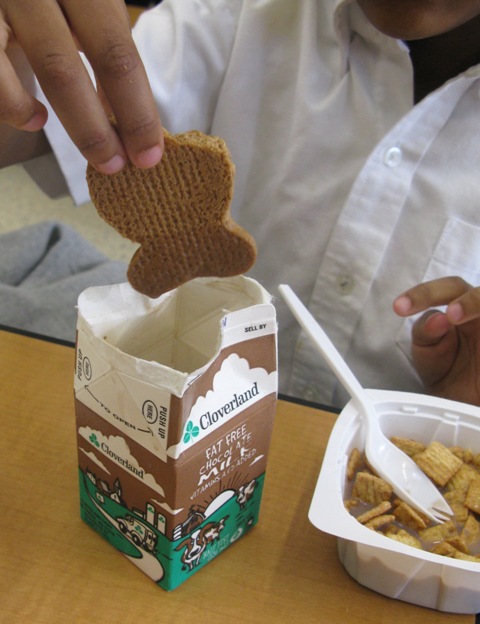
The National Dairy Council is circulating the testimony of a first-grader at Lafayette Elementary School who told the D.C. Council kids aren't drinking milk as much since chocolate milk was removed from the menu.

D.C. Council Chairman Kwame Brown last week grilled schools Chancellor Kaya Henderson on the subject during her confirmation hearings, trying to get Henderson to commit to reinstating chocolate milk in school cafeterias based on the 7-year-old boy's "research."

The boy's father, Chris Murphy, told Washington Post columnist Mike DeBonis that his son, Aidan Cohn Murphy, "is not a dairy lobbyist." But yesterday I was on the receiving end of a mass e-mail sent by Greg Miller, vice-president of science and research at the National Dairy Council, linking to Aidan's testimony with the words, "This kid did his homework."

Did he really?

Kwame Brown said he was impressed by the sleuthing Aidan had conducted, including a poll of 410 of his school mates to find that 58 percent are not drinking milk. (Apparently 42 percent are drinking plain milk, a lot more than are eating the green beans.) But a closer look shows that on several key points, Aidan got it wrong.

"We use to have chocolate milk in D.C. public schools," Aidan said in written testimony he submitted to the Council June 11. "But then you passed a law that said that no kids in D.C. Public Schools could buy chocolate milk. They could buy only white milk."

False. Apparently Chairman Brown thought Aidan was referring to the "Healthy Schools Act" the Council approved last year. But the act did not address flavored milk, nor does any other D.C. law. Removing flavored milk--which had included chocolate and even more sugary strawberry milk--was a decision made independently by school officials as part of an overhaul of school menus to make them healthier.

The chocolate milk from Cloverland Dairy the schools had been serving contained 14 grams of added sugar in the form of high-fructose corn syrup, or 3.5 teaspoons. “We’d like to teach students that sugar doesn’t need to be added to a natural food to make it ‘taste good,' " school food services spokeswoman Paula Reichel told the Post.

Aidan says that according to his survey, kids now substitute water for milk more than anything else. Many parents think that's a good idea. They don't believe milk is necessary. But Aidan went on to say that kids are substituting fruit juice for milk, and that would not be accurate. In D.C. elementary schools, children are required to take all of the offered food items at any meal. Milk is always offered. If juice is on the menu, they would be required to take that as well, not in place of milk. Juice typically is offered at breakfast, not so much at lunch. And at affluent schools like the one Aidan attends, breakfast participation traditionally is very low.

In proposed new meal guidelines, the USDA would make it more difficult for schools to substitute juice for whole fruit.

Aidan says Fairfax County also removed chocolate milk from the menu, but then brought it back with a "healthier kind of sugar." The truth is, sugar is sugar. There is no real difference between cane sugar and high-fructose corn syrup as far as your body is concerned, except that the corn syrup may contain a higher percentage of fructose. Both are equally bad. In fact, Robert Lustig, a specialist in pediatric obesity at the University of California, San Francisco, has called sugar "poison." The American Heart Association has linked it to risk factors for cardio-vascular disease in children. According to the heart association's guidelines, millions of children drink too much flavored milk.

Aidan said that as part of his research he interviewed a doctor who told him chocolate milk is "medium healthy" and "better than drinking soda." The policy of the American Academy of Pediatrics is that flavored milk served in schools can be a "healthful alternative" to sodas and other soft drinks. But D.C. schools have not allowed the sale of sodas or soft drinks since 2006. They are not available for sale in D.C. elementary schools, although some kids bring them from home.

According to this doctor, the calcium and protein in milk "are good--but the sugar is not good."

Aidan quotes a recent Washington Post article in which a USDA spokesman says the agency would rather have kids drink milk with added sugar than no milk at all. But there's something Aidan needs to know: the USDA's job is to promote dairy products. In fact, the USDA oversees the Milk Processors Education Program (MilkPEP), which collects money from dairies by congressional fiat in order to spend millions of dollars promoting the "Raise Your Hand for Chocolate Milk!" campaign.

The USDA designates milk as its own food group in the school meals program, and requires that it be offered at every meal. No other agricultural product receives such preferential treatment from the federal government. Still, sales of plain milk are only half what they were after World War II, while sales of flavored milk have tripled in since the 1970s. Chocolate milk is the dairy industry's way of competing with Coke and Pepsi. Big Dairy is desperate to keep kids drinking chocolate milk.

In other words, Aidan, there's very little difference between the dairy industry and the USDA when it comes to peddling chocolate milk to children.

Aidan, you should be listening to your doctor and your other schoolmates and just drink water if you don't like plain milk. Kids are not suffering a "calcium crisis," as the dairy industry would have you believe.

We know you and your friends love sugary chocolate milk. But you need to make the healthier choice and learn to like plain milk. What you should be lobbying the D.C. Council for is extra money the schools can use to install electric milk dispenser so kids can have fun pouring themselves glasses of cold, delicious white milk instead of the stuff they serve you in those miserable little cartons.

Thursday, April 28, 2011

Big Dairy Puts Big Scare Into Parents to Push Chocolate Milk--But for How Long?

Drink chocolate milk or else!

By Ed Bruske

aka The Slow Cook

Los Angeles schools are prepared to announce they will no longer serve flavored milk beginning in the fall, according to a report yesterday in the Los Angeles Times. Superintendent John Deasy says he will make that recommendation to the L.A. school board in July. Could this surprise development in the nation’s second-largest school district spell the end of chocolate milk as we know it?

Faced with a cultural shift away from milk in favor of drinking sodas, the U.S. dairy industry has pulled out all the stops to scare parents and school food service directors into believing that kids will collapse in a heap of rickets and osteoporosis unless they have access to milk tarted up with sugar.

It’s no surprise that kids love sugar and sweets of all kinds--including chocolate milk and strawberry milk and grape milk and any number of other flavors. The question is whether the dairy claims are true, and whether enticing kids to eat foods laced with added sugar is a good thing in the midst of an obesity epidemic that threatens to cut short the lives of a generation of children and send the nation’s health care bill through the roof.

Don’t be fooled. The dairy industry would like you to think this fight is about nutrition, but it’s really about money. Since the end of World War II, annual milk consumption in the U.S. has plummeted from 45 gallons per person to around 20 gallons today, with milk losing market share to all kinds of sodas, juices and sports drinks sweetened with cheap high-fructose corn syrup. The one bright spot on this sorry trend line is flavored milk: Since 1975, sales of chocolate and other milk products with added sugar have tripled.

In the federally-subsidized school meals program, milk enjoys special status. The U.S. Department of Agriculture, whose primary job is to promote sales of the nation’s farm products, has singled out milk as the one food that must be offered to all 32 million children who eat the government-sponsored lunch. It’s required at breakfast, too, and an estimated 70 percent of the milk kids drink at school is flavored. Many schools have eliminated sodas, but they still serve strawberry milk containing nearly as much sugar as Mountain Dew.

With so much on the line, the dairy industry has funded research to bolster its cause. For instance, in its “Raise Your Hand for Chocolate Milk!” campaign, the industry cites three research papers as supporting its contention that adding sugar to milk encourages kids to drink it, with no harmful effects. Through this lens, chocolate milk emerges as the healthy alternative to Coke.

In all three cases, those papers were either written or co-written by Rachel K. Johnson, a nutritionist who until 2008 was dean of the College of Agriculture and Life Sciences at the University of Vermont, a state with deep roots in the dairy industry. Johnson specializes in child obesity issues with “an emphasis on the nutritional role of dairy foods,” according to the university. She continues to teach nutrition there and might as well be on the dairy payroll as well: All three of the studies in which Johnson was involved were in fact funded by dairy organizations. She lists herself as an advisor to the National Dairy Council and the International Dairy Foods Association.

Biased though it may be, industry-funded research, with its gloss of scientific authority, makes its way into widely circulated professional journals such as the Journal of the American Dietetic Association and the Journal of Adolescent Health. It then migrates into findings of medical groups like the American Heart Association and the American Academy of Pediatrics. Dairy groups reference these to convince food service directors, pediatricians and parents that kids must have flavored milk.

The result is a kind of public relations echo chamber in which dairy industry messages based on “research” it pays for are parroted by proxies in the health and education communities who also have financial ties to dairy.

To further whip up public hysteria, dairy interests claim that if flavored milk is removed from schools, kids will stop drinking milk altogether. As proof, they site a “study” purporting that in seven different school districts milk consumption dropped an average 35 percent over a three-month period when chocolate milk was taken away. Kids drank 37 percent less milk even a year after the move to plain milk had taken place, according to these findings.

Very likely, some kids do drink less milk when sugary milk is taken off the menu. But this was no scientific study. It was written by a marketing research firm hired by the Milk Processor Education Program (MilkPEP), the industry-funded group responsible for the famous “Got Milk?” campaign. The company in question--Prime Consultant Group—is a major player in consumer analysis and sales strategies that lists among its clients Coca-Cola, PepsiCo International, Kraft Foods/Nabisco, Sara Lee and Proctor & Gamble.

MilkPEP refuses to make details of its “study” available for public scrutiny. Yet it immediately touted the new “findings” to the nation’s school food service directors through the School Nutrition Association, which represents some 53,000 cafeteria bosses.

MilkPEP is a program mandated by Congress and overseen by the USDA that collects money from milk producers and uses it to promote milk consumption. MilkPEP and the National Dairy Council are listed as “patrons” of the School Nutrition Association, meaning they pay at least $10,000 in annual dues to support SNA activities. A MilkPEP representative also sits on the SNA’s “industry advisory board,” along with representatives from corporate food giants such as Tyson, Sysco and General Mills.

In August of last year, shortly after the “study” was unveiled at the SNA’s annual conference in Dallas, the SNA hosted a “webinar” for its members titled, “Keep Flavored Milk from Dropping Out of School.” The SNA advertised the webinar this way on its website: “Learn about free resources available to use with parents, school officials, and other interested parties to help show that student nutrition and food budgets are negatively impacted when flavored milk is removed from schools.”

Jamie Oliver, while filming his second season of the Food Revolution television series, ran into the same buzz saw in Los Angeles. There, a special break-out session on the need to retain flavored milk—led by a dairy industry representative—was held at a conclave of the California School Nutrition Association. Jamie was filmed attending the session and making his objections known.

In the face of such concerted and well-funded efforts by the dairy industry, opponents of flavored milk would seem to be hopelessly outgunned. In fact, you might say this fight is rigged in the dairy industry’s favor. Yet no less an authority than Walter Willett, head of the nutrition department at Harvard University, says milk containing added sugar should not be offered to children in school, and that milk itself “is not an essential nutrient.”

The prestigious Institute of Medicine, an arm of the National Academy of Sciences, recently knocked some of the stuffing out of the milk industry’s claim that children face a “calcium crisis.” In the most authoritative scientific statement to date, an IOM panel of experts said most Americans get all the calcium and Vitamin D they need.

As far as school children are concerned, one segment of the population that might need extra attention is pubescent girls. According to the IOM, girls leading up to and during puberty typically consume around 823 milligrams of calcium daily. Because they experience a growth spurt during this period, they should aim to get about 200 milligrams more calcium, or “between 1,000 and 1,100” milligrams, said Dr. Steven A. Abrams, a professor of pediatrics at Baylor College of Medicine who specializes in the calcium intake of children and was one of the panelists who wrote the IOM report.

By comparison, a one-cup serving of Total cereal contains 1,000 milligrams of calcium, a cup of low-fat milk around 300, and a half-cup of cooked collard greens 200, about the same as in a single serving of string cheese.

In an interview, Abrams--who also advises MilkPEP--told me: “I’ve never been a fan of the term ‘calcium crisis.’ I’m much more in favor of policies that ensure we meet that 1,000 milligrams. What we need to do is make sure that we have a lot of different ways for kids to get to it.”

In other words, milk isn’t the only way to get calcium. It’s available in lots of other foods. Milk is not required in the schools of most other countries. According to Oliver, flavored milk is prohibited in schools in Great Britain and the rest of Europe.

More ominously, emerging science paints a dire picture of sugar as a trigger for obesity and related health problems such as diabetes, hypertension and coronary artery disease. A 6,000-word feature article appeared in the April 17 edition of the New York Times Magazine under the headline, “Is Sugar Toxic?”

Robert Lustig, a specialist in childhood obesity and pediatric hormone disorders at the University of California, San Francisco, is at the center of this report. Lustig, who helped write the American Heart Association’s guidelines on added sugar, is convinced that the fructose in ordinary sugar as well as in even sweeter high-fructose corn syrup is intimately connected with the obesity epidemic and so-called diseases of modern civilization because of the way it is metabolized in the liver, like alcohol.

Sugar represents not just empty calories, Lustig insists. “It has nothing to do with the calories. It’s a poison by itself.” Lustig says Americans are consuming more calories than ever because their appetite suppression mechanisms are disrupted by eating too much sugar, especially in sodas and other sweetened beverages.

Lustig worries about a worldwide outbreak of obese infants and an epidemic of fatty liver disorder in children caused by too much sugar. Research finds that female adolescents get 20 percent of their total energy in the form of added sugars, meaning sugar that does not occur naturally in food. Even for children aged 6-11, the figure is an astonishing 19 percent.

Needless to say, Lustig does not approve of chocolate milk in school. Gary Taubes, one of the nation’s foremost science writers and author of the New York Times article, is convinced sugar is dangerous even though the scientific evidence isn’t conclusive.

Some medical researchers Taube’s interviewed have eliminated sugar from their personal diets because they believe it may cause common forms of cancer.

The U.S. government has been slow to fund adequate studies of sugar in the diet, and the sugar industry has vigorously fought efforts to issue guidelines on sugar consumption. In fact, in all the volumes of rules governing the school meals program, sugar is one ingredient the USDA does not regulate at all. Cash-strapped schools use it as a cheap way to boost the calorie count in their food. The USDA’s proposed new meal guidelines were specifically written to leave room for flavored milk, even while lowering the number of calories schools can serve in meals.

I’m not waiting for “conclusive” science either. Like school officials in Los Angeles and other forward-thinking districts, I believe we have enough information to know that we as a society—and kids in particular—have gone way overboard in our taste for sugar, a food substance that wasn’t even widely available for most of human history.

I sympathize with parents who are perplexed and worried about kids getting enough calcium and Vitamin D. But we can’t play Russian roulette with our children’s health. All of us need to change the way we eat and stop teaching kids to expect sugar with their food every day, especially in the one-size-fits-all meal program at school.

In at least one respect I agree with the dairy industry: We need to get children off soda. We need to teach them to like plain milk again--as well as other fresh, wholesome foods that deliver the nutrients they need. Here’s one great way to get Vitamin D and build strong bones: go outside and exercise.

As much as the dairy industry would like us to believe otherwise, flavored milk is not a solution. It’s part of the problem. If kids are to drink chocolate milk at all, it should be reserved for an occasional treat—at home with parental supervision, not in school.

Wednesday, April 13, 2011

Jamie Oliver: Home Run?

By Ed Bruske
aka The Slow Cook

Did you watch the opening episode of Jamie Oliver's new Food Revolution series in Los Angeles last night?

Even if you think reality television is a bit hokey, Oliver did a brilliant job of pinpointing some of the school food issues that often make me want to quit this job.

One is the indifference of many parents to what schools are serving kids as food.

Let's acknowledge up front that there are some incredibly active and engaged parents working on this issue. Sometimes you don't hear about them: they are totally focused on fixing their neighborhood school, not making a name for themselves in the blogosphere. But generally speaking, most parents are AWOL. What will it take to motivate them, if not the current health crisis affecting our children around food?

Secondly, I hope you took proper note of how schools would just as soon not have prying eyes looking into their food service operations.

Los Angeles is no different from most school districts I've encountered. The food they serve is kept secret, away from public view. Why? Because even in districts that claim to be exceeding the most stringent government standards, what they are actually serving is crap. You can't know that from the menus. You have to be present in the cafeteria and see what the kids are getting on their trays.

My wife and I watched the show together and she was horrified over the segment where Oliver demonstrated the ammonia treated beef that's used as a filler in hamburger, and the fact that the government does not consider it an ingredient. It doesn't appear on any label.

Finally, it was plain to see why the dairy industry is winning the battle over chocolate milk (read sugar) in schools. Oliver showed up at a California School Nutrition Association convention where a dairy rep was holding forth in a breakout session on why schools need to keep flavored milk.

Sugary flavored milk is a big winner for Big Dairy, which explains why the industry is spending millions on its "Raise Your Hand for Chocolate Milk!" campaign. It has operatives all over the country telling school food service directors that kids will dissolve in a heap of rickets and osteoporosis if they don't have access to milk containing the sugar equivalent of Mountain Dew.

The dairy industry buys its way into school nutrition associations with sponsorships on the state and the national level, which gives it immediate entree to hold those sales talks where it enlists food service directors in its cause. The industry then trots out a bogus "study"--really a marketing report it paid for--showing that kids won't drink milk unless it has sugar in it. It pulled the same trick most effectively with a gullible Washington Post reporter yesterday.

As Oliver pointed out, the U.S. is probably alone in the developed world in allowing dairy interests to push sugary milk in schools. According to Oliver, flavored milk is not allowed in schools in Great Britain, nor in all of Europe.

Oliver was totally dejected at the end of the episode, when his crew filled a school bus with sugar (or sand) to demonstrate how much of the sweet stuff Los Angeles kids are consuming each week, but only a handful of parents showed up to see it.

If I have any beef at all with Jamie Oliver, its the tired and incorrect information he often gives about what causes people--or children--to get fat. It's not the fat in the mayo or the ice cream, Jamie. It's all the carbs in the hamburger buns, the fries, and the sugary milkshakes.

Otherwise, right on, Jamie.

Thursday, August 12, 2010

School Nutrition Association Dances to Milk Industry Tune

By Ed Bruske
aka The Slow Cook

The School Nutrition Association, representing thousands of school food service workers across the country, has embraced a "study" promoting chocolate and other sugar-enhanced milk that was paid for by the dairy industry, conducted by a firm that specializes in devising corporate marketing schemes, and which the dairy group refuses to release for close inspection.

The SNA has announced it plans to hold a "webinar" on the study Aug. 25 to examine findings from a sample of schools that purport to show that milk consumption dropped an average 35 percent when chocolate and other flavored milks were removed and students were offered only plain milk.

The study was commissioned by MilkPEP, a dairy industry group that operates under the auspices of the U.S. Department of Agriculture and uses funds collected from members to promote milk. Perhaps best known for the catchy "Got Milk?" advertising campaign, the group has spent more than $1 billion to halt what has been a steady decline in U.S. milk consumption in recent decades.

MilkPEP, along with National Dairy and the National Dairy Council, are listed as "patrons" of the School Nutrition Association, meaning they pay at least $10,000 in annual dues to support SNA activities. A MilkPEP representative also sits on the SNA's "Industry Advisory Board," along with representatives from corporate food giants such as Tyson, Sysco and General Mills.

On its website, the SNA says the free "webinar," entitled, "Keep Flavored Milk from Dropping Out of School," is being offered "in partnership with the Milk Processor Education Program (MilkPEP)," and that participants will "learn how to share" the study's findings. "Learn about free resources available to use with parents, school officials, and other interested parties to help show that student nutrition and food budgets are negatively impacted when flavored milk is removed from schools," the SNA urges.

The School Nutrition Association figured prominently in recent Congressional hearings on the reauthorization of school meal programs, testifying that schools on average lose 35 cents on every lunch they serve.

The flavored milk "study" was first unveiled at the SNA's annual conference in Dallas July 13. When I called MilkPEP here in Washington, D.C., to obtain a copy of the study, I was referred to the Chicago offices of Weber Shandwick, a global public relations firm with 81 offices in 40 countries, according to its website. A representative there, Chris Bona, first asked me how I intended to use the study. After I provided him with my professional background and links to my reporting on the school food issue--including the debate over flavored milk--Bona declined to make the study available.

"I checked and since MilkPEP may decide to present or publish the study, at this time we’re only able to share the information I sent you on Friday," Bona said, referring to a press release and a two-page colored flyer describing the study's findings.

Because MilkPEP refuses to release the study for closer scrutiny, it is impossible to know whether its finding are at all scientifically valid. References cited in the study are mostly from the American Dietetic Association, another group heavily sponsored by the food industry.

Nutritionist and food politics author Marion Nestle dismissed the MilkPEP report.

"It's well known in nutrition research that sponsored studies yield results that favor the sponsor's interests," Nestle said. "This study was sponsored by the Milk Processors who have a vested interest in making sure that milk sales increase. Without reading the actual study, I cannot comment on its methods, but I'm willing to hazard a guess that the investigators designed the study--consciously or unconsciously--to favor consumption of chocolate milk.

"Of course kids will choose chocolate milk," Nestle continued, "or candy for that matter if given a choice. I know of plenty of examples of schools that have given up chocolate milk and do not see losses in sales once the kids get used to the idea that they can't have it at school any more."

Kate Adamick, a nationally recognized school food consultant who is an outspoken advocate of eliminating flavored milk from schools, both because of the hazards posed by added sugar in flavored milk and because it costs schools more to buy it, dismissed the study on the same grounds.

"What a 'shock' that the folks who have the most to gain financially by convincing everyone that kids need to drink flavored milk came up with a study that says kids need to drink flavored milk," Adamick said.

Ann Cooper, the "renegade lunch lady" who has eliminated flavored milk from two prominent school districts--Berkeley, Calif., and Boulder, Co.--has called flavored milk "soda in drag." Chocolate milk, for instance, usually contains around 26 grams of sugar--including the lactose that occurs naturally--the equivalent of 6.5 teaspoons, or about the same, ounce-for-ounce, as Classic Coke. Strawberry milk contains nearly as much sugar as Mountain Dew.

"The argument is like this: If our kids don't like apples--but do like apple pie--then let's just feed them apple pie in school," Cooper said. "It just doesn't make any sense." Cooper said she believes children can get enough calcium and Vitamin D from sources other than milk and that flavored milk should only be served as a treat at home.

The disease primarily associated with insufficient Vitamin D--rickets--is so rare as to be practically unheard of, except in some infants that breast feed and do not receive Vitamin D supplements. Still, many parents worry about children not getting enough calcium and Vitamin D. The dairy industry claims the U.S. is suffering a "calcium crisis." And as more school districts take up the question of whether to remove flavored milk, the issue is being hotly debated. School officials in the District of Columbia recently decided without fanfare to discontinue serving flavored milk and sugary cereals, a move that has reverberated around the country.

Americans today consume only half as much milk per person as they did at the end of World War II. Milk has steadily lost ground to competing beverages, such as sodas. Flavored milk is one of the few bright spots in this otherwise dismal picture. More than half the flavored milk sold is sold to schools, and 70 percent of the milk kids drink at school is flavored.

The milk industry claims the situation would be even worse without advertising. MilkPEP is a commodity "check off" program authorized by Congress in 1990, under which processors pay a charge according to the amount of milk they produce. The group's annual budget for 2006, for instance, was $107.8 million. Spending of the funds is overseen by the USDA.

"First and foremost, MilkPEP is the industry's only marketing tool solely devoted to promoting fluid milk to America's consumers nationally," according to the group's website. "It is essential in the industry's fight to maintain share of stomach against strong national beverage brands such as Coke, Pepsi, Tropicana, Minute Maid, Gatorade, Poland Springs, Dasani and others."

The flavored milk "study" being promoted by the School Nutrition Association was conducted by Prime Consultant Group, a major player in consumer analysis and sales strategies that lists among clients Coca-Cola, PepsiCo International, Kraft Foods/Nabisco, Sara Lee and Proctor & Gamble. Besides MilkPEP, Dairy Management Inc. and the International Dairy Association, it conducts business for the Grocery Manufacturers of America and the Food Marketing Institute.

Prime Consultant Group reported in the summary documents provided by Weber Shandwick that it examined children's milk drinking habits in 58 schools in seven school districts across the country over a three month period in 2009. Not only did milk consumption drop an average 35 percent when flavored milk was removed, it said, but kids drank 37 percent less milk even a year or more after the move to plain milk had taken place.