Showing posts with label school gardens. Show all posts

Monday, March 21, 2011

Families Turn Out for a School Garden Raising

New garden in the making at Stoddert Elementary

By Ed Bruske

aka The Slow Cook

Months of planning resulted in a new garden at my daughter's elementary school Saturday as parents, teachers and kids all pitched in to dig beds, haul compost and spread wood chips.

The masterminds behind construction of the Stoddert Elmentary School garden in Glover Park are two women who live in the neighborhood--Lauren Biel and Sarah Bernardi--who just happen to be passionate about school gardens. Unlike most of us who simply support the idea of school gardens, they actually did something about it, forming a non-profit--D.C. Greens--that operates a farmers market nearby on Wisconsin Avenue precisely to generate funds they can use in their gardening efforts.

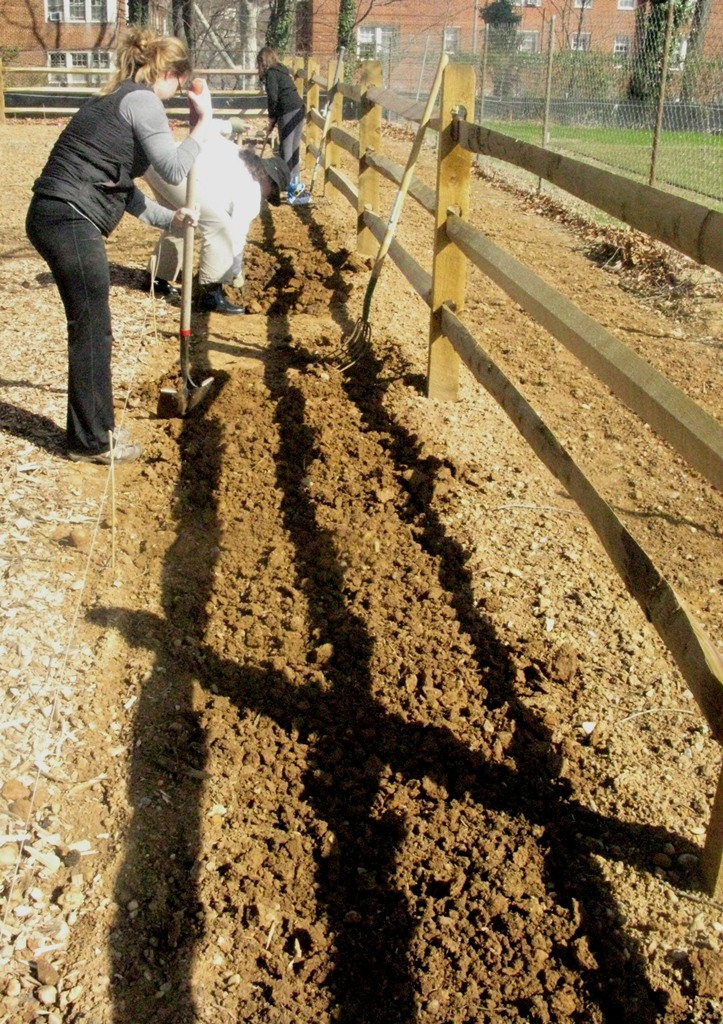
Removing clay for blueberries

The site for the garden lies between the school and a new sports field. There's a big tree to offer some shade, a neat little wooden tool shed donated by Home Depot, and an old-fashioned split-rail fence that gives the place a country feel. Biel and Bernardi have been busy lining up sponsors as well as expertise to get the garden in shape. Whole Foods donated a lunch of hot dogs, cole slaw and macaroni salad.

My job was to help dig a bed for blueberries. I quickly discovered that my spade shovel was of little use trying to dig into solid clay. I walked to the hardware store and purchased a five-pound mattock. At one point there were at least eight of us toiling away on this bed, tossing clay to the side and removing stones.

The Slow Cook swings his mattock

You may recognize Sarah Bernardi--she was the art instructor at Bancroft Elementary School who was deeply involved in the garden program that Michelle Obama adopted. Sarah wrote a guest post here describing how difficult it was for teachers to maintain gardens like the one at Bancroft. You may not be surprised to learn that she's left teaching to work in gardening full time. But rather than me telling it, I'll let you read what Sarah sent to me in an e-mail last week:

Teaching was wearing me out! I'm wrinkled and grey haired and I haven't even had kids yet!


I'd been wanting to move out of the classroom for a few years. I began moving away from teaching art and more and more into the garden, which is where my personal interests lay. What I always loved about my job as an art teacher was that it forced me to constantly learn new processes and methods and allowed me to be really creative and 'make stuff'. I realized I can take both of these things with me out to the garden, which is a place - unlike the classroom - that also makes me feel at ease and allows me to be completely present (two things I struggle with!) And that's what I really want to impart on the kids, how gardening can do all of these things, all the while it's teaching you how to eat and how to live.


I've been working with DC Farm to School and DC Greens since leaving teaching and have been really focusing on the Stoddert Garden project. I remain involved with the garden program at Bancroft and am working on the committee there to structure the program for their newly designed garden. I've just begun working at the Farm at Walker Jones, which I'm thrilled about, as it is a perfect marriage of my passion to Farm to School programming and interest in school garden program design.


Lauren Biel founded DC Greens to create a farmers market for the neighborhood that would channel profits back into the community in the form of school garden programs. The seed for the Stoddert garden was planted two years ago when the school was undergoing modernization. Lauren and I connected with a couple of parents, Julie Schneider and Ginger Jacobs, who also loved gardening wanted to include a garden in the plans for modernization. They worked very hard to make that happen and were able to have a very large space (4,000 square feet) earmarked for the garden.

Last year we surveyed the teachers to get their input and developed a plan for the space based on this. DC Greens is fully funding the project using proceeds from last season's market, a Building Healthy Communities grant from Home Depot and a 5% day from Whole Foods. This is allowing many projects that have been started to actually move forward. For example, a first grade class built a green house out of recycled bottles with the help a local architecture firm and it will be finished and installed next week. Mr. Dingledine, a fourth grade teacher, has been developing a relationship with the Monarch Sister Schools program and their chief botanist Christopher Puttock, has created a beautiful butterfly garden design that now has the funding to move it forward. it will be planted at the end of April. We've got Andy Lynch, a colleague of 'Stickwork' artist Patrick Dougherty, (www.stickwork.net) coming for a week to install a 'Stickwork' entrance designed by Patrick and made from maple branches. He will be assisted daily by local artists and sculpture students, providing a great opportunity for these artists.


We've really tried to thoughtfully consider all of the challenges school gardens face in the planning process and tried to set up a a system that will addresses them. We have a set of about 10 teachers, each adopting a section of the garden for the year. Two teachers will serve as the in school coordinators and will run an after school garden club funded by the PTA. The school is blessed with a strong level of parental and community involvement and I have a long list of volunteers wanting to help with summer maintenance. Whole Foods and the Glover Park Hardware store have adopted the garden and are supporting it long term with in kind donations. DC Greens will continue to structure an support the program, provide professional development for teachers and take care of the details that usually bog teachers down and contribute to the decline of school gardens.

As we know, without a dedicated staff person assigned to oversee and teach in the garden, creating an integrated program remains a challenge. We have not chosen a set curriculum to use but will be setting up a section in the library containing a few of out favorite curriculum guides and books to use in their classrooms. We are anxiously awaiting local curriculum (available for purchase soon!) from City Blossoms and The Washington Youth Garden and hope to provide that for teachers to use that next year.

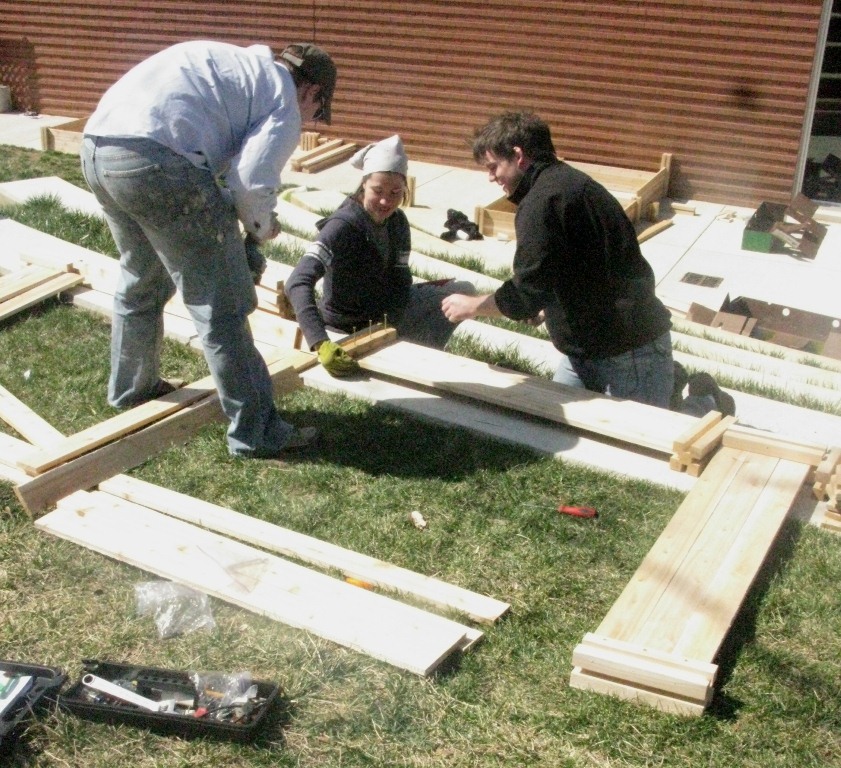
Building raised beds from kits


You can follow events at the Stoddert Garden at the new blog here. And here are some more pictures of yesterday's garden raising.

Saturday, September 25, 2010

What Does the Berkeley School Garden Study Really Mean

By Ed Bruske
aka The Slow Cook

Supporters of school gardens were positively giddy with news yesterday that a three-year study of s garden and cooking initiative in Berkeley, Calif., schools had shown students more eager to eat vegetables and make healthy food choices. But a closer look at the study shows that these positive results were attributed only to fourth and fifth graders in two Berkeley elementary schools, and that students as they moved into middle school not only made little further progress, but actually regressed, even though they spent more time in gardening and cooking classes.

The message seems to be that unless your school has a highly structured program around a paid gardener, cooking instructor and nutrition curriculum, don't expect a garden to increase your child's appetite for vegetables.

In their report, researchers from the University of California, Berkeley, said there was wide variation in how Berkeley schools rolled out the so-called School Lunch Initiative sponsored by Alice Waters' Chez Panisse Foundation. They also said it was difficult to establish a control group for their study against which to measure results. So what they did was divide Berkeley schools into two groups, one described as have a "highly developed" garden, cooking and nutrition education program, the other have a "less developed" program. They selected two elementary schools from each group and began tracking the progress of fourth and fifth graders using questionnaires and photographs of what the kids chose for lunch.

The two "less developed" schools, represented by 193 fourth- and fifth-graders, were distinguished by having no paid garden staff, little to no garden programming, and students who spent little or no time in the garden. In addition, these two schools had no paid cooking staff and no cooking classroom, and teachers in the school had done little to integrate nutrition concepts into the curriculum. These schools tended to have larger proportions of higher-income students and were thus ineligible for outside funding for enhanced programs.

In contrast, the two "highly developed" elementary schools, represented by 134 fourth- and fifth-graders, had paid garden and cooking staff and the students spent 22 to 56 hours in garden and cooking classes each year. In addition, some teachers had integrated nutrition into the curriculum. These schools tended to have higher propotions of low-income students and were thus eligible for outside funding for enhanced programs.

All three of the middle schools that these students eventually attended had garden and cooking programs in place, although some programs were more advanced than others.

Following the students from these four schools over a three-year period yielded these results:

* In year one, fourth- and fifth-grade students in schools with highly developed School Lunch Initiative components and those in schools with lesser-developed School Lunch Initiative components all ate about the same amount of fruit and vegetable servings per day (about 4 servings, or 2 cups). In year two, the younger students (fourth graders who had moved into fifth grade) attending the schools with highly developed School Lunch Initiative components had increased their consumption of vegetables by nearly 1 serving (0.4 cups), and for both fruits and vegetables by about 1.5 servings (0.7 cups), while those attending schools with lesser-developed School Lunch Initiative components had decreased their consumption of both fruits and vegetables by nearly 0.4 servings.

* As they became fifth-grade students in year two, fourth-grade students from schools with highly developed School Lunch Initiative components showed upward trends in family dinner prepared from scratch, eating family dinner nearly every day, using recipes from school at home and helping prepare dinner. In contrast, fourth-grade students from schools with lesser-developed School Lunch Initiative components did not show increasing trends in these behaviors from the fourth to fifth grade, although more students from these schools said they ate family dinner nearly every day and this remained consistent from year one to year two.

* Fourth-grade students from schools with highly developed School Lunch Initiative components showed significantly greater increases in preference for green leafy vegetables in particular as they moved into fifth grade, compared to fourth grade students from schools with lesser-developed School Lunch Initiative components. By seventh grade, preference for fruits and vegetables was similar among the various exposure groups, except preference for green leafy vegetables was associated with higher exposure to School Lunch Initiative components.

* Sixth-grade students showed no significant increase in fruit and vegetable consumption compared to the previous year, but seventh-grade students in the middle school with the most highly developed School Lunch Initiative components showed small increases in total fruit and vegetable consumption, putting them at a consumption level of about 4.5 servings of fruit and vegetables daily. Seventh grade students in the other middle school, where there was less exposure to School Lunch Initiative components, showed a mean decrease in both fruit and vegetable consumption of about one serving per day.

* By Year Three, seventh-grade students attending the middle school with the most highly developed School Lunch Initiative program had increased their nutrition knowledge scores by 5% over the previous year, while students attending the other two middle schools, which had lesser-developed components, had decreased their knowledge scores by 6% in one school and 14%in the other.

* Students attending the middle school with highly developed School Lunch Initiative components in year three showed more positive attitudes toward eating the food served at school, liking the cafeteria, agreeing that produce tastes better in-season, and agreeing that eating choices can help or hurt the environment compared to students attending the other two middle schools, which had lesser-developed School Lunch Initiative components.

* There were no consistent differences in attitudes about food, health, the environment or school between students attending schools with highly developed School Lunch Initiative components and students attending schools with lesser-developed School Lunch Initiative components over the three years of the evaluation. However, proportionately more students attending Middle School X, with highly developed School Lunch Initiative components, in year three tended to show positive attitudes toward eating the food served at school and liking the cafeteria at school, as well as agreeing that produce tastes better in-season and that eating choices can help or hurt the environment.

* The need for continued exposure to the School Lunch Initiative into middle school is further supported by the observation that at the one middle school where seventh-grade students showed a mean decrease in fruit and vegetable consumption of about one serving per day, the cooking and garden programming was offered only as an elective.

* Parents with children in schools with highly developed School Lunch Initiative components were more likely than parents with children in schools with lesser-developed School Lunch Initiative components to agree that school had changed their child’s knowledge about making healthy food choices (60%versus 36%) and their child’s attitudes about food (42% versus 19%), and had improved their child’s eating habits (35% versus 16%).

Clearly, exposure at the elementary school level to garden and cooking programs with paid staff can improve children's eating habits. So how to account for the fact that progress comes to a virtual standstill in middle school, even where sixth- and seventh-graders spend many hours in the garden and in cooking classes and teachers have integrated nutrition into their lesson plans?

"Middle school is often a time when eating habits worsen as children move into adolescence," is as close to an explanation as the authors of this report offer. "To sustain gains in healthy eating made by program exposure in the younger grades," they conclude, "continued learning and availability of healthy food options can help overcome the pull toward poor habits."

In other words, carry on.

Friday, September 24, 2010

Mixed Results from Edible Schoolyard

By Ed Bruske
aka The Slow Cook

Elementary school children regularly involved in gardening, cooking and nutrition education are more likely to develop a taste for fresh fruits and vegetables--even leafy greens--and will more eagerly help make fresh meals at home, but those gains come to a screeching halt as kids get older and move into middle school, where they often backslide.

Those are the mixed results from a three-year evaluation of the "School Lunch Initiative" undertaken by Alice Waters' Chez Panisse Foundation in Berkeley, Calif., schools. Performed by researchers from the University of California at Berkeley, and easily the most ambitious examination to date of an integrated school garden and cooking program, the report [PDF] found that fifth-graders in the second year of the program increased their vegetable consumption by one serving per day and also ate more fruit. Sixty percent of the parents of those children said involvement in the gardening and cooking initiative had made their child more aware of healthier food choices.

By seventh grade, however, student improvement even in Berkeley's most advanced middle school slowed almost to a standstill, although students were significantly more likely to enjoy the food served in the cafeteria and had better knowledge of how their food choices affected the environment. Still, their small rate of improvement was much better than in schools where the initiative was less robust. There, seventh graders actually showed declines in food knowledge: 6 percent lower in one middle school, 14 percent in another.

The findings roughly confirm my own anecdotal experiences working in the "dining commons" at Berkeley's Martin Luther King Jr. Middle School where the students, despite being involved in Waters' flagship "Edible Schoolyard" gardening and cooking program, displayed a conspicuous indifference to vegetables in the food line. The three-year evaluation seems to indicate that while children at a certain age embrace the idea of eating more healthfully, they lapse into a sort of food funk after entering puberty.

So, do memories of gardening and cooking lessons revive in high school or after adolescence and produce more food-conscious adults? That seemed to be the hope of Berkeley's food service team, who stressed to me repeatedly while I was there that kids must be exposed to healthier foods even if they don't eat them, that the lessons will inform their eating habits later in life.

"I think in Middle School developmentally kids are all over the place. It is really a tough stage and it is also reflected in their food choices," Bonnie Christenson, executive chef for Berkeley schools, said today when asked about the evaluation's results. "In high school you see the kids starting to eat salad again. They are moving away from their parents' control but they are more mature and responsible. They eat a wider variety of foods including veggies."

But, as Christenson notes, "The study doesn't cover a long enough period to reflect this."

"I really do think it makes an impact for life–truly," said chef Ann Cooper, who was hired by Waters to reform the meal program at Berkeley and now runs food service for schools in Boulder, Co. "Middle School is tough no matter what. But in all other academic domains we continue to work with them and we need to in this area as well."

Waters, who was quoted celebrating the study's results in The Washington Post and the San Francisco Chronicle, did not respond to my query about the underwhelming middle school results.

Berkeley schools are in the fifth year of a major food service overhaul instigated by parents with help from the Chez Panisse Foundation and the non-profit Center for Ecoliteracy. The schools eliminated processed, reheated meals and adopted food made from scratch. A local bond initiative helped pay for a new central kitchen. Meanwhile, the School Lunch Initiative, designed to show children the connection between how food is grown and prepared and their own health, installed gardens in all 11 of the district's elementary schools and three middle schools. Thirteen instructional kitchens were built.

Waters' vision of children growing and cooking their own food has inspired school gardens across the country. The perceived benefits have been the subject of sometimes furious debate.

To varying degrees, students in Berkeley's "School Lunch Initiative" were engaged in gardening and cooking intermittently during the school year, but the program was stronger at some schools than others. For instance, some schools did not have paid garden staff or dedicated cooking instructors. Over the course of the three-year evaluation, researchers used questionnaires as well as photographs of what kids chose for lunch to measure the impact at schools with the most highly developed programs, compared to those where kids spent less time gardening and cooking.

In the more dynamic programs, for instance, food grown in the garden was harvested and used in a cooking class. The same food was then served in the school cafeteria. The Martin Luther King Middle School, where Waters' original "Edible Schoolyard" is staffed by several workers in the garden, and includes a lavish kitchen facility with individual work stations, a convection oven, a dishwashing area, and a dedicated instructor, was not mentioned by name in the report. But the best results seventh graders managed to muster out of the district's three middle schools--presumably at Martin Luther King--was a five percent improvement in food knowledge, despite all the resources lavished on them.

Initially, 327 students were involved in the study, but by year three the number had dropped to 238.

The Berkeley schools are racially and ethnically highly diverse. Among all the families involved, more than 90 percent of parents said it was "very important" to serve their child fresh fruits and vegetables every day, 75 percent said it was important to serve whole grains, and nearly half thought it was very important to serve locally grown foods.

Researchers said they were puzzled that overall only 30 percent of the children studied helped with meal preparation at home.

Tuesday, April 20, 2010

Garden Sprouts Committee

by LC Cokinos

It was the school garden that inspired parent Christy Halverson Ross to start a "healthy food" committee at Key Elementary. The committee has met only a few times since the beginning of the school year, but parents have already accomplished changes where they can.

Besides writing articles for the school newsletter, the group took a hard look at what the after- school program ordered from the grocery store. Now most of those snack choices are organic.
Another idea was to connect with the Farm to School program, which promotes making fresh local produce a part of the every-day school lunch (radical!). Farmers visited the school to give the kids that often needed reminder about where food actually comes from.

The next project ponders a healthier alternative to selling pizza at school events.

The school garden that sparked Christy's imagination still remains a challenge. An amazing rosemary bush and two patches of mint have been well established there, but organizing functioning edible plots and gardeners to tend the plots are part of a not-quite-realized future plan. Perhaps a batch of mint juleps might help fire up support.

Friday, April 16, 2010

Beyond "Museum" Gardens

By Jesse Kurtz-Nicholl

With all of the coverage of Michelle Obama in the news lately, you would be a fool not to think that gardens are the answer to all of our public health problems. In addition to the “White House” garden, you’ve got the new “People’s Garden” at the USDA building in D.C., you’ve got Secretary of Agriculture Vilsack and his wife cheering the establishment of gardens at local Washington D.C. elementary schools. The public and the food movement should laud these efforts and they are not without merit. I similarly applaud states like California that began the “Garden in every school,” initiative. Many others are following suit and I’m glad they have supported that initiative with some funding. However, it’s like the old proverb, “give a man a fish and he’ll eat for a day, teach him how to fish and he’ll eat for a lifetime.” Those wonderful intentions without substantial follow through are “paper tigers” against the environmental and health issues that face our public with regards to the food system, most notably: food insecurity, obesity, loss of bio-diversity and environmental degradation. Gardens that exist as exhibitions to only be looked and talked about will not move us anywhere close to where we need to go. We need this garden movement to move far beyond what Michelle Obama has heroically brought to the nation’s attention.

I want to push beyond the awareness building of the White House garden and I see this garden movement at the crossroads of two paths. One path makes us all feel better, but yields very little in the way of reduced obesity, urban food deserts and local control of food. The other requires more effort, but actually can affect, not only our local food shed, but more importantly, our children’s nutritional path, future health and prosperity. Right now, we are on path number 1. Throughout the United States, if students learn about food in school it is through “museum” gardens. I call them “museums” because they exemplify our look but don’t touch mentality towards food production. If your child is lucky, their school may grow herbs, some vegetables and receive a lesson or two about nutrition, plants and the growth cycle. The students may even be able to take home a carrot or munch on it happily. Then they walk into the corner store, the vegetables disappear and there’s no significant follow up to those isolated nutrition lessons. This could explain why the Associated Press reported that out of 57 federally funded programs of over 1 billion dollars spent to increase fruit and vegetable consumption among children, only 4 succeeded in their task. We need to shed this museum mentality. Students can no longer stare at our food system from behind protective glass, wearing blindfolds and waiting for the teacher to take them to the food court. Follow the proverb; we need to hand them that trowel and teach them how to grow.

Our children face an unrelenting obesity epidemic the world has never seen. A recent study out of the Bloomberg School at Johns Hopkins estimates that 75% of adult Americans will be overweight by 2015. These numbers have consequences, not only for our health as a nation, but our economy and future prosperity. One in three children born in the year 2000 will develop diabetes in their lifetime and for minorities that number is one in two. A recent study by Kenneth Thorpe, the chairman of the Department of Health Policy and Management at Emory University finds that at current trends, by 2018, annual obesity related health care costs will total more than 20 percent of total health care spending. That means that in less than a decade, health care costs attributable to obesity will have more than doubled.

Obesity is an extremely complex, multi-faceted health problem. Countries can have under nourished and over nourished individuals in the same community and even the same household. Obesity cannot be unraveled from poverty or corporate greed. There are causal elements in personal responsibility and government policy. Yes, we need taxes on sugary beverages, a new farm bill and campaign finance reform, but we need something more fundamental. The next generation of kids needs the chance to connect with food. With every generation since urbanization our connection with food, our understanding of where it comes from and how it is grown has become more distant. I’ve worked with students in urban areas where the connection is so lost, that whole fruits and vegetables are unrecognizable to their senses.

Path number 2 takes down the glass partition and places the kids in the museum, locks them in overnight, and makes the broccoli and squash come alive. Every school in the United States should have a garden/school farm engaged in real food production that is working towards adding fresh, healthy produce to the food shed of that community. It’s even more local than local.

Take for example a school district with 30 schools. In order to supply every school with a salad bar worth of lettuce greens once a week, you would need about 3 pounds of lettuce per school. That works out to approximately 100 pounds of lettuce per week. A school site could easily produce this much with just 4,000 square feet of space, a small chunk of land that the majority of schools have to spare! With a handful of schools participating, schools could have a healthy salad bar every day of the week. While those students are feeding their classmates they are engaged in an authentic education about food and nutrition that cannot be replicated in a classroom. This is not a pipe dream. The numbers are there. That is the vision of a food production program as opposed to a museum garden.

Students will no longer enter a school garden, be handed a carrot like it is some foreign object from mars and told, “look, this stuff actually comes from the ground!” No! Students will grow food from seed and along the way, learn to cook with it, take significant amounts home with them, and see it in their cafeterias. High schoolers can learn trades, career and leadership skills, business and marketing skills, through established school farms. They can pass that knowledge to younger kids through mentoring programs further bonding communities together. The food system is so integrated into everything we as a society do, that it can be a holistic approach to so many issues. Will we make communities more food secure? Yes. Will be reduce the separation between urban and rural communities? Yes. Will we get childhood obesity under control? Yes. Will future consumers look more closely at locality, organic food, pesticides and pollution that exist in our current food system? Yes.

Jesse Kurtz-Nicholl is a Masters in Public Health candidate at Johns Hopkins Bloomberg School of Public Health. This article originally appeared in Edible East Bay and is reposted here with permission of the author.

Tuesday, March 9, 2010

All Roads Lead to Berkeley


By Ed Bruske
aka The Slow Cook

D.C. Public Schools' new food service director, Jeff Mills, and Bacroft Elementary art and garden teacher Sarah Bernardi are flying off to Berkeley, California, tomorrow on a fact-finding mission for a pilot D.C. school gardening project that appears to moving ahead at light speed.

Mills and Bernardi will get a tour of Alice Waters' famed "Edible Schoolyard" and meet with staff at the Chez Panisse Foundation, where the garden proposal Bernardi has been so furiously assembling in recent weeks has been getting vetted by experienced school garden hands.

Mills and Bernardi will be joined by Lauren Biel, who, along with Bernardi, formed an organization called DC Greens to operate the Glover Park Farmers Market and raise funds for school gardens. (There's just so much going on with school gardens these days--and so quickly.)

We've yet to see details of the Bernardi/Biel pilot garden proposal, but Bernardi lately has been walking it all over town, trying to establish a consensus among school garden advocates. While in California, she'll also be meeting with the head of the San Francisco Green School alliance and touring school gardens there. Then it's back to D.C. to sell the garden proposal to school officials here and start looking for funds.

All of this started in January when Waters, who was in D.C. for a fundraising event, met with schools Chancellor Michelle Rhee and Mills to offer help with school gardens. Subsequently, Bernardi, who is one of the Bancroft teachers working closely with Michelle Obama in the White House garden, wrote an impassioned essay about the need overburdened teachers have for help managing school gardens.

Mills picked Bernardi to solve the problem. (Careful what you wish for?)