Showing posts with label tapas. Show all posts

Saturday, April 16, 2011

More Tapas: Kids Make Mushroom Canapes

Making mushroom canapes like a pro

By Ed Bruske

aka The Slow Cook

If you can saute mushroom, you can easily make these mushroom canapes served as a Spanish "small plate," or tapas. What sets these apart from the standard sauteed mushrooms are the seasonings of paprika and white wine vinegar. They're a perfect appetizer.

Start by slicing 30 cremini mushrooms and heating 3 tablespoons or more extra-virgin olive oil in a heavy skillet. Turn the mushrooms into the skillet and tossing, adding more oil if the mushrooms seem dry. It helps to season the mushrooms with salt at this point to draw out the moisture in them, which will evaporate as you cook. Stir in 2 cloves garlic, minced and continue cooking. When the mushrooms have shrunk in size and darkened, add 1 tablespoon white wine vinegar and 1 1/2 teaspoons paprika. Continue cooking until the mushrooms are quite tender.

The aroma of this dish is so enticing, it drew people into our kitchen from down the hall.

Adding white wine vinegar

Remove mushrooms from the heat and stir in a small fistful of chopped parsley. Finish your tapas by spooning the mushrooms over small slices of bread or toasts spread on a decorative platter. We used a thinly sliced baguette, lightly toasted under the broiler.

You can make the dish even more inviting off with a decorative dusting of more chopped parsley.

Note: Mushrooms have virtually no calories or carbohydrates but are a rich source of fiber, potassium, niacin and important minerals. If exposed to ultraviolet light, mushrooms also contain large quantities of Vitamin D.

Saturday, April 9, 2011

Kids Make Tomato & Tuna Salad

Stirring our tuna salad

By Ed Bruske

aka The Slow Cook

My food appreciation classes are still in Spain making tapas. Maybe we'll never leave, as there's so much great food to explore in this particular corner of the world. This week were were making an extremely easy salad of tuna, tomatoes and roasted red peppers that relies entirely on the quality of the individual ingredients. I also used this as a chance to talk to the kids about sustainable seafood and some particular environmental and health concerns around tuna.

Some varieties of tuna, such as the bluefin, have been fished nearly to extinction in the waters of the Mediterranean. According to Monterey Bay Aquarium's Seafood Watch program, there are numerous different varieties of tuna on the market. It lists some as "best choice," others as "good alternative" and some as "avoid," depending on where and how they are caught. The best bets are U.S.-caught tuna as opposed to those fished elsewhere in the world.

For instance, albacore tuna, caught by trolling or with pole and line in the Pacific waters of the U.S. and Canada, is listed as "best choice." But canned yellowfin tuna caught worldwide--except the U.S.--by longline or purse seine is listed as "avoid." Unfortunately for us consumers, making a conscientious choice of tuna can be tedious, requiring some research and careful reading of labels at the market. Sometimes the labels are not very informative.

One reason to be concerned about tuna is they are a large, carnivorous fish the require some time before growing to a size where they can reproduce. Unlike much smaller fish, such as anchovies, which reproduce quickly, tuna are are more easily over-fished. Another concern is the pollutants tuna often accumulate in their flesh. Being at the top of the ocean food chain, they become depositories for heavy metals such as mercury, which falls into the sea from the smoke blown out of coal-burning power plants.

Mercury is a particular hazard for small children and pregnant women. The Environmental Defense Fund recommends that adults eat canned white or albacore tuna no more than three times per month; children aged six to 12 no more than twice per month; and kids up to age six no more than once per month. Yellowfin tun contains similar levels of mercury. But skipjack tuna, a smaller fish--found in canned "light" tuna--contains less mercury and can be eaten more frequently.

For our classes, I chose a yellowfin tuna packed in a glass jar in olive oil. This is premium stuff--not cheap, and not at all like the stinky tuna you sometimes find in a can. Since we were not going to pulverize our tuna and disguise it with a ton of mayonnaise, I wanted the kids to experience a version of canned tuna that looked something like real fish. Ours was packed as batons of meat that had to be carefully extracted from the jar, then cut into flakes.

To make our salad, we used a 6.7-ounce jar of tuna, flaked and placed in a mixing bowl. To this we added two medium ripe tomatoes, cored and cut into bit-size pieces; a couple ounces pimientos, or roasted red peppers cut into small pieces; 1/4 white onion, diced, 1 clove garlic, smashed and minced; a small handful cured and pitted black olives. Toss everything together, then season with 2 or 3 tablespoons extra-virgin olive oil, a generous splash or two of white wine vinegar, salt, freshly ground black pepper and a pinch of sugar.

This will easily make a small serving for six to eight people, or display it on a decorative platter on your next tapas bar. You might be shocked how good canned tuna can taste without the mayo.

Saturday, April 2, 2011

More Tapas: Kids Make Spinach & Chickpeas

Using the big knife on cooked spinach

By Ed Bruske

aka The Slow Cook

I might not have believed it if I hadn't seen it myself: kids digging into spinach, as in the classic Spanish tapas dish of spinach and chickpeas.

I'm just guessing, but perhaps what stimulated their appetites was the aroma of bread and garlic browning together in olive oil. Or maybe it was all those herbs and spices: thyme, oregano, rosemary, paprika, cumin.

In any case, I am making a mental note of this dish as one that demonstrates how eagerly children will embrace vegetables when they are prepared with some creativity. It also helps to be in a fairly small class setting, where the kids get to do all kinds of prep work with their hands, like pulling tough stems off the spinach leaves, cutting the crusts off bread, chopping cooked spinach and mixing all those herbs and spices.

No tapas menu would be complete without some sort of pairing of spinach and chickpeas and this one is especially aromatic. Start by removing the tough stems from 10 ounces of fresh spinach leaves (I suppose you could use frozen spinach if you had to), then wash the spinach in a colander and shake off the excess water. Slide the still-moist spinach leaves into a heavy skillet over moderate heat, cover, and steam the spinach until it is cooked through and tender, about 5 minutes. Remove the spinach to a cutting board, chop fine and set aside.

Turning bread and garlic into a paste

Meanwhile, remove the crust from a thin slice of rustic bread--1 or 2 ounces worth. Smash two large cloves of garlic and remove the skin. Place the bread and garlic in a skillet generously greased with extra virgin olive oil and cook over moderate heat until the bread and garlic are golden brown, turning as needed. Place the garlic and bread in a mortar and season with 1/2 teaspoon white wine vinegar. Pound into a rough paste. Alternatively, chop the bread and garlic fine on a cutting board as we did and smash it together with the side of a chef's knife. (You could also do this in a food processor.)

In a bowl, mix the chopped spinach with the bread paste and add 3/4 cup cooked chickpeas (or 1/2 14-ounce can chickpeas).

In a separate bowl, mix together 1/4 teaspoon paprika, 1/4 teaspoon ground cumin, 1/4 teaspoons dried thyme (or 1 teaspoon fresh thyme leaves), 1/4 teaspoon dried oregano (or 1 teaspoon minced fresh oregano leaves), 1 teaspoon finely chopped rosemary leaves. Stir this into the spinach mix and season with salt and red pepper flakes to taste. Scrape the finished vegetables into a hot skillet greased with 1 tablespoon extra-virgin olive oil, reduce heat, cover and cook gently for a few minutes until heated through.

Add more olive oil as needed to make the vegetables smile, then serve warm or at room temperature.

Saturday, March 12, 2011

Kids Make Roasted Vegetable Canapes (Tapas!)

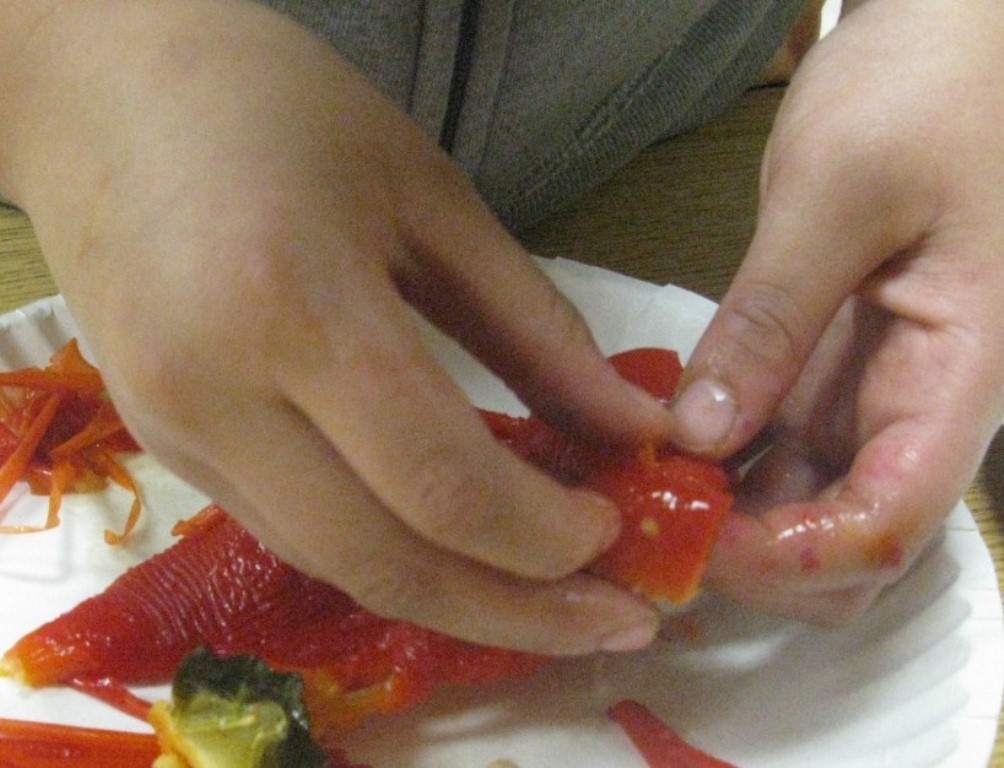
Peeling roasted pepper for tapas

By Ed Bruske

aka The Slow Cook

Every Mediterranean culture seems to have some sort of treatment combining onion, eggplant and bell pepper. In France it's called ratatouille. Others call it tapenade. In Spain, they serve a tapas dish made of roasted vegetables tossed with olive oil, thyme and parsley. I found a recipe calling for this aromatic mix to be spooned over slices of raw zucchini. What could possibly be simpler, tastier or more healthful?

Making tapas is so much fun, I'm thinking our food appreciation classes might just linger here in Spain on our virtual world culinary tour. In fact, I'm beginning to get the idea that our spring parents dinner might just consist of a tapas bar. If that's the case, we're going to need a few more weeks to perfect our tapas making skills. There are so many different possibilities to choose from. My wife and I had such a great time recently in Barcelona exploring the local tapas bars. I think we can have fun with it in our cooking classes.

This dish couldn't be much simpler, but it does require quite a bit of vegetable prep work--the perfect thing to keep a group of kids busy. They love messing around with vegetable peelers and chopping things with real knives. This recipe also involves peeling the skin off roasted bell peppers, something many of them had never experienced before.

To make a generous, family-sized portion of these canapes, peel 1/2 of a small eggplant and cut it into 1/2-inch slices. Place these on a baking sheet lined with parchment paper. Follow with 1/2 red bell pepper, 1/2 green bell pepper and 1 medium onion, peeled, cut in half lengthwise, then sliced into 1/2-inch half-moons. Place in a 350-degree oven and roast about 60 minutes, or until the peppers are blistered, the onion is beginning to brown around the edges and the eggplant are cooked through.

Remove the vegetables from the oven and set them aside to cool. Meanwhile, finely chop a small fistful of parsley leaves and remove the leaves from several stems of fresh thyme (or use about 1/4 teaspoon dried thyme).

When the vegetables are cool enough to handle, chop them well, but not too fine. Place them in a bowl and stir in the parsley and thyme. Squeeze in about 1 tablespoon juice from a fresh lemon, then season with just enough extra-virgin olive oil to coat everything, some salt and freshly ground black pepper. Stir well to mix.

Here's one way to get kids to eat vegetables

To serve, cut a Zucchini on an angle into slices about 1/4-inch thick--perhaps a bit thinner, but thick enough to hold the roasted vegetables without collapsing. Then spoon the vegetables onto the zucchini slices and present them on a decorative platter.

This is one way to get kids to eat their vegetables. I was surprised how much they liked it. You just never know what kids will go for. But I think these tapas are too beautiful to resist. In fact, in our "open enrollment" class where we get kids of all ages--and quite a large number of them--what we did was line the kids line up behind the bowl of vegetables, gave them a spoon and the sliced zucchini and let them make their own tapas. I've never seen such a patient, determined and focused group of kids around food. Most of them took two.