Showing posts with label spinach. Show all posts

Friday, June 10, 2011

What's for Lunch: Uneaten Tilapia

By Ed Bruske
aka The Slow Cook

D.C. schools lately have been serving tilapia on Thursdays on a fairly regular basis. You might think that's a great thing. Fish is a clean, lean source of protein and exposes children to something different from the usual routine of chicken nuggets and mac-n'-cheese.

But while fish looks great on the menu, it doesn't go over so well in the cafeteria--at least not at my daughter's elementary school in Northwest Washington. Yesterday I was careful to wait until most of the kids had eaten, then I took a slow walk around the lunch room. I saw only three kids who had actually eaten the tilapia. A couple others had poked at it.

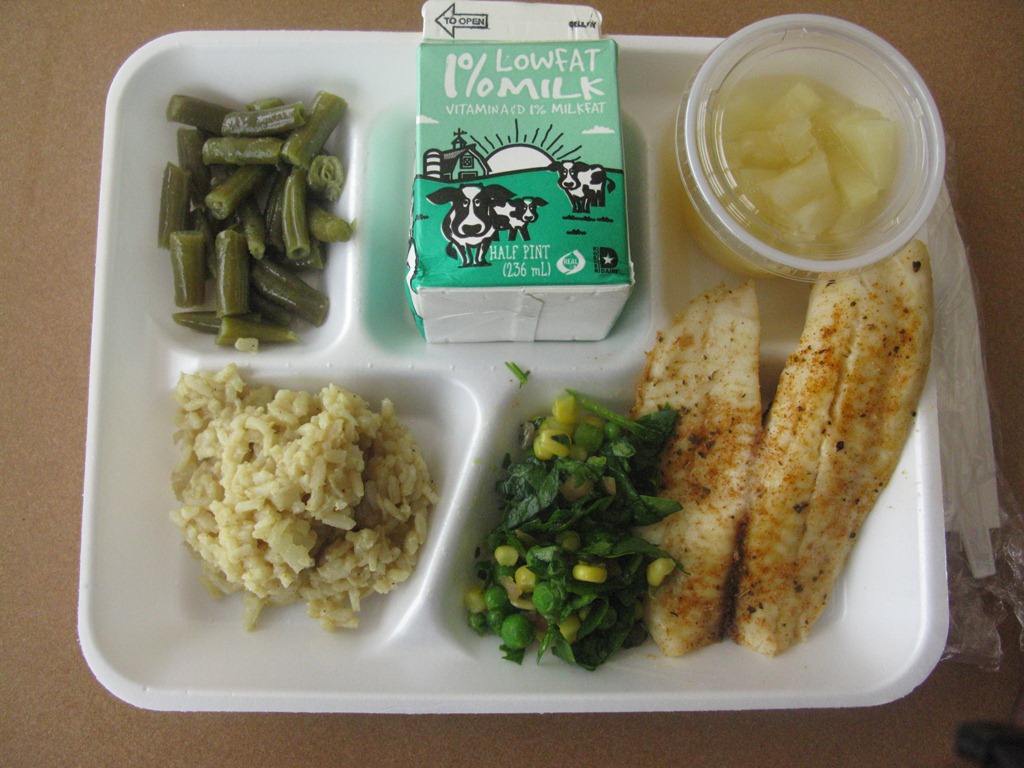
Most of the trays looked like this one. As you can see, the fish hasn't been touched at all. Nor was the featured vegetable side dish, the "crunchy spinach," as Chartwells calls it, a mix of frozen spinach, corn, peas and sunflower seeds. It's a clever combination of vegetables--whoever thought of it deserves a hat tip. But the kids don't eat it.

What did they eat from this meal? From what I saw, this tray was pretty typical. The kids dove into the roasted potatoes and the whole wheat biscuit. In other words, they gobbled up the starch.

Kids love potatoes, of course. It's their second favorite food after pizza. And now there's a controversy around spuds because the new meal guidelines the USDA has proposed would limit servings of potatoes and other starchy vegetables--corn, peas, lima beans--to just one cup per week in favor of more green and orange vegetables that kids are much less fond of.

They also loved the watermelon. And what's not to like about that? I tasted the watermelon and it was delicious. So much of the fruit served in school isn't nearly ripe, but this watermelon was. This was a real treat.

The lesson I draw from all this is that menu changes don't mean nearly as much as what actually takes place in the cafeteria. You can put "healthier" foods in front of kids every day and still they'll only eat what they want and throw the rest in the trash.

I shudder to think how much uneaten tilapia D.C. schools sent to the landfill yesterday.

Thursday, April 14, 2011

What's for Lunch: Tilapia!

By Ed Bruske
aka The Slow Cook

Look! Clean fish fillets being served in D.C. Schools!

This tilapia with a bit of Cajun seasoning makes a beautiful tray, no? Next to it is something else I that seems very new" "crunchy spinach," which means frozen spinach mixed with corn, bits of green pepper and sunflower seeds.

Who do you suppose cooked up that recipe?

Here's a what the kids saw when they came through the food line.

And here's what the "crunchy spinach" looked like in its hotel pan.

Okay, now for the bad news: As great as this meal looked, most of the kids in the lunchroom with my 11-year-old daughter didn't eat it.

To be more precise, I'd say about half of them at least tried the tilapia, and some of those were wolfing it down. "The ones who are eating it say it's the best thing ever," said one of the teachers who was monitoring things.

They also ate the canned pears and poked at the rice. But forget about those green beans and the "crunchy spinach." They wouldn't touch it. I tried the spinach. As much as I liked the concept, it was too cold. Almost frozen. Kids don't like spinach in general, and they seem to be really put off by exceptionally cold vegetables.

The tilapia fillets arrive frozen and are heated fairly easily. I wonder how the cost compares to other entrees the schools serve, especially the processed ones like those phony "grilled" chicken patties.

Saturday, April 2, 2011

More Tapas: Kids Make Spinach & Chickpeas

Using the big knife on cooked spinach

By Ed Bruske

aka The Slow Cook

I might not have believed it if I hadn't seen it myself: kids digging into spinach, as in the classic Spanish tapas dish of spinach and chickpeas.

I'm just guessing, but perhaps what stimulated their appetites was the aroma of bread and garlic browning together in olive oil. Or maybe it was all those herbs and spices: thyme, oregano, rosemary, paprika, cumin.

In any case, I am making a mental note of this dish as one that demonstrates how eagerly children will embrace vegetables when they are prepared with some creativity. It also helps to be in a fairly small class setting, where the kids get to do all kinds of prep work with their hands, like pulling tough stems off the spinach leaves, cutting the crusts off bread, chopping cooked spinach and mixing all those herbs and spices.

No tapas menu would be complete without some sort of pairing of spinach and chickpeas and this one is especially aromatic. Start by removing the tough stems from 10 ounces of fresh spinach leaves (I suppose you could use frozen spinach if you had to), then wash the spinach in a colander and shake off the excess water. Slide the still-moist spinach leaves into a heavy skillet over moderate heat, cover, and steam the spinach until it is cooked through and tender, about 5 minutes. Remove the spinach to a cutting board, chop fine and set aside.

Turning bread and garlic into a paste

Meanwhile, remove the crust from a thin slice of rustic bread--1 or 2 ounces worth. Smash two large cloves of garlic and remove the skin. Place the bread and garlic in a skillet generously greased with extra virgin olive oil and cook over moderate heat until the bread and garlic are golden brown, turning as needed. Place the garlic and bread in a mortar and season with 1/2 teaspoon white wine vinegar. Pound into a rough paste. Alternatively, chop the bread and garlic fine on a cutting board as we did and smash it together with the side of a chef's knife. (You could also do this in a food processor.)

In a bowl, mix the chopped spinach with the bread paste and add 3/4 cup cooked chickpeas (or 1/2 14-ounce can chickpeas).

In a separate bowl, mix together 1/4 teaspoon paprika, 1/4 teaspoon ground cumin, 1/4 teaspoons dried thyme (or 1 teaspoon fresh thyme leaves), 1/4 teaspoon dried oregano (or 1 teaspoon minced fresh oregano leaves), 1 teaspoon finely chopped rosemary leaves. Stir this into the spinach mix and season with salt and red pepper flakes to taste. Scrape the finished vegetables into a hot skillet greased with 1 tablespoon extra-virgin olive oil, reduce heat, cover and cook gently for a few minutes until heated through.

Add more olive oil as needed to make the vegetables smile, then serve warm or at room temperature.

Friday, March 11, 2011

What's for Lunch: Chicken Florentine?

By Ed Bruske
aka The Slow Cook

Here's another example of some of the clever new options we're seeing on the menu in D.C. schools this year. Someone thought to take a piece of flat bread and cover it with "chicken Florentine."

Where I come from, "chicken Florentine" means sauteed chicken tossed with spinach and a wine-infused cream sauce. This was a bit more like a pizza (kids love pizza, as we know). I tried it and did not taste any cream or wine, although it was perfectly palatable--more a mouthful of spinach with a bit of onion and some scattered pieces of diced chicken, all topped with some melted cheese.

The kids, on the other hand, looked at it and were completely intimidated by all that spinach.


This looked like a repeat of the homemade spinach lasagna experience we've seen before, where kids assiduously work their way around the spinach to get at the pasta and the cheese. In the case of this chicken Florentine, I was surprised to see that most of the kids in the lunch room never touched it.

Just to make sure, I took a walk around the lunch room and, sure enough, the entree in most cases was entirely uneaten. Some of the children--we're talking elementary school kids in the upper grades--were tentatively nibbling on the flat bread around the edges. Others, like this girl here, were a bit more bold. They had scraped all the spinach off the flat bread, then attacked the bread and picked through the green matter to get at the cheese and chicken bits.

On the tray also were some carrot sticks tossed in ranch dressing that were definitely more popular. Many of the kids also had sampled the peas. But just a note here on that: peas are one of those "starchy vegetables," along with potatoes, corn and lima beans, that the USDA proposes in new meal guidelines to sharply limit in the future.

The federal government would like to serve kids much bigger portions of things they don't normally like--vegetables and whole grains--and take away things kids really love, like potatoes (especially French fries). Sound like a winning formula?

Thursday, January 27, 2011

What's for Lunch: Homemade Lasagna--Hold the Spinach

By Ed Bruske
aka The Slow Cook

Behold the beautiful lasagna "homemade" in the kitchen of my daughter's elementary school here in the District of Columbia by the kitchen manager, affectionately referred to as "Mrs. G."

"Mrs. G" has been working in school kitchens for 23 years and does know a thing or two about making food from scratch, even though that definitely has not been the drill in D.C. schools in recent memory. Since Chartwells took over food service three years ago, she now works for Chartwells.

The lasagna was introduced this year. Lately, I have been eating the food myself. I haven't dared before--there are just too many carbs in school food for me. But in addition to recording what the food looks like and how the kids react to it, I thought it was high time I knew how it tasted as well.

I can now announce: the lasagna is divine. Okay, it's not the lasagna with bechamel sauce I would make at home. This lasagna calls for frozen spinach, prepared tomato sauce, no-boil noodles and commercially grated mozzarella cheese. Still, a superb effort I would say.

The peas, lightly cooked from the frozen state, also were delicious, as was the Caesar salad. It even came with little croutons. The dressing, I'm told, was a "light Italian," not really Caesar. Still, it was dusted with Parmesan cheese.

I can't vouch for the food service all of D.C.'s schools are getting from Chartwells. I'm limited to visiting my daughter's school, and they may be making a special effort there because they read this blog. But some days I am impressed by what the kids are seeing on their trays.

Then I noticed my daughter doing something odd with her spork. She was picking up pieces of the lasagna noodles and scraping at them. Then I realized: she was scraping away all the spinach.

Some adults have this fantasy that if we just give kids real vegetables, they will light up like Christmas trees and eat healthfully ever after. Obviously, adults don't' understand the lengths some kids will go to avoid vegetables and other "healthy" foods.

This reminds me of the story my daughter told last year about what the kids did with the raw cucumber slices that were delivered to their classes as snacks: They liked to stomp on the bags of cukes and "turn them into slush."


.
After picking out as much of the noddles and cheese as she could, this was the heap of spinach my daughter left on her tray. "It was just too much spinach," she told me later.

Some of the kids--not many--ate the peas and the salad. But most of this, unfortunately, also wound up in the trash. The U.S. Department of Agriculture is proposing to sharply curtail the use of green peas, potatoes, corn and other "starchy vegetables" in favor of more dark green, orange and red vegetables.

That would mean the sweet potatoes the kids didn't eat on Monday I suppose.

Tuesday, August 24, 2010

Yesterday's Lunch: Teryaki Chicken

By Ed Bruske
aka The Slow Cook

I hate to miss a school meal, especially the first one of the year when D.C. food service staff are pushing to make improvements. But I could not be in the cafeteria yesterday. I did, however, manage to find out what was in the teryaki chicken Chartwells served.

That would be the "fully cooked, coated" eight-piece, bone-in chicken from Tyson. According to the packing label, these are the ingredients, besides the chicken: Water, seasoning (salt, hydrolyzed corn protein, extrose, onion powder, autolyzed yeast extract, garlic powder, soybean oil, spice extract), sodium phophates.

And the chicken was "coated with": Water, coating (modified corn starch, tapioca dextrin, dried whey, soy protein isolate, sodium alginate, caramel (color), sodium tripolyphosphate, methylcellulose, guar gum).

The cooking instructions call for 10 to 15 minutes in a 375-degree convection oven from the frozen state.

Also on the menu was a "whole wheat roll," a "crunchy" spinach salad, "orange glazed" carrots and "locally grown" watermelon. Under the "Healthy School Act" passed earlier this year by the D.C. Council, the schools receive an extra five cents for every lunch that includes a locally grown component, meaning from within the Mid-Atlantic region.

The spinach, on the other hand, came from a place called The Salad Farm in Salinas, Calif. That business is actually a complex of growers and processors that harvest crops in both California and Arizona. The history, starting with a man named Lex Camany, who worked in lettuce fields to make money for college, is worth a read. At one point, Camany conducted agricultural research for the Mexican government. Then he started a strawberry department at Hartnell College.

So many American success stories touch the federal school meals program.

Wednesday, May 12, 2010

Wilting Spinach at Washington Youth Garden

By Ed Bruske
aka The Slow Cook

The Washington Youth Garden, located at the National Arboretum here in the District of Columbia, does some wonderful work reaching out to local schools with science, cooking and gardening instruction. It's very much like the Edible Schoolyard that Alice Waters started in Berkeley, CA, except that in addition to the actual gardens and programs that take place there, Youth Garden instructors travel to teach classes in city schoolrooms as well.

Yesterday, one of those classes was invited to the garden for a cooking demonstration with me as the guest chef. Keep in mind, this is all happening al fresco, under the shade of a huge tree, except that it was cold and cloudy and threatening to rain the whole time. The Youth Garden has a propane stove to cook on and a few rudimentary tools. I brought along my big, iron wok and a plan to show the kids how to wilt spinach.

I wasn't sure exactly what was growing in the garden. So I brought along plenty of supermarket spinach--enough to feed 25 curious kids and their teachers.

First we had some fun washing the spinach with the hose and spinning it dry. The kids took turns. They love doing things like spraying water and handling the salad spinner.

Next we cooked some minced garlic at the bottom of the wok with extra-virgin olive oil. Then add lots of spinach leaves. This is why I love to use the wok. It holds lots of greens. I showed the kids how to press the spinach leaves down with their hands to make good contact with the hot oil. Then they took turns turning the spinach and garlic.

We improvised a lid using a metal bowl. That helped the spinach cook faster. Then we drained it out of the wok and dressed it with a little more olive oil, some salt, and a drizzle of balsamic vinegar.

Do I need to tell you how much they loved the spinach? They were crying for second and third helpings.

They also got to pick a little spinach before it started to rain and forced them back on their bus.

Kids love to pick vegetables. Does that make them better vegetable eaters? The teacher said they're crazy for the salad bar they have at school. I'd like to see that.