Showing posts with label Sweden. Show all posts

Friday, November 18, 2011

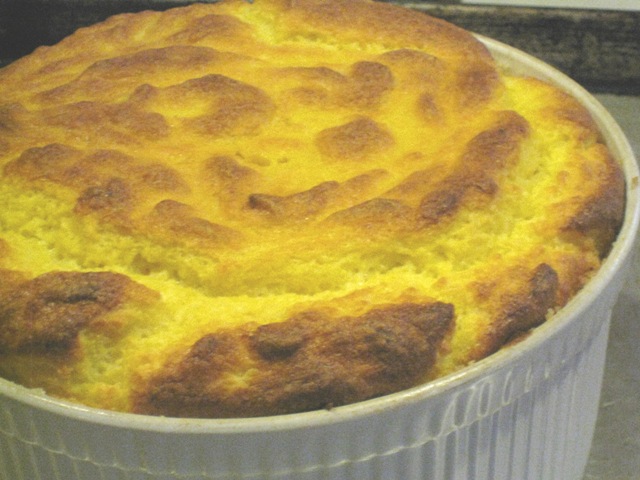
Kids Make Rutabaga Souffle


The lowly rutabaga, transformed

By Ed Bruske

aka The Slow Cook

This was the last week in Scandinavia for my food appreciation classes on our virtual world culinary tour. We couldn't very well leave without sampling one of the Nordic region's favorite vegetables: rutabaga.

I know what you're thinking: Rutabaga! Yuck! This underground cousin of cabbage and kale is so closely associated with Swedish tastes that it's often called "swede." I happen to like it--especially home-grown rutabaga--but a survey of rutabaga recipes online left me cold. I wanted the kids to try something a little more inspiring than the usual root vegetable casserole or rutabaga-potato mash.

Then I remembered one of our favorite preparations, from an old Gourmet magazine article: rutabaga souffle. This 20-year-old article that I've saved in my recipe files describes several ways to elevate the lowly rutabaga into something sublime. Rutabaga souffle makes an elegant--and delicious--side dish.

Truly, you can turn almost anything into a souffle. It's just a matter of transforming your base ingredient into something you can fold into egg whites. The basic steps are cooking the rutabaga and grinding it into a paste; mixing that into a sauce made with a basic roux and some of the rutabaga cooking liquid; flavoring with cheddar cheese and fortifying with egg yolks; then finally folding the mix into egg whites and baking in the oven.

When you break it down into these steps, it's really not so complicated. But it is a bit of a workout in a classroom situation, especially if you have to run back and forth from the prep table where the kids are working and the stove at the other end of the room. That's why I've started using my portable butane burner more and more for our classes: I can cook right on the prep table where the kids can see what's happening. Not only can they see what's in the pot, but they can take turns stirring, something they love to do.

There's plenty for the kids to do to make this souffle. They get to peel the rutabaga. (Most had no idea what it was, but several surprisingly guessed the connection with cabbage from the aroma.) There's the grinding of the cooked rutabaga in a food mill, the cracking and separating of eggs (always fun, because they get to separate eggs in their bare hands). There's the stirring of the roux and the mixing of the sauce, the beating of the egg whites and the folding of the final ingredients. And seeing the finished souffle emerge from the oven with its glorious brown top is a show-stopper.

Here's how to do it. First, peel 1 pound of rutabaga and cut into 1-inch cubes. Cover these with water in a saucepan, season liberally with salt and cook, covered, until the rutabaga is quite soft, about 30 minutes. Drain the rutabaga but reserve the cooking liquid.

Meanwhile, in a separate saucepan start a roux by melting 4 tablespoons (1/2 stick) butter. Add 1/4 all-purpose flour, stir and cook over moderate heat, stirring continuously, for a couple of minutes. You don't want to brown the flour, just cook it a thoroughly. Add 1 1/2 cups of the rutabaga cooking liquid and continue stirring. You might want to raise the heat at this point as flour won't fully thicken until it reaches the boiling point.

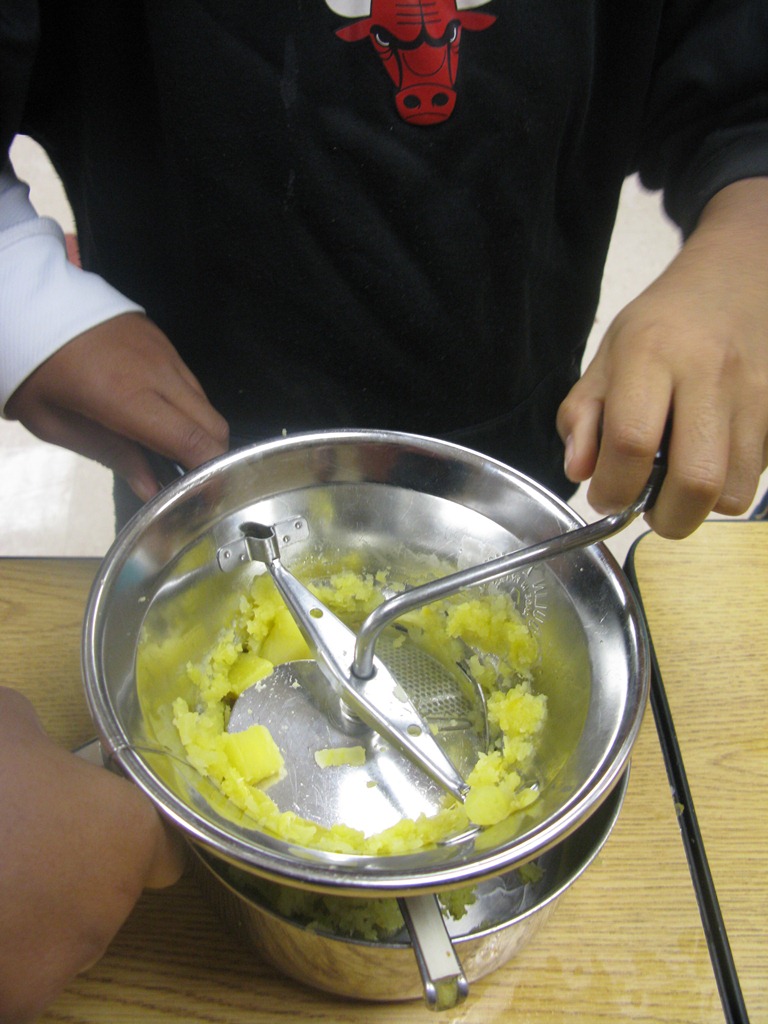
After two or three minutes, you will have a thick sauce. You can now add 6 ounces grated cheddar cheese. (My wife, the professional cook, suggests half cheddar and half Gruyere for more depth of flavor). Stir until the cheese has melted and is completely incorporated. Remove the pan from the heat and add your cooked rutabaga ground fine either in a food processor or in a food mill. We do everything by hand in our classes--no electric gadgets--so we used a food mill for this. Just as well, as it gives the kids something to do with an appliance they find utterly fascinating.


Rutabaga in the food mill

Separate 6 eggs. Stir the yolks into the rutabaga mix. In a large mixing bowl, beat the egg white to stiff peaks. You can add 1/4 teaspoon cream of tartar to the whites if you have it. This chemical--potassium hydrogen tartrate--is an acid salt that helps give egg whites more volume and stiffness. Again, we do the beating by hand with a wire whisk, but feel free to use an electric mixer. Just don't go overboard or your stiff peaks will start to get grainy.

Stir about 1/4 of the whites into the rutabaga mix, then pour the mix into the bowl with the beaten whites and gently fold everything together with a rubber spatula. Folding is an acquired skill in our classes. We monitor the kids closely so they are stirring or beating the mix. You're trying to maintain the air in the egg whites--that's where "souffle" gets its name, from the French word for "breathe."

When everything is incorporated, pour the mix into a greased, standard-size souffle bowl fitted with an aluminum collar, also greased. (You can grease with butter. We used a cooking spray.) This collar is made from a sheet of aluminum foil cut large enough to completely encircle the souffle bowl. You can fasten it in place with a piece of butcher's twine, but I found it just as easy (and more convenient) to just hold the two ends of the foil together with a large paper clip. The idea is to contain the souffle when it rises up over the top of the souffle bowl. You'll see: the final mix will come up to the top of the bowl, and if you've done your job well with those egg whites, it will rise from there.

Place the bowl on a baking sheet and then in a 400-degree oven for about 60 minutes, or until the top is deep golden brown and the souffle firm. Don't worry--souffles are not all that fragile. It won't collapse if you open the oven door to take a peak. You'll know it's done when the souffle is puffed and no longer sloshing around in the bowl.

To serve, dig a spoon through the crust all the way to the bottom of the dish. You want everyone to see some of that glorious crust on their plate.

As for the seasoning of your souffle, be your own judge. It does pick up quite a bit of salt from the rutabaga cooking liquid and from the cheese. You can add more when you are mixing the base ingredients. But taste it first.

This is one lesson that left me exhausted, but the kids stayed busy and they had a great time. In fact, I would rate this as one of our all-time best cooking lessons.

Friday, November 11, 2011

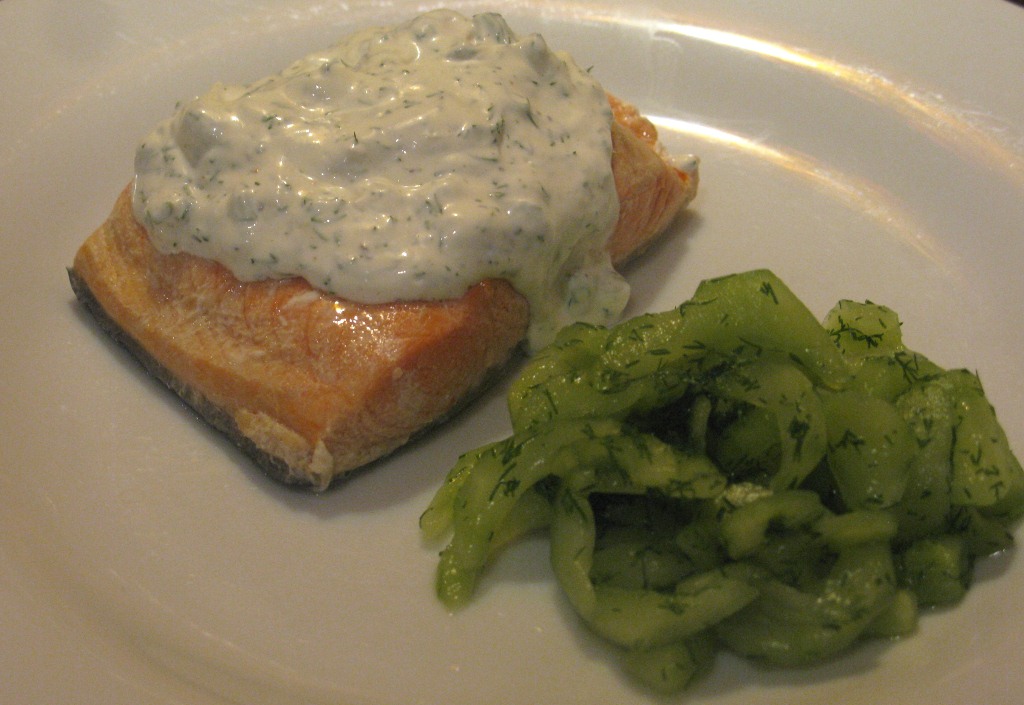
Kids Make Poached Salmon with Dill Sauce and Cucumber Salad


No skimping on the dill

By Ed Bruske

aka The Slow Cook

It's not always easy getting kids to eat fish. Some automatically gag at the very aroma of seafood--even when it doesn't smell at all. But the kids in my food appreciation classes adored the poached salmon we made this week, especially when it was smothered in a creamy dill sauce. (Some requested it without the sauce, and I have to admit the really little kids--pre-K and Kindergarteners, were not entirely enthusiastic.)

We're still in Scandinavia and I was inspired by a recent "Nordic Day" in D.C. Public Schools sponsored by various embassies. The Norwegian embassy, for instance, flew in 10,000 pounds of salmon for the event. Salmon and dill go naturally together, as do cucumber and dill, completing our meal with a classic Scandinavian salad.

Poaching is one of my favorite cooking methods for fish. It's so gentle and results in the most tender and moist salmon with the essential flavor of the fish intact. Plus, we can easily set up a skillet with poaching liquid on our portable gas burner so that the children can actually watch the fish cook in front of them on our prep table.

Salmon also is rich in heart-health Omega-3 fatty acids.

But you may want to start with the cucumber salad. The flavors need time to meld, and you can easily make it hours or even a day ahead and refrigerate it. Peel three large cucumbers, then slice them in half lengthwise. Use a teaspoon (or even better, a grapefruit spoon) to scoop out the seeds. Cut the cucumbers into thin crescents and toss these with 1 1/2 teaspoons kosher salt in a colander. Set the colander in a pan and allow the cucumbers to drain for 1 or 2 hours. Use your hands to squeeze more liquid out of the cucumbers.

In a mixing bowl, combine 1/3 cup white vinegar, 2 tablespoons cider vineagar and granulated sugar to taste (about 1/4 cup). The finished dressing should be sweet and sour. Stir until the sugar is dissolved, then add 1 tablespoon chopped fresh dill. Toss the cucumbers in the dressing and serve.

Likewise, make the dill sauce ahead so the flavors have a chance to develop. It's easy. Simply mix together 1/4 cup mayonnaise, 1/4 cup sour cream, 2 scallions, thinly sliced, the juice from 1/2 lemon, 1 tablespoon chopped fresh dill and salt and pepper to taste. You can keep it in the fridge until it's needed.

To make the poaching liquid for the salmon, peel 1/2 onion and cut into thin slices. Toss this into a medium saucepan along with 1 small carrot, peeled and sliced into thin rounds, 1 small celery stalk, thinly sliced, 4 sprigs thyme, 2 sprigs parsley, 1 generous piece lemon peel and 3/4 teaspoon salt. Cover this with 5 cups water, bring almost to a boil, then reduce heat and simmer for 20 minutes. Strain the liquid and discard the vegetables. (You can use 3/4 cups dry white wine, such as Sauvignon Blanc, and reduce the amount of water, but I chose not to bring wine to school.)

To poach the salmon, use individual 6-ounce fillets. If possible, choose wild-caught Alaska salmon rather than farmed salmon. For environmental reasons, ocean scientists continue to discourage the consumption of farmed salmon. But most salmon sold in stores--typically labeled "Atlantic salmon"--is farmed. To find wild caught salmon, you must seek it out. It usually comes from Alaska.

Place the fillets in a heavy skillet and cover with the finished poaching liquid. Bring the liquid almost to a boil (200 degrees, as measured with an instant-read thermometer), then reduce heat and simmer until the fish is just cooked through.

This is always the hardest part poaching fish--deciding when it's done. I've found the easiest way is to insert the point of paring knife into the middle of a fillet at its thicket point. Wait 5 seconds, then press the knife tip to your lower lip. It should feel very warm, but not hot.

Use a spatula to remove the fish immediately from the pan. You can serve it warm, or chilled. with a big dollop of dill sauce and cucumber salad on the side.

Sunday, October 30, 2011

Swedish-U.S. Farm to School Meetup


Annika Unt Widell, left, with Andrea Northup
By Ed Bruske
aka The Slow Cook

As part of "Nordic Week" in D.C. Public Schools, one of the people I met on my recent fact-finding mission to Sweden was here in the District of Columbia. Annika Unt Widell, spokeswoman for better school food in Sweden, had flown here to mentor Swedish students who had competed for a chance to take part in food preparation for "Nordic Week."

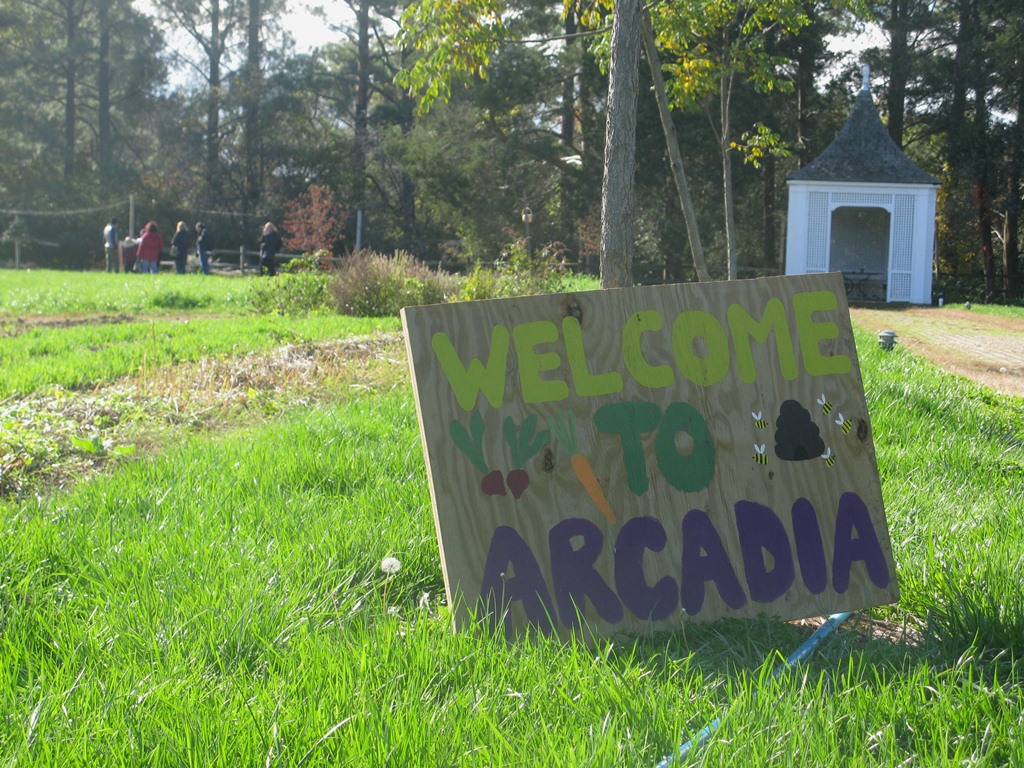
I wish some of my friends in D.C. schools had thought to invite me for all the work that went on behind the scenes--rolling thousands of Swedish meatballs and preparing some 10,000 pounds of Norwegian salmon for Wednesday's lunch. Annika was anxious to see our farm to school program in action, so on Friday I drove with her to the Arcadia Farm at Woodlawn Plantation. In the photo above, she's conferring with another hero of the school food movement--Andrea Northup--whose brilliant idea it was to form the D.C. Farm to School Network.


A garden for kids at Woodlawn Plantation

Andrea created the farm to school network two years ago after graduating from college. The idea sparked a movement, drawing hundreds of supporters, including many of the city's non-profits involved in agricultural issues and food access and hordes of chefs anxious to get involved in efforts to improve local school food. My own involvement was accidental: I met Andrea while catering a reception for the D.C. Schoolyard Greening organization and wound up on the network's advisory board. But Andrea doesn't need much advice. She's made this idea work mostly on her own, including finding grant money to fuel the project.

Andrea originally found a home for the network at the Capitol Area Food Bank in northeast D.C. But this year she struck up a partnership with a local restaurant business called Neighborhood Restaurant Group and its foundation arm, Arcadia. They struck a deal with the National Trust for Historic Preservation to start a children's garden at Woodlawn Plantation, a property once owned by George Washington and located just a few miles from Mount Vernon in suburban Virginia. It's called Arcadia Center for Sustainable Food and Agriculture, "dedicated to creating a more equitable and sustainable food system and culture in the Washington, DC area and a collaborative space for the many local efforts and initiatives around better food."

The garden and the staff who tend it now host regular visits from D.C. school children. The D.C. Farm to School Network at Arcadia also retrofitted a bio-diesel-fueled school bus to take garden plants and fresh produce to D.C. schools--a kind of garden on wheels.


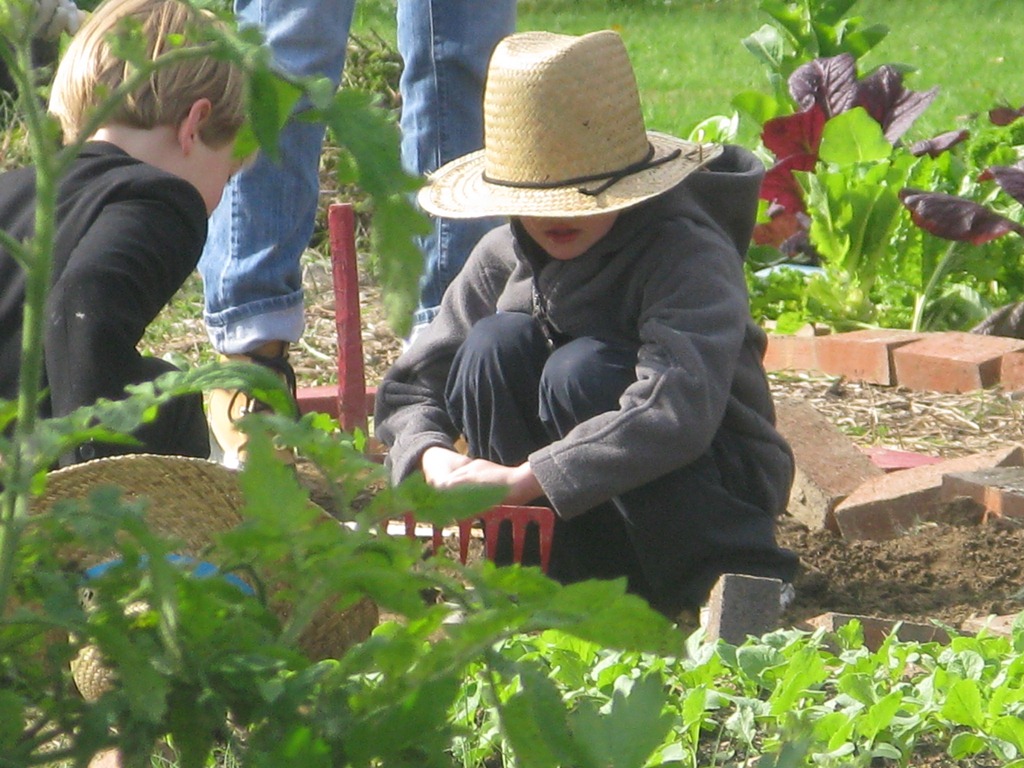
Kids love to dig in the garden

On Friday, the garden was hosting a group of children from the private Lab School. Among the organized activities, kids learn about butterflies and how salads grow. But I think their favorite part is just running around and digging in the dirt with rakes. There are plenty of herbs for kids to touch and smell. Straw hats provided by the garden give the kids a real professional gardener look.


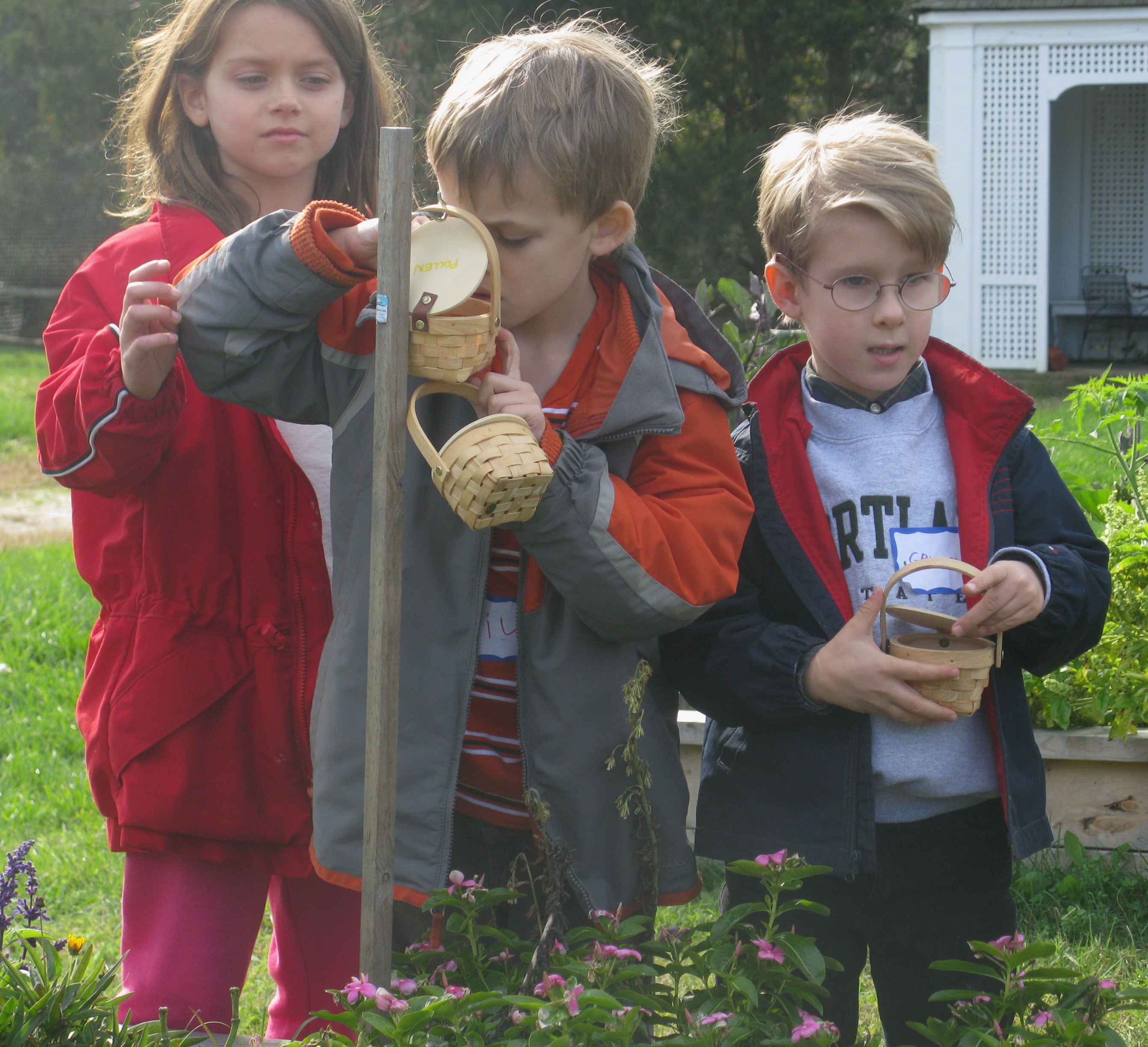
Kids posing as bees deliver pollen

To demonstrate how plants depend on bees and other insects for pollination, the kids get little baskets filled with colored balls of cotton. Their job is to fly around the garden and deposit the "pollen" in baskets hanging from strategically planted wooden posts.

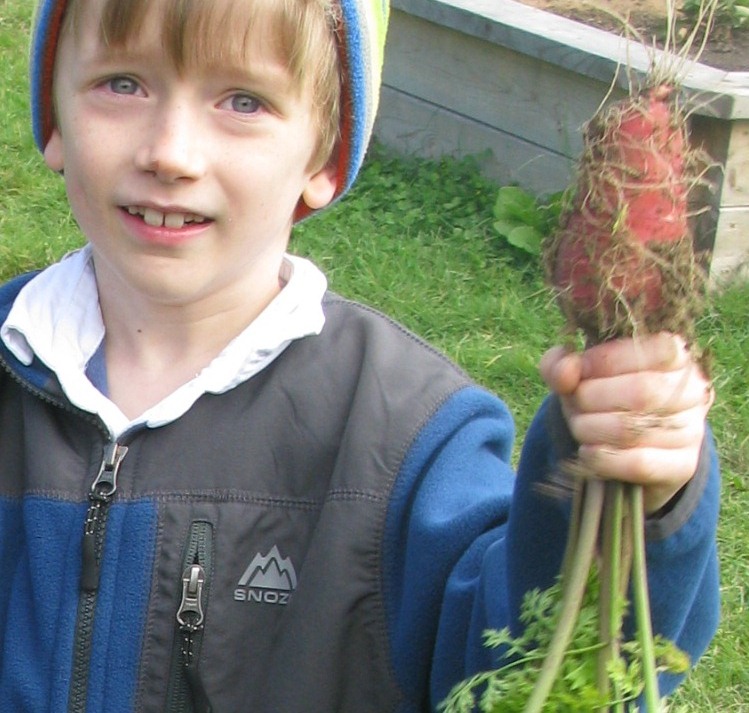
Finally it was time for the children to get a lesson in harvesting greens and vegetables for a salad. They don't need much instruction before they are racing from one raised bed to the next, plucking leaves of lettuce and mustard greens and yanking jumbo-sized carrots out of the soil.


Catch of the day: carrots

My job was to peel and chop carrots and one giant beet for a salad bar. The garden has it's own weather-proof salad bar in the outdoor "kitchen" and eating area. The kids would also get a demonstration in salad and vinaigrette making from a professional chef, before having their turn at the salad bar.


A 7-year-old who knows his salad

We couldn't stay for lunch. Annika had to get back to her hotel and prepare for the flight back to Sweden. But I know she was impressed. They may have universal free school lunches in Sweden, but the farm to school concept has yet to catch fire. Schools there simply don't have the funds to transport children to farms on a regular basis. And that's part of the attraction of Arcadia: it's closer to city schools than any traditional farm, and you don't have to find a farmer willing to take visitors.

"I'll always remember this day," Annika said.

Friday, October 28, 2011

Kids Make Swedish Split Pea Soup and Pancakes


Sour cream of lingonberry jam on your pancake?

By Ed Bruske

aka The Slow Cook

If it's Thursday, it must be split pea soup and pancakes with lingonberry jam. At least that's the custom in Sweden where our food appreciation classes happen to be visiting on their virtual world culinary tour.

Concidentally, this was happening at the same time D.C. Public Schools were celebrating Nordic day, with traditional foods being supplied by the embassies of Iceland, Norway, Denmark, Sweden and Finland.

The split pea soup I remember from childhood was thick as mud and full of little bits of gelatinous fat from the ham bone that was cooked in it. The soup we made is over-the-top delicious. Still, it's not especially pretty, except for the bits of carrot (not fat) swimming around in it, and getting the kids to eat it takes a bit of cajoling. But once they find out how good it tastes, they come back for more. And it's such an inexpensive way to make a family meal, even if you just serve bread on the side instead of the pancakes.

Why pancakes with split pea soup? Frankly, I don't know. I guess you'd have to ask the Swedes. It's a bit like dessert--especially if your stuff your pancake with jam. The pancakes are bit more like eggy crepes than the thick, floury pancakes we're used to here. Personally, I like the combination of sour cream and lingonberry jam on mine.

The Swedes are especially proud of their berries, which thrive during the long, northerly days in summer. Lingonberries are a bit tart, like cranberries, which makes for an interesting jam. I was surprised to find it at our local Harris Teeter's. But then my wife brought some home from a shopping trip to Ikea, the Swedish furnishings store, and it was $2 cheaper. It's rather a long way to drive for jam, though.

Make the soup a day ahead so the flavors have a chance to develop. Start by place 1 pound dried yellow peas (we got ours from the bulk section at Whole Foods), 2 onions peeled and finely chopped and 2 carrots peeled and finely chopped in a stock pot and cover with 8 cups water. Add 1 onion studded with two cloves and 2 ham hocks. Bring to a boil, then cover, reduce heat and cook slowly for 3 hours. Remove the onion with cloves and the ham hocks. If there's any meat on the hocks, you can chop it up and add it to the soup if you like. Season with salt and pepper to taste.

About 30 minutes before serving, bring the soup back to a simmer and stir in 1 teaspoon dried thyme leaves and 1 teaspoon ground ginger.

The pancakes can also be made ahead and held warm in the oven. This recipe makes about 2 dozen, each about 4 inches across. You can make the batter in a blender or a food processor, but we don't use electric gadgets in our classes. We simply whisked it together by hand. I think the kids get a better feel for the ingredients and the food preparation process working this way.

In a large mixing bowl, whisk until frothy three eggs. Mix in 1 1/2 cups milk, then add 1 cup flour, 1 tablespoon granulated sugar and finally 3 tablespoons melted butter. Continue whisking vigorously until the batter is perfectly smooth, without and lumps.

Over moderate heat, melt some butter in a small, well-cured or non-stick skillet. Pour in some pancake batter. You can make the pancakes as small or as large as you like. When the underside has lightly browned and the top is nearly dry, use an inverted spatula to flip the pancake onto the other side. Cook for about 30 seconds and remove. Repeat this process until all of the batter has been used.

Serve with sour cream and lingonberry jam.

Friday, October 21, 2011

Nordic Love: Kids Make Swedish Meatballs


Best meatballs in 1 hour

By Ed Bruske

aka The Slow Cook

Just in time for the "Nordic Day" festivities in D.C. Public Schools next week, my food appreciation classes arrived in Scandinavia on our virtual world food tour and made the best meatballs you've ever tasted from scratch--including fresh bread crumbs and white sauce--in less than an hour.

It helps to have a portable burner to make the sauce at the prep table. Otherwise, the stove is about 30 paces away, and running back and forth gets tired after a while. The kids love pulling the bread apart for the crumbs, mixing the beef with the toasted crumbs, onions, eggs and other ingredients, then rolling the mix into balls. Nobody refuses the finished meatballs either. The only question at that point is, do you take them with or without the white sauce? And how about the lingonberry jam?

I tried to explain to the kids that the Swedes like their sweet and savory combinations and that lingonberries are a big deal in the land of the midnight sun. Not all were convinced. Still, I was delighted to find authentic Swedish lingonberry preserves amongst the other jams right next to the peanut butter display at my local Harris Teeter's.

Most Nordic countries have a traditional meatball recipe and there are any number of ways to sauce it. I thought the white sauce was easiest for the time we have allotted for our classes. It makes a good lesson in basic sauce construction.

Start with the fresh bread crumbs. And by all means make them fresh--the stuff in the cans won't due. Use about three thick slices of a country-style loaf (I chose a Tuscan round). Remove the crust and chop the white part fairly fine. Spread on a baking sheet and toast lightly in a 450 degree oven. Set aside to cool.

Meanwhile, in a mixing bowl beat 2 eggs. Add 1 small onion, minced, and 1 1/2 pounds (or a little less) ground beef. Add bread crumbs and mix well, seasoning to taste with salt, black pepper and a generous pinch of ground nutmeg. You would do well to work the mix for a few seconds with your hands. Kids love squishing it between their fingers.

Use a measuring spoon to scoop out heaping tablespoons of meat mix. Roll these into balls and place on a baking sheet lined with parchment paper, leaving a little space around each meatball. Place in the 450-degree oven and bake until lightly browned and cooked through, 10 to 15 minutes.

While the meatballs are cooking you can make your sauce. Melt 2 tablespoons butter in a small skillet. Add 2 tablespoons all-purpose flour and stir together to create a roux. Cook over moderate heat, stirring, for a minute or two, then begin adding 1 cup chicken broth. Stir continuously while you add the broth. The sauce will still be quite thick. As it begins to bubble again, add about 1/3 cup half-and-half, or enough to make a fairly thick sauce. Remember that it will thicken more as it cools. Season with salt and possibly a little nutmeg.

Serve the meatballs warm, covered with sauce, with some lingonberry jam on the side. Our kids got them in hot drink cups with a spoon. Hold any leftover meatballs warm, as your family is bound to ask for seconds.

Sunday, October 16, 2011

Exploring Swedish School Lunch: Epilogue


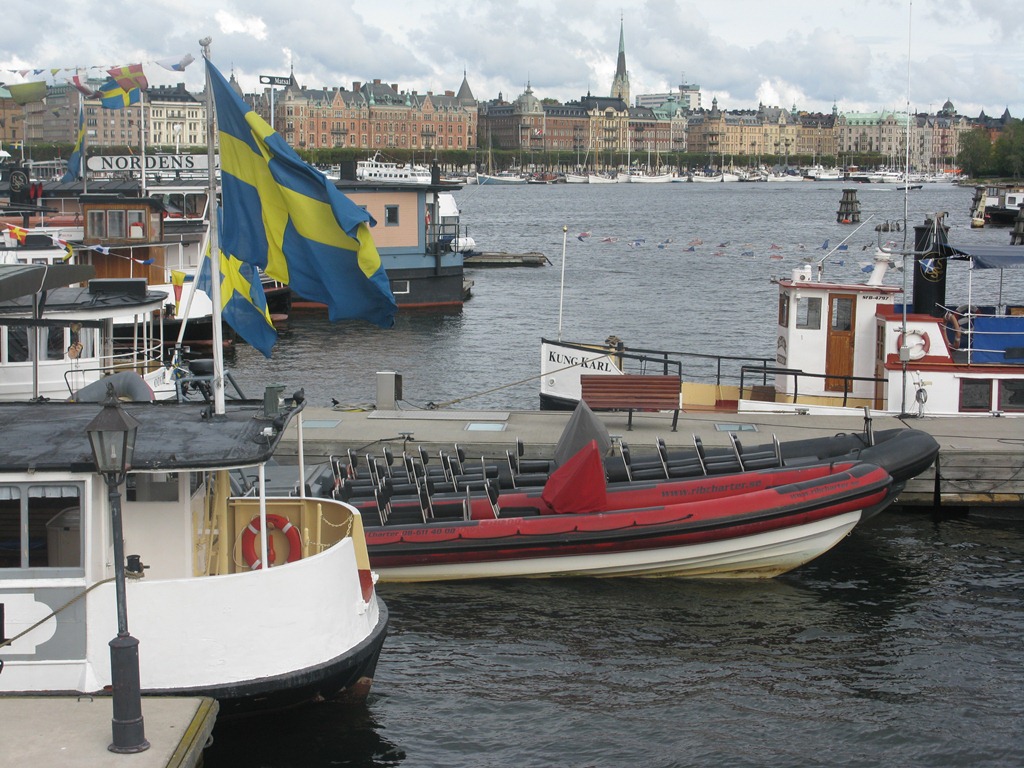
Stockholm is a series of islands

By Ed Bruske

aka The Slow Cook

At first I thought it was a prank.

On September 7, I received an e-mail purporting to be from the press office at the Swedish embassy in Washington. I was invited to attend a "study visit" of the school lunch program in Sweden just two weeks hence.

"The Swedish Institute is willing to cover costs in Sweden and the Embassy will pay for economy class airline tickets," the note from press officer Larilyn Andre explained. "Or you are free to attend at your media outlet's expense if you are not able to accept this offer."

Well, I certainly didn't have a "media outlet" to pay may way. Could this be legit? Why me? And if it was legit, why the last-minute invite?

As I would later learn, the press junket I was about to embark upon had been instigated months earlier by the Swedish embassy in Berlin. They had contacted the Swedish Institute in Stockholm suggesting that since school food had become such a hot topic, Sweden might want to show off its free school lunch program, especially since the government had embarked upon an intiative promoting Sweden as Europe's new "culinary nation."

The Swedish institute, which promotes all things Swedish, had contacted embassies around the world. Apparently, the memo sat in someone's in box in Washington for all those months. That still didn't explain how they picked me. "I enjoyed your article about the food service agency programs in DC public schools and today's piece on flavored milk, and thought this might interest you," press officer Andre had written.

But while in Sweden, I learned that the Swedish embassy in Washington had been in talks for weeks with food service personnel in the D.C. Public Schools about holding a "Nordic Day" that would feature Scandinavian foods in the cafeterias. The event is now scheduled for Oct. 26, and some of the people I met in Stockholm are scheduled to be on hand. The following evening, Oct. 27, the Danish embassy is hosting a cocktail event to raise funds for salad bars in D.C. schools. (There are definitely perks to be had living in the nation's capital.)

D.C. schools food services Director Jeff Mills now admits that my name had come up in those meetings. "I mentioned you a lot," he said.

Okay, mystery solved. On Sept. 17, I flew off to Chicago's O'Hare Airport to board an extremely comfortable, seven-hour flight to Stockholm. Did I mention the complimentary cocktails? I landed at 7:30 Sunday morning and breezed through customs. But the "free taxi" into Stockholm I'd been promised never materialised and I was soon introduced to the high cost of living in Sweden. The express train from Arlanda Airport downtown--a 25-mile ride--cost an astounding $50. (Alright, it's cheaper if you buy a ticket from the machine on the platform, but I couldn't figure out how to work the machine.)

The city seemed deserted when I arrived at Stockholm's central train station. Using the map inside a guide book I'd purchased in the States (Time Out Stockholm), I managed to locate my hotel on foot, about a mile and a half away on Berzelli Park, near the waterfront.


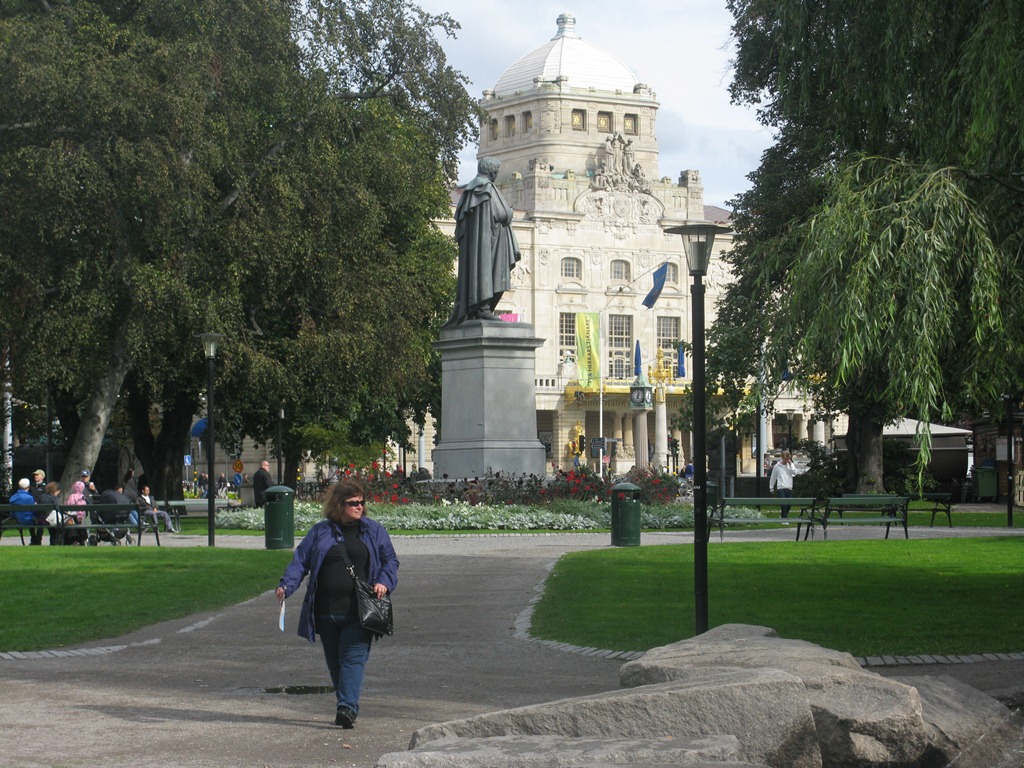
Berzelli Park, seen from Berns Hotel

The receptionist at Berns Hotel--a beautifully appointed boutique hotel and famous entertainment complex in downtwon Stockholm--was so impressed by my travails that morning she urged me help myself to the free breakfast buffet, even though the usual check-in was still hours away.

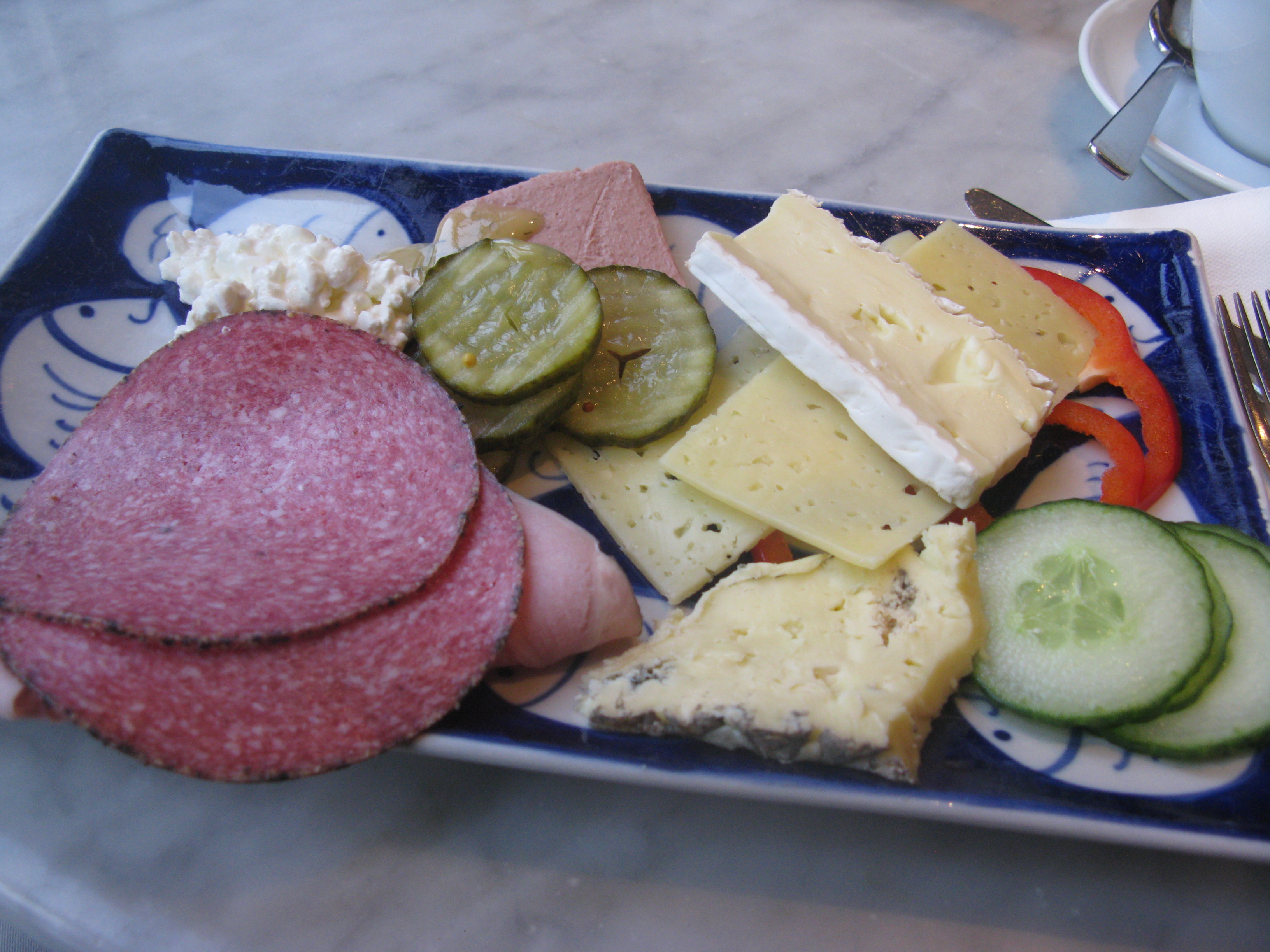
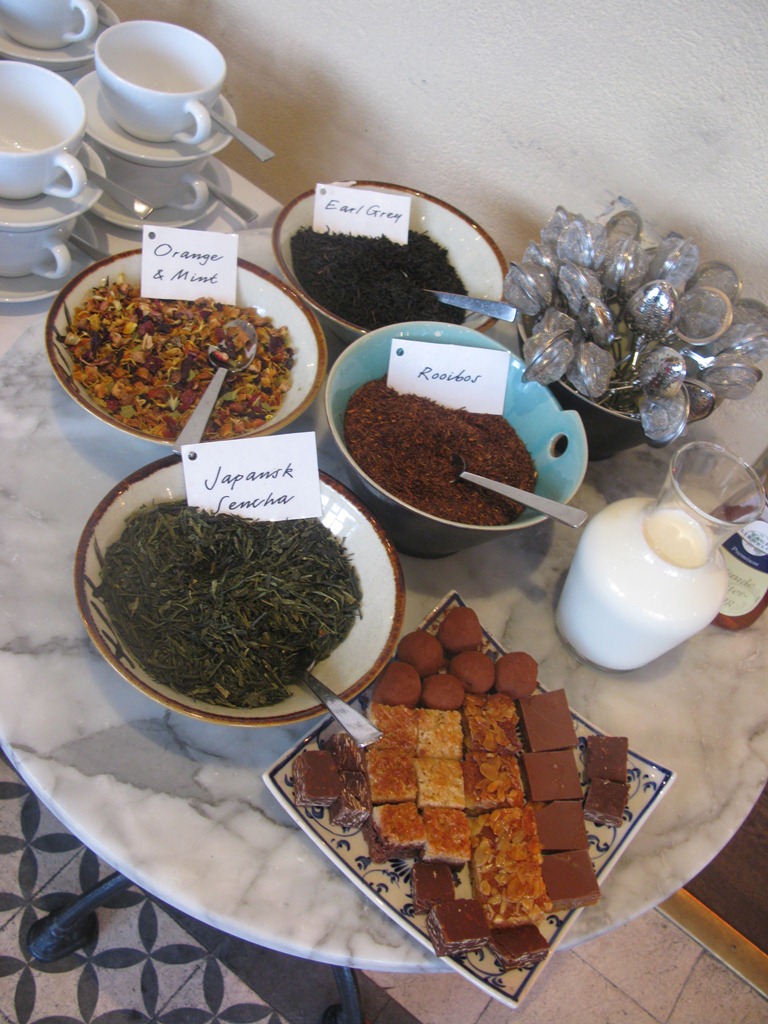
At this point I might as well say something about the Swedish breakfast I experieced at Berns Hotel. It was a protein lovers nirvana. Cheeses, cold cuts, smoked salmon, sausage, bacon, eggs--especially since I'd been warned how expensive restaurants were in Sweden, I was primed to eat my fill. Oh, there were also pitchers full of various yogurts, a variety of granolas and cereals, an entire buffet table devoted to various whole grain breads and rolls. There was even a display of different teas for do-it-yourself brewing, along with a plate of truffles and assorted chocolates.


My breakfast at Berns Hotel

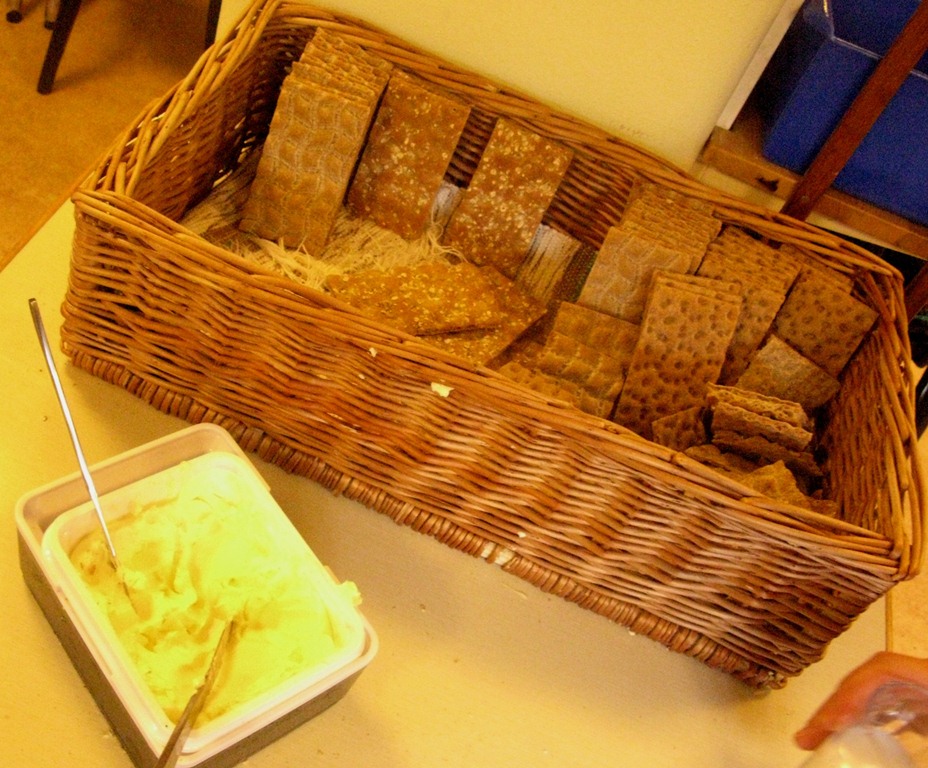
Who needs lunch or dinner when you can eat a breakfast like this? In fact, what I mostly did for other meals while in Stockholm was snack on the nuts, cheeses and sausage I'd brought from home. I was later struck by how thoroughly Swedish officials try to minimize fat in school lunch. The milk offered in cafeterias is .5 percent. And rather than serve butter with the ubiquitous displays of traditional crispy bread, schools are urged to offer margarine instead.

As I mention in part six of this series, school meal recommendations are much more concerned with serving children copious amounts of potatoes and bread.


Breakfast tea and chocolate display

Apparently the reason I was flown to Stockholm on a Saturday, when the press tour didn't start until Tuesday, is that it was cheaper for the Swedish government to put me up in a boutique hotel for two extra nights than to pay weekday air fare. That gave me most of Sunday and all day Monday to sight-see and adjust my inner clock to the six-hour time difference.

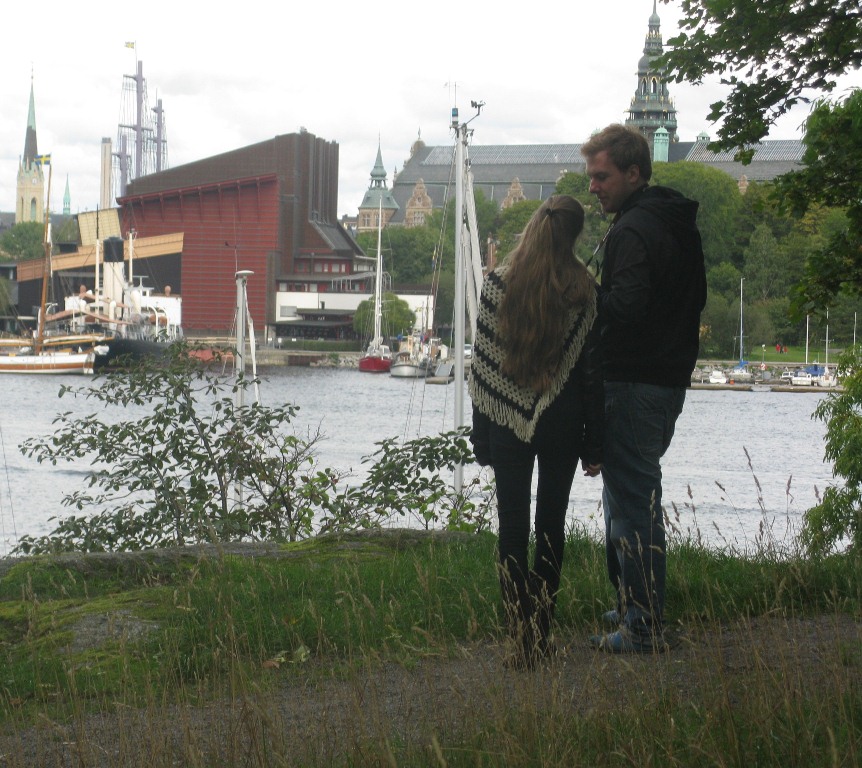
I spent most of that time just walking the Stockholm waterfront, which is extensive, since the city is built on a series of islands connected by bridges and water taxis. But I especially wanted to see the Vasa museum housing a 17th century wooden war ship that sank to the bottom of Stockholm's harbor shortly after setting sail on it's maiden voyage. Apparently, after two years in construction, the hull was not designed to carry enough ballast and the ship simply blew over in a strong wind. It filled with water through the gun ports.


View of the Vasa museum--and romance

A short film explains how the Vasa was accidentally discovered and carefully raised from the briny depths with help from the Swedish Navy in the 1960s. It was then moved to its current location and surrounded by the museum building. The ship is huge, rising more than 40 feet from the waterline at the stern and weighing the equivalent of three jumbo jets. Great pains were made to examine the skeletal remains found on the ship and reconstruct lifelike faces and period clothing.

Many of those on the ship apparently suffered a variety of ailments due to a steady diet of porridge.


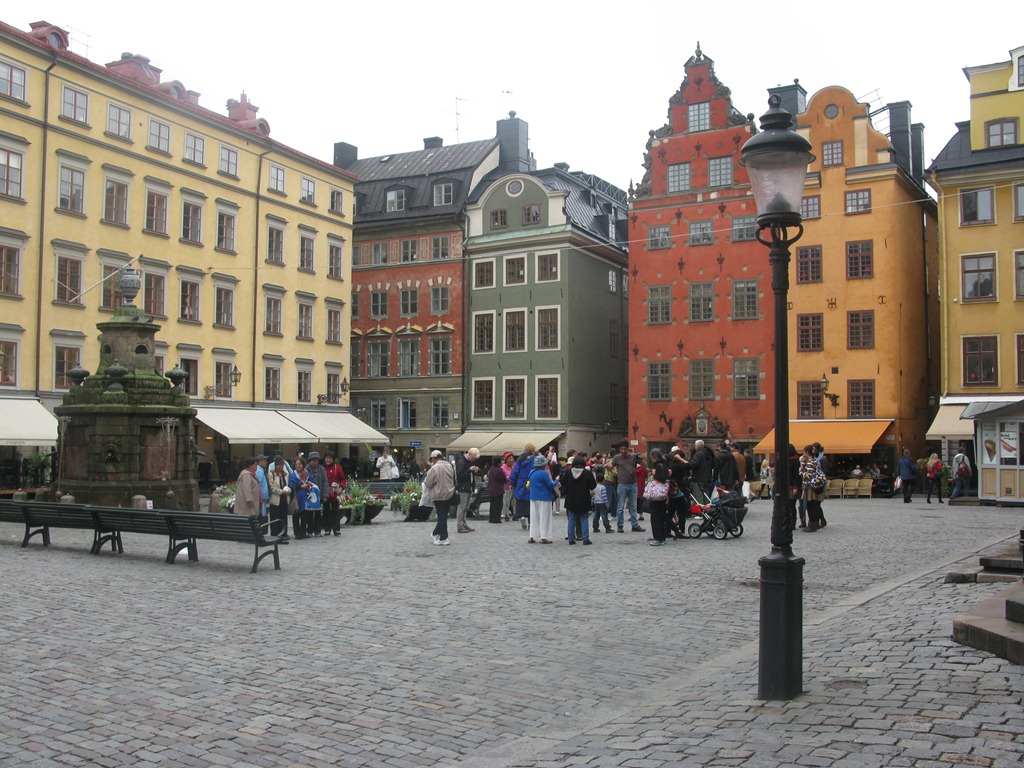
Gamla Stan, Stockholm's old town

Stockholm is among the few large urban centers in Europe that sustained no damage during World War II. Sweden remained neutral while much of the rest of Europe was in flames. Stockholm's old town on the island Gamla Stan--also site of the royal castle--maintains the charm of centuries-old cobblestone streets and colorfully painted townhouses. You can tell this is tourist central from all the stores displaying postcards on the sidewalks and kitch in the windows. Still, it's worth a stroll, and possibly even an afternoon fika--the traditional break for coffee and pastry.


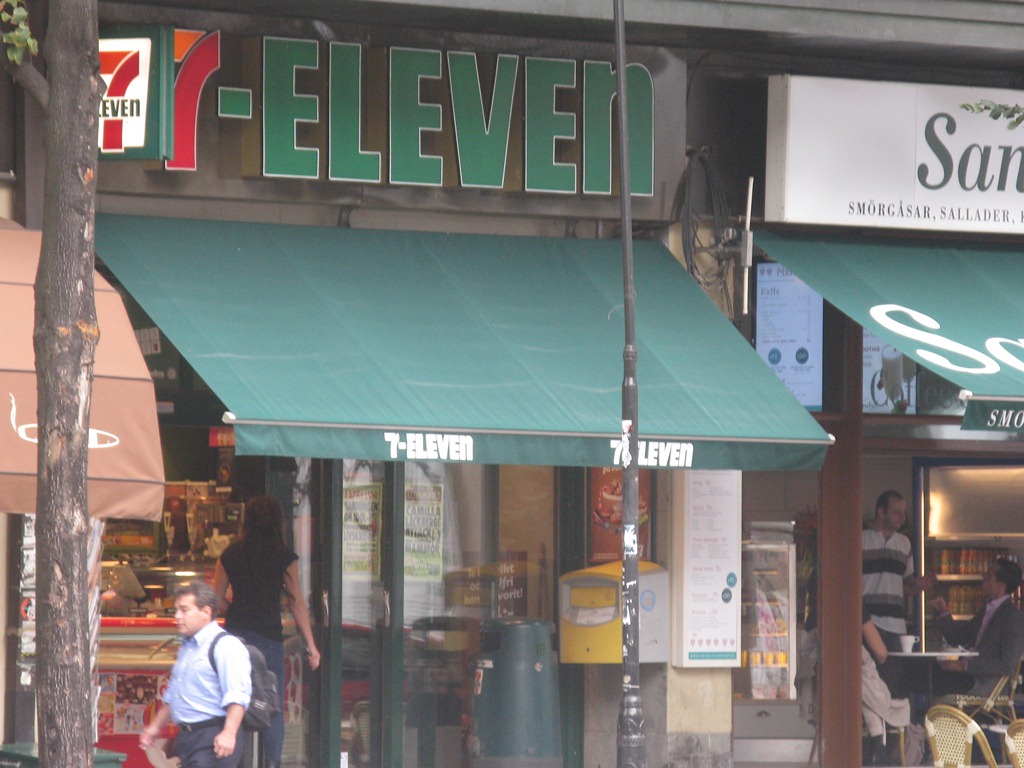
7-Eleven stores are everywhere in Stockholm

America's food influence on Sweden is impossible to miss. There seems to be a McDonald's on every corner, including the one a block from my hotel--in the middle of one of Stockholm's most fashionable neighborhoods--where the Big Mac dinner was priced around $10. In case you needed a candy bar or soda, 7-Eleven was never far away.


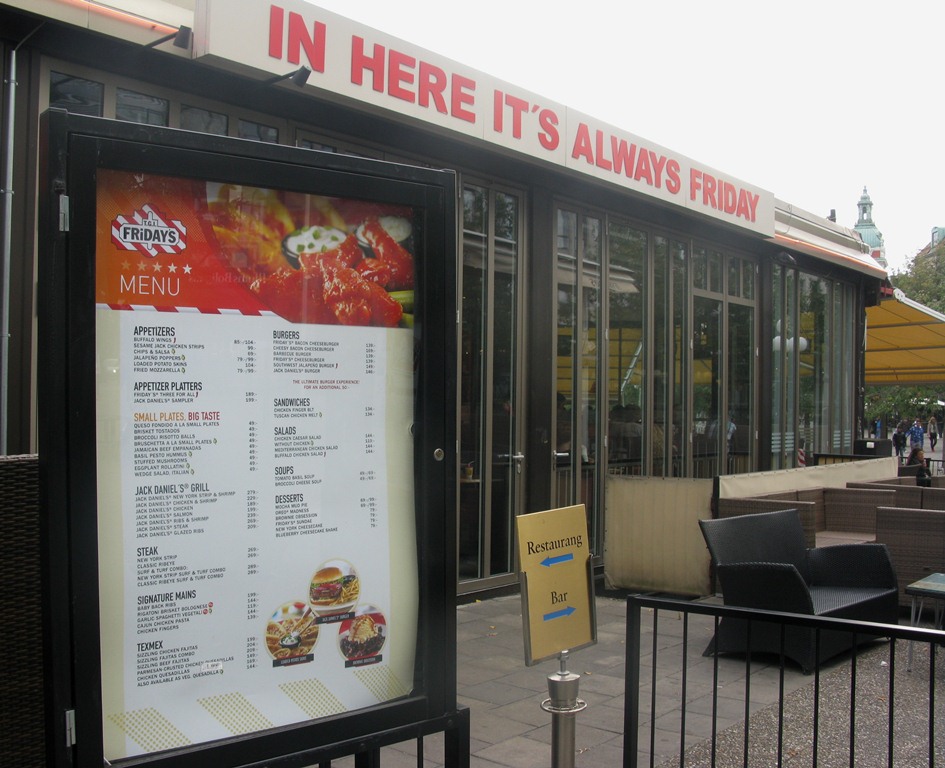
A taste of the U.S. is never far away

T.G.I. Fridays also has a spot close to the downtown waterfront. The "sizzling fajitas combo" sells for $32. Everywhere I went, school officials and chefs complain that the fast food culture makes it hard to get children to eat the healthier food they serve. Sound familiar?


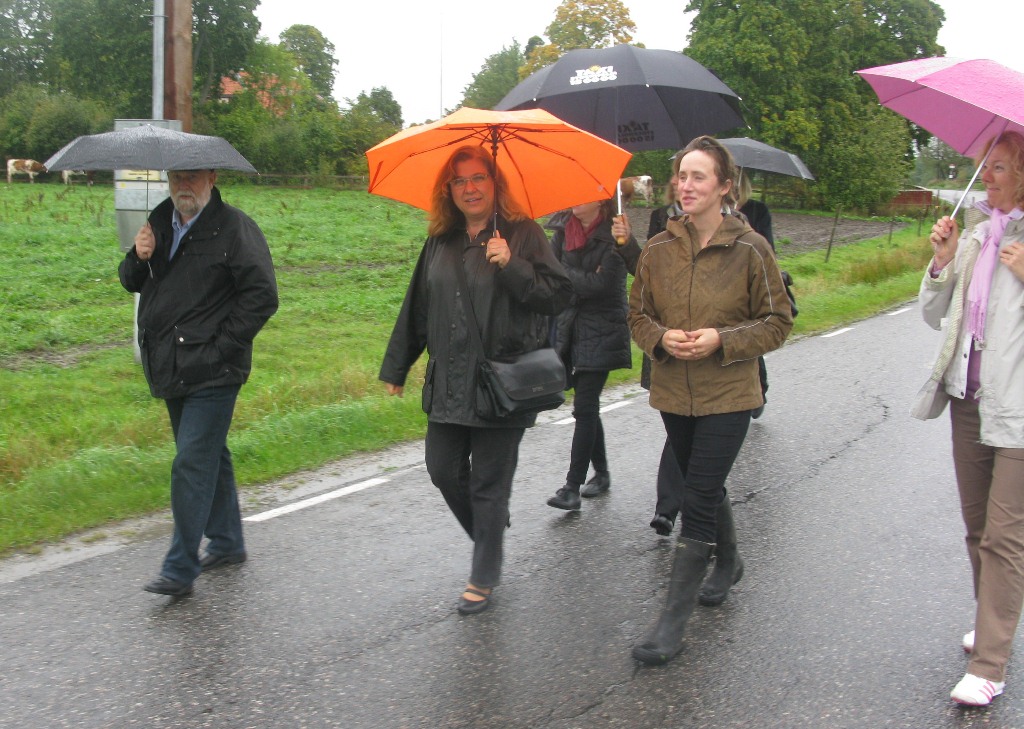
Visitng organic dairy farm outside Stockholm

Early Tuesday morning I met up with my fellow journalists--four Germans from Berlin, one Russian based in Prague--and our guide, Kasja Guterstam of the Swedish Institute. Among the Germans was a writer for Slow Food Magazin, another from FOCUS Magazin, a third from Die Tageszeitung, and one gentleman representing a group that advocates for better school food in Germany, Schulverpflegung.

The Germans did not seem terribly impressed with the idea of free school lunch. Why should it be free? they asked. But they were fascinated to here about all the drama occurring around school food in the U.S. Apparently, a national school food program is not something that exists in Germany the way we know it and the journalists I was traveling with--one of whom had lived in Washington--were not seem especially concerned about it. The school day in Germany typically ends early, they explained. Kids eat at home.

They were particularly amused to hear about nutrition guidelines for U.S. schools, and the impending new ones that would sharply cut back on potatoes in favor of green and orange vegetables. "What's wrong with potatoes?" they asked.

Mostly what we did for two days was zip from one meeting to the next--10 in all over two days--in a hired taxi. Our last stop involved a ferry ride to an island-bound organic dairy farm where Arla, the giant Swedish dairy company, pays the farm family to host visits from school groups. Otherwise, we were told, the farm to school concept has not taken a strong hold in Sweden, mainly because schools can't afford to send the kids on farm outings.

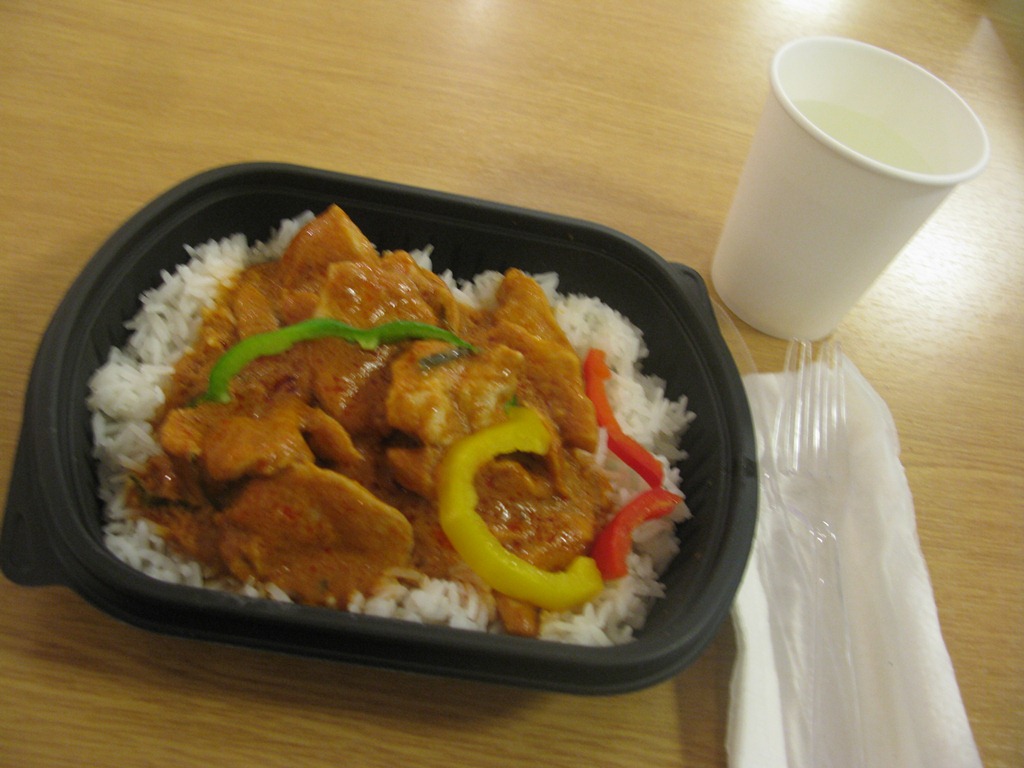
We did have our evenings free. One night I decided to splurge for dinner and walked past the McDonald's to a huge department store near the hotel--Nordiska Kompaniet, or simply NK, a cherished institution in Sweden. Along with several restaurants, the store boasts a huge grocery, deli and prepared food department. I spent 74 Swedish Kroner--nearly $12--on a simple microwave meal that turned out to be a rather good version of Thai curried chicken over rice.


Department store Thai chicken curry

For convenience sake, the store provides e a few eating tables in the prepared food section (also a bar with a full menu), along with a microwave machine, plastic utensils and pitchers of drinking water.

Before leaving the U.S., I had reached out to friends for any contacts they might have in Sweden with school food experience. I was soon corresponding with a number of families there--some American--as well as several of chefs who had learned about my visit through Facebook and other social networking sites and wanted to share their experiences. One of those exchanges resulted in part seven of this series, My Life as a Swedish School Chef.

I got some heat from the Swedes for not painting their school lunch program in glorious hues. But from the many people I corresponded with, I learned that all is not perfect with the Swedish system. It has warts, just like ours. But I was most encouraged to see that the Swedes are not afraid to let their children serve themselves in their "school restaurants," and that so many professional chefs are pursuing careers leading school kitchens.


Swedish chefs only boast in private

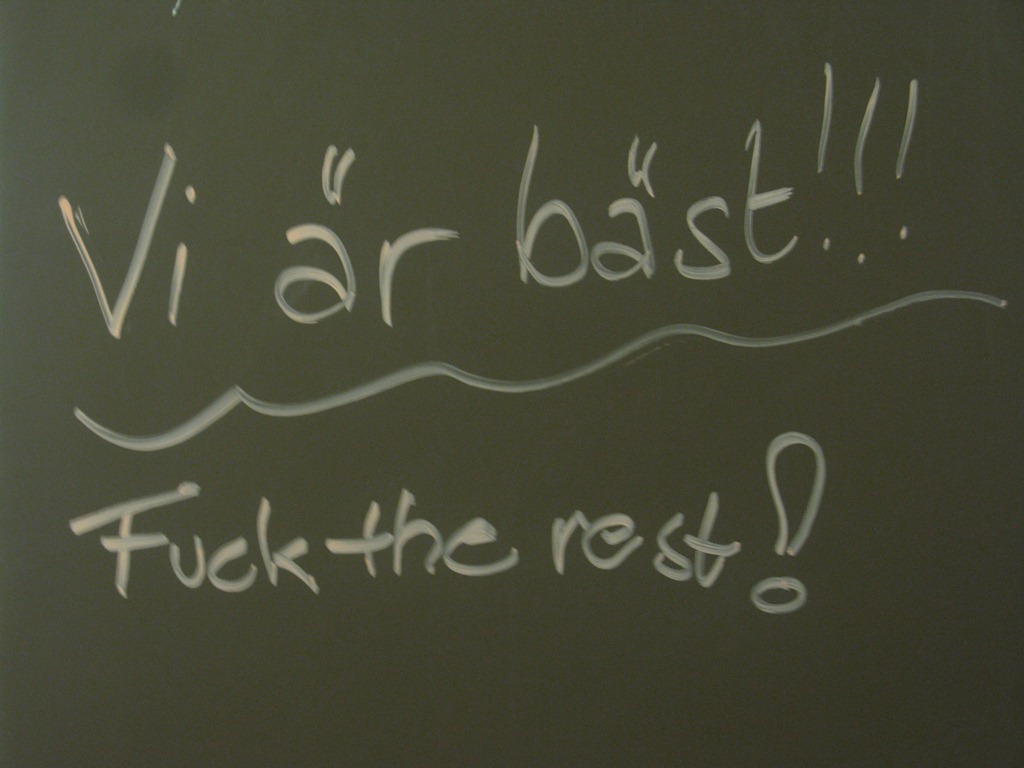
Apparently, not everyone in Sweden is happy with all the acclaim some of those school chefs have gotten. Chef Michael Backman, at the Annersta School, said he's received no small amount of grief from the school food community because of all the favorable publicity showered on his restaurant-quality school meals. "In Sweden, no one's supposed to be that much better than everyone else." You have to travel deep into the rear of his kitchen to find a blackboard where Backman has scribbled a simple message about the pride he feels in the food he and his staff produce.

"We are the best!" the message declares in Swedish. "Vi ar bast!"

The rest of the message requires no translation.

Thursday, October 13, 2011

What Does Sweden's Free School Lunch Say About Us?


By Ed Bruske

aka The Slow Cook

Imagine a school cafeteria where lunch is free for all children, where there are no cash registers, no a la carte lines, no vending machines, where kids serve themselves from long food bars loaded with different entrees as well as salads, and where they pour themselves plain milk or water to wash it all down.

That would be the school lunch I saw in Sweden where, since 1997, all "primary" school children--or those through age 16--are guaranteed a free lunch. Unlike our system here in the U.S., where free lunch carries the stigma of being poor, and where cafeterias serve fast food in order to entice paying children to help finance the program, the Swedes pride themselves on a cradle-to-grave social welfare system that serves everyone equally.

But as I quickly learned during my recent trip to Stockholm, there's no need to idealize the Swedish system. It has plenty of its own problems.

"Fun and interesting article you wrote, I think. We were hoping, though, that you'd be a bit more impressed with the Swedish school meals in general."

That was the comment I received from Annika Unt Widell, the spokeswoman for Swedish School Meal Supporters, after I published the first installment in my recent series on Swedish school food. But as I replied to her, I was terribly impressed with the Swedish school lunch I witnessed. I was also impressed, however, by the number of issues the lunch program there shares with ours here in the U.S.

Chief among those is money, and the fact that the government doesn't supply enough to do meals right.

Things work a bit differently in Sweden, though. There, the money for meals comes out of the general education funding supplied by the national government for each child. It filters through 290 municipalities, then through the individual schools. At each step, school meals may or may not be given high priority. Schools that allocate the most for their cafeteria operations spend three times as much as those that spend the least. While school lunch may be universally free in Sweden, that doesn't mean it is universally good. Sometimes it can be pretty awful.

"My son's school is great but the food is not," said Bronwyn Griffith, and American living in Stockholm with children five and eight. The food in that school comes from Sodexo, the giant international food service company that also has a huge presence in the U.S., and Griffith said her son refuses to eat it.

In the U.S., meanwhile, the Department of Agriculture reimburses schools $2.77 for each lunch it serves to a "low income" child. (That's five cents more than last year, to compensate to inflation.) Children whose family income is too high to qualify for free meals, but still low enough for "reduced-price" meals, earn a $2.37 subsidy. For kids who pay "full price," the federal government chips in 26 cents. The rates are a little higher in schools where at least 60 percent of the students qualify for free or reduced-price meals.

U.S. schools say they can barely scrape decent meals together because they only have around $1 out of the federal subsidy money to spend on ingredients for each meal. Spending disparities in Sweden result in vast differences in food quality from one district to the next. "I have 7.5 Swedish Kroner ($1.19) per lunch per student. Another school in the same town can have 12 Kroner ($1.90)," said Even Bakke, the chef at a school "restaurant" in Goteborg. "That doesn't sound like much of a difference. But it's a hell of a difference for us."

The Swedes are also just getting around to requiring that their meals meet specific nutritional requirements. U.S. school meals if anything are over-regulated. The USDA sets forth strict guidelines specifying not only what kinds of food schools must offer students in order to receive those federal reimbursement dollars, but what the serving sizes must be. Kids have to pass a cashier or "point of sale" not only to make payment, but to demonstrate to a cafeteria employee that the food on their trays qualifies as a "meal," as defined by the federal government.

And this year those rules become only more strict. Schools will have to remove from the steam table most of the French fries and other potato products kids love and offer more stuff kids don't like very much: green and orange vegetables and whole grains.

Perhaps I shouldn't have been surprised to hear that Swedish chefs and school administrators alike describe their biggest problem as getting children to actually eat the better foods they put on their buffets. Like their counterparts here, kids in Sweden grow up surrounded by fast food. The one thing they don't have are food commercials on television aimed at them. That's forbidden in Sweden. To our everlasting shame, we in the U.S. can't get the processed food industry to agree even to voluntary guidelines on marketing to minors. Rather, we've allowed corporate food interests to hijack the health of our children under the guise of "free speech."

As in the U.S., there's a move afoot in Sweden to place more professional chefs in school kitchens. Trained chefs know how to make more out of less--and make it better. As I found in Boulder, where culinary school graduates were drawn into school kitchens by the allure of working with "renegade lunch lady" Ann Cooper, there is a yearning on the part of some chefs to do something more meaningful with their skills than slave over a hot stove in a fancy restaurant. Schools should be looking for ways to attract more of them.

The cafeteria design and service method in Sweden also has something to teach us. Lunch should not be about force-feeding children green vegetables and whole grain pasta, too much of which ends up in the trash. We need to engage kids in the act of making healthier food choices. Swedish children from the earliest grades learn to serve themselves from a food bar. Not only do they learn to like foods they might not otherwise try, they help loosen the Gordian knot around school lunch finances by taking only what they really want. (That's not to say there isn't food waste in Swedish cafeterias. There is, as I described in part three of the the series.)

"No child offered food ever starved," my wife likes to say. The U.S. national school meals program would do well to embrace that maxim. Why not just pay schools for every kid who picks up a cafeteria tray and let them make their own choices? Of course, that would mean the USDA would have to undo many of the rules and regulations it has spent decades putting in place. Government bureaucrats would be horrified to lose their strict accountability standards. But really, U.S. school lunch has become a Rube Goldberg contraption that seems to be more about following government rules than serving children.

"The more dishes, the easier to satisfy the students!" said chef Bakke of the buffet spread he lays out every day in Goteborg. "We serve three different lunch dishes every day, plus a salad buffet and freshly baked bread. The students have no reason to complain about the lunch when they have so many alternatives."

Truthfully, I don't think school meals will ever be universally free in the U.S. It's just not in our DNA. Still, we may have more in common with the Swedes than not. Just like in Berkeley and Boulder, it's obvious that the greatest progress in Swedish school meals is being made by chefs and school administrators who buck convention. As true as it is in other walks of life, this maxim holds for running a successful school meals program: following the rules is a surefire recipe for mediocrity.

It's time to change the rules.

Tuesday, October 4, 2011

My Life as a Swedish School Chef

When Swedish school chef Fredrik Kampenberg heard I had been in Stockholm learning about school food there, he sent me an enthusiastic e-mail mentioning that he had started a Facebook page where he could talk with students about the food service operation he runs at a high school in Orebro, a town about 125 miles north of Stockholm. (See Part 4 of this series.) There ensued a rapid correspondence in which I encouraged Kampenberg to elaborate on his experiences being a school chef in Sweden, where the cafeteria is referred to as the school "restaurant." The result is this essay, which I have stitched together from Kampenberg's e-mails. His English is very good, so I've only made minor edits for grammar and clarity.

Swedish school kitchens employ some 30,000 chefs, prep cooks, dishwashers and other personnel. This would be the story of just one of them--Ed Bruske, aka The Slow Cook

Guest Post

By Fredrik Kampenberg

I worked as a chef in the public sector for many years, mostly in restaurants in Sweden, in ski-resorts and others. I´ve also tried my luck in fine-dining—starred restaurants in Stockholm. I ventured to the States, Australia and Tokyo for a few months in my early twenties too.

Originally I am from the north of Sweden, as it is called. Geographically it´s more in the middle of the country: Östersund in Jämtland.

I studied at Örebro University, in Grythyttan, where the oldest and most renowned culinary school is located, then moved to a small city called Karlskoga and worked as a head chef in a new restaurant there. Later I started commuting to Örebro, which lead me to move here!

I was out of work for a while and applied for just about everything, including school restaurants. I had a job at another new restaurant in town, but there weren’t enough hours. So when a job came up as head of a school restaurant, I had to apply for it. But, with my professional background, I really had my doubts. I really didn’t want to work with that kind of cooking.

School food had a bad reputation--even for me!

A few years ago there was a TV show in Sweden with famous star chefs going to school restaurants, trying to change them into better restaurants with higher standards. In some episodes their negative criticisms of the kitchen and how things were done landed on the people working there. Sometimes the criticisms were accurate, but very often they should have been aimed at those in charge--the government and so on. A lot of people in the business of school food took offense.

The show ran for two years and as one of its followers I thought it was interesting to see—largely because the famous chefs were sort of my idols then and seeing them in that environment made it all the more interesting, especially since the kids didn´t always choose their version of meatballs over the processed ones made by the food industry. It was a lot like what happened to Jamie Oliver when he showed the kids how chicken nuggets are made.....

As I said, that was a few years ago when I had no intention to begin working with school food. But it sure made an impression on me when I did become a school chef.

This job gave me secure employment at a time when the numbers of unemployed were rising. And since I have a son, now seven, the hours and the security of course became more important, so I gave it a shot.

Turns out it was one of the best choices I've made so far!

I started learning from the ladies in the school kitchen, all the different routines and what it means to have a job where taxpayers are the ones paying my salary. Then I changed everything, trying not to cook typical “school food,” or meals with the typical school food taste.

This proved to be too much for the young adults at the school (16 to 18 years old). When a local newspaper came around with their web camera, and the kids had a chance to say whatever they wanted, they called my food “gross” and “strange.”

I was very saddened by that—and angry with the newspaper for showing only one side of the story and the negative side at that. So I called them up, demanding to give my version. The ball started rolling from there.

That’s when I really started to work for good, healthy, fair, homemade cooking in the schools. I soon realized that we had to raise the reputation for school food and for the people who make it, one of the more important jobs in the country! It´s important for everyone in school restaurants—myself included. I refuse to associate with food that’s called "gross,” “bad,” or “disgusting." That’s how it was for 40 years and no one raised an eyebrow.

It`s time to take a stand--not dwell in the shadows--to step up, take responsibility and show that we are able to change the way the general public views school food. We are chefs like any other chefs. We just have to stop buying prefab food—crap that looks like food, tastes like food, and smells like food, but is nowhere near the real stuff that contains love, passion and knowledge.

Now, being the boss at a place funded by tax money calls for certain things--for example where the money is spent and how that information is public. There were routines to be learned. Especially I had to learn about being responsible for a staff in a way that a boss and chef in the private market isn´t. That takes a bit of time.

When I finally had some of those things figured out, I began looking at the menu.

The menu where I work is decided by a man who is the boss of seven high school restaurants. It´s different in almost every municipality, since they can decide for themselves how things are done, as long as they follow the law (sort of...).

He makes the menu, using recipes that are nutritional and in budget--typical school restaurant menus and recipes, meaning boring and often based on pre-fabricated components. For instance, meatballs, hamburgers, pancakes, bread and such. I used his menu and tried to understand what the main ingredients were. Instead of buying ready-made meatballs, I bought minced meat and the other things that a meatball consists of. You get the idea.

But it took time to get the ladies in my kitchen to do those things—make meatballs from scratch—so we exchanged industrial made meatballs for something like homemade meatloaf, which is basically the same, just another shape. You get the idea, again!

I remember when we were supposed to serve cauliflower soup, or something like that, and I served [the Thai soup] Thom Ka gai instead, using fresh lemongrass, kaffir leaves, red curry, etc. I even had one of the students who was from Thailand taste and help out with the soup. I thought it was fab! Usually we thought the food was great in the kitchen. But the kids did not!

Ever since, we in the kitchen love to comment on how much we like the food. We know that if we like it, the kids won’t. (Hee, hee!)

In fact, the most activity we’ve had on our Facebook page so far was when I removed the ketchup that used to be displayed at every lunch. The kids frequently used it, and I think it wrecks good food, almost like salting food and using pepper before tasting. Ketchup is the perfect companion to pre-fab food I think, as it disguises the poor taste and quality, covers up all those additives.

It’s a funny thing. We’ve had lunches where we gave the students a choice between a prefab fish with breadcrumbs, lots of additives and processed meat, and a fish that we made ourselves, with no additives. When we served the two different fish, we displayed them with labels listing all the additives and different ingredients. Of course the list with our homemade fish was much shorter.

There wasn’t such a big reaction—except we learned that the kids really liked our fish. So we’ve made it a few times since…

But the ketchup. Oh, boy. There was an uproar when we took it away. It’s been a year and the ketchup issue still comes up. Now we serve ecological ketchup—sometimes a ketchup we make ourselves. Why not? I don’t think there’s any harm in eating fast food or ketchup or candy or soda—as long as it’s not an everyday thing.

I think I was a big winner in this, cutting ketchup back from five days a week to one.

Whether you’re a famous Swedish chef or Jamie Oliver, homemade food is still hard to "sell" to the kids. They are in high school and they’re used to a certain taste and texture in food. Homemade food is very different and not every hamburger or meatball looks the same.

I gave a lecture once and reflected on this: "I was standing there, at the hot stove, making hamburger after hamburger, trying to get the color and the shape as perfect as possible. I was nervous knowing the kids wouldn´t like it otherwise. And then it hit me: I was trying to make my hamburgers as perfect and as much like industrial-made burgers as possible, when at the same time, the industry is trying to make their products imperfect to simulate homemade. It´s just sick!"

I created my menu together with my staff for a long time. The staff was involved and our experiments and ideas led to great recipes that were served in the restaurants. We listened to our guests—the kids-- and tried to reason with them, teach them, give them what they wanted. And I think we were on our way. The staff dared to experiment. They felt pride in the food we served. They were becoming creative and using the most important spice of all: love.

It´s hard for people to change 23 years of opening cardboard boxes, to stop doing what you´ve been told all those years and begin creating, thinking, taking risks and to invest feelings in their work. But they did, and they put their love into the food.

Then we were told that all schools that my boss was in charge of had to have the same menu. That set us back a bit! At the time, I had already received awards and a lot of media attention. My name was becoming known. But now the school food method that had made municipalities infamous was hitting us too.

But that will soon change again and we keep developing our two school restaurants in other ways. For example, one of the restaurants just got renovated this summer. I saved the old steam table and turned it into a cold buffet for salads and dressings and such. Our salad bars are now twice the size as before.

We also have a blog now as well as a Facebook page. I suck at it, but I’m learning. It´s about a dairy cow that lives on a farm 10 minutes from Örebro—how she lives, how milk is produced, how much milk is in one piece of cheese, how much time and effort the farmer puts into the operation every day.

It’s all about teaching ourselves and our guests—the kids--how things really are, to learn respect for the food and make conscious choices. Not just in school, but in life! That’s what I’m hoping for, at least.

Our "adopted" cow just had a calf--a bull. There’s only one ending for a baby bull. So it fits my plan perfectly. Maybe some of the kids will stop screaming for more beef now….

Photo credit: Andreas Hythen.

Monday, October 3, 2011

How Swedes Spell "Nutritious": P-O-T-A-T-O


What's wrong with potatoes?

By Ed Bruske

aka The Slow Cook

U.S. potato growers and members of Congress who support them are ready to storm the U.S. Department of Agriculture over proposed regulations that would sharply curtail the use of potatoes and other starchy vegetables in school meals. Kids love potatoes, but school food activists say they need "more balance" by eating things they hate, like green vegetables and whole grains. And there's good scientific evidence indicating that too much starch in the diet only contributes to the childhood obesity epidemic.

But in Sweden, the spud is still king. "Pupils’ consumption of potatoes, pasta, rice, barley, couscous, bulgur and millet should be encouraged as much as possible," read the school meal recommendations published by Sweden's National Food Administration. "From an environmental point of view, potatoes and barley are at the top of the list," says the NFA.

The agency suggests children eat 4.25 portions of potatoes every two weeks, but acknowledges that "it is often difficult to get pupils to eat 175 grams [6.2 ounces] of potatoes if they are served boiled. Add variety with potato wedges or potato gratin."

The recommendations, developed by a group of "school meal experts" from several municipalities, along with the Center for Applied Nutrition, and based on the 1997 Swedish Nutrition Recommendations, call for Swedish school children to get a minimum 47 percent of their calories from carbohydrates.

"A good-sized portion of a foodstuff rich in carbohydrates and fiber is the cornerstone of every meal. The food we eat in Sweden today often contains too few carbohydrates," the food agency intones. "A school lunch with too few carbohydrates is not as filling and provides less energy to get through afternoon activities."

As to the green and orange vegetables the USDA and lobbying groups such as the Center for Science in the Public Interest say kids should eat much more of instead of potatoes, the Swedish recommendations are virtually silent.

A potato a day, it seems,will keep the doctor away in Stockholm.

The Swedish school lunch program has been in place since the 1940s and since 1997 every school district is required to provide a free lunch to all students enrolled in primary school, or between the ages of six and 16--about 1.4 million. Remarkably, in all that time, the Swedish program has not had firm nutrition requirements in place for school meals. The country's 290 municipalities are supposed to each have a "dietary plan," but according to the advocacy group Swedish School Meal Supporters, fewer than a third of the country's school cooks know what's in their local plan or follow it.

The situation in Sweden contrasts sharply with the school meals program here in the U.S. The USDA has book-length regulations stating exactly what kinds of foods schools should be serving--even the serving sizes children must be offered in order for schools to collect the federal reimbursement dollars on which the program depends. This year those regulations are being revised to restrict starchy vegetables such as potatoes, lima beans and corn to no more than one cup per week, and require bigger servings of green and orange vegetables and whole grains.

Importantly for Swedish schools, the government there this year amended its education act to require that school lunch be not only free, but also "nutritious." Exactly what that means remains unclear. But according to School Meals Sweden--a collaboration of the Karolinska Institute, the Swedish Association of Local Authorities and Regions, and the Swedish National Institutes of Public Health--the precise nutritional requirements are likely to be determined by the agency tasked with monitoring compliance, Skolsinspektion.

School Meals Sweden says it will soon unveil a questionnaire it plans to send to all of the nation's school districts that should reveal in great detail the kind of lunch service the schools are providing. The schools could then use the questionnaire results to demonstrate compliance with the new nutrition requirements.

Meanwhile, I thought it might be instructive to look at the guidelines already in place at the National Food Administration and see how they compare with the buffet lunches I ate at two schools during my visit to Stockholm and described in parts one and three of this series.

In Sweden, school lunch should provide 30 percent of daily calorie requirements, or 625 calories for children aged 10 to 12. It should consist of at least one and preferably two cooked main dishes, along with bread and "low-fat margarine," mixed salad, skimmed milk and water. Children should be getting 20 percent of their calories from protein, a maximum 33 percent from fat (11 percent saturated fat), and 47 percent from carbohydrates. Bread should be a part of every lunch.

A hearty salad or soup can serve as an alternative main course as long as they contain enough carbohydrates. The agency urges the following rules of thumb to provide enough energy with soups and salad:

"All soups should have potato, pasta, rice or dried pulses as their base, and this should make at least one third of a portion."

"Supplement the soup with dessert or soft bread and cold cuts, cheese, etc."

"Include potatoes, pasta and rice or couscous-based salad in the salad."

Beware of dishes too heavy on protein, and light on carbs. "Dishes like black pudding, fish pudding, lasagna and beef casserole often contain too few carbohydrates, so it is good to supplement them with filling salads or extra bread," the agency suggests.

On the subject of bread, the agency says kids can hardly get enough.

"The aim is for each pupil to eat at least one, and preferably two, pieces of bread with lunch. An appetizing range of both soft and hard breads can be a way of encouraging pupils to eat more bread," according to the recommendations. "The bread should be served with a 5 grams portion of low-fat margarine. Soup should always be served with extra bread if there is no dessert, and often three slices of hard or soft bread with cold cuts, cheese, etc. are needed to supplement the soup."

Milk and dairy products "provide valuable protein and are also an important source of calcium," the guidelines state. But full-fat milk, cheeses and yogurt should be limited because of the saturated fat they contain. "If these guidelines are followed and pupils eat the recommended amounts of main dish, salad, bread and fat, they will get the calcium they need even without drinking milk with their food, mainly from the milk products used in the meals themselves."

Children should eat 100 to 125 grams (3.5 to 4.4 ounces) of fruits and vegetables with every lunch. From the protein category, the following number of servings every two weeks is considered optimal: boneless meat or poultry, two servings; minced meat, two servings; sausage, 1.5; black pudding or liver, .5 minimum; fish, two servings; dried pulses, .5 minimum; eggs, .5; cheese or milk, 1 serving.

If you must serve porridge such as rice pudding for lunch (hopefully not very often), make sure to accompany it with milk, three slices of bread with margarine, enough cold cuts to cover two slices of bread, a mixed salad and fruit.

A yogurt-based meal should be served with musli or corn flakes, fruit or jam, three slices of bread with low-fat margarine, enough cold cuts for three slices of bread, and enough cold cuts to cover three slices of bread (think ham, fish, eggs, cheese), plus a salad and fruit.

Lunch buffets in Swedish schools typically contain a wide variety of "salad," although I did not see many leafy greens or other garden-type vegetables we typically association with a salad bar here in the U.S. Here are what the Swedish guidelines recommend for salads:

At least two items from the "Vitamin C list": cauliflower, broccoli, pepper, mixed salad, white cabbage, orange, kiwi, small citrus fruit.

At least three items from the "carbohydrate/dietary fiber list": beans, lentils, chickpeas, carrots, parsnip, rutabaga, sweetcorn, peas, peas-sweetcorn-pepper, American vegetable mix, green beans, potato salad, pasta salad, rice salad, salad with couscous or bulgur, pear, kiwi, apple.

An "unlimited amount of garnish": tomato, lettuce--iceberg and head lettuce, cucumber, radish.

"The salad dressing should contain no more than 15 percent fat."

The recommendations also contain a long section on constructing vegetarian meals, and suggestions for making lunch more international and welcoming for immigrants.

And besides providing adequate and balanced meals, schools should maintain a dining environment that promotes healthful eating.

"Lunch sitting should be organized in such a way that all pupils are able to eat their lunch in peace and quiet."

"Each class should be served lunch at the same time each day."

"Lunch should be served more or less in the middle of the pupils' working day, and at the very earliest at 11."

And what are Swedish kids supposed to drink with their lunch?

"Skimmed milk and water should be served with school lunch. No other drinks are suitable to be served on a daily basis," the National Food Administration admonishes. "Vitamin C-rich juice may occasionally be served."

You can read the full text of school food recommendations set forth by Sweden's National Food Administration in English here [PDF].

Sunday, October 2, 2011

The Voice of School Meal Reform in Sweden


Annika Unt Widell

By Ed Bruske

aka The Slow Cook

Annika Unt Widell immigrated to Sweden from Estonia when she was nine years old. A communications consultant by trade, she's been an advocate for better Swedish school lunch for the last 10 years, and was recruited to be spokeswoman for Swedish School Meal Supporters, a group funded by the Swedish Federation of Farmers. Widell is the go-to expert on school lunch in Sweden when journalists come calling. I and a group of reporters from Germany and Russia met with her for an hour in Stockholm, where she was releasing on new book showcasing the results of her travels to school cafeterias around the country, or what she's calling a "school lunch safari."

Sweden, along with Finland, has the only free school lunch program in the developed world. Still, Unt Widell thinks the Swedes can do better. Here are a few of her thoughts.

Q: How did you become an advocate for better school food in Sweden and what is the work you do for Swedish School Food Supporters?

A lot of people all around the country are working for good quality school meals, so I am definitely not alone standing up for pupils’ rights in this matter. I was asked to be the spokesperson for Swedish School Meals Supporters (SSMS), and couldn´t think of a better task. I have a great passion, or almost obsession, for school meals – I really love the fact that any kid here gets a free hot meal every day. It affects the public health and gives every student the possibility to do their best at school. As a dietician, I know the importance of nutritious food, but being also a mother I know for a fact you have to also make the healthy food tasty for it to end up in the children’s tummies.

The Federation of Swedish Farmers, called LRF in Sweden, for the last 10 years has been financing the work of the SSMS. We try to get the attention of the media and the politicians so that school meals are strongly supported and the quality of meals secured all over Sweden. We have an Education Act that says that school lunches must be free and nutritious, but a lot of decisions regarding the quality of the meals are up to each municipality or even individual schools. So the quality can vary and that is why Swedish School Meal Supporters publishes how much municipalities spend per pupil each year, and the extent to which the guidelines set by The National Food Administration are followed.

Q: What were your personal experiences like with Swedish school lunch?

I myself am an immigrant and will never forget the happy experience of my first hot school lunch in third grade. I thought I was in heaven. What a luxury it felt like, and the friendly welcome in the canteen was just as important as the food.

In recent years I have been seeking out good examples of school lunch in Sweden. And I have found a lot of them, tasting them all and getting to know the dedicated chefs.

Wise politicians making the right decisions and allocating sufficient resources, the right knowledge and passion in the school-kitchen, shortening transportation links for food, and an ongoing communication between the kitchen and the pupils – all of that makes good school food.

Q: What are the most extreme examples of Swedish school food that you find unacceptable?

When the pupils won´t eat the lunch for some reason, even though it is free. This is quite rare I would say, but sometimes things go wrong when organizing meals, on delivery, or while cooking, and of course the pupils will notice and protest. School lunch means a lot to them. It just has to be at least OK. Sometimes the kitchen has a budget that is just too small. It is not possible to make good meals out of nothing, even if the kitchen staff tries their best.

Q: How would you describe the level of interest in school food in Sweden? Are parents concerned?

Well, every Swede has an opinion on school food, as the meals are paid forthrough taxes. Parents mostly so, of course. But there is no national parents organization or anything like that. Parents protest locally when school meals are not up to standards. Often I hear from them and try to advise. We have quite a lot of info on our website on how to proceed.

Q: What are the most urgent needs for improving school food in Sweden?

In some municipalities, a bigger budget is urgently needed. Most important are funds to educate kitchen staff and purchase high quality raw materials. Local politicians need to decide on a Dietary Plan that states the intended quality of meals in all schools and pre-schools.

Q: How has the government responded to your advocacy?

We have an ongoing dialogue, I would say. Now there is a book out, good examples of school kitchens, and a national educational program for the staff - two of several projects receiving governmental funding. I feel the matter of school meal quality is high on the agenda, being a part of the national strategy “Sweden – Europe´s new culinary nation”.

Q: How did you identify the examples of excellent school food programs for your book, and what is the secret to their success?

I have had the good fortune during many years now to visit a lot of schools. Also I have a great network of school food lovers all around Sweden who keep me informed. And articles in local media have been helpful in my search.

All these schools have experienced chefs in well equipped kitchens who love to cook really good food – local to some extent, mixing Swedish traditional food with modern international tastes- -and who really appreciate working with children, seeing them as guests at their restaurant.

Q: Is there anything else you would like to add?

I dream of free school meals in every country, rich or poor. It can be very hard also in a rich country, if you are poor, or living in a dysfunctional family. That is why this is a really great idea, (even though I am not directly involved in this, yet):

United Nations Association-Sweden is an umbrella organization supported in around 100 national civil society organizations. It enjoys the support of 7,000 individual members organized in 120 local chapters.

One of the fund-raising campaigns is carried out in cooperation with the World Food Programme School Feeding Program. The idea is to offer poor children free lunch at school, something which has several positive effects for the children themselves as well as for their families, communities and countries. The Swedish school feeding campaign cooperates with well-known Swedish restaurants and the coffee shop Barista Fair Trade Coffee. Both campaigns have enrolled famous Swedish entertainers, media representatives and sport stars as ambassadors.

Thursday, September 29, 2011

What's for School Lunch in Sweden? There's an App for That


App developer Andreas Egerup

By Ed Bruske

aka The Slow Cook

Andreas Egerup says he was standing in the grocery store trying to think what to make for dinner when it occurred to him to find out what his daughter had eaten for lunch at school. He didn't want to repeat something she'd already had, so he went to his iPhone and started to look for the school menu.

Minutes passed. Egerup busily worked the phone, clicking from one web page to the next. It seemed to take an awfully long time and a lot of effort to find that school menu. And then the proverbial light bulb clicked on: there should be an app for that.

One year and 500,000 Kroner ($ 80,000) later, filmmaker and entrepreneur Egerup is the proud owner of Sweden's first and so far only app for school lunch menus. Already he's placed it in 103 of the country's 290 municipal school system. There have been 150,000 downloads so far this year. And in April it was the number two i-Phone download in Swedish.

Apparently, where school lunch and technology are concerned, the sky's the limit.

"The school food thing was very important to me to be a good dad," said Egerup, who lives and works out of the remote town of Lulea, nearly 600 miles north of Stockholm. "Now you can see what's for lunch on your mobile phone."

According to Egerup, parents as well as students are downloading the app--called Dinskolmat, or Your School Meal--to four different types of "intelligent" phones currently available in Sweden. Along with expanding use of Facebook and other social media, the trend is injecting some glitz into the once staid school lunch scene, connecting families with school cooks, chefs with chefs, and increasing momentum for better school meals across the country.

Here's how it works: Egerup sells access to the app to individual municipalities, who pay 250 Kroner (about $40) for a one-semester subscription for each school in the district, up to five schools. If there are more than five schools, all of the other schools are covered at no extra charge.

So far he's signed up 103 districts, giving him plenty of room to grow. At this point, he doesn't have to leave his office much. Sales are spreading by word of mouth. To push things along, he started a Facebook page where students and parents can sound off. "People complain that their school isn't covered. I tell them to tell the kitchen manager." As of yesterday, the site had 1,053 "likes."

Egerup said it only takes a few calls from parents before a school administration will call him, requesting to subscribe.

In some districts, one app will cover all the schools because they all share the same menu. But other municipalities had multiple satellite kitchens with different menus. Individual districts or schools enter their menus into Egerup's data base. When you call them up with the app, they appear in the same format under the Skolmat logo.

For instance, here's what the current menu looks like for the Langbro Valley School in Stockholm. Here's another for Osteraker municipality outside Stockholm. Here's a third for the John Bauer High School in the city of Vaxjo. (Use your browser's translation feature to view these menus in English.)

To promote the idea, Egerup created posters the schools can hang in their dining halls. Egerup says the technology is drawing communities much closer to their school chefs.

"They get so much positive feedback from students and parents," he said.

Chefs are getting hip to the social media craze. Some have started their own Facebook pages where they can talk directly with their customers. Frederik Kampenberg, the head chef of a school in Orebro, 125 miles north of Stockholm, has a Facebook presemce here and here.

"Originally I was going to create a website, but the I thought, Where are the kids? On Facebook, of course," Kampenberg said. "I wanted to show in pictures that we really put our heart into the food--and lots of time and effort, too. It was a way to communicate more directly with students. They can comment on anything and nothing is censored."

Meanwhile, Swedish School Meal Friends, the principal advocacy organization for school lunch quality, has started an online chat room where school chefs from all over the country can talk to each other about issues affecting the program, share strategies, recipes and tips.


Software for planning school meals

As part of a press tour organized by the Swedish Institute, I and several other journalists from Germany and Russia visited a software firm in Stockholm that produces Mashie, an online menu planning program aimed at schools that allows chefs to view nutritional information for meal components and integrate their menus with food procurement.

The Swedish government this mandated that in addition to being free, school lunch must also be "nutritious." Specific guidelines have yet to be developed. But when they are, program like Mashie are certain to be more in demand. So far, the company has sold subscriptions to more than 100 of the country's 290 municipalities.

One feature of the program is color coding of meal ingredients according to healthfulness--green for good, yellow for less good and red for really bad. Call up a hamburger, for instance, and you get a pie chart full of red.

Apparently, Mashie doesn't like saturated fat.

Wednesday, September 28, 2011

Please Pass the Pancakes and Lingonberry Jam: What Swedish Kids Eat at School


My lunch plate at Lilla Academy

By Ed Bruske

aka The Slow Cook

On a press junket paid for by the Swedish government, it's hardly surprising I was steered toward some of the best school food the country has to offer. I didn't get to see schools where the food is awful or even below par. But what I did see at two different schools in Stockholm gives a rough idea of the kinds of lunches being served to the country's 1.4 million primary school children every day.

At the Lilla Academy, a school devoted to music instruction on the campus of what was a 19th-century hospital, the lunch buffet consisted of numerous dishes simply displayed in large bowls and steamer trays in a somewhat cramped, semi-subterranean dining hall. Unlike the restaurant-style food at Annersta School I described in the first part of this series, where the kitchen is run by a chef with years of restaurant experience, the meal at Lilla was simple but incredibly varied.

There was a bowl of sliced carrots, a bowl of Brussels sprouts, marinated olives, two different kinds of cole slaw--one with vinegar, the other creamy--cottage cheese, sliced beets, black beans with red pepper and feta cheese, an entree of meat loaf stuffed with shredded vegetables, a vegetarian alternative of falafel. At the end of the buffet was an intriguing display of bowls containing roasted eggplant (like baba ganouj without the tahini), a chutney of coconut, mint and lime and an apple chutney with balsamic vinegar.

Naturally, I had to try all of it and I can attest that while some of the items were extremely rudimentary, it was a most stimulating meal.

A self-serve buffet with numerous salad-type offerings is typical of Swedish school lunches, although the quality can vary widely and students voice many complaints, as I described in yesterday's post. This buffet with its many moving parts was the work of two remarkable women--Karin Berglund and Karina Gummeson--who've been working so long together they finish each other's sentences.


Karin Berglund and Karina Gummeson

According to the group Swedish School Meal Supporters, two out of three schools in Sweden employ at least some staff with professional chef training. Berglund and Gummeson studied nutrition and meal planning. Before coming to the Lilla Academy, they spent 10 years together managing 25 school kitchens. And when they aren't cooking at school, they spend their off hours running a food consulting business.

In a small kitchen they call "the submarine," Berglund, Gummeson and another helper make an average 420 meals each day--375 for kids, the rest for staff.

Half of all Swedish schools prepare meals in their own kitchens, while the other half have meals catered from a kitchen they share with other schools. In some municipalities, the cost of transporting meals from a central kitchen to individual schools represents a significant expense. Some schools opt for professional catering companies to provide meals.

When Lilla Academy was established 13 years ago, it was proposed that the school share a kitchen with several other nearby schools. But principal Bo Lindgren was determined that his students would have freshly cooked food from their own kitchen.

"It was not so popular to start a kitchen," said Lindren, who apparently had no easy time convincing his bosses they actually needed to invest in one. The cost was around 3.5 million Kroner ($555,000). Lindren approached equipment manufacturer Electrolux, which agreed to install the kitchen on loan.

"The food is absolutely necessary for the results we achieve in the school," Lindren said.

Meals are cooked from scratch, mostly using raw ingredients, although Berglund and Gummeson do use frozen components as well. They also bake their own bread. Typically, they prepare eight to 10 different "salads" each day and their entree menus follow a pattern: one day for pasta, one day for fish, one day for a typical Swedish dish such as meatballs, one day for something international and one day for soup.

Student participation in the lunch is nearly 100 percent. Food from home is not permitted in the dining hall.

Because Sweden lies so far north, it's growing season is short and fresh vegetables are precious. I did not see any leafy greens or what we in the U.S. would consider typical salad ingredients on the two school buffets I visited. The focus instead is on storage vegetables such as cabbage and root vegetables. Often there are three different kinds of cole slaw on the buffet at Lilla, and Swedish cuisine would hardly be Swedish without potatoes, whether mashed, baked or boiled. Carrots, beets, turnips and rutabaga all play a role. Berglund and Gummeson were proud to show us chips they had made by roasting thinly sliced parsnips. They said most of the produce they use is organic.


Dispenser for fresh, cold milk

Both schools we visited offered milk and water in the cafeterias. Children serve themselves milk from electric coolers, the water from plastic pitchers. The Swedes are big milk drinkers and dairy is an important part of the diet everywhere. In keeping with current health trends, the milk is low-fat--actually .5 percent--something I found somewhat ironic considering that just a few feet away was a display of traditional Swedish crispy flat bread--knackebrod--along with a tub of butter or margarine.

A school meal would hardly be complete without knackebrod, so you typically see clusters of children gathered around the bread display, grabbing the butter knife and slathering their bread. If they were offered jam--Sweden is big on berry preserves--they'd no doubt smear that on as well.


Swedish kids are wild for knackebrod
Note: Swedish schools do not serve chocolate milk or other flavored milk products, nor do they have a la carte lines offering all sorts of junk food for sale.

Children eat from re-usable plastic plates using metal knives and forks. That keeps a dedicated dishwasher busy most of the day. Because of the small size of the dining room at Lilla, students eat in several shifts according to age, the youngest at 10:45 a.m., although Swedish nutrition guidelines recommend that lunch not be served before 11. Lunch is served through 1:30. The small children come back at 2:30 in the afternoon for a snack, typically some form of dairy such as milk or plain yogurt, homemade bread, butter, perhaps a meat pate and fruit.

For an idea of what other schools are serving, here are recent menu listings for Kramfors, a municipality of about 20,000 inhabitants 300 miles north of Stockholm on Sweden's eastern coast. The menu, translated by Google, shows meat/vegetarian entrees:

August 22: hot dogs and mashed potatoes/soy burger; Aug. 23: soup, bread, cheese/carrots and parsnips; Aug. 24: fish gratin and potatoes/potato and root vegetable casserole; Aug. 25: taco mince pie and rice/taco mince with quorn; Aug 26: chicken stir fry/vegetable stir fry; Aug. 29: pasta with spaghetti sauce/pasta with tomato sauce; Aug. 30: sausage and mashed potatoes/squash casserole with lentils; Aug. 31: fried salmon and potato with sauce/vegetable pate; Sept. 1: steak, roasted root vegetables, potatoes, gravy/shredded root vegetables with bean sprouts; Sept. 2: black pudding/potato buns.

"Our school meals were excellent," said Annika Brancato, who grew up in Kramfors but now lives outside Toronto with her husband and three children. "Unlimited milk, bread and specialty food for kids with allergies, etc. I wish I could have lunches like they do. I did not know it at the time," Brancato continued, "but our community allocates more money per student for their lunches than many other communites in Sweden. Kramfors is among the top five Swedish communities as to how much they spend."

Ten years ago, said Gummeson, afternoon snacks consisted of sweets. But not so much any more. Even the traditional Swedish fika--or mid-afternoon coffee break observed in work places across Sweden--seems to be trending away from cinnamon buns and other pastries toward lighter options like fresh fruit. Annika Unt Widell of School Food Supporters said that while tacos and pancakes are among the most popular foods among children, tacos are served only occasionally, and pancakes typically appear only as an accompaniment to pea soup or as a dessert.

One chef said he serves classic pancakes with lingonberry jam only as a special after-school treat. But at the Langbro Valley School in Stockholm, pancakes with blueberry jam and vanilla quark, or sour cream, were listed as the featured lunch entree yesterday.

One problem that continues to plague U.S. schools is the feasting around pizza, cupcakes and other junk food in frequent classroom celebrations. At Lilla School, Berglund and Gummeson throw a party for the students once a year to celebrate everyone's birthday.

What disturbs these school cooks most is all the food the children don't eat and throw in the trash. That's something I see every day in my daughter's school here in the U.S. Kids gladly eat the foods they like most--pizza, potatoes, chicken--and toss the things adults think they should be eating, like vegetables and whole grain products. Kids in Sweden also avoid certain foods in these categories, like the barley pilaf chef Michael Backman serves at the Annersta School.

"We're calling it 'Swedish rice.' It's more expensive, but the kids don't eat as much of it so it balances out," Backman said. "Kids aren't used to it. But I'm trying to get them to like it."

Backman said the worst waste occurs on days when he serves things kids especially like. They always take more than they can eat.

"One day we gathered up all the food the kids threw away the day before and placed it on a table where they could see it when they came in to eat," said Gummeson. "But what was their reaction? They just looked at it and shrugged their shoulders. So what?"

"What I would really like to do," said Berglund, "is just sit next to the trash can during lunch, maybe read a book, so they could see me. I think it would remind them to eat their food and not throw it away."