Showing posts with label farm to school. Show all posts

Sunday, October 30, 2011

Swedish-U.S. Farm to School Meetup


Annika Unt Widell, left, with Andrea Northup
By Ed Bruske
aka The Slow Cook

As part of "Nordic Week" in D.C. Public Schools, one of the people I met on my recent fact-finding mission to Sweden was here in the District of Columbia. Annika Unt Widell, spokeswoman for better school food in Sweden, had flown here to mentor Swedish students who had competed for a chance to take part in food preparation for "Nordic Week."

I wish some of my friends in D.C. schools had thought to invite me for all the work that went on behind the scenes--rolling thousands of Swedish meatballs and preparing some 10,000 pounds of Norwegian salmon for Wednesday's lunch. Annika was anxious to see our farm to school program in action, so on Friday I drove with her to the Arcadia Farm at Woodlawn Plantation. In the photo above, she's conferring with another hero of the school food movement--Andrea Northup--whose brilliant idea it was to form the D.C. Farm to School Network.


A garden for kids at Woodlawn Plantation
Andrea created the farm to school network two years ago after graduating from college. The idea sparked a movement, drawing hundreds of supporters, including many of the city's non-profits involved in agricultural issues and food access and hordes of chefs anxious to get involved in efforts to improve local school food. My own involvement was accidental: I met Andrea while catering a reception for the D.C. Schoolyard Greening organization and wound up on the network's advisory board. But Andrea doesn't need much advice. She's made this idea work mostly on her own, including finding grant money to fuel the project.

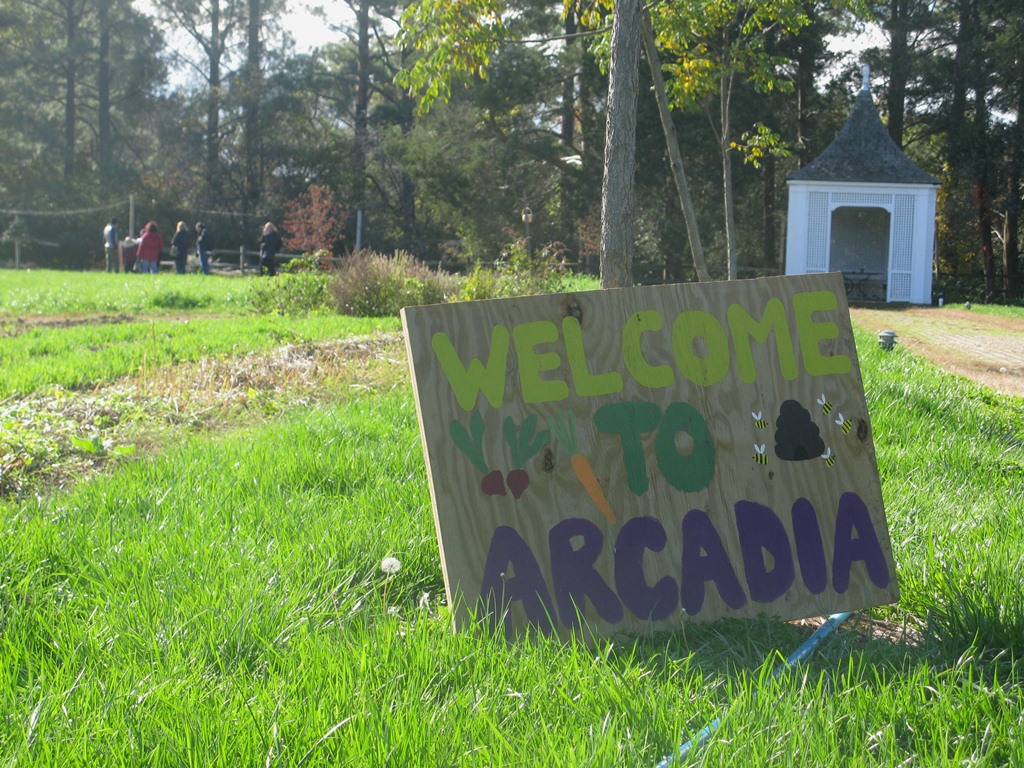
Andrea originally found a home for the network at the Capitol Area Food Bank in northeast D.C. But this year she struck up a partnership with a local restaurant business called Neighborhood Restaurant Group and its foundation arm, Arcadia. They struck a deal with the National Trust for Historic Preservation to start a children's garden at Woodlawn Plantation, a property once owned by George Washington and located just a few miles from Mount Vernon in suburban Virginia. It's called Arcadia Center for Sustainable Food and Agriculture, "dedicated to creating a more equitable and sustainable food system and culture in the Washington, DC area and a collaborative space for the many local efforts and initiatives around better food."

The garden and the staff who tend it now host regular visits from D.C. school children. The D.C. Farm to School Network at Arcadia also retrofitted a bio-diesel-fueled school bus to take garden plants and fresh produce to D.C. schools--a kind of garden on wheels.


Kids love to dig in the garden

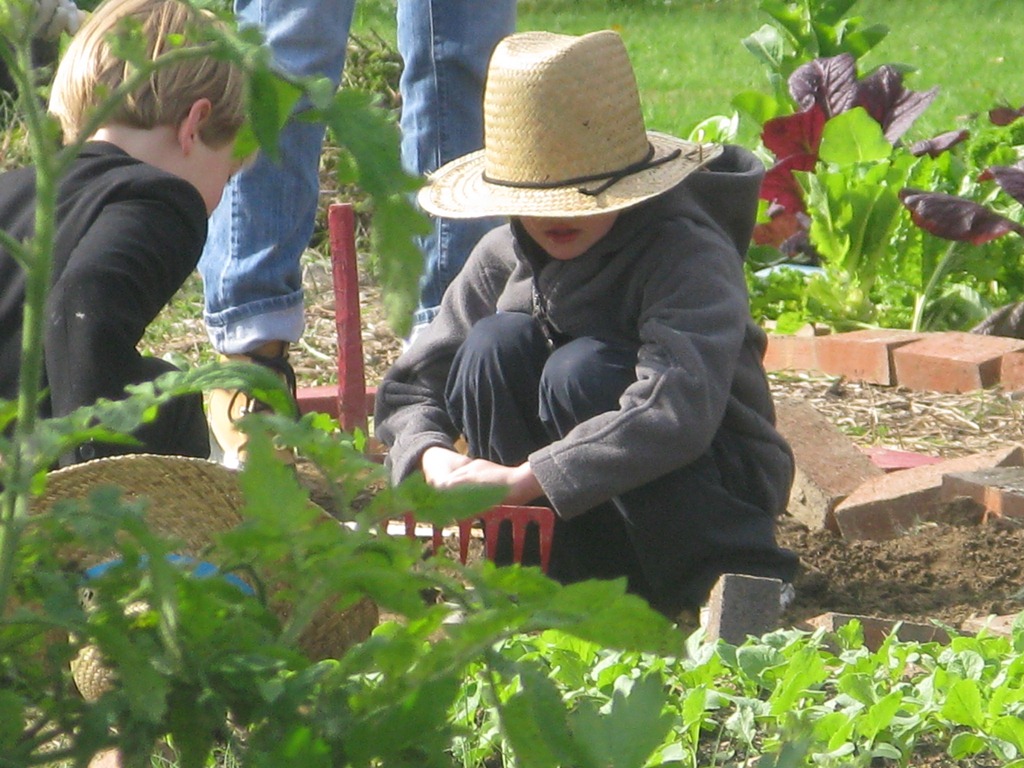
On Friday, the garden was hosting a group of children from the private Lab School. Among the organized activities, kids learn about butterflies and how salads grow. But I think their favorite part is just running around and digging in the dirt with rakes. There are plenty of herbs for kids to touch and smell. Straw hats provided by the garden give the kids a real professional gardener look.


Kids posing as bees deliver pollen

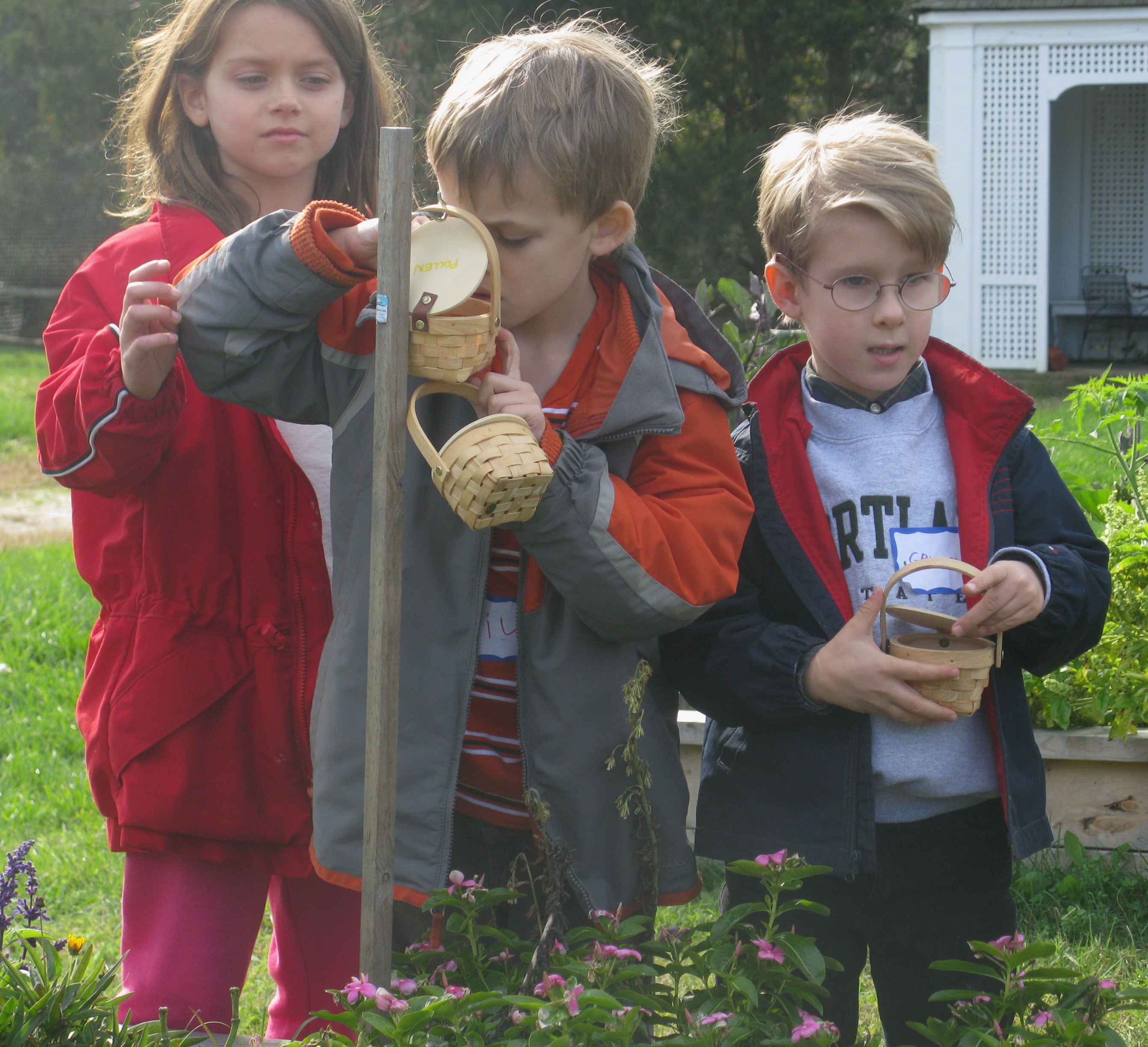
To demonstrate how plants depend on bees and other insects for pollination, the kids get little baskets filled with colored balls of cotton. Their job is to fly around the garden and deposit the "pollen" in baskets hanging from strategically planted wooden posts.

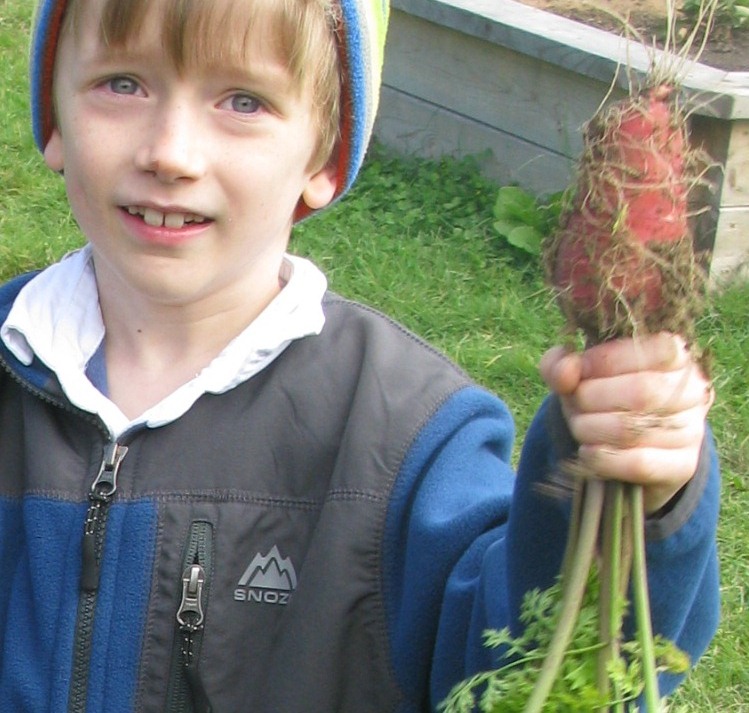
Finally it was time for the children to get a lesson in harvesting greens and vegetables for a salad. They don't need much instruction before they are racing from one raised bed to the next, plucking leaves of lettuce and mustard greens and yanking jumbo-sized carrots out of the soil.


Catch of the day: carrots

My job was to peel and chop carrots and one giant beet for a salad bar. The garden has it's own weather-proof salad bar in the outdoor "kitchen" and eating area. The kids would also get a demonstration in salad and vinaigrette making from a professional chef, before having their turn at the salad bar.


A 7-year-old who knows his salad

We couldn't stay for lunch. Annika had to get back to her hotel and prepare for the flight back to Sweden. But I know she was impressed. They may have universal free school lunches in Sweden, but the farm to school concept has yet to catch fire. Schools there simply don't have the funds to transport children to farms on a regular basis. And that's part of the attraction of Arcadia: it's closer to city schools than any traditional farm, and you don't have to find a farmer willing to take visitors.

"I'll always remember this day," Annika said.

Friday, September 9, 2011

Get Ready for Farm to School Week

Kids learn where their food comes from

Guest Post

By Andrea Northup

What’s a child’s first reaction to a bright orange roasted sweet potato on her cafeteria tray? “Weird!” or “What’s that?!” But take that child to a nearby farm and show her how sweet potatoes are grown; or bring a local chef into her classroom to make a delicious sweet potato dish. Then what? That sweet potato in her school meal is gone before you know it.

The D.C. Farm to School Network is pleased to announce that the third annual D.C. Farm to School Week will take place October 3-7, 2011 in schools across Washington, DC! The week will get students excited about local food and where it comes from. Schools will feature seasonal, local foods in their school meals, and engage students in hands-on food education.

Get your school involved! Learn how at www.dcfarmtoschoolweek.org, where you’ll find tools, resources and instructions for registering your school. The D.C. Farm to School Network will help every step of the way.

Sponsor the event! We're looking for organizations and individuals interested to help make D.C. Farm to School Week a success. Read our Sponsor Packet to learn more.

The event will kick-off the first ever National Farm to School Month in October, celebrated by schools all over the country. Last year, over 150 schools served up seasonal specialties such as honey-braised local apple and collard green salad, and Asian slaw with local cabbage during D.C. Farm to School Week. And dozens of schools coordinated farm field trips and chef demonstrations to engage students in the farm-to-table process. Let’s make this year’s event even better.

For more information, visit www.dcfarmtoschoolweek.org or email Andrea Northup, D.C. Farm to School Network Manager at the Arcadia Center for Sustainable Food & Agriculture, at andrea[at]dcfarmtoschool[dot]org. This event is brought to you by the D.C. Farm to School Network and the Office of the State Superintendent of Education Department of Wellness & Nutrition Services, in conjunction with schools and other community partners. And remember, D.C. School Garden Week will take place Sept. 26 - Oct. 1.

Wednesday, June 29, 2011

What's for Lunch: Local Beef


By Andrea Northup and Anna Chute

Lisa Dobbs, Chef and Nutrition director at E.W. Stokes, will stop at nothing to make sure that the 350 students she serves each day have healthy, delicious meals. Cooking from-scratch and using no processed foods, she and her staff prepare breakfast, lunch and supper in their antiquated kitchen for the school’s population of mostly low-income students. Lisa incorporates fresh, locally-grown foods whenever possible, especially on the school’s salad bar. And she works with the rest of the school staff to ensure that the school’s garden, nutrition and wellness programs are coordinated with her healthy menus.

As the Director of the D.C. Farm to School Network, I heard about Joy Evans from a friend who works in a local farm-to-table restaurant. Joy and her husband operate a business called Shenandoah Foods, which delivers meat, cheese and eggs from Virginia’s Shenandoah Valley to Washington, DC-area restaurants. Joy takes a delivery fee from her clients to run her business, and then farmers deal directly with customers to handle food costs. I reached out to see if she might be interested to work with Washington, DC schools.

Getting local meats into school meals is difficult. Most schools buy pre-cooked commodity meat from large distributors. It’s cheap (less than $1 per lb) and can be ordered in the evening and delivered the next morning – a system that’s hard to beat. But we’re not quite sure where it comes from, and it’s not always the highest quality product. But with about $1 per meal to spend on food, school food service directors have to make difficult choices about what they can afford.

I invited Joy and her husband to Washington, DC to meet with a few schools interested in buying local meat. We had a lively discussion about what products schools want, how much they need, what prices they can afford, and how to handle invoicing and delivery. We tried some delicious cheeses, Virginia-grown ground beef hamburgers, and fresh yogurt with local berries. If your mouth isn’t watering, it should be - the school food service providers could taste difference.

Joy and Lisa connected, and decided on a trial-run of 200 pounds of lean ground beef for $2.60 per pound. Joy picked up the meat from D&M Meats in Harrisonburg, VA in her refrigerated van, and delivered it to E.W. Stokes in conjunction with her regular restaurant deliveries. Lisa and her team expertly sautéed and seasoned the ground beef, and served it with pico-de-gallo, tortilla chips, and fresh guacamole. The result? A delicious and healthy meal for hungry students, which put money into our local economy, supported a sustainable small producer and made clean-beef fans out of Stokes’ young scholars.

Lisa Dobbs, Food Service Director at E.W. Stokes says the quality of the Virginia-grown beef is unparalleled. There isn’t murky liquid left over after cooking – something she’s used to with the lower-quality products. “We would never go back to the beef we were cooking before! We would drop beef from our menu entirely if we had to go back,” says Lisa.

Lisa can’t serve local meat every day, but it’s on the menu about once or twice a week, and they are looking to incorporate other items like chicken and eggs. We’re working to get more schools on board, and we’re excited for the potential to grow this partnership.

Andrea Northup is manager of the D.C. Farm to School Network. Anna Chute is the network's intern. This article originally appeared on the Arcadia Center for Sustainable Food and Agriculture blog.

Thursday, May 26, 2011

D.C. Farm to School Day: Strawberries & Salad Greens

By Ed Bruske
aka The Slow Cook

Yesterday was the annual big event for our D.C. Farm to School Network: Strawberries and Salad Greens. Network coordinator Andrea Northup outdid herself this year: schools in all eight wards of the city had volunteers signed up to engage kids in learning where their food comes from, specifically the strawberries and salad from local farms that were served for lunch.

All of the kids in the cafeteria got a sticker and they proudly showed them off.


At my daughter's school, there was a display of salad greens from the newly installed gardens. The strawberries, supplied by local farmers, were incredibly ripe and delicious.

This year I acted as "contact" for the event at daughter's elementary school, meaning I dropped by an "orientation" last week hosted by Whole Foods, where volunteers were supplied with all sorts of signage, photos of local farmers in action, and stickers to hand out to the children featuring original logo art.

Here you can see my wife doling out salad greens. She was impressed by how many of the kids requested salad--hesitatingly at first, but once one of two agreed to try it, soon they were all clamoring for it. Just shows why school cafeterias need more adult presence to coach kids in better eating habits.

The original concept was to have a table posted near the cafeteria where the kids could see the signage and photos and get their sticker. In our case, there wasn't really anywhere to put such a table, so I went around the room with a display of lettuce and strawberry plants that the farm to school network had conveniently dropped off at my home on Tuesday.

"Hey, kids! Did you know that lettuce and strawberries grow out of the ground?"

Some kids actually said, no, they didn't know that. Many of them wanted to touch the strawberry leaves, others asked if they could eat the lettuce. I think they were joking.

In the background, you can see the bulletin board where we taped the various signage and photos supplied by the farm to school network. No sooner had we posted it in the morning than a group of kids gathered to inspect a seasonality chart.

"Oh, I've had asparagus before," said one boy.

"Me, too," said a second. "I really like it."

Once we had the kids going, they were hard to stop. Soon they were following me around the cafeteria, telling me about the vegetables they grow at home.

"I have two strawberry plants," said one little boy. "The strawberries are about this big," he said, using his hand to indicate berries that weren't ready to eat yet.

"My grandmother grows rhubarb," said another.

Who likes strawberries? I asked them. They all raised their hands.

Wednesday, March 2, 2011

Eat Out Thursday to Benefit D.C. Farm to School

Local D.C. Restaurants for Local Kids Fundraiser - March 3rd, 2011

On Thursday March, 3rd, 2011, portions of proceeds from some of the best farm-to-table restaurants in the District of Columbia will go to the D.C. Farm to School Network. Enjoy a night out and support two good causes: locally-owned restaurants that source from farms nearby, AND the D.C. Farm to School Network, which connects D.C. schools with healthy, local foods for their school meals.

Here’s how it works...

Choose from the many great local restaurants that graciously agreed to donate a percentage of proceeds from sales for the event. Participating restaurants include Bar Pilar, Eatonville, Equinox, Poste Moderne Brasserie, Cafe St. Ex and Zest Bistro.

Check out this MAP for the full list, where you can see the percentage of proceeds each restaurant will donate. Check back often (more restaurants are coming on board every day!) Make reservations if the restaurant is busy, and then enjoy your dinner and drinks on March 3rd knowing a portion of your check will go to D.C. Farm to School Network.

Friday, November 26, 2010

Farm to School Week in D.C.


It's time for this movement to explode! I'm very excited about what's happening here.

- Kathleen Merrigan, USDA, on the Washington, D.C. Farm to School Movement

By Andrea Northup

The week of October 12-15 2010, marked the second annual D.C. Farm to School Week - a celebration of farm-fresh fruits and veggies in D.C. schools! In total, 28 schools coordinated events f0r the week. Over 500 students experienced farm field trips where they harvested local produce and learned about farming in the region. Over 1,100 students experienced cooking demonstrations where professional chefs prepared local foods with students in healthy, delicious ways.

Throughout the week, school menus featured locally grown produce in dishes like salads and seasoned vegetables, serving over 30,000 students in cafeterias across the District. For example, Revolution Foods celebrated the week by serving Carrot, Raisin and Apple Salad in each of its D.C. schools. DC Central Kitchen featured local honey apple braised collard greens and DCPS students served by Chatewells enjoyed Asian slaw with locally grown cabbage.

The week began with a kick-off celebration marking the start of D.C. Farm to School Week and D.C. School Garden Week. We were joined by White House Chef Sam Kass, White House Pastry Chef Bill Yosses, and Deputy Secretary of Agriculture Kathleen Merrigan. The program featured a Top Chef-style competition between four local chefs and their student assistants. Student judges voted Chef Tee with his Apple Cranberry Crisp as the winner! Keep your eyes peeled for his recipe in DCPS school meals this December.

D.C. schoolchildren visited both rural and urban farms to learn about farm life and to be a part of growing and harvesting food. Kids picked apples, harvested kale, explored greenhouses, and even held warm chicken eggs. Two farmers even traveled to the schools, bringing truckloads of produce, seeds for planting, and a 12-pound cabbage that kept the kids talking for days!

When they came back from the farm, the kids were so excited and ready to share. They were introduced where vegetables really come from, which I don’t think they really knew. Now they may be willing to explore something different, something they may not have tried before.

- Principal Angela Tilghman, Garfield Elementary

More than 1,100 students had the opportunity to participate in cooking demonstrations with a host of dynamic local chefs. Many prepared recipes using the fruits and vegetables they harvested earlier in the week. Students helped create kale salads, braised apples and collard greens, tomato bread salads, and tofu vegetable dumplings, among other healthy recipes highlighting seasonal and local produce. [Link to recipe book] For many students, this was their first time ever tasting leafy greens like kale and chard, and fall crops like squash and sweet potatoes. They were asking for seconds and thirds!

I’ve never seen so many kids eat salads!

- Parent organizer at Brent Elementary

D.C. Farm to School Week was more than just classroom lessons about growing food and eating healthy - it was a chance for our entire community to come together. As teachers engaged in the Week’s activities with their students; chefs, grocers and restaurants shared their time and talents; farmers opened their fields to inquisitive children; and parents helped coordinate events, we saw a community working together to grow a healthier generation.

Andrea Northup is coordinator for the D.C. Farm to School Network.

Tuesday, August 17, 2010

Getting Fresh Produce to D.C. Kids


Guest PostAdd Image

By Katherine Bryant


Greetings from Delaware, the watermelon capital of the world!


Recently I had the good fortune to join a small group of D.C. school food service providers, Farm to School Network Coordinator Andrea Northup, and a D.C. City Council staffer on a trip to Delaware--a fitting ‘initiation’ into my role as DC Farm to School Network intern. The goal of the trip was to get a feel for Delaware’s local food supply, and explore how that supply can connect with the demand for local foods in the D.C. school system.


Our knowledgeable and well-connected host--fourth-generation watermelon farmer and Delaware Fruit and Vegetable Association president David Marvel--led our energetic and passionate group on a wonderful journey of learning, networking, and of course, eating!


Just a two-hour drive from the District of Columbia, Delmarva (a catchy name for the Eastern Shore region of Delaware, Maryland, and Virginia) makes its mark as the epicenter of watermelon production, with a notable portion of the country’s corn and lima bean yield as well. Our first stop was the S.E.W. Friel sweet corn farm.


We were able to snag a few minutes with the farmers amidst the business of a season full in swing--which means around the clock harvesting, packing, distributing and marketing of products. We stood in awe of the over 13-feet tall machines capable of harvesting 60,000 lbs of corn per hour. We chatted with some of the many folks who work in concert to bring that sweet corn all the way from seed to harvester to tractor-trailer truck to storage facility to point-of-sale (e.g. supermarket) and finally to some lucky family’s home.


Would you have guessed that both schoolchildren and Delmarva watermelons use the same form of transportation? In our exploration of the watermelon’s journey from farm to table, we learned that retired school buses are rendered windowless and accompany teams of migrant workers as they walk through fields tossing watermelons on board. The roads of Delaware are jammed with melon-filled buses on their way to washing facilities, auctions or markets.


We saw Lakeside Farms. It was here that we met Sean Cloughtery, Managing Editor of American Farm. He shared our adventures with the farming community.

We watched in fascination at the Laurel Produce Auction as truckloads of locally-grown produce were paraded and sold to the highest bidder by what appeared to be inconspicuous nods. From mid-July until mid-September, the Auction sells an average of 2.3 millikon watermelons!


We paid a visit to the Kenny Brothers cucumber sorting and grading facility, for a glimpse into how a cucumber becomes a pickle. The facility washes, sorts and ships 15-20 truckloads per day to local pickle manufacturers - each truckload containing five-acres worth of cucumbers!


Over lunch, we met and shared ideas and best practices with the inspired folks behind the Delaware Farm to School Network, a coalition of Delaware Department of Agriculture, Department of Education, and private/non-profit sector partners led by Nemours Health & Prevention Services.


We also stopped at Fifer’s Orchard and Market and tasted some of the best peaches in Delaware. And of course, no day would have been complete without a stop at the Delaware State Fair, complete with animal auctions, 4-H and FFA displays, kettle corn, and John Deere farm equipment.


The trip offered a valuable perspective on the scale of production needed to feed the children of Washington, DC; the kindness and generosity of those local food producers and their willingness to meet that demand; and the tremendous process involved in getting food from farm to cafeteria tray.


When it was over, we piled into our van, District-bound and laden with some of the best fruits and vegetables available in Delaware. We also came home with big dreams for schools and growers and how to narrow the gap between them.


Katherine Bryant is an intern with the D.C. Farm to School Network, and a seasoned community food security advocate.