Showing posts with label France. Show all posts

Saturday, June 4, 2011

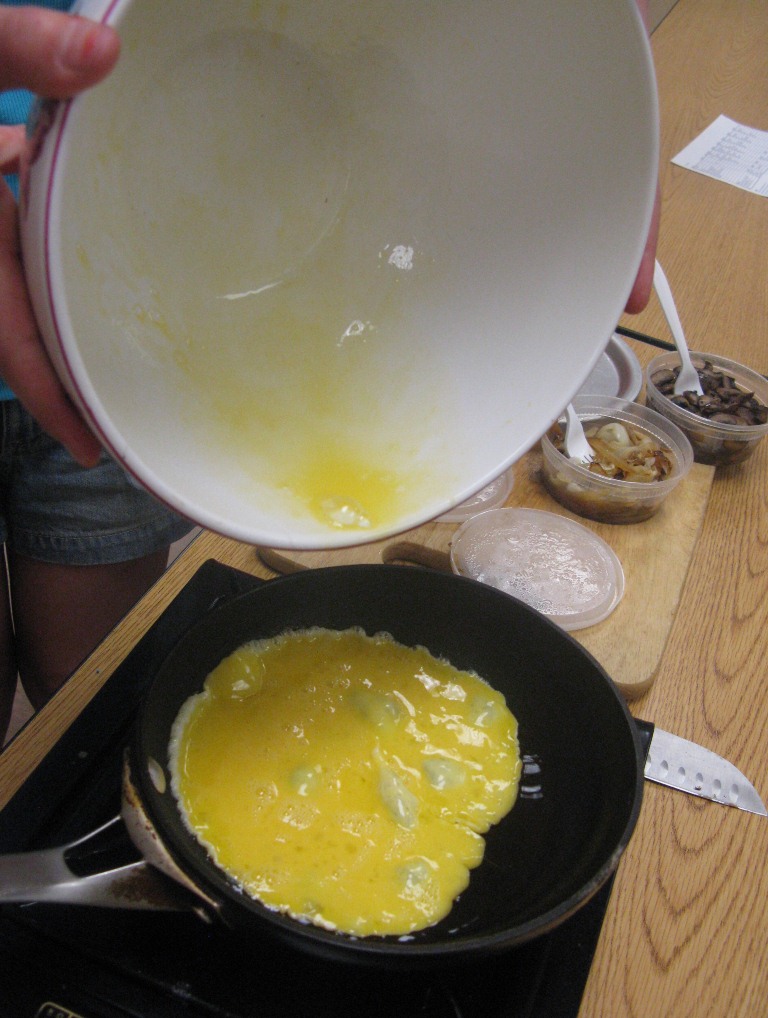
Kids Make Mushroom Omelets

Omelets made on the cassette feu

By Ed Bruske

aka The Slow Cook

This was our last week of food appreciation classes for the current school year. How tragic is that? It's also our final week in France on our virtual world culinary tour, so I picked something simple but classic to make with the kids: omelets.

I brought my cassette feu--or portable butane burner--to class so we could make the omelets at our usual work table, rather than at the stove, which is at the other end of the kitchen area. The work surface is also lower, which makes it easier for the kids to actually test their skill at making the omelets--meaning scraping around the edges of the eggs as they cook, tilting the pan to run the uncooked egg onto the surface of the pan, folding the omelet in half.

You don't want the pan too hot or the eggs will cook too quickly, brown too much, and possibly even burn. You also need to work fairly quickly so that you can add your filling--in our case sauteed onions and mushrooms--before the eggs are completely cooked. They should be still wet when you fold the omelet. The omelet will seal itself as it finishes cooking. I usually place a lid over the pan and lower the heat to assist in the process.

Preparing mushrooms for the saute

As always, the challenge is finding enough work for the kids to do. I had them slice cremini mushrooms and dice onions for the fillings. Half of a medium onion, cut into medium dice, plus a couple of handfuls of cremini mushrooms, thinly sliced, is enough for three omelets. We sauteed the onions and mushrooms together in some extra-virgin olive oil. Season with salt to draw out the liquid.

The kids also get to crack and whisk the eggs, one of their favorite kitchen tasks. They always leap at a chance to crack eggs. We added Roquefort cheese to our omelets, which works well with caramelized onions and presents an opportunity to talk about French cheese making and beneficial molds. After that, it's simply a matter of standing back and watching the kids gobble up the omelets.

This is one of those dishes that kids either love or hate. Some don't want the mushrooms. Others swoon over mushrooms. My own daughter won't eat eggs. But making omelets is one of her favorite kitchen activities. You just never know how kids are going to react to different foods. But I'd rank omelet making high on my list of essential kitchen skills.

Saturday, April 23, 2011

Who Knew? Kids Love Chicken Liver!

Squishy, slimy chicken liver: kids love it

By Ed Bruske

aka The Slow Cook

Sometimes I like to test the kids in my food appreciation classes with a food I'm sure they'll find repulsive. Not long ago it was squid. This week, I brought them chicken liver. And just to challenge them even more, I urged them to pick up with liver in their hands and feel it. Pretty gross, no?

I think it's important for kids to experience food with all of their senses--including their sense of touch. And if we're going to kill animals, I think they should learn about all the edible parts. Of course they backed away from the chicken livers at first. But pretty soon they were playing with them and having a great time, as you see here. And when the livers were cooked--surprise!--the kids wolfed them down asked for more. (Well, maybe not all of the kids. But a surprising number, I'd say.)

This was all part of our continuing world culinary tour. We've been lingering in Spain recently, cooking all kinds of tapas or small plate dishes. But it was time to move on to France. The southwestern part of that country is known for its various treatments of ducks and geese, as in confit of duck--or duck preserved in its own fat--and turned into a delectable stew with beans and pork called cassoulet. I would love for my kids to make cassoulet, but it takes about three days to prepare properly, so I searched through Paula Wolfert's definitive book, The Cooking of Southwest France, and found a recipe for a watercress salad with duck (or chicken) liver.

Not having ready access to duck liver, I opted for the chicken liver at the local supermarket. I also switched baby salad greens for the watercress. In any case, this is a wonderful salad with crisp apple, strips of salami, walnut oil and sherry vinegar--ingredients we don't use every day, but truly representative of a certain part of the world where they pay close attention to the flavors derived from particular local ingredients.

Start by soaking one chicken liver per person in lightly salted milk for at least three hours. I'm not sure exactly what the milk is supposed to do, except perhaps soften the liver flavor. Then rinse the livers thoroughly in a colander and drain them well. Set the colander aside over paper towels so the livers can dry a little while you prepare the rest of the salad.

You'll need half of a crisp apple, unpeeled and thinly sliced. Toss the slices with the juice from 1/2 lemon, then add 1/2 leek, cleaned and thinly sliced. Add a mix of baby greens--or watercress if you have it.

Cut one slice of garlicky salami per person, then cut the slices into thin strips. Set aside.

In a separate bowl, make a vinaigrette with the juice of 1/2 lemon, 1 tablespoon sherry vinegar, 1 tablespoon walnut oil and 2 tablespoons extra-virgin olive oil. Season with salt and freshly ground black pepper and whisk until thickened.

To finish the livers, cook in a heavy skillet with plenty of butter over moderately low heat. You don't want to burn the livers, just cook them gently until lightly browned. Turn them once. When they are cooked through, remove from heat.

Toss the salad with enough vinaigrette to lightly coat. Arrange the salad on individual plates and garnish with the sliced salami. Place chicken livers in the middle of the greens and serve. Watch the kids gobble it up.

Thursday, May 20, 2010

School Food in Lyons, France: Where Taste and Culture Matter


Guest Post
By Nicholas Morin

Directed here from an article in the New York Times, I've been interested in reading this blog and I thought I could share something with you in return: I live in Lyons, France, and I have a 6-year-old daughter. She eats at school every day, and I thought it might be interesting to share with you what she eats at her school.

Obesity is rising in France: from about 6% of the population in 1990, to a little under 10% today. But that's still very low compared to more than 25% in the US. And Wikipedia tells me that "while French youth culture has gravitated toward fast food and American eating habits (with an attendant rise in obesity), the French in general have remained committed to preserving certain elements of their food culture through such activities as including programs of 'taste acquisition' in their public schools".

Yes, my daughter has a "taste acquisition" class in school: it's part of the curriculum here to be taught about food, not just as something abstract (remember the "food pyramid"?), but official programs say children should be taught about different tastes. And they are also encouraged to talk about what they feel when they taste something. Children are taught that food is something cultural, something you experience: food as taste and culture.

This cultural bias towards food and it's importance shows in what children eat when they eat at school. Even though each school contracts independently with a catering company, selecting offers from the marketplace, schools have to abide by national guidelines in the contracting process. Those guidelines mandate certain things about food security or waste management, but they also mandate things about the diet itself.

For instance, the guidelines require that each menu should have at least one dairy product, three courses, etc. At the local level, parents get the menu for every school day about three months in advance. Here's what my daughter had last week:

Monday: Grated carrots with a light vinaigrette; roasted chicken wing with cauliflower in a "béchamel sauce", aka "white sauce"; blue cheese; a fruit.

Tuesday: Cold vegetable pie with vinaigrette; fish with a tomato sauce; pasta; cheese; a fruit.

Wednesday: No School

Thursday: Green salad; veal with olives and beans; a yogurt; a fruit.

Friday: potato salad; cheese omelet with spinach; fresh goat cheese; a yogurt.

That's it. Does anything about this sound wrong to an American ear? Besides a lot of cheese?

Choice: There is no choice. Children don't get to choose if they'd rather have cauliflower or fries. It's mandatory: cauliflower for all! If your kid hates it--well, she'll eat better tomorrow: it's spinach day!

But in truth, my daughter loves to eat there.

Wednesday, March 3, 2010

Imagine School Lunch in Paris

What do other countries do about school food?

TIME magazine recently published the account of an American living in Paris who discovered that even where her pre-schooler is concerned, the French take their school meals quite seriously.

"In a country where con artists and adulterers are tolerated, the laws governing meals are sacrosanct and are drummed into children before they can even hold a knife," she writes. "The French don't need their First Lady to plant a vegetable garden at the Élysée Palace to encourage good eating habits. They already know the rules: sit down and take your time, because food is serious business."

Every meal includes an hors d'oeuvre, salad, main course, cheese plate and dessert. The schools even give suggestions for what to serve for dinner at home to compliment school lunch.

Meanwhile, at School Lunch Talk, writer Deborah Lehmann describes lunch in one Paris school district: cucumbers with garlic and fine herbs; Basque chicken thigh with herbs, red and green bell peppers and olive oil; couscous; organic yogurt and an apple. For snack, they had organic bread, butter, hot chocolate and fruit.

In elementary school, the lunches are served in a restaurant scolaire "where furniture, silverware and sound level are just as important as the food itself." In that Parisian district, the schools spend $8.23 to produce lunch. Compare that to the $2.68 per meal subsidy our federal meal program allots.