Showing posts with label lunch. Show all posts

Friday, June 10, 2011

What's for Lunch: Uneaten Tilapia

By Ed Bruske
aka The Slow Cook

D.C. schools lately have been serving tilapia on Thursdays on a fairly regular basis. You might think that's a great thing. Fish is a clean, lean source of protein and exposes children to something different from the usual routine of chicken nuggets and mac-n'-cheese.

But while fish looks great on the menu, it doesn't go over so well in the cafeteria--at least not at my daughter's elementary school in Northwest Washington. Yesterday I was careful to wait until most of the kids had eaten, then I took a slow walk around the lunch room. I saw only three kids who had actually eaten the tilapia. A couple others had poked at it.

Most of the trays looked like this one. As you can see, the fish hasn't been touched at all. Nor was the featured vegetable side dish, the "crunchy spinach," as Chartwells calls it, a mix of frozen spinach, corn, peas and sunflower seeds. It's a clever combination of vegetables--whoever thought of it deserves a hat tip. But the kids don't eat it.

What did they eat from this meal? From what I saw, this tray was pretty typical. The kids dove into the roasted potatoes and the whole wheat biscuit. In other words, they gobbled up the starch.

Kids love potatoes, of course. It's their second favorite food after pizza. And now there's a controversy around spuds because the new meal guidelines the USDA has proposed would limit servings of potatoes and other starchy vegetables--corn, peas, lima beans--to just one cup per week in favor of more green and orange vegetables that kids are much less fond of.

They also loved the watermelon. And what's not to like about that? I tasted the watermelon and it was delicious. So much of the fruit served in school isn't nearly ripe, but this watermelon was. This was a real treat.

The lesson I draw from all this is that menu changes don't mean nearly as much as what actually takes place in the cafeteria. You can put "healthier" foods in front of kids every day and still they'll only eat what they want and throw the rest in the trash.

I shudder to think how much uneaten tilapia D.C. schools sent to the landfill yesterday.

Thursday, June 9, 2011

Lunch from Home: Tofu & Noodles

By Ed Bruske
aka The Slow Cook

Our daughter loves tofu and Chinese food. So for a special school lunch treat I sometimes stop at the hot food bar at our local Harris Teeter and put together a meal like this one, with tofu in a spicy sauce, noodles and vegetable won tons.

I try to minimize the carbs. Daughter would eat noodles and rice all day if you let her. And I know I don't get any browny points for buying prepared food at the supermarket. Still, I don't think it's such a bad thing, and I know daughter appreciates it. She doesn't care much for the food at school.

What do you think? Am I a really bad dad for feeding my kid from the food bar at Harris Teeter?

Tuesday, March 29, 2011

What's for Lunch: Cheeseburger or Ham & Cheese?

By Ed Bruske
aka The Slow Cook

You definitely needed two packets of ketchup for this lunch--one for the burger and one for the potato wedges. Most of the kids dove straight into the potatoes. They're not fries, exactly, but they look enough like fries to make them irresistible.

Wouldn't you know it, the USDA is proposing to tightly restrict fries and all other kinds of potatoes in school meals, as well as other "starchy vegetables" such as corn, peas and lima beans. Instead, schools would have to serve bigger portions of green and orange vegetables. In other words, the governments wants schools to serve more foods that kids don't like, and cut back on the food kids really love.

This is the formula for making school food healthier. The question is how we go about convincing kids they should eat it. I really wanted to taste the burger, but by the time the last kid had gone through the food line all the burgers were gone. Here's was was left: the alternated ham and cheese sandwich.

In fact, it was pretty good, the ham being "turkey ham" spread on toasted whole wheat bread. Okay, it was a little stale. But still....Carrots sticks with ranch dressing came on the side, and the lunch ladies tossed in some potato wedges to finish things off.

Monday, March 28, 2011

What's for Lunch: Uneaten Chicken Fajitas

Ed Bruske
aka The Slow Cook

This meal was a great disappointment to me, and not because the food wasn't good. I was just baffled that the kids showed so little interest in eating it.


As you can see, the large, whole wheat tortilla was filled with strips of seasoned chicken. These arrive at the school frozen. It's no trouble reheating them in the commercial steamer. But apparently, most of the kids thought the tortilla and the chicken inside were "nasty."

As best I could tell, only a couple of them in the entire lunchroom were actually picking the tortilla up and eating it. A few nibbled around the edges. Otherwise, they just left it on the tray untouched.
As frequently occurs, the kids have absolutely no idea what to do with the condiments on the side--in this case the lettuce, the chopped tomato and the grated cheddar cheese. At my table, I demonstrated how these were supposed to be piled on top of the chicken inside the tortilla. Looks lovely, no?

The refried beans--out of a can--weren't any better than they look. They were merely edible. Otherwise, I thought this was a terrific meal that mostly went into the trash.

Friday, March 11, 2011

What's for Lunch: Chicken Florentine?

By Ed Bruske
aka The Slow Cook

Here's another example of some of the clever new options we're seeing on the menu in D.C. schools this year. Someone thought to take a piece of flat bread and cover it with "chicken Florentine."

Where I come from, "chicken Florentine" means sauteed chicken tossed with spinach and a wine-infused cream sauce. This was a bit more like a pizza (kids love pizza, as we know). I tried it and did not taste any cream or wine, although it was perfectly palatable--more a mouthful of spinach with a bit of onion and some scattered pieces of diced chicken, all topped with some melted cheese.

The kids, on the other hand, looked at it and were completely intimidated by all that spinach.


This looked like a repeat of the homemade spinach lasagna experience we've seen before, where kids assiduously work their way around the spinach to get at the pasta and the cheese. In the case of this chicken Florentine, I was surprised to see that most of the kids in the lunch room never touched it.

Just to make sure, I took a walk around the lunch room and, sure enough, the entree in most cases was entirely uneaten. Some of the children--we're talking elementary school kids in the upper grades--were tentatively nibbling on the flat bread around the edges. Others, like this girl here, were a bit more bold. They had scraped all the spinach off the flat bread, then attacked the bread and picked through the green matter to get at the cheese and chicken bits.

On the tray also were some carrot sticks tossed in ranch dressing that were definitely more popular. Many of the kids also had sampled the peas. But just a note here on that: peas are one of those "starchy vegetables," along with potatoes, corn and lima beans, that the USDA proposes in new meal guidelines to sharply limit in the future.

The federal government would like to serve kids much bigger portions of things they don't normally like--vegetables and whole grains--and take away things kids really love, like potatoes (especially French fries). Sound like a winning formula?

Monday, March 7, 2011

Decoding Congress' Stealth Formula for Raising the Price of School Lunch

Higher prices mean fewer kids in the lunch line

By Ed Bruske

aka The Slow Cook

A little knowledge can be a dangerous thing—especially when it results in a stealthy government formula for raising lunch prices at the nation’s schools that will cause hundreds of thousands of children—perhaps millions--to abandon the program.

In its recent re-authorization of the school meals program, Congress included a provision that would force schools to raise the price they charge students who don’t qualify as low-income.

Some hailed this little-noted mandate as a way to generate what the USDA estimates could be a $2.6 billion windfall for schools over 10 years. But I wondered, did this estimate include all the kids who will stop buying the much-maligned school lunch if it gets more expensive? And how could the federal government possibly know how many kids would drop out of the lunch line rather than pay the higher tab?

It took some weeks of prodding, but I finally obtained an internal document from the USDA’s Food and Nutrition Services branch revealing how the agency at the Senate's behest formulated the magic number--$2.6 billion—that it then passed on to the committee where the price mandate was hatched.

It also confirms what I originally suspected: The government can’t really know what will happen to participation in the lunch program if schools raise prices. You might expect the federal government to bring every possible resource to bear and weigh ever so carefully a decision that stands to affect some 90,000 public schools. But that is not the case.

“We do not prepare or publish cost estimate memoranda in the way that the Congressional Budget Office sends such materials to members of Congress,” explained a USDA spokesman. “There was no formal document or methodological write-up given to the committee. The agency gave the committee a number in answer to a question.”

So here’s where the number came from:

School food experts for years have known that raising the price of lunch means some students who pay "full price"--about 12 million of the 32 million who participate in the school lunch program on any given day—will stop buying it.

In 2005, Mathematica Policy Research, contracted by the USDA to conduct one of the agency’s periodic reviews [PDF] of the school meals program, created a statistical model that estimated 56 percent of paying students would buy lunch if the price were $1.50, but that fewer—50 percent—would pay if the price were $2.00.

It’s important to note that Mathematica did not conduct a study of children’s actual purchasing behavior at different price levels. What they gave the USDA was a modeled prediction based on all sorts of data the firm collected from 2,314 students at 398 schools that year, including the types of food served, the amount of time kids were given to eat, prices charged, and interviews with children and their parents revealing what the kids typically ate in the course of a day and family income.

Based on Mathematica’s prediction within this narrow price range, Food and Nutrition Services extrapolated its own formula in order to respond to the Senate committee's request for an estimate: For every cent the price of lunch increases, students who pay full price will drop out at a rate of .11 percent. It then calculated that the Senate’s proposed lunch price mandate would generate $2.6 billion more income over 10 years—and cause nearly 500,000 paying students to stop buying lunch.

But that's hardly the end of the story. Under the new mandate, schools will be required to raise prices each year by an amount equal to the rate of inflation plus two percent until they are completely caught up with what the USDA estimates is the actual cost of providing a school lunch, currently $2.72. Many schools now charge as little as $1.50.

As if things couldn’t get any more complicated, the government’s baseline is a moving target. What the USDA calculates as the cost of providing lunch—the amount it gives schools to pay for a fully-reimbursable meal--is adjusted upward annually with the rate of inflation. Thus, the vast majority of schools will take longer than 10 years to reach the government’s baseline. Nearly half will take more than 20 years.

Could the USDA’s formula for calculating drop-outs possibly hold up that long and under all sorts of different economic conditions?

“They [the USDA] asked us that, and we told them we had a problem with it,” said Mathematica senior researcher Anne Gordon, one of the report’s primary authors. “I don’t remember exactly, but I think it was around $3 we couldn’t make a prediction. We can’t know what will happen at that price, because none of the schools we looked at charged that much.”

In other words, accepting the USDA’s predictions years into the future requires a leap of faith. “It’s probably the best they can do,” Gordon said.

The prospect of annual price hikes out to the horizon has caused great alarm among the nation’s lunch ladies. In the current recession, they are grappling with millions of dollars’ worth of meals eaten by children whose families are deemed able to pay, but haven’t.

School food service directors opposed a congressional edict to raise prices, but would have preferred a House version that “sunsetted” the law after 10 years and required the USDA to conduct an impact assessment after four years. But in a last-minute rush to enact the child nutrition legislation, that version never came up for a vote.

When I asked the School Nutrition Association, representing some 53,000 school food workers, to comment on the new law, they reported results from some recent price increases.

When the lunch price rose 15 cents to $1.75 in Munster, Ind., in 2008, for instance, nine percent of the kids dropped out. In Caroline County, Md., the price rose 35 cents to $2 in 2007 and participation plummeted 16 percent. In Franklin Township, Ind., schools hiked the price 15 cents to $2.10 in 2009 and 12 percent of the kids stopped buying. Schools in Willoughby-Eastlake, Ohio, raised the price 10 cents in 2008 to $2.60 and participation fell 10 percent.

SNA spokeswoman Diane Pratt-Heavner said that while food service directors accept Mathematica’s 2005 report as “the most comprehensive data available to FNS, they question it's accuracy in portraying how families will react to current price increases.”

“The economy is worse than in school year 2004-2005, and their own experience tells them that participation drops when you increase prices,” Pratt-Heavner said.

The School Nutrition Association is asking the USDA to test the lunch price increases on a pilot basis before imposing the mandate nationwide.

Besides higher prices, other looming factors will likely suppress school lunch participation and upset the cafeteria business model. Upgraded nutrition standards—including more helpings of vegetables, more whole grains, fewer French fries and other potato products, and much less salt in food—are expected to cause more paying kids to reject the federally-subsidized hot meal.

In a 2010 report to the USDA [PDF], Mathematica predicted that adopting a full range of improvements to make meals “healthier” would result in 5 percent of elementary school children dropping out of the program, and even more—12 percent—at the secondary school level.

Sociologist Janet Poppendieck, whose book on the federally-subsidized meals program, Free for All, has become a widely-cited text, rejects the idea of forcing schools to raise prices across the board.

Undercharging may give an unfair advantage to some families who can afford to pay at the expense of low-income children. But Poppendieck says the USDA is probably underestimating the number of parents who will react angrily to higher prices and pull their children out of the lunch line. And that could hurt the entire program's ability to function.

She fears for millions of children on the margins--those who aren’t exactly affluent, but don’t qualify as “low income” either.

“If we lose them, it’s not just the loss of children, we lose the claim that this is not just a welfare program,” Poppendieck said. “And the more school lunch has the label of being a welfare program, it imposes a kind of a shame tax on kids who do want to participate. I think that’s the wrong direction to go.”

Friday, March 4, 2011

What's for Lunch: Whole Wheat Spaghetti

By Ed Bruske
aka The Slow Cook

We check the Chartwells menu site each morning to see what's for lunch. On Wednesday, our daughter knew spaghetti was on the menu, yet she still insisted on taking her own steamed dumplings for lunch. It wasn't until she actually saw the pasta with the turkey meat sauce that she decided she had to have it and pushed the dumplings aside.

Yes, kids will go crazy for pasta. But I wondered how well they would take to the "whole wheat" spaghetti noodles in this dish. As I made my way around the lunchroom, asking the kids for their opinion, I heard time after time that they didn't especially care for the pasta. "It tastes like cardboard," seemed to be the general consensus.

And yet they ate it, mostly. And I have feeling they could get used to this kind of pasta--as long as it's smothered in meat sauce. You might recall a spaghetti and meatballs dish recently when the kids wolfed down the meatballs and asked for seconds, but threw the noodles in the trash.

Same goes for this "whole wheat" dinner roll. Most of the kids left it untouched. As they did the green beans. Having been steamed from a frozen sate, they were "seasoned" with a faux butter. I tried them and thought they were just fine. My daughter also liked them. "Hey guys, you should try the green beans!" she urged her table-mates at one point. But they were dubious.


Kids are always experimenting with ways to make meals more fun. Here's one fifth-grade girl who discovered a way to work her dinner roll into the pasta entree. She scooped the pasta with her "spork" and slathered it on the roll, creating a kind of pasta sandwich.


This is what a pasta sandwich should look like. The meat sauce is made by steaming frozen turkey "crumbles," then mixing them with tomato sauce and some dried oregano.
Note the designer fingernails as well.
Note: Occasionally Blogger has a mind of its own where the display of my photographs are concerned. I cannot get the top photo of the meal tray to display horizontally. Just turn your monitor 90 degrees.


Monday, February 28, 2011

What's for Lunch: Pizza and Uneaten Veggies

By Ed Bruske
aka The Slow Cook

I was intrigued by this "Sicilian cheese pizza with whole wheat crust"--so described by Chartwells at its menu website--because I had never seen a pizza so thin.

Turns out it was made with rectangular pieces of flat bread that conveniently fit precisely at the bottom of a stainless hotel pan. They're then slathered with tomato sauce and topped with mozzarella cheese.

The pizza, big slabs of it, did not look especially appetizing on the trays. But I tried it and it was quite good--if a bit limp. The "crust" was very soft. I wouldn't call it a crust at all.

What also fascinated me about this menu was the selection of sides. The green beans are pretty standard. But this celery? Really?

The Chartwells menu called for carrots with salad dressing, so I'm guessing the celery must have been a substitution for carrots that were never delivered.

The beans, delivered frozen, were steamed and seasoned with phony butter. I liked them, but the kids didn't touch them. They didn't touch the celery either. I took a walk around the cafeteria and didn't see a single child eating the beans or the celery. I may have missed a couple. But from what I could tell, all of these vegetables simply got dumped in the trash.

This is what most of the trays looked like after the kids finished their pizza.


Tuesday, February 8, 2011

Lunch from Home: Fettucine al Parmesan

By Ed Bruske
aka The Slow Cook

Is it any secret that kids love noodles?

Here's the simple lunch one boy brought to school recently: fettuccine pasta with peas on the side. The pasta appeared to have been dusted with Parmesan cheese, little more, and the boy was wolfing it down.

If the USDA has its way, noodles like this won't be served in the federally-subsidized school meal program. All grain products will have to be "whole grain-rich," meaning at least 51 percent whole grain.

The only problem with that is, kids don't really like whole grains. In fact, I recently witnessed a spaghetti and meatball lunch where the kids inhaled the meatballs and tomato sauce, but wouldn't touch the "whole grain" pasta.

And yet switching to "whole grain-rich" will add a considerable expense to school meals. Do you suppose kids will grow to like whole grains?

Wednesday, February 2, 2011

What's for Lunch: Tamale Pie

By Ed Bruske

aka The Slow Cook

Not only is this meal monochromatic, there's a double dose of beans: pinto beans in the "tamale pie," and kidney beans in the beans and rice.

There is no lack of jokes about beans in elementary school, trust me, and this may be one reason why.

Still, the "tamale pie," as Chartwells calls it on the menu site, was darn good cafeteria food and proves once again that our lunch ladies can cook from scratch, even with the limited ingredients they are given.

This particular dish is made with that infamous "beef crumbles" (frozen ground beef clumps) I saw when I first stumbled into the kitchen at my daughter's school kitchen a year ago, along with canned diced tomatoes, onion, canned pinto beans, some Mexican-style seasonings, onion, cheddar cheese and corn bread mix.

What, you were expecting authentic masa? Nevertheless, this reminds me of the terrific homemade enchilada dish the schools in Boulder were serving when I was there.

I shouldn't have eaten it with all the starch, but I want to taste the same thing the kids are tasting. I liked it, and I think the kids did, too.

The mystery is why someone thought the kids needed a second dose of beans in the "brown" rice. Talk about starch. In fact, kids are pretty crazy for starch, which is why the new meal guidelines proposed by the USDA cut back on starchy vegetables such as potatoes and corn. Yet there's no restriction on breads and pastas--as long as they contain at least 51 percent whole grain--or on beans.

The Caesar salad is a personal favorite of mine. As you can see, the dressing isn't real Caesar, but Kraft ranch.

Thursday, January 13, 2011

Lunch from Home: Steamed Dumplings

By Ed Bruske
aka The Slow Cook

One of our daughter's favorite foods are steamed vegetable dumplings. We buy them frozen in large bags at an oriental market. Getting them to stay warm in her lunch box has proved a bit problematic. Maybe we need a better thermos.

Here you see a recent lunch that was quickly assembled, including the dumplings, carrots, half an apple acidulated with a little lemon juice and a couple of chocolate truffles left over from Christmas for dessert.


Daughter loves to bring chop sticks with her so she can eat her dumplings like this.

Thursday, December 16, 2010

Lunch from Home: Chicken Soup


By Ed Bruske
aka The Slow Cook

There's precious little on the Chartwell's menu that appeals to our daughter anymore. She takes her lunch to school almost every day and she's very particular about what she will eat.

One thing she loves is soup. She swoons over corn chowder, but she also adores chicken noodle. I brought some home from the steam table at Whole Foods. It was pretty thick, so we added a little chicken broth to it.

Remember glass-lined thermoses? They haven't gone completely out of style. I'm still amazed how well an old-fashioned thermos will keep soup hot. This soup was still steaming when daughter opened it at school.

Things she also likes in her lunch: apple slices acidulated with lemon juice (I've learned that some kids grow up like no other kind of apple), "baby" carrots and certain kinds of semi-hard cheese, like this Robusto. And note her favorite Chinese spoon. She wouldn't have her soup any other way.

With a lunch like this, daughter is happy. Of course, you could make her even happier if you threw in a cookie for dessert.

Wednesday, December 8, 2010

Lunch from Home: Chips

By Ed Bruske
aka The Slow Cook

Parents often say the food at school is so bad, they would much rather pack their kid's lunch at home.

From what I've seen, the lunch kids bring from home often is much worse than what the schools are serving. It's a funny thing what some parents think is appropriate lunch food.

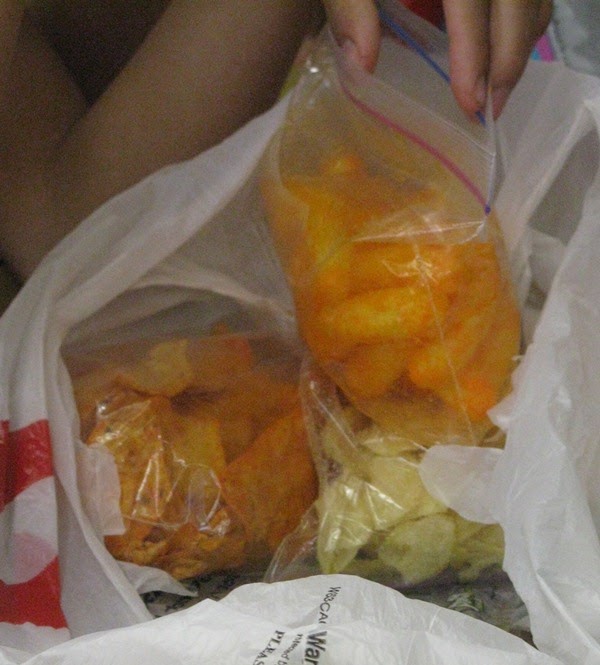
I couldn't help noticing this girl, for instance, who was diving into a plastic shopping bag crammed with an assortment of different chips and cheese puffs.

I suppose the trick is to pack enough different kinds of chips to maintain a child's interest.

Is this anything like what you call lunch?

Sunday, December 5, 2010

What's for Lunch: Black Bean Burger

By Ed Bruske
aka The Slow Cook

No, this isn't a hamburger, although it looks very much like one. Chartwells at its menu website called it a "spicy black bean burger on a whole wheat roll."

I would love to know where the black been burger came from. I guess I'll have to do some snooping around to find out, since the info isn't posted by Chartwells or the schools.

But here's where it gets even more interesting. What looks like a salad of romaine lettuce and tomato on the side is actually intended as a topping for the burger. And in that plastic cup--what the kids throught was salad dressing--was actually an "ancho sauce" that was supposed to be spread on the burger as well.

I didn't see any of the kids using the salad or the sauce the way. This is where parent volunteers in the cafeteria could help out: coaching the kids on the food and how to eat it. But that doesn't seem to be a particular priority at the moment.

The vegetable on the tray is "herb-roasted potato wedges with shredded carrot." The potatoes, of course, arrive frozen. I didn't see a lot of shredded carrot. Have you ever heard of shredding carrots on roasted potatoes? That's a novel concept, I think.


Here's what the burger looked like with the top down.

Friday, October 29, 2010

What's for Lunch: Bean Taco

By Ed Bruske
aka The Slow Cook

Chartwells at its menu website called this "vegetarian Baja bean" taco. The corn you see on it was actually a side dish (Tex-Mex corn), but some kids opted to have it served on top of the beans.

What looks like a salad on the side is actually "Romaine, tomato and salsa taco fixings" intended to go on top of the vegetables inside the taco.


Here's what the taco looks like if you remove the corn. The apple was advertised as "locally grown."

This might not look like much, but the kids seem to enjoy eating their tacos, although there is spillage.

Thursday, October 28, 2010

What's for Lunch: Spicy Chicken Fajita


By Ed Bruske
aka The Slow Cook

To compare with the chicken fajita I photographed earlier this week, I give you the same dish as it was presented in September. The frozen and re-heated diced chicken is the same, but here the pinto beans were deployed as posted on the Chartwells menu website rather than the black beans.

This student apparently ordered the fajita without the whole wheat tortilla.

But notice also that the "peach cup," meaning canned peaches, was being served without the cup. Likewise, the "salsa cup" consisted of salsa ladled directly onto the tray. Lately, these items have been served in actual plastic cups and one might wonder why, since the kids don't seem to care either way and those plastic cups not only don't come free, they create more waste for the landfill.

Tuesday, October 26, 2010

What's for Lunch: Chicken Fajita

By Ed Bruske
aka The Slow Cook

Chartwells at its menu website advertised this as "spicy chicken fajita with roasted onions and peppers in a whole wheat tortilla." Honestly, I'm not seeing the roasted onions and peppers. What I'm seeing is corn and black beans, probably frozen corn and canned black beans.

The menu also called for "Southwest pinto beans," so I suppose you'd have to count the black beans as a substitution. On the side is a "salsa cup." I heard one girl remark, "I really like the salsa," but I didn't get a chance to taste it.

Would this qualify as one of those instances of over-hyping a menu?

The menu also called for a "locally grown apple," but this looks more like canned peaches. Since the schools receive an extra five cents for every lunch meal that contains a locally grown product, I wonder how they account for meals that say they're supposed to have a locally grown piece of fruit but then don't deliver.


In case you were wondering where the chicken was on this chicken fajita, some of the kids opted not to take the corn and beans, revealing the chicken underneath. This is diced chicken that arrives at the schools pre-cooked and frozen. Add the salsa and I suppose it wouldn't look so plain.

Here's the alternate for Mondays: a whole wheat bagel with sunflower butter, string cheese and "marinated tomato and cucumber salad." The vegetables sure brighten up this tray, but I don't see much marinade. If you were a kid, would you eat this?
Not pictured: the sunflower butter and the other half of the bagel. Maybe it was being eaten when I snapped this photo.

Wednesday, October 20, 2010

What's for Lunch: Cuban Turkey Sandwich

By Ed Bruske
aka The Slow Cook

Chartwells on its menu website described this as a "roasted Cuban turkey sandwich with Swiss on a whole wheat roll" with "fresh locally grown cucumber coins" and "locally grown sweet potato salad."

A Cuban sandwich traditionally is made with roast pork, Black Forest ham, Swiss cheese and pickles, all heated and crushed between two slices of Cuban bread in a panini press or something like it. This, is other words, was a very rough approximation. But who's complaining?

The local cucumber coins turned out to be steamed zucchini and yellow squash: no problem with that substitution. I don't know if I'd go so far as to call those sweet potatoes a salad. In fact, I do make a terrific salad with roasted sweet potatoes, pecans, raisins and other stuff tossed with a maple-flavored vinaigrette. These look more like cooked sweet potatoes.

The schools score big points for the local vegetables, and in fact receive a five-cent bonus from the District for any lunch meal that contains a locally grown component. The only trouble is that kids don't really like vegetable side dishes for the most part, and they really didn't eat much of this either.


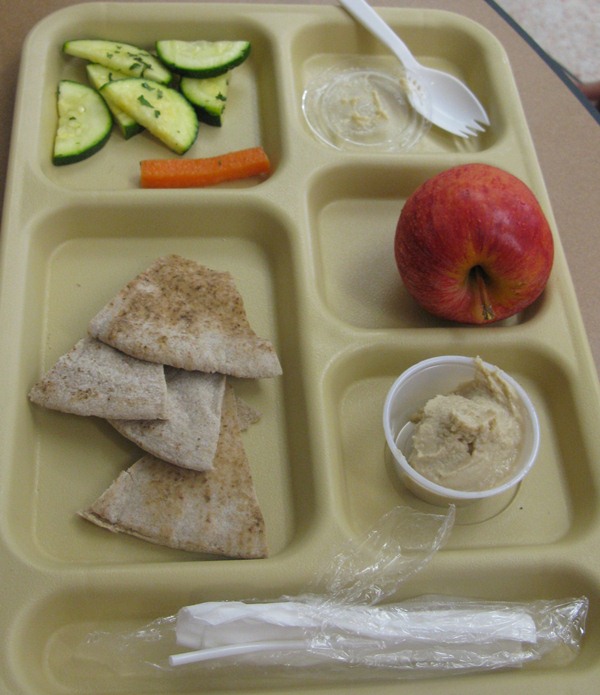
Here's the standing Wednesday alternate: hummus with pita wedges, an apple and finally those locally grown cucumber coins.

The commercial hummus is quite good. It comes from Kronos Greek Specialties in Glendale Heights, Ill.

Friday, October 15, 2010

What's for Lunch: Symphony of Browns

By Ed Bruske
aka The Slow Cook

Some of us believe that the current childhood obesity epidemic is simply slow death brought about by too many sugars and starches in the diet. But the U.S. Department of Agriculture loves starches. In fact, grains and other starchy foods form the foundation of the Dietary Guidelines for Americans as well as the famous federally-sponsored food pyramid.

Thus, a school lunch such as this one served yesterday at my daughters school can be dominated by starches in the form of a baked potato as the featured entree, accompanied by something Chartwells calls "vegetable chili"--meaning beans that qualify as a "meat alternate" under USDA guidelines--a bread roll, canned peas and "warm baked locally grown apple slices" that look more like diced apples to me.

What do you suppose the glycemic load of this meal would be, especially for a 5-year-old?

Fortunately, perhaps, kids showed very little interest in the "vegetarian chili" or the peas or in many cases the baked potato. "It's dry and it's burned," said one fifth-grader of the spud on her tray. But my daughter gladly snatched it up. "All it needs is salt and butter," she declared.

Clearly, this is one case where the USDA regulations are not aligned with the country's weight issues.

Tuesday, September 28, 2010

What's for Lunch: Bean Taco

By Ed Bruske
aka The Slow Cook

Chartwells calls this "vegetarian Baja bean whole wheat soft taco." Quite a mouthful. It looks like canned black beans and frozen corn with lettuce, topped with a tomato sauce or salsa. It was served open faced with a choice of "Tex-Mex corn" and a "pineapple cup." Or, in this case, pineapple without the cup.

I saw very few kids actually choose this lunch. Most of them were taking the Tuesday alternate: "turkey and cheese whole grain wrap." Meaning, there was a choice of tortilla two different ways.


One fifth-grade girl wanted nothing to do with the tortilla. She emptied out the contents--turkey, tomato, lettuce, grated cheddar cheese--and was tossing it around to make a salad.

This poses its own challenges, since the processed turkey meat, cut into deli-style rounds, does not lend itself to being cut with a plastic "spork."