Showing posts with label local produce. Show all posts

Wednesday, June 29, 2011

What's for Lunch: Local Beef


By Andrea Northup and Anna Chute

Lisa Dobbs, Chef and Nutrition director at E.W. Stokes, will stop at nothing to make sure that the 350 students she serves each day have healthy, delicious meals. Cooking from-scratch and using no processed foods, she and her staff prepare breakfast, lunch and supper in their antiquated kitchen for the school’s population of mostly low-income students. Lisa incorporates fresh, locally-grown foods whenever possible, especially on the school’s salad bar. And she works with the rest of the school staff to ensure that the school’s garden, nutrition and wellness programs are coordinated with her healthy menus.

As the Director of the D.C. Farm to School Network, I heard about Joy Evans from a friend who works in a local farm-to-table restaurant. Joy and her husband operate a business called Shenandoah Foods, which delivers meat, cheese and eggs from Virginia’s Shenandoah Valley to Washington, DC-area restaurants. Joy takes a delivery fee from her clients to run her business, and then farmers deal directly with customers to handle food costs. I reached out to see if she might be interested to work with Washington, DC schools.

Getting local meats into school meals is difficult. Most schools buy pre-cooked commodity meat from large distributors. It’s cheap (less than $1 per lb) and can be ordered in the evening and delivered the next morning – a system that’s hard to beat. But we’re not quite sure where it comes from, and it’s not always the highest quality product. But with about $1 per meal to spend on food, school food service directors have to make difficult choices about what they can afford.

I invited Joy and her husband to Washington, DC to meet with a few schools interested in buying local meat. We had a lively discussion about what products schools want, how much they need, what prices they can afford, and how to handle invoicing and delivery. We tried some delicious cheeses, Virginia-grown ground beef hamburgers, and fresh yogurt with local berries. If your mouth isn’t watering, it should be - the school food service providers could taste difference.

Joy and Lisa connected, and decided on a trial-run of 200 pounds of lean ground beef for $2.60 per pound. Joy picked up the meat from D&M Meats in Harrisonburg, VA in her refrigerated van, and delivered it to E.W. Stokes in conjunction with her regular restaurant deliveries. Lisa and her team expertly sautéed and seasoned the ground beef, and served it with pico-de-gallo, tortilla chips, and fresh guacamole. The result? A delicious and healthy meal for hungry students, which put money into our local economy, supported a sustainable small producer and made clean-beef fans out of Stokes’ young scholars.

Lisa Dobbs, Food Service Director at E.W. Stokes says the quality of the Virginia-grown beef is unparalleled. There isn’t murky liquid left over after cooking – something she’s used to with the lower-quality products. “We would never go back to the beef we were cooking before! We would drop beef from our menu entirely if we had to go back,” says Lisa.

Lisa can’t serve local meat every day, but it’s on the menu about once or twice a week, and they are looking to incorporate other items like chicken and eggs. We’re working to get more schools on board, and we’re excited for the potential to grow this partnership.

Andrea Northup is manager of the D.C. Farm to School Network. Anna Chute is the network's intern. This article originally appeared on the Arcadia Center for Sustainable Food and Agriculture blog.

Thursday, May 26, 2011

D.C. Farm to School Day: Strawberries & Salad Greens

By Ed Bruske
aka The Slow Cook

Yesterday was the annual big event for our D.C. Farm to School Network: Strawberries and Salad Greens. Network coordinator Andrea Northup outdid herself this year: schools in all eight wards of the city had volunteers signed up to engage kids in learning where their food comes from, specifically the strawberries and salad from local farms that were served for lunch.

All of the kids in the cafeteria got a sticker and they proudly showed them off.


At my daughter's school, there was a display of salad greens from the newly installed gardens. The strawberries, supplied by local farmers, were incredibly ripe and delicious.

This year I acted as "contact" for the event at daughter's elementary school, meaning I dropped by an "orientation" last week hosted by Whole Foods, where volunteers were supplied with all sorts of signage, photos of local farmers in action, and stickers to hand out to the children featuring original logo art.

Here you can see my wife doling out salad greens. She was impressed by how many of the kids requested salad--hesitatingly at first, but once one of two agreed to try it, soon they were all clamoring for it. Just shows why school cafeterias need more adult presence to coach kids in better eating habits.

The original concept was to have a table posted near the cafeteria where the kids could see the signage and photos and get their sticker. In our case, there wasn't really anywhere to put such a table, so I went around the room with a display of lettuce and strawberry plants that the farm to school network had conveniently dropped off at my home on Tuesday.

"Hey, kids! Did you know that lettuce and strawberries grow out of the ground?"

Some kids actually said, no, they didn't know that. Many of them wanted to touch the strawberry leaves, others asked if they could eat the lettuce. I think they were joking.

In the background, you can see the bulletin board where we taped the various signage and photos supplied by the farm to school network. No sooner had we posted it in the morning than a group of kids gathered to inspect a seasonality chart.

"Oh, I've had asparagus before," said one boy.

"Me, too," said a second. "I really like it."

Once we had the kids going, they were hard to stop. Soon they were following me around the cafeteria, telling me about the vegetables they grow at home.

"I have two strawberry plants," said one little boy. "The strawberries are about this big," he said, using his hand to indicate berries that weren't ready to eat yet.

"My grandmother grows rhubarb," said another.

Who likes strawberries? I asked them. They all raised their hands.

Friday, September 10, 2010

Alternate Lunch: Hummus

By Ed Bruske
aka The Slow Cook

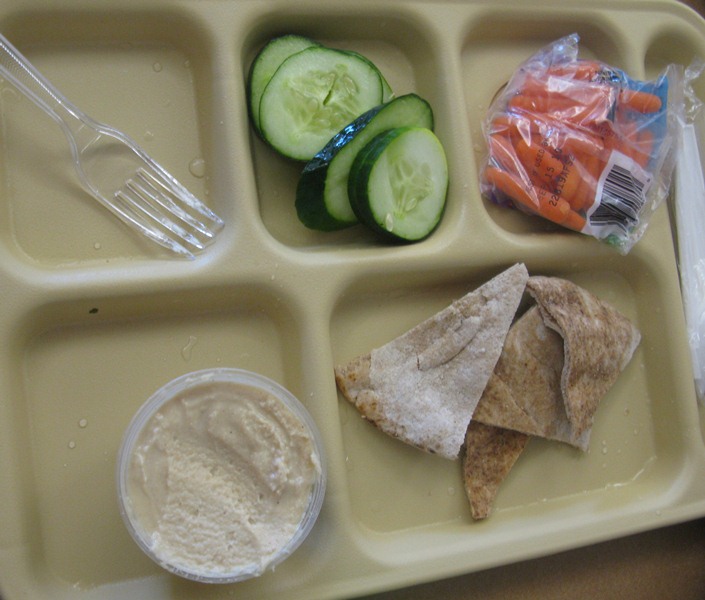
Although this lunch looks sparse, it comes fairly close to the 664 calories the U.S. Department of Agriculture says schools must offer for lunch daily to kids in Kindergarten through grade six averaged over a week. (An 8-ounce carton of unflavored milk, not shown here, would also factor into the total.)

An half-cup portion of hummus such as the one shown here, packed with healthy fiber, contains around 220 calories, and a serving of pita bread adds another 260. There may be 50 calories in the cucumbers and carrots combined, and a carton of milk contains another 120 calories.

According to my calculations, that's 650 calories--and without any added sugar! (At least I don't think so, although the manufacturer could have snuck some into the hummus. We don't have the ingredient list.)

The hummus originates from a company called Kronos Greek Specialties in Glendale Heights, IL. According to the company's website, it's sold in packages of two four-pound tubs, then our local kitchen ladies scoop it into plastic cups, as shown in the photo. School officials have said they hope to have a website up and running in November where the public can find all of the ingredients for foods served in D.C. Public Schools.

The "locally grown cucumber coins" have an added feature: being local, they earn the schools a five-cent bonus per meal from the D.C. treasury. I wonder how they keep track of that, since the cucumbers were only offered with the alternate meal, not with the main meal served on this particular day.

Chartwells at its menu website listed the carrots as "carrot sticks," but in fact they are "sanded" carrots (aka "baby" carrots.)

This meal seams like a smart use of processed foods (Greek hummus made from chickpeas and tahini), as opposed to some of the really awful processed foods we've seen in the past. Perhaps there are other ethnic foods that could be deployed in the school meal program. Can you think of any?

Friday, September 3, 2010

What's for Lunch: Turkey Sandwich

By Ed Bruske
aka The Slow cook

Chartwells had its menu writers working overtime on this one. At its website, the company describes this as "sliced oven-roasted turkey on a whole wheat mini sub roll with cranberry mayo," plus "fresh veggie gardenaria with broccoli and carrots," "seasoned green beans," and "local peach."

Veggie gardenaria?

My dictionary (Webster's New Universal Unabridged) doesn't even list "gardenaria" as a word. It looks to me more like frozen broccoli and "sanded" carrots cooked together, although these broccoli do seem to be holding together better than the frozen variety I've seem steamed into oblivion in the past. The "seasoned green beans" are out of a can. And the "oven-roasted turkey" is simply processed turkey breast that arrives sliced and frozen from the Jennie-O Turkey Store in Willmar, Minn.

According to the packing label, the turkey consists of "turkey breast, white turkey, turkey broth, modified food starch."

I'm not sure how the "cranberry mayo" was made, but it sure was pink. The kids debated each other over what they were supposed to do with it. Some were dipping their carrots in it.

The "local peach" seems to be the one item on this tray not suffering an identity crisis. And being local, it also earns the schools a five-cent bonus from the D.C. treasury.

Monday, August 30, 2010

What's for Lunch: Chicken Sandwich

By Ed Bruske
aka The Slow Cook

My daughter looked at the Chartwells menu for lunch, saw it was a chicken sandwich and decided she didn't want any part of it. She packed her own lunch. She just doesn't like the processed chicken patty on this sandwich. The lettuce and tomato salad you see here is actually intended as a topping for the sandwich, with a plastic container of barbecue sauce to finish it off. It looked more like peanut sauce to me, and I don't think I saw any of the kids use the salad or the sauce as it was intended. Were they supposed to get instructions in the food line?

What looks like cucumbers is actually "locally grown zucchini," according to the Chartwells website. I assumed the pear was local, but the website does not say so. The schools would get an extra five cents from the District of Columbia to pay for this lunch by virtue of the zucchini being local. But vegetable side dishes are a hard sell in the cafeteria, and the kids were not exactly attacking these zucchini.

I stayed through the entire lunch period to see what the kids did with their pear. Was it ripe? Was it edible? Would they eat it? It turned out to be a little hard, but the kids seemed to like it. Like most whole fruit served in schools, it was bigger than they needed. But what they did eat, they ate with relish. In Berkeley, Calif., the schools have found an orchardist who sells them his small, kid-size apples. Would it be hard--cheaper maybe?--to find growers here who can supply smaller fruit?

Friday, August 27, 2010

Is There Enough Corn on this Tray?

By Ed Bruske
aka The Slow Cook

Chartwells listed "taco salad" with ground turkey meat and "baked whole grain tortilla shells" as the entree for this meal. So what was the thinking behind including still more corn in the form of corn on the cob as the vegetable?

The menus at Chartwells' website also called for a "locally grown nectarine" with this meal. But as you can see, the fruit is a banana. The nectarine would earn school food services an extra nickel from the D.C. treasury for being local. So if this is simply a matter of a delivery slip-up--or maybe a few schools getting bananas instead of local nectarines--how will the food services department account for that when it comes time to ask the city for its locally-inspired check?

Now that school is back in session, a number of wrinkles are starting to become apparent in the "Healthy Schools" law passed this year by the D.C. Council, such as a possible accounting nightmare where the local food component is concerned.

Meanwhile, my daughter was so taken with the idea of tacos for lunch that she decided not to bring a lunch from home. Tragically, she was one of the last kids in line and by then the kitchen had run out of tacos. The alternate was salad. She doesn't like salad. So this is what she got for her $1.25:

Under the "offers versus served" rule that prevails in the federally subsidized school food program, this qualifies as a meal. Children are offered an entree, milk and three other items. They must choose three. Even kids who pay full fare are underwritten by the feds to the tune of 25 cents. This year for the first time, kids who only qualify for "reduced price" meals don't have to pay anything at all. The city is picking up the tab, care of the "Healthy Schools Act" passed earlier this year and a sales tax imposed on soft drinks.

Fortunately, daughter really likes black beans, bananas and corn on the cob. Not so fortunately, this corn on the cob was obviously the frozen variety and cooked to death. It was mealy and dull. Most of the kids declined to eat it. They also shied away from the black beans, which Chartwells advertised as "Southwest beans." They looked straight out of the can to me.

Kids are terribly inventive around lunch. Look how they dealt with the corn on the cob: speared on the end of their spork to make for easier eating.


This was how the alternate looked. In fact, it was a delicious looking salad, complete with croutons.

Local Peaches Mystery Solved

By Ed Bruske
aka The Slow Cook

On Tuesday I contacted D.C. schools wondering why the "local peach" that was supposed to be on my daughter's breakfast tray looked so much like canned peaches instead. I also inquired where parents needed to look to find the ingredients for school menu items, as required by the new "Healthy Schools Act."

Yesterday I received a kind of robo e-mail from the Office of the Chief Operating Officer (Anthony Tata) clearing up the mystery of the canned-versus-local peaches, plus much more that I thought might interest parents. Here is the complete text of that e-mail:

"Good Afternoon, Mr. Bruske:

"Thank you for your email about your student’s peaches, and for bringing your concerns to our attention. Jeff Mills [food services director] followed-up on your concern and visited the school to discover that Stoddert was indeed off-menu. We double-checked with all our schools, and Stoddert was the one school to serve canned peaches that day, which is unacceptable. A formal complaint has been lodged with Chartwells, and we are re-doubling our efforts to ensure that this does not happen again.

"Thank you for being a watchdog for your student’s school. Parents like you keep us, and our vendors, accountable. We want to make sure your blog readers know the process for lodging a menu complaint if they have concerns at any time about the food served at their schools: they should email officeoftheCOO.inquiries@dc.gov, which is checked regularly throughout the week. Each email is taken seriously, and we always appreciate when parents and community members bring things to our attention.

"In regard to the nutritional information you asked about, we are still working to upload all the information and working with our vendors to ensure that it is correct. In a few months we will be revamping our entire menu website to be more interactive. We will be sure to let you know when we’re about to launch.

"Thanks, as always, for your inquiries"

I feel a little embarrassed making Jeff Mills go to all that trouble. It's scary to think that a few missing peaches can ruin his whole day and draw him away from all the important work he's doing trying to upgrade the food for the D.C. Public Schools' 45,000 students.

Still, I can only report what I see. And if we're truly concerned about the food kids are eating, the only thing that really matters is what actually ends up on their cafeteria trays.

Tuesday, August 24, 2010

Yesterday's Lunch: Teryaki Chicken

By Ed Bruske
aka The Slow Cook

I hate to miss a school meal, especially the first one of the year when D.C. food service staff are pushing to make improvements. But I could not be in the cafeteria yesterday. I did, however, manage to find out what was in the teryaki chicken Chartwells served.

That would be the "fully cooked, coated" eight-piece, bone-in chicken from Tyson. According to the packing label, these are the ingredients, besides the chicken: Water, seasoning (salt, hydrolyzed corn protein, extrose, onion powder, autolyzed yeast extract, garlic powder, soybean oil, spice extract), sodium phophates.

And the chicken was "coated with": Water, coating (modified corn starch, tapioca dextrin, dried whey, soy protein isolate, sodium alginate, caramel (color), sodium tripolyphosphate, methylcellulose, guar gum).

The cooking instructions call for 10 to 15 minutes in a 375-degree convection oven from the frozen state.

Also on the menu was a "whole wheat roll," a "crunchy" spinach salad, "orange glazed" carrots and "locally grown" watermelon. Under the "Healthy School Act" passed earlier this year by the D.C. Council, the schools receive an extra five cents for every lunch that includes a locally grown component, meaning from within the Mid-Atlantic region.

The spinach, on the other hand, came from a place called The Salad Farm in Salinas, Calif. That business is actually a complex of growers and processors that harvest crops in both California and Arizona. The history, starting with a man named Lex Camany, who worked in lettuce fields to make money for college, is worth a read. At one point, Camany conducted agricultural research for the Mexican government. Then he started a strawberry department at Hartnell College.

So many American success stories touch the federal school meals program.

Thursday, July 8, 2010

What Does "Local" Mean for School Food?

By Ed Bruske
aka The Slow Cook

D.C. Schools are set to start two pilot meal programs that would require food vendors to supply at least 20 percent of ingredients from sources in the Mid-Atlantic region, defined as Maryland, Virginia, West Virginia, Pennsylvania, Delaware, New Jersey, North Carolina and the District of Columbia.

Making school meals with local produce has been promoted as a way of serving fresher, more appetizing fruits and vegetables to kids and was embraced in "Healthy Schools" legislation recently approved by the D.C. Council. "Healthy Schools" also encourages schools to use produce grown according to "sustainable" farming methods.

The "Healthy Schools" act requires all public schools in the District to identify the sources of their meal ingredients and rewards the use of local products by providing a five-cent bonus for every meal that contains locally-sourced ingredients.

Up to now, fruits and vegetables in D.C. Public Schools have been provided by the school system's contracted food services provider--Chartwells--which relies for its purchases on a national food distribution system.

The salad mix served in D.C. schools, for instance, consists of shredded iceberg lettuce, carrots and purple cabbage grown and processed in California. Apples sometimes come from as far away as New Zealand. When I spent a week as an observer in the kitchen of my daughter's elementary school--H.D. Cooke--a mix of broccoli, carrots and cauliflower came from Mexico.

One of the reasons schools don't use more local produce is because local farmers are not connected to a large-scale distribution system. Keany produce, one of the area's larger distributors, located in Landover, MD, does offer customers locally-grown selections. D.C. Central Kitchen, which provides thousands of meals to the needy every day, and provides foods for some schools through it's catering arm, Fresh Start Catering, sources much of its produce from a food auction site in Virginia's Shenandoah Valley.

What difference does "local" make for school meals?

Most of the vegetables served in D.C. schools are never eaten because they are cooked to death and served as dull-looking side dishes that kids reject. Simply replacing those vegetables with locally-grown produce won't make any difference at all. Broccoli, after all, is still broccoli, whether it's grown in California or Maryland. It all comes down to kitchen skills and presentation.

In Berkeley, CA, where I worked for a week as a "kitchen lady" to see how one of the country's most progressive school food operations worked, vegetables rarely were served as side dishes. Instead, they were mixed into sauces and soups, or tossed into pasta and other dishes. Even so, the kids I served in the food line often went to great lengths to avoid vegetables.

Under the proposed pilot schemes, the 20 percent figure does not refer to a quantity of local produce, but is calculated according to price. In other words, local products are to represent 20 percent of the cost of food ingredients. Thus, if the local goods are more expensive, kids might see proportionately less of them on their trays.

This is just one more wrinkle food vendors involved in these pilot programs will have to deal with in order to comply with food service contracts loaded with new standards and requirements, but paid for with the same old budget. It's a tall order.