Showing posts with label alternates. Show all posts

Thursday, February 10, 2011

What's for Lunch: Turkey Sandwich


By Ed Bruske

aka The Slow Cook

People wonder why schools go to all the trouble trying to make a different hot lunch every day. Can't kids just eat sandwiches? Peanut butter and jelly put me through school for years.

Well, this is a blast from the past: a turkey sandwich on "whole wheat" bread. But this was an alternate selection to the hot entree, which was chicken.

The alternates--a different one for each day of the week--are often quite tempting. You just don't see kids choosing them much, except on this particular day when they seemed to like the looks of this sandwich. At the Chartwell's menu website, it was advertised as a "turkey and cheese whole wheat wrap." I'm guessing they ran out of the whole wheat flour tortillas the kitchen normally uses to make those wraps.

And just in case there might be any shortage of carbs on this tray, one of the side dishes is a big scoop of rice. Looks like some broccoli in another corner.


Here's what the sandwich look like after it emerged from the plastic. I would have made mine slathered with mayonnaise. Still, it looks good enough to eat.

Thursday, January 20, 2011

What's for Lunch: Chicken Wrap

By Ed Bruske
aka The Slow Cook

Here's some news: frozen food doesn't have to be bad. For instance, you can do some pretty amazing things with frozen chicken.

Okay, so it isn't local, pastured chicken. It comes from a factory farm (CAFO: confined animal feedlot operation) far away, processed most likely by an industry giant like Tyson. But this is, after all, school food, made on a tight budget and frequently chicken is on the list of the U.S. Department of Agriculture's commodity foods, meaning schools get a substantial break on the price.

When you make school food, you also have to make some compromises.

In Boulder, Colorado, I had a fabulous barbecued chicken sandwich made from frozen "diced chicken." There, Ann Cooper has hired professional chefs to devise recipes that turn simple frozen and canned products into delicious cafeteria food. Here you see "honey mustard chicken," as Chartwells calls it, wrapped in a "whole wheat" tortilla with lettuce.

This is offered on Tuesday's as the cold alternate to the hot meal selection in D.C. schools. It's not true that school food has to be bad. But making it better does require some imagination and motivation to spend a little extra effort.

To be honest, however, few of the kids at my daughter's elementary school choose options like this and I think that's primarily because they just aren't familiar. As I learned during my week in Boulder, where the food services department was actively recruiting parents and student interns to help in the cafeterias, it takes active taste-testing and coaching in the cafeterias to get kids to eat new and different foods.

Unfortunately, here in D.C. we haven't seen any effort on the part of our local food services team to collaborate with parents or the broader community. We can hardly get them to communicate anything at all.

Friday, September 10, 2010

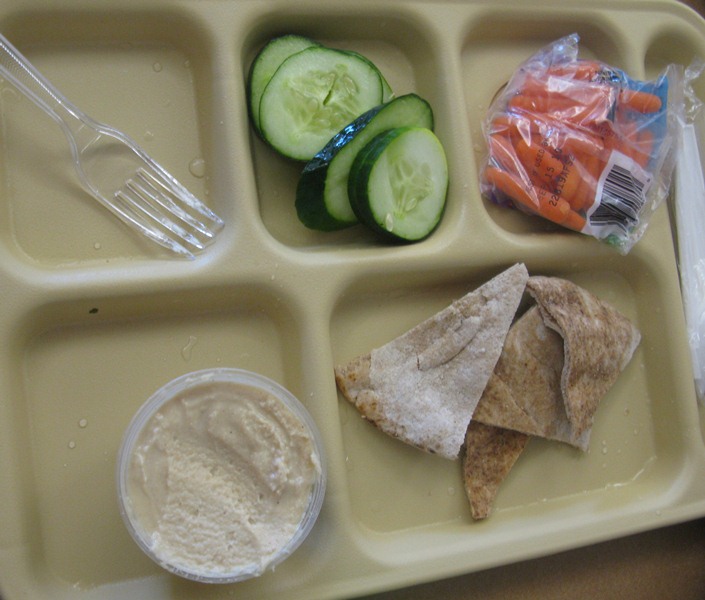
Alternate Lunch: Hummus

By Ed Bruske
aka The Slow Cook

Although this lunch looks sparse, it comes fairly close to the 664 calories the U.S. Department of Agriculture says schools must offer for lunch daily to kids in Kindergarten through grade six averaged over a week. (An 8-ounce carton of unflavored milk, not shown here, would also factor into the total.)

An half-cup portion of hummus such as the one shown here, packed with healthy fiber, contains around 220 calories, and a serving of pita bread adds another 260. There may be 50 calories in the cucumbers and carrots combined, and a carton of milk contains another 120 calories.

According to my calculations, that's 650 calories--and without any added sugar! (At least I don't think so, although the manufacturer could have snuck some into the hummus. We don't have the ingredient list.)

The hummus originates from a company called Kronos Greek Specialties in Glendale Heights, IL. According to the company's website, it's sold in packages of two four-pound tubs, then our local kitchen ladies scoop it into plastic cups, as shown in the photo. School officials have said they hope to have a website up and running in November where the public can find all of the ingredients for foods served in D.C. Public Schools.

The "locally grown cucumber coins" have an added feature: being local, they earn the schools a five-cent bonus per meal from the D.C. treasury. I wonder how they keep track of that, since the cucumbers were only offered with the alternate meal, not with the main meal served on this particular day.

Chartwells at its menu website listed the carrots as "carrot sticks," but in fact they are "sanded" carrots (aka "baby" carrots.)

This meal seams like a smart use of processed foods (Greek hummus made from chickpeas and tahini), as opposed to some of the really awful processed foods we've seen in the past. Perhaps there are other ethnic foods that could be deployed in the school meal program. Can you think of any?

Thursday, September 9, 2010

Regard, the Turkey Wrap

By Ed Bruske
aka The Slow Cook

The standing alternate cold lunch option in D.C. schools on Tuesdays is a turkey wrap. Just by chance, I happened to see some boys in the cafeteria who had gone to the trouble of unfolding their wraps to reveal what was inside. (Some, apparently, were removing the vegetables.)

First, the tortilla itself appears to contain more whole grain than in the past. The "turkey" in fact is processed turkey breast conveniently sliced into deli portions. It does seem a bit dry, but the grated cheddar, diced red bell pepper and lettuce are a thoughtful touch.

Compare that to the "lunch meat burrito" the schools were serving as recently as last April. It's the same processed turkey, but notice any differences?

While some things have stayed much the same, school meals in the District of Columbia do seem to have undergone some dramatic changes over the summer. Maybe that's what Food Services Director Jeffrey Mills meant when he said he and has staff were busy taste-testing some 300 different "products" while the rest of us were on vacation.