Showing posts with label cereal. Show all posts

Tuesday, March 1, 2011

What's for Breakfast: Kix

By Ed Bruske

aka The Slow Cook


Last year, after I wrote a series of articles detailing in part how kids in D.C. schools were pouring strawberry milk over Apple Jacks cereal and routinely consuming as much as 15 teaspoons of sugar for breakfast, school officials removed flavored milk and sugary cereal from the menu.

Here's one of the replacement cereals we see in school cafeterias now. Kix contains just three grams of sugar--that's less than a teaspoon--in a one and one-quarter cup serving.

There's more sugar--way more--in that small container Stonyfield yogurt. A four-ounce serving of Stonyfield's blueberry yogurt, for instance, contains 13 grams of sugar, or a little more than three teaspoons. That's only slightly less, ounce for ounce, than the sugar in a can of Pepsi.

Good thing, I guess, kids only see this yogurt in a four-ounce size.

For complete nutritional information on Kix, go here.


Monday, December 13, 2010

What's for Breakfast: Kix & Muffin

By Ed Bruske
aka The Slow Cook

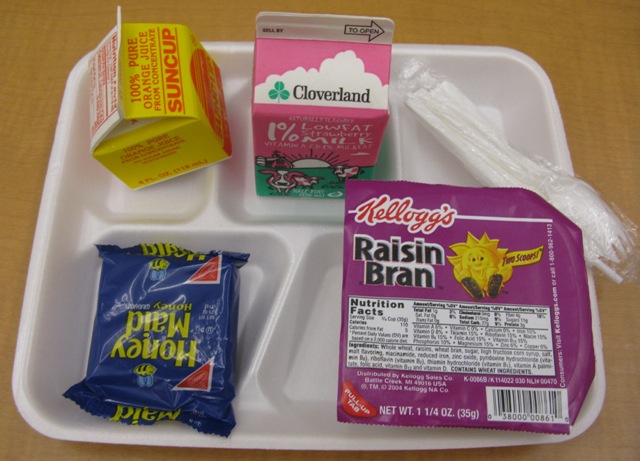
Over the summer, the food services director for D.C. Public Schools decided to remove flavored milk and sugary cereal from school breakfast menus. The means no more Apple Jacks or Raisin Bran. Instead, the kids are served only cereals with six grams of sugar or less.

According to the General Mills website, these Honey Kix, made primarily of corn, contain six grams of sugar in a 1 1/4 cup serving. Next to it is an "apple cinnamon muffin," according to the Chartwells menu website. It doesn't have any packaging identifying the nutritional content. The Healthy School Act approved by the D.C. council earlier this year requires the schools to post the ingredients in school food. But a website containing that information and promised for November has now been delayed till next year.

Notice also the string cheese on this tray. That's also something new that began in the fall. All in all, this is a big change from the Apple Jacks, strawberry milk, Pop-Tart and Giant Goldfish Graham breakfast--often 15 teaspoons worth of sugar first thing in the morning--D.C. kids were getting as recently as last spring.

The big change had nothing to do with Congress or the USDA or even our own Healthy Schools Act, and everything to do with the bold action of our local food services director. Even though school meals are funded mostly by the federal government, it's much easier to make change at the local level than to wait for Uncle Sam.

Tuesday, October 26, 2010

What's for Breakfast: Muffin Square

By Ed Bruske
aka The Slow Cook

I thought the item pictured here was coffee cake--a square piece of pasty cut from a larger pan. But I was corrected. This, I was told, was a "fresh-baked muffin square," in this case dotted with blueberries. (I could not get Blogger to load this photo in the correct, horizontal orientation.) And, in fact, it was baked in the kitchen by our own school cooks.

I tasted it, expecting it to be very sweet, like coffee cake. But it wasn't. I was glad it didn't contain a lot of sugar. We've worked hard trying to get sugar out of our local school food.

Accompanying the "muffin square" is a "yogurt cup," meaning Stonyfield organic vanilla yogurt, as a container of canned peaches. I wondered why these were being served in plastic containers. In the past, the yogurt and fruit typically was just spooned directly onto the tray, saving the expense and waste of the plastic cups. Is it to make the food look better in the photos?


Here's the alternate breakfast: Kashi Heart to Heart cereal with a cup of cottage cheese and a cup of those canned peaches. The kids like to joke that the Kashi "looks like dog food." I have to admit, it does bear a strong resemblance to kibbles. "But it tastes good," says my daughter, who eats it with her fingers. (She's lactose intolerant.)

A one-ounce container of Kashi Heart to Heart contains 5 grams of sugar, much less than the Apple Jacks and Chocolate-Frosted Mini Wheats the schools were serving last year.

Thursday, September 23, 2010

What's for Breakfast: Cheerios

By Ed Bruske
aka The Slow Cook

Cheerios is a perfect example of how food served in D.C. Public Schools has changed just in the last few months. Last year, you'd be looking at a container of Apple Jacks containing nine grams of sugar (more than two teaspoons) per serving, or perhaps Chocolate Frosted Mini-Wheats with 12 grams of sugar (three teaspoons).

This serving of Cheerios contains less than one gram of sugar and may be the closest thing to a whole grain cereal you can find on a school menu. Of course it is processed: Those little "o's" don't grow on trees. Still, the oats and fiber in Cheerios are something to cheer about. Sugar-free cereals like this one should be the go-to choice for schools in an era of rampant obesity.

There's more than enough sugar in that cherry-flavored yogurt and the apple juice.

Here are the facts on Cheerios:

Cheerios Ingredients

Whole Grain Oats, Modified Corn Starch, Sugar, Oat Bran, Salt, Calcium Carbonate, Oat Fiber, Tripotassium Phosphate, Corn Starch, Wheat Starch, Vitamin E (Mixed Tocopherols) added to preserve freshness.

Cheerios Nutrition Information

Serving Size: 1 Cup (30g)

Amount per Serving:

Calories: 110
Calories from Fat: 18
Total Fat: 2g 4%
Saturated Fat: 0g 0%
Trans Fat: 0g
Cholesterol: 0mg 0%
Sodium: 210mg 9%
Potassium: 200mg 4%
Total Carbohydrates: 22g 8%
Fiber: 3g 12%
Sugar: 1g
Other Carbohydrates: 18g
Protein: 3g 2%

Cheerios Vitamins & Minerals

Vitamin A: 10%
Vitamin B6: 25%
Vitamin B12: 25%
Vitamin C: 10%
Vitamin D: 10%
Folic Acid: 50%
Niacin: 25%
Riboflavin: 25%
Thiamin: 25%
Calcium: 10%
Copper: 2%
Iron: 45%
Magnesium: 10%
Phosphorus: 10%
Zinc: 25%

*Percent Daily Values are based on a 2,000 calorie diet. Your daily values may be higher or lower depending on your calorie needs.

Friday, September 3, 2010

Serving Cheap Calories from Sugar

Ed Bruske
aka The Slow Cook

I had originally intended to focus in this post on the cottage cheese you see in the photo. Serving cheese products seems like a great way to address the concerns of parents that kids aren't getting enough calcium. But then the apple juice on this tray caught my eye and I wondered what would happen if you removed it, since it contains so much sugar (2.5 teaspoons in a 4-ounce serving, or about the same as Coca-Cola).

But then I started to add up the calories in this meal, which Chartwells offers at my daughter's elementary school as the cold alternate breakfast on Thursdays. Under D.C.'s "Healthy Schools Act," schools must serve children in pre-kindergarten through eighth grade a minimum 350 calories for breakfast. The Kix, with four grams of sugar, contain just 70 calories, the low-fat milk 110 calories, the apple juice 55 calories and the cottage cheese I'm guessing around 45 calories. (It looks to be about one-quarter cup).

With a total of 280 calories, this meal, by my reckoning, already falls short of the minimum prescribed by law. Take away the apple juice, with its dose of calories from fructose, and this breakfast would be 36 percent shy of the calories prevailing law says the schools should be serving every day.

That helps explain why school food service operations have become so addicted to sugar. Sugar adds a cheap boost of calories to meat meal program standards. But more than any other ingredient, sugar is linked to the current epidemic of childhood obesity, as well as health consequences such as elevated cholesterol and triglycerides, high blood pressure, atherosclerosis, and even non-alcoholic fatty liver disease in children.

Maybe that's why some schools are so desperate to hang onto flavored milk: not for the calcium and other nutrients, but for the calories that come with the added sugar.

What could you put on this tray that would satisfy the requirements for calories, would not add sugar, and wouldn't bust the food services budget?

Thursday, September 2, 2010

What's for Breakfast: Kashi

By Ed Bruske
aka The Slow Cook

In the past, you were much more likely to see Kellogg's Apple Jacks or Chocolate Frosted Mini-Wheats served for breakfast in D.C. Public Schools. Those cereals are loaded with sugar. usually in the form of high-fructose corn syrup. Kellogg paid Chartwells, the school system's hired food services management company, a hefty rebate to help imprint those brands in the minds of D.C. school kids.

Parents complained about the sugar and the rebates. Now we are seeing a different kind of breakfast service. School officials decided to ditch the chocolate and strawberry milk, and limit cereals to six grams of sugar or less. One morning it's Kix from General Mills with four grams of sugar--less than half the sugar in Apple Jacks. On this particular morning, the choice was Heart to Heart Honey Roasted Oat Cereal from Kashi. This cereal has five grams of sugar in a 1-ounce serving.

Kahsi is supposed to be health food, but not all Kashi cereals are low in sugar. In fact, Kashi is now just another brand of Kellogg, having been purchased by the cereal giant 10 years ago for an undisclosed price. Owner and co-founder Phillip Tauber said at the time that he and his wife chose Kellogg because they hoped to advance the Kashi mission.

“The real issues for us have always been to have as many people in the world educated about minimally processed foods, so it’s ironic that we are winding up part of a Fortune 200 company. But as time changes, so do circumstances, and we had limited resources to reach the large demographic we wanted to reach,” Tauber said. “We pursued a relationship with Kellogg because it was very, very sincere about being part of the natural foods category.”

Kellogg said "the acquisition of Kashi gives us leadership in the ready-to-eat cereal category," and would help boost its flagging sales growth.

According to the package label, this particular Kashi cereal---Heart to Heart Honey Roasted Oat--contains the following:
"Whole oat flour, evaporated can juice syrup, oat bran, yellow corn meal, corn flour, Kashi seven whole grain flour (whole oats, hard red wheat, rye, brown rice, triticale, barley, buckwheat), oat fiber, wheat germ, honey, salt, caramel color, expeller pressed canola oil, decaffeinated green tea extract, natural flavor, decaffeinated white tea extract, alpha tocopherol acetate (Vitamin E), sodium bicarbonate, ascorbic acid (Vitamin C), Activin, grape seed extract, beta carotene (source of Vitamin A), folic acid, pyridoxine hydrochloride (Vitamin B6), ferrous fumarate, zinc oxide, Vitamin B12.

Saturday, August 28, 2010

What's for Breakfast: Kix


By Ed Bruske
aka The Slow Cook

Breakfast in a District of Columbia elementary school has a pared-down look this year. Gone are the Pop-Tarts, Giant Goldfish Grahams and Otis Spunkmeyer muffins we saw virtually every day in the past. Food Serivices Director Jeffrey Mills, who took the job some eight months ago, has said he wants to eliminate processed foods as much as possible from school menus.

Also gone are the flavored milks with so much added sugar that kids drank with breakfast and with lunch. The new choice is low-fat or non-fat plain milk. And sugary cereals such as Apple Jacks and Chocolate Frosted Mini-Wheats are no longer an option. The schools now serve only cereals containing six grams or less sugar, such as these Whole Wheat Honey Kix, which contain only four grams of sugar per serving.

As you can see from this photo, kids sometimes can also choose a piece of string cheese with breakfast. On Wednesday they were offered zucchini bread and cottage cheese. Cheese, cottage cheese and yogurt are good sources of calcium for kids who don't drink milk--like my daughter, who is lactose intolerant.

Between the sugary cereals, the flavored milk, the fruit juice and the sugary processed treats, kids in D.C. schools used to consume up to 60 grams of sugar (15 teaspoons) before classes even started. Does that make sense in the middle of an obesity epidemic?

Parents who were distressed over the amount of sugar being fed to kids in school are glad to see these changes, which also teach valuable lessons about what healthy food looks like. What do you think? What is your local school serving for breakfast?

Monday, August 23, 2010

Got Un-Flavored Milk?


By Ed Bruske
aka The Slow Cook

Notice anything different about this milk cooler at my daughter's elementary school here in the District of Columbia?

This is the place kids head first when they enter the food line in the cafeteria. In the past, there was always a scramble to get there and grab either a chocolate- or a strawberry-flavored milk. It wasn't uncommon at all to see kids at breakfast pouring a strawberry milk containing 28 grams of sugar (6.5 teaspoons) into a plastic container of Apple Jacks cereal with another 8 grams of sugar (2 teaspoons). When you added in Pop-Tarts, fruit juice and Giant Goldfish Grahams, kids in D.C. frequently were eating 60 grams of sugar (15 teaspoons) before classes even started.

And you're wondering why we have an obesity epidemic?

But earlier this summer D.C. Public Schools officials quietly determined to ditch the flavored milk and serve only cereals with six grams of sugar or less. Despite the absence of any fanfare, the decision sent reverberations around the country, and even to the United Kingdom, where Jamie Oliver featured it on his website.

True to their word, D.C. schools this morning had no flavored milk on display in the cafeteria, just what you see in this photo: low-fat and fat-free milk and orange juice. Not shown are the tubs of Honey Kix cereal being offered. They contain 4 grams of sugar per serving, according to the label.

Now we just have to get the fruit juice switched to whole fruit. Fruit juice delivers a concentrated dose of sugar in the form of fructose. It's cheap, but much better would be whole fruit, which not only contains less sugar, but also delivers the fiber that's squeezed out in the juicing process.

So take a bow, parents. Your hard work shining a light on what schools serve in the cafeteria has already paid benefits. Food service officials say they've been busy testing new products and making changes to the menu their hired food service provider, Chartwells, will be serving this year. We need to be there with the kids in the cafeteria to see how those changes unfold.

Wednesday, June 23, 2010

'No Flavored Milk' to Start in Summer School

The Washington Post, following up our revelation last week that D.C. Public Schools will discontinue serving flavored milk and sugary cereal, reports that school meals will be served without the usual chocolate and strawberry milk beginning next week.

Columnist Mike DeBonis further reports that schools will only be serving cereals with six grams of sugar or less. That would rule out nearly all of the cereals that the DCPS hired food service provider, Chartwells, has served in the past, such as Apple Jacks, Raisin Bran and Chocolate Mini-Wheats.

Parents for Better D.C. School Food have advocated that school meals could be made healthier overnight simply by eliminating sugar. We believe schools should stick with cereals containing five grams of sugar or less per one-ounce serving.

Kellogg's Apple Jacks contains nine grams of sugar per serving, compared to regular Cheerios, which contains only one gram. DeBonis quotes schools spokeswoman Jennifer Calloway as saying the schools will be testing a variety of low-sugar alternatives.

Friday, June 18, 2010

D.C. Schools to Discontinue Flavored Milk, Sugary Cereal

By Ed Bruske
aka The Slow Cook

Jeffrey Mills, director of food services for D.C. Public Schools, told parents at H.D. Cooke Elementary school yesterday that the city's schools beginning in the fall would no longer serve flavored milk or sugary cereals.

Mills made the remarks at a meeting to discuss staffing changes in the H.D. Cook cafeteria and further details could not be obtained. A PTA officer at the meeting said Mills told the parents that other positive changes in cafeteria menus would be made by the time school resumes in August.

Chocolate- and strawberry-flavored milk, as well as sugary cereals such as Apple Jacks, Raisin Bran and chocolate-flavored Little Bite Mini-Wheats, have been standard fare for breakfast in D.C. schools. Flavored milks contain nearly as much sugar as Classic Coke or Mountain Dew, and when served alongside sugary cereals and breakfast treats such as Pop-Tarts. Giant Goldfish Grahams and orange juice, consitute meals containing 60 grams of sugar before classes even begin. That's the equivalent of 15 teaspoons of sugar, more than a quarter cup.

Some experts argue that the empty calories from sugar cause behavorial problems in school and prime children for health problems ranging from tooth decay to obesity and early onset of diabetes. Flavored milks also cause a drain on school food budgets because they are more expensive than plain milk. But the dairy industry has fought hard to keep flavored milk in school, fearing that children would drink less milk if it did not contain the added sugar.

Many D.C. students drink flavored milk at least twice a day in school, both at breakfast and at lunch, even though other sugary beverages such as sodas, sport drinks and teas have been banned from schools since 2006.

Low-fat milk typically contains 12 grams of naturally occurring sugar as lactose in an 8-ounce service. The chocolate-flavored milk in D.C. schools, from Cloverland Dairy, lists 24 grams of sugar, the added sugar coming from high-fructose corn syrup. Strawberry-flavored milk from Cloverland Dairy contains 28 grams of sugar, or seven teaspoons.

Apple Jacks cereal lists 9 grams of sugar in a 1-ounce serving, or a bit more than two teaspoons, compared to just 1 gram of sugar in a similar serving of regular Cheerios. Cereals with higher sugar content, served aggressively by the D.C. Public Schools' hired food service contractor, Chartwells, are seen as a vehicle for imprinting on vulnerable children the popular kids' brands of corporate food companies such as Kellogg's, which pays hefty rebates to have its products promoted in schools.

The move to reduce sugar in D.C. school food would be significant, since neither U.S. Department of Agriculture standards nor the District's recently adopted "Healthy Schools" act regulate the amount of sugar in school meals. It would bring the District in line with other progressive jurisdicitions that have eliminated flavored milk as a health measure. Typically, milk sales drop after flavored milk is removed, but eventually rebound once students get used to the idea of drinking plain milk.

Mills, who previously worked developing restuarant concepts in New York City, took the DCPS food services job six months ago after the positioin had gone unfilled for a year. He has promised to act aggressively to improve D.C. school food quality. We will certainly report further details as they become available.

Tuesday, May 4, 2010

What's for Breakfast: Raisin Bran "The Worst"?

By Ed Bruske
aka The Slow Cook

Raisin Bran is a "healthy" cereal, right?

Not according to a recent health column published on the Yahoo! site. Columnist David Zinczenko called Kellogg's Raisin Bran with the smiling little sunshine on the cover "the worst iconic cereal" of all. It's all about sugar. Here's what he had to say:

"It'll be hard to find a more sugar-loaded cereal than Raisin Bran. It’s sweeter than even Lucky Charms, Reese’s Puffs, or Cocoa Krispies. Some of that sugar can be attributed to the raisins’ natural blend of fructose and glucose, but the real culprit is the sticky white armor of sucrose that enrobes each piece of fruit. Both Kellogg’s and Post are guilty of this raisin mistreatment, so what should be a legitimately healthy bowl of fruit and grains pours out closer to a candy-coated dessert."

Fact is, giant food companies like Kellogg's give out huge sums in "discounts" (some people call them "kickbacks") to food service companies like Chartwells-Thompson--the one that provides food service for D.C. schools--to carry their products. And since Chartwells-Thompson serves millions of meals to kids all across the country, we can only imagine what those "discounts" add up to each year.

So there are corporate incentives to steer kids to sugary cereals like Raisin Bran, and also imprint the Kellogg's brand on them in the process.

In the breakfast above, this elementary school child had on her tray 11 grams of sugar in the Raisin Bran, 28 grams of sugar in the strawberry-flavored milk, 11 grams in the orange juice and six grams in the graham crackers. That's 56 total grams of sugar, or the equivalent of 14 teaspoons. (The American Heart Association recommends no more than six teaspoons of "added" sugar per day for an adult woman.)

But if you can't eat good ol' Raisin Bran, what can you eat? Zinczenko recommends another Kellogg's product: All Bran. Just add a few of your own raisins.

Tuesday, April 27, 2010

What's for Breakfast: Sugar Strategies

By Ed Bruske
aka The Slow Cook

The General Mills Cinnamon Toast Crunch cereal contains 9 grams of sugar--a bit more than 2 teaspoons--in a 1-ounce serving, the Pepperidge Farm Goldfish Giant Grahams 6 grams of sugar, the Cloverland Dairy chocolate milk 26 grams, the four-ounce container of orange juice 13 grams. That's 54 grams of sugar in this elementary school breakfast, or 13,5 teaspoons, which translates as 216 calories worth of sugar.

How does a six-year-old manage that much sugar?


First, you pour the chocolate milk over the Cinnamon Toast Crunch cereal.


Then, you split open the milk container and dunk the Giant Grahams into what's left.

Tuesday, April 13, 2010

What's for Breakfast: 15 Teaspoons of Sugar

Can you say c-e-r-e-a-l real fast three times?

That's what one little boy had on his tray at my daughter's elementary school. "See how skinny I am?" the boy explained, lifting up his skinny arms to show me. "I want to get big."

I wondered how he got past the ladies at the food line with three containers of Cinnamon Toast Crunch. But there it was, plain as day, along with the strawberry milk, the apple juice and a package of graham crackers already devoured.

Cinnamon Toast Crunch, made by General Mills, is one of those "healthy" cereals. "Whole Wheat" and "Rice" are printed in boldface on the label. It also has nine grams of sugar--a bit more than two teaspoons--in a 1-ounce serving. That would be in addition to the 28 grams of sugar in the 8-ounce container of strawberry milk (almost as much as Mountain Dew), the 20 grams of sugar in the 6-ounce container of apple juice, and the six grams of sugar in the graham crackers.

Let's see. We're up to 63 grams of sugar so far, about 15 teaspoons. A pretty sugary start to the morning, wouldn't you say? But that's if this little boy only eats one of those cereals. Oops. He's opening the second.

School meals are subject to a tangle of regulations that rivals the U.S. tax code. Even so, there's no limit to the amount of sugar a child can consume at school.

What happens, I ask him, if he can't finish all three cereals?

"I take it home in my back pack and save it for later."

Kids are just too smart these days.