Showing posts with label sugar. Show all posts

Wednesday, May 25, 2011

What's for Lunch: Gooey BBQ Chicken

By Ed Bruske
aka The Slow Cook

My daughter says she doesn't like the chicken at school because it's "never cooked right." She says it's either overcooked, or it's covered in sticky barbecue sauce.

Well, in the case of the barbecue chicken, I'd say she's way off the mark. There's no lack of sauce. But I thought the meat was done about as well as you might expect. It was downright edible, in fact. The only question is, How exactly are you supposed to eat it?

As you can see in the photo, my fingers were quickly covered in the gooey sauce--the kind that comes out of a big plastic jar. Tasty, but pretty sugary.

A stroll around the lunch room revealed that most of the kids also had their hands covered in sauce.

The reason, of course, is that a plastic spork is virtually useless against a bone-in chicken breast, although some kids tried. Mostly they picked at the chicken, and by that I mean chiseled, using the spork to break off pieces of meat.

Before lunch was over, kids were swarming into the nearby bathrooms across the hall to wash their hands. I swear, this is one school lunch that should be served with moist towelettes.

Then there were a couple of girls at my daughter's table who just went for the skin, peeling it off and slurping up all that sugary sauce. When I asked one of them why she was doing that, she replied: "I really don't like chicken."

She just likes the skin slathered in sauce.

As you might guess, the kids didn't do much with the green beans or the rice you see on these trays. That mostly got tossed in the trash. But some of them did poke around the baked beans. Those also were tarted up with sugar.

Lesson: kids love food spiked with sugar.

Tuesday, May 24, 2011

Heart Association Says Too Much Chocolate Milk a Health Risk

This may be dangerous for kids' health

By Ed Bruske

aka The Slow Cook

The U.S. dairy industry spends millions trying to convince parents that medical professionals are firmly behind feeding kids milk spiked with sugar as a healthful way to deliver calcium and Vitamin D. Dairy interests pay for "research" that conveniently delivers the message that chocolate milk is a better choice than Coke. Proxies such as the School Nutrition Association and the American Dietetic Association then make sweeping statements implying that physicians approve kids drinking unlimited amounts of milk that tastes like candy.

It's all part of a well-oiled public relations campaign that deftly obscures the truth about how various medical groups approach sugar in food. The dairy industry has a lot riding on keeping things murky: For decades, milk sales have been plummeting, but sales of flavored milk have tripled. It would be very helpful indeed if the nation's medical doctors all stood behind the dairy industry's campaign to put a carton of chocolate milk on every kid's cafeteria tray.

In this first report on the actual policies of various medical groups the dairy industry calls allies, I look at how the American Heart Association, once pre-occupied with the fat Americans eat, is now focused on the risks of heart disease and other dangers posed by the excessive amounts of sugar we and our children consume--including flavored milk.

Read closely and you may find that your child already is drinking more chocolate milk at school than the heart association thinks wise.

In 2009, the heart association issued guidelines on sugar urging that men consume no more than 150 calories worth of "added sugar" daily, and women no more than 100. To put that into perspective, 150 calories of sugar represents the amount in 10 teaspoons, or a bit less than the sugar in a 12-ounce can of Coca-Cola.

The heart association reasons that Americans already eat too much and exercise too little. We therefore have little room for "discretionary" calories in the form of sugar, which has no nutritional value. If you are an average sort of guy, consider that can of Coke your entire allotment of sugar for the day.

In January of this year, the association in its journal Circulation published an article identifying cardio-vascular risks for adolescents who eat too much sugar. A third of all U.S. children are overweight or obese. On average they get more than 21 percent of their calories from "added" sugars, meaning sugars that don't occur naturally in food--such as the sugar in an apple--but are put there by the food industry to sell product. (Manufacturers aren't required to identify how much sugar they've added to prepared foods, but consumers can get a fair idea by reading ingredient and nutrition labels carefully.)

A detailed survey of 2157 adolescents aged 12 to 18, conducted by the U.S. Centers for Disease Control in the years 1999 to 2004, revealed that sugar consumption was positively correlated with several key risks of cardio-vascular disease, including increased triglyceride levels, suppressed HDL ("good" cholesterol) and elevated LDL ("bad" cholesterol). Researchers pointed to an emerging body of science linking sugar and refined carbohydrates with these and other health risks, such as insulin resistance--a precursor to diabetes--and increased fat production by the liver. They said the federal government's position on sugar was out of date.

“In 1986, the Sugars Task Force of the U.S. Food and Drug Administration published a review of the research then available and concluded that there was no conclusive evidence of an association between sugar consumption and (cardio-vascular disease) or its risk factors," the researchers said. "Since then, the results of several new epidemiological studies and short- and long-term experimentsal studies have provided more evidence linking the intake of carbohydrates and sugars (particularly fructose) and increased risk of (cardio-vascular disease). And importantly, consumption of added sugars has risen substantially since the research reviewed in the Sugar Task force report was done."

According to the heart association, no more than half of discretionary calories--those beyond what are needed to provide proper nutrition--should be consumed as sugar. For children, figuring out what that means can be tricky, since kids come in all shapes and sizes and have different energy and nutritional needs depending on how old and how active they are. Along with its "food pyramid," the U.S. Department of Agriculture has published a chart indicating the discretionary calorie allowances for children of different age and activitiy levels.

For instance, an 11-year-old girl who gets less than 30 minutes worth of "moderate exercise" most days would be allowed 130 discretionary calories. According to the heart association, only half of those--65--should come from sugar. By comparison, a typical eight-ounce serving of chocolate milk contains 14 grams of added sugar, usually in the form of high-fructose corn syrup, which translates as 3.5 teaspoons or 52.5 calories.

This girl might well have a container of chocolate milk for breakfast. But a second container at lunch would put her 40 calories over her sugar limit--and that represents all the sugar the heart association thinks she should be eating the entire day. In other words, no cupcake at her classmate's birthday party, no soda on the way home, no ice cream for dessert after dinner, no sucking on a lollipop while watching television.

By contrast, a 16-year-old boy who is very active--meaning he gets at least 60 minutes worth of moderate physical activity most days--would be entitled to 650 discretionary calories, half of those--325--from sugar. That represents a much bigger flavored milk allowance--more than six eight-ounce cartons of chocolate milk.

The point is that millions of children already are drinking too much flavored milk at school. Some are taking it at breakfast, lunch and in supper programs--three times a day--then stopping at a convenience store for a 24-ounce Coke containing 290 calories worth of high-fructose corn syrup to drink on the way home. Is it any wonder kids are obese?

The heart association recommends that Americans limit their consumption of sugary beverages--including sodas, sports drinks and ice teas--to no more than 36 ounces per week.

In April of this year, the association urged the USDA to impose a limit on the amount of sugar in school food, something the agency in all the rules and regulations governing the school meals program has never attempted before. The heart association suggests that new school meal guidelines, now pending, should restrict a single serving of milk to 130 calories or less to hold down the sugar content, and cereal to no more than 7 grams of total sugar. (A 1.25-ounce serving of Kellogg's Raisin Bran contains 11 grams of sugar.)

The association says it is disappointed the USDA would allow schools to serve half of all fruitportions as juice. Too much sugar. It would rather schools serve exclusively whole fruit.

"It just makes sense if you’re asking the American public to reduce sugars you wouldn’t add more sugar than needed to flavored milk," said heart association science advisor Dorothea Vafiadis. "There has to be a limit."

Friday, May 20, 2011

What's for Breakast:: Picking Through a Breakfast Bar

By Ed Bruske
aka The Slow Cook

Here's something I'd never seen before: This fifth grade girl for some reason was picking the insides out of her breakfast bar and making a mound of it on her tray. When I asked her why, she replied: "I just like the crust."

Kids' eating habits never cease to amaze.

Here's what the breakfast bar looks like on the tray before it's been picked over. (Sorry, Blogger won't let me display this photo horizontally.) This particular breakfast bar--called BeneFIT, made by a company called J&J Snack Foods in Pennsauken, N.J.--first appeared in D.C. schools this year.

For some reason, our lunch ladies have taken to removing the breakfast bars from the original packaging before serving it. Is that so parents can't see the nutrition label?
This is what the package looks like.

Here are the listed ingredients:

"Whole wheat flour, sugar, enriched flour (wheat flour, niacin, reduced iron, thiamine mononitrate, riboflavin, folic acid), dried apples, vegetable shortening (canola oil, palm fruit oil), oats, eggs, invert syrup, molasses, leavening (baking soda, sodium acid pyrophosphate, corn starch), whey, natural flavors, inulin, xanthan gum, cinnamon, salt."

And here's the nutritional information. As you can see, each bar contains a whopping 48 grams of carbohydrates and sugar is the second ingredient--nearly 23 grams of it. That's almost six teaspoons worth, or 84 calories from added sugar.

The American Heart Association recommends that an adult woman consume no more than 100 calories worth of added sugar per day.

READI-BAKE BeneFIT Breakfast Bars - Apple Cinnamon
Manufacturer's
Product Code
40403
Nutrition Facts
Serving Size: 71 g
Servings Per Container: N/A
Amt Per Serving 1 bar
Calories 289.35
Calories from Fat 79.03
Per Serving % Daily Value*
Total Fat 8.78g 13.51%
Saturated Fat 2.42g 12.1%
Trans Fat 0.19g
Cholesterol 17.67mg 5.89%
Sodium 251.56mg 10.48%
Total Carbohydrate 48.13g 16.04%
Dietary Fiber 3.31g 13.24%
Sugars 22.59g
Protein 4.75g
Vitamin A 0.76% Vitamin C 0.58%
Calcium 2.55% Iron 9.22%
Storage/ Handling:
Keep Frozen (0° F or below). Shelf life up to one year when stored properly. When thawed at ambient temperature, shelf life is one week.
Preparation Instruction:
Thaw and serve.
Ingredients:
Whole wheat flour, sugar, enriched flour (wheat flour, niacin, reduced iron, thiamine mononitrate, riboflavin, folic acid), dried apples, vegetable shortening (canola oil, palm fruit oil), oats, eggs, invert syrup, molasses, leavening (baking soda, sodium acid pyrophosphate, corn starch), whey, natural flavors, inulin, xanthan gum, cinnamon, salt.
Allergen Information:
Contains: Eggs,Milk,Soy Beans,Wheat
Kosher Type:
OU - DAIRY
Child Nutrition Statement:
The listed serving size contains 31.88g creditable grains of which 16.59g are whole grains. This provides 2 servings of breads/grains under the Child Nutrition Program.
Product Specifications:
UPC SCC/GTIN Case Pack
073321404031 10073321404038 1 48
Case Dimensions
Case Length Case Width Case Height Case Cube Net Weight (Lbs) Gross Weight (Lbs)
12.6875 7.3125 9.125 0.49 7.5 9
Pallet Dimensions
Pallet Tier Pallet High Pallet Count
20 7 140


Friday, April 29, 2011

Lunch from Home: Pasta & Processed Stuff

By Ed Bruske
aka The Slow Cook

At first glance this looks like a pretty healthy lunch--pasta in a thermos and a fresh apple. But on the side we have the processed stuff.

That four-ounce container of Yoplait Whips!--key lime pie-flavored yogurt "snack"--contains a whopping 21 grams of sugar, or five teaspoons worth in the form of high-fructose corn syrup. That's almost twice as much sugar, ounce-for-ounce, as in chocolate milk.

Then there's some kind of Special K bar. Unfortunately, I didn't get a good look at it and can't read the label from the photo. Maybe one of our readers recognizes it and can fill us in.

Need we repeat? Sometimes the lunch from home is worse--sometimes much worse--than what the schools are serving.

Monday, April 18, 2011

NY Times' Sugar Bombshell

Science writer Gary Taubes

By Ed Bruske

aka The Slow Cook

We may look back on this week as the moment when public opinion finally turned against the idea that fat is what makes us ill and embraced the emerging science implicating sugar as the nation's number one threat to good health.

In Sunday's New York Time's Magazine, science writer Gary Taubes makes the case that sugar--not fat--is the agent behind our most pressing health problems, including obesity and the various degenerative ailments associated with "metabolic syndrome," including diabetes, hypertension and coronary artery disease. If true, this would overturn more than 30 years of ill-conceived nutrition and health policy in this country, recognizing what a growing number of medical researchers have already concluded: fat is not the problem, carbs are. The reason for America's shocking level of obesity and related health issues lies with our addiction to processed, carbohydrate-rich foods, starches, and especially sugar.

The implications for those of us primarily concerned with children's health are clear: kids should not be drinking sodas or sugary flavored milks. They need to stop indulging in all kinds of snack foods and desserts that now play such a prominent role in children's eating habits. School menus should be sugar-free--and that goes for chocolate milk, too.

The most vocal of medical authorities now blaming sugar is Robert Lustig, a specialist in childhood obesity and pediatric hormone disorders at the University of California, Berkeley. We've written about Lustig and quoted him here before. Taubes describes his 2009 lecuture called "Sugar: The Bitter Truth," which at last count had been viewed 973,123 times at YouTube and has been increasing viewership at a rate of some 50,000 per month.

In his 90-minute talk, Lustig outlines in some detail how the fructose contained in either sugar or high-fructose corn syrup is treated by the body as a toxin; how, unlike glucose, the sugar derived from other carbohydrates such as bread and potatoes, fructose is converted into fat in the liver, triggering not just "metabolic syndrome," but, in Taubes' view, many common cancers as well. Lustig blames sugar for a worldwide epidemic of fatty liver disease in children.

Most importantly, Lustig insists that the obesity epidemic we are so concerned about is not just about too many calories, but eating the wrong kinds of calories--specifically, too much sugar. Sugar represents not just empty calories. "It's not about the calories," Lustig says. "It has nothing to do with the calories. It's a poison by itself." Lustig says the reason Americans are consuming more calories is because their appetite suppression mechanisms are disrupted by eating too much sugar, especially from soda and other sweetened beverages.

"In animals, or at least in laboratory rats and mice, it's clear that if the fructose hits the liver in sufficient quantity and with sufficient speed, the liver will convert much of it to fat," Taubes writes. "This apparently induces a condition known as insulin resistance, which is now considered the fundamental problem in obesity, and the underlying defect in heart disease and in the type of diabetes, type 2, that is common to obese and overweight individuals. It might also be the underlying defect in many cancers."

How much sugar do you have to eat before it becomes toxic? That's the $64,000 question. The last time the federal government looked at this, in a 1986 Food and Drug Administration report, it was estimated sugar did not pose a danger at what was then the current level of consumption: 40 pounds of sugar per person per year of "added sugar," meaning in addition to what the normal person would get from eating fruits and vegetables. That's 200 calories per day of sugar, Taubes says, or less than the amount in a can and a half of Coca-Colar or two cups of apple juice.

"But 40 pounds per year happened to be 35 pounds less than what Department of Agriculture analysts said we were consuming at the time--75 pounds per person per year--and the USDA estimates are typically considered to be the most reliable," Taubes writes. "By the early 2000s, according to the USDA, we had increased our consumption to more than 90 pounds per person per year."

Obesity rates in this country correlate neatly with increasing consumption of sugar, and especially high-fructose corn syrup, which contains more fructose than table sugar as is not only sweeter but cheaper than cane sugar. Now researchers are finding that many forms of virulent cancer thrive on the insulin the body produces in response to sugar. Obesity and diabetes go hand in hand. Likewise, people who are obese or diabetic are more likely to develop some form of cancer.

That has some medical researchers swearing off sugar in their personal diets. "I have eliminated refined sugar from my diet and eat as little as I possbly can," says researcher Craig Thompson, president of Memorial Sloan-Kettering Cancer Center in New York, "because I believe ultimately it's something I can do to decrease my risk of cancer."

Lewis Cantley, director of the Cancer Center at Beth Israel Deaconness Medical Center at Harvard Medical School says, simply: "Sugar scares me."

Unfortunately, little funding on the dangers of sugar has been forthcoming from the federal government. The National Institutes of Health is funding a few small studies. Taubes suggests these need to be bigger and of longer duration. But even though the current science is not as conclusive as Robert Lustig believes it to be, Taubes says he's convinced.

"Officially I'm not supposed to worry because the evidence isn't conclusive, but I do."

That's good enough for me.

Tuesday, April 12, 2011

The Wash. Post's Sorry Coverage of Chocolate Milk

Kids love sugar any which way

By Ed Bruske

aka The Slow Cook

The most popular story in today's Washington Post concerns the "controversy" over flavored milk in schools. Two jurisdictions in the paper's readership area--the District of Columbia and Fairfax County--have recently banned milk with added sugar from their cafeterias. But because of complaints from the community, Fairfax County this month announced that it is re-introducing chocolate milk, except with cane sugar instead of high-fructose corn syrup.

As if there's a difference!

Too bad the Post reporter behind the story didn't do a little more homework. He might have reported how D.C. parents have pressed to eliminate flavored milk and the incredibly sugary breakfasts Chartwells routinely was serving in D.C. schools, and how sugar unregulated by school meal standards has no place on the menu in the middle of an obesity epidemic.

He might have mentioned the recent report from the Institute of Medicine finding that children are not suffering a "calcium crisis," as the dairy industry would have us believe.

He might have noted that prominent nutritionists, such as Walter Willett, head of the nutriton department at Harvard University, declare that milk is not an essential nutrient.

Or that the "study" so often cited by the dairy industry as indicating kids won't drink milk if it doesn't have sugar in it was really no study at all. It was paid for by the dairy industry!

Or that the problem with chocolate milk--or strawberry milk, or root beer flavored, or grape flavored--isn't the calories, it's the metabolic effects of sugar directly linked to obesity and a host of serious health problems, such as diabetes, hypertension, and coronary artery disease. Sugar is a key player in the so-called "metabolic syndrome."

Healthy school food advocates really need to get their talking points in order on the issue of flavored milk. It's not enough to compare chocolate milk with apple pie. People like apple pie too much. There are plenty of scientifically sound reasons to object to sugary milk served in schools. Reporters for powerful media outlets such as The Washington Post should know what they are.

Fortunately, D.C. Public Schools officials--most importantly food services director Jeffrey Mills--are sticking by their decision to keep sugary milk off the menu. This is something we now want to encode in the district's wellness policy.

Friday, April 8, 2011

What's for Breakfast: French Toast

By Ed Bruske
aka The Slow Cook

Food service officials in D.C. Public Schools wanted to get rid of the frozen "French toast sticks" Chartwells served on a routine basis. So now we have French toast that's actually made out of toast and liquid eggs by our own lunch ladies.

And instead of serving it with high-fructose corn syrup masquerading as maple syrup, they offer it with a dollop of flavored yogurt. In this particular case, the "whole grain" French toast (it's really 51 percent whole grain, 49 percent regular flour) came with a container of juice, milk, a cup of canned peaches and a piece of string cheese.

Sometimes the kids dip the toast in the yogurt, or they don't eat it at all.

They probably could have skipped the juice. I wouldn't be able to eat the toast because of the carbs. Or the yogurt or the peaches, for that matter, because of the sugar. Otherwise, this seems like a reasonable breakfast for an elementary school kid, no?

Tuesday, March 1, 2011

What's for Breakfast: Kix

By Ed Bruske

aka The Slow Cook


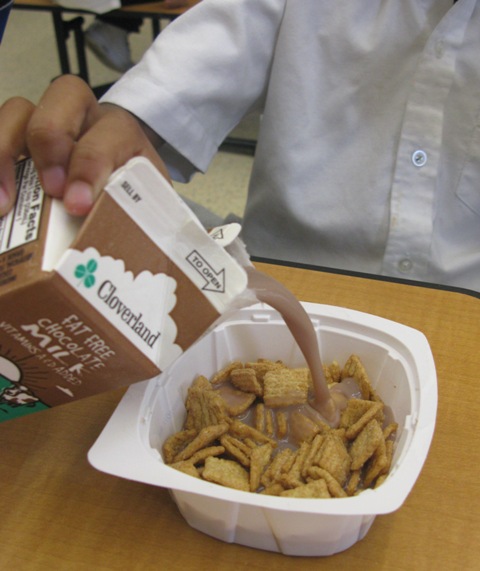
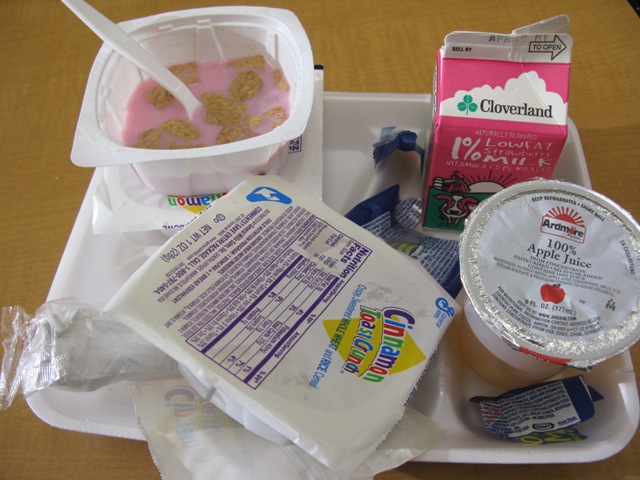
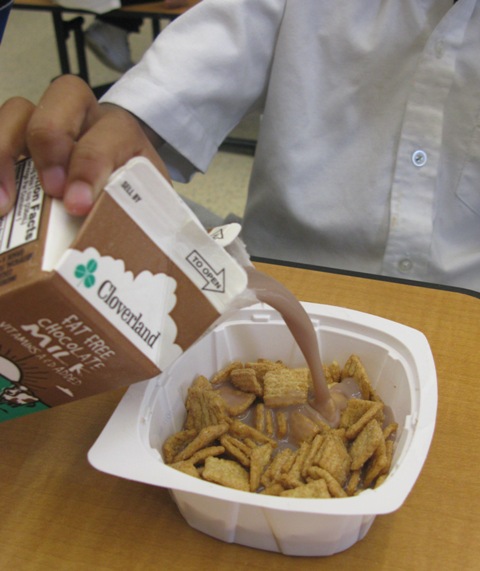
Last year, after I wrote a series of articles detailing in part how kids in D.C. schools were pouring strawberry milk over Apple Jacks cereal and routinely consuming as much as 15 teaspoons of sugar for breakfast, school officials removed flavored milk and sugary cereal from the menu.

Here's one of the replacement cereals we see in school cafeterias now. Kix contains just three grams of sugar--that's less than a teaspoon--in a one and one-quarter cup serving.

There's more sugar--way more--in that small container Stonyfield yogurt. A four-ounce serving of Stonyfield's blueberry yogurt, for instance, contains 13 grams of sugar, or a little more than three teaspoons. That's only slightly less, ounce for ounce, than the sugar in a can of Pepsi.

Good thing, I guess, kids only see this yogurt in a four-ounce size.

For complete nutritional information on Kix, go here.


Friday, February 25, 2011

What's for Breakfast: Glycemic Bomb

By Ed Bruske
aka The Slow Cook

Just when you thought we'd gotten rid of the tater tots, they show up on the breakfast menu. My daughter couldn't wait to dig into hers. In fact, kids wolfed down the potatoes and ran back to the food line for more. After pizza, potatoes are kids' favorite food in the federally-subsidized meal program.

But with all of the other starches and sugars on this tray, were potatoes really necessary? The USDA's proposed new meal guidelines would cut back sharply on "starchy vegetables" such as potatoes, corn and peas. But they would also add 80 percent more grains to breakfast in the form of "whole grain-rich" products.

In other words, kids will be getting tons more starch, as long as it contains 51 percent "whole grain." So don't be looking for actual whole grains, but rather processed foods that have "whole grain" added.

This particular breakfast is full of starch and sugar. Consider what Chartwells advertises as the "all natural whole grain bluenanaberry muffin," next to it the "oven baked hash browns" that are actually re-heated, processed tater tots. Then there's the 4.23-ounce container of "fruitables" juice, containing 12 grams of sugar and the four-ounce container of Stonyfield organic yogurt containing another 13 grams of sugar.

Between the juice and the yogurt alone kids are consuming the equivalent of nearly six teaspoons of sugar, to which is added the starch from the potatoes and the muffin. Most people still fixate on fat in kids' diet, while it's the starch and sugar in foods like this that are intimately linked with rampant illnesses such as diabetes, hypertension and heart disease.

That's quite a lot to be trying to disguise with soothing labels such as "all natural" and "organic" and "100 percent juice."

Thursday, January 13, 2011

Head of Harvard Nutrition Unit Says No to Chocolate Milk

Too much sugar in school food?

By Ed Bruske

aka The Slow Cook

The dairy industry would like to see Americans everywhere lift a glass for chocolate milk—and pour one for their kids while they’re at it. Dr. Walter Willett, chairman of the department of nutrition at the Harvard School of Public Health, sees that as a recipe for a health disaster.

Willett says the nation’s schools should not be serving sugary chocolate milk to children, adding that too many refined, starchy foods in the federally-subsidized school meals program pose a risk of obesity and other weight-related illness.

“These highly sugared milks make absolutely no sense whatsoever,” Willet said in an interview. “The use of sugar as an important part of the diet makes absolutely no sense nutritionally, especially when obesity is the number one health problem facing our nation.”

Willett and Harvard colleagues recently went public with findings exonerating fat and blaming sugar and too many starchy carbohydrates--such as those found in bread, pasta and potatoes--for many of the nation’s health problems, including obesity, diabetes, hypertension and heart disease.

“People are getting 50 percent of their calories from carbs, and 80 percent of those calories are from refined starch and sugar,” Willett said. “Kids in school are getting the full brunt of that diet.”

Willett, who had not spoken out publicly on the school food issue previously, thus adds Harvard’s prestige to a growing chorus of critics questioning the routine use of flavored milks and other sugary products in school meals.

Meanwhile, an Emory University study described as the first of its kind finds that children who eat lots of sugar are at greater risk for heart disease. Released this week, the study found that sugar accounted for more than 21 percent of the calories in the diets of average teenagers, resulting in lowered levels of “good cholesterol” (HDL) and elevated levels of fat in the blood (triglycerides), both key markers of heart disease.

In examining dietary survey results compiled by the U.S. Centers for Disease Control from 2,157 teenagers across the country, the study found that some teens got an astonishing 30 percent of their calories from sugar. Overweight children with the highest level of sugar consumption also showed increased signs of insulin resistance, a precursor to diabetes.

Most of that sugar is believed to come from sodas and other sugary beverages. Sugar, while delivering calories, has no nutritional value, and some have called it an “anti-nutrient” because of the health problems it can cause. Yet it has become a regular stand-in for real food in school meals because it delivers lots of calories at little cost.

Greg Miller, a nutritionist and executive vice-president of research , regulatory and scientific affairs at the National Dairy Council, defended flavored milk in school meals, saying he routinely feeds his own children chocolate milk because of the many nutrients it contains—calcium, vitamin D, potassium, riboflavin, to name a few—and because his children won’t drink plain milk.

Miller said studies indicate that kids offered chocolate and other milk products with added sugar get equally good nutrition as drinkers of plain milk and do not show signs of being any heavier. “Certainly we want to be concerned about sugar,” Miller said. “But I look at other places to cut sugar—less nutrient-dense foods, like cookies.”

The National Dairy Council vigorously promotes flavored milk in school through the industry’s “Raise Your Hand for Chocolate Milk!” campaign. Miller noted that companies such as milk giant Dean Foods are looking for ways to reduce the sugar content of flavored milk. “We want to be a responsible industry,” he said.

Likewise, the School Nutrition Association, which is partially funded by the dairy industry, and where dairy interests have a seat on an “industry advisory committee,” also continues to promote flavored milk in schools despite its sugar content.

The SNA represents some 50,000 of the country’s school food service workers, giving it broad influence over the kinds of foods served in school cafeterias.

SNA spokeswoman Diane Pratt-Heavner pointed to proposed nutrition guidelines for school meals, published in October 2009 by the Institute of Medicine, that set no limit for sugar in school meals and make specific allowances for including sugary flavored milk on cafeteria menus.

Saying they were “concerned that eliminating all flavored milk would result in a substantial decrease in milk intake,” committee members cited a 2008 study published in the Journal of the American Dietetic Association that found that children who prefer flavored milk drink just as much milk as kids who prefer plain, and get just as much nutrition without adverse weight gain.

That study was funded by dairy interests and written by nutritionists with longstanding ties to the industry.

The IOM committee also said it expected that reducing calorie requirements for school meals, increasing the amount of fat permitted, and requiring bigger portions of vegetables and whole grains would tend to squeeze sugar-laden foods such as desserts off school menus.

The recommendations, written at the behest of the U.S. Department of Agriculture, have not yet been formally adopted, but are expected to be released today for public comment.

The USDA requires that schools offer milk with breakfast and lunch. Kids overwhelmingly prefer chocolate milk over plain. Estimates indicate that between 60 and 70 percent of the milk consumed in the school meals program is flavored.

Many children start their day with a government-sponsored breakfast consisting of strawberry-flavored milk containing nearly as much sugar as Mountain Dew, ounce-for-ounce, poured over a bowl of Apple Jacks or other sugar-enhanced cereal. Until recently, kids as young as five here in the District of Columbia routinely were being served the equivalent of 15 teaspoons of sugar before classes even started, and experts say that’s not at all uncommon in school districts around the country. Some are even worse.

Monday, January 10, 2011

New Report Challenges Dairy Campaign Promoting Chocolate Milk in Schools

A little sugar with that calcium?

By Ed Bruske

aka The Slow Cook

A landmark study on calcium and vitamin D nutrition recently published by the Institute of Medicine poses a serious challenge to a dairy industry campaign to sell chocolate milk to the nation’s school children, finding that only girls aged 9 to 18 might need more calcium and only by an amount contained in a half-serving of calcium-fortified cereal .

In setting new dietary standards, the IOM found claims that Americans are deficient in calcium and vitamin D to be greatly exaggerated. But the dairy industry has spent millions of dollars promoting sugary flavored milk in schools based on the idea that children are threatened with a “calcium crisis.” The industry is fighting efforts to remove flavored milk from school menus, saying kids will be in danger of not getting the calcium they need to build strong bones.

Meanwhile, a growing body of scientific evidence links sugar with an epidemic of childhood obesity as well as a host of related health problems: diabetes, hypertension, heart disease and even an unprecedented outbreak of non-alcoholic fatty liver disease in children.

According to the IOM, girls leading up to and during puberty typically consume around 823 milligrams of calcium daily. Because they experience a growth spurt during this period, they should aim to get about 200 milligrams more calcium, or “between 1,000 and 1,100”milligrams, said Dr. Steven A. Abrams, a professor of pediatrics at Baylor College of Medicine who specializes in the calcium intake of children and was one of the panelists who wrote the IOM report.

By comparison, a one-cup serving of Total cereal contains 1,000 milligrams of calcium, a cup of low-fat milk around 300, and a half-cup of cooked collard greens 200, about the same as in a single serving of string cheese.

“I’ve never been a fan of the term ‘calcium crisis.’ I’m much more in favor of policies that ensure we meet that 1,000 milligrams,” said Abrams. “What we need to do is make sure that we have a lot of different ways for kids to get to it.”

Sources of calcium besides milk, cheese and yogurt include fortified cereal and fruit juice, as well as certain green vegetables, such as bok choy, broccoli and collard greens. Dairy products contain more calcium, but the calcium in vegetables is more readily absorbed.

Abrams declined to address the question of using sugar and flavorings to entice children to drink milk at school, saying “people have different perspectives,” and noting that he sits on a board that advises MilkPEP, the dairy group responsible for the “Got Milk?” and “Raise Your Hand for Chocolate Milk!” campaigns.

But a leading medical voice on the dangers of sugar, Dr. Robert Lustig, a professor of clinical pediatrics at the University of California at San Francisco specializing in endocrinology and obesity, said schools should not be offering flavored milk to children. “But it won’t get fixed any time soon,” Lustig said. “The dairy industry is very tight with the USDA.”

The IOM report created a sensation when it was released in November because it debunked rampant promotion of vitamin D supplements as a treatment for everything from cancer to arthritis to diabetes. The IOM panel said there was no scientific basis for those claims and found that calcium supplements also are not necessary. Their report, based on a review of more than 1,000 studies and testimony from medical professionals, constitutes the most authoritative dietary recommendations on calcium and vitamin D to date.

Calcium and vitamin D working in tandem are essential to skeletal health throughout life. Vitamin D actually acts as a hormone, enabling calcium in its job of building and “remodeling” bones, as well as performing vital functions elsewhere in the body. In fact, there is very little study of how much calcium and vitamin D are needed independent of each other. Complicating the task of setting dietary requirements , the IOM panel said, is the fact that as well as being contained in some foods, such as oily fish and egg yolks, vitamin D is synthesized by the skin from sunlight.

Most Americans don’t consume enough vitamin D in theory, but measurements of the hormone in their blood consistently show they have more than enough, indicating they get at least some from sunshine, the panel reported.

Also unknown is the minimum amount of calcium needed for healthy bone growth. Abrams said some experts put the number as low as 600 milligrams in pubescent girls. But he said the IOM panel “chose not to set a minimum number.”

The committee took a more cautious route, adopting 1,100 milligrams of calcium daily as the “estimated average requirement” for all children aged nine to 18, meaning the amount that would ensure that at least half the children in that age group get the calcium they require. But because genetic differences can affect how well some people’s bodies utilize calcium, Abrams said the committee went a step further and established 1,300 milligrams as a “recommended dietary allowance” that would cover 97 percent of all children in the group.

Well-designed studies of children’s calcium intake and its effect on bone health are scarce. One study cited by the panel found that while children who were given extra calcium did show increased bone growth, it did not last after the supplementation ended.

The IOM report makes no mention of bone impairment being suffered by children not getting enough calcium or vitamin D outside the rare cases of rickets experienced by infants, typically those with dark skin who are breastfed. Breast milk contains less vitamin D than infant formula and dark pigment inhibits the skin’s ability to synthesize sunlight.

Milk sold commercially is fortified with vitamin D. Exactly how much calcium children consume or where they get it isn’t known, although some surveys have attempted to establish a rough idea. For many children, the federally-subsidized meals program, where milk is a required element at breakfast and at lunch, is an important source of calcium and vitamin D—at least when school is in session.

The 2007 School Nutrition Dietary Assessment Study published by the USDA found that the mean 24-hour calcium intake among middle-school students was 1,137 milligrams—or well within the acceptable range—for those who participated in the meals program, but 906 milligrams—less than the amount recommended—for children who ate outside the subsidized lunch line.

The USDA reports that children who participate in the federally-subsidized lunch program are four times as likely to drink milk at school than other children.

A “study” commissioned last year by the dairy industry, and performed by a company that conducts marketing research for corporate food clients, suggested that 35 percent fewer elementary school students drank milk when flavored milk was removed from the cafeteria. But the dairy industry has refused to release the full study, and some experts have dismissed it as inherently biased.

Estimates indicate that anywhere from 60 to 70 percent of all milk consumed in schools is chocolate or another flavor with added sugar. An eight-ounce serving of chocolate milk, for instance, typically contains about 14 grams of high-fructose corn syrup, the equivalent of three and a half teaspoons.

According to Lustig and other anti-sugar activists, the dangers of sugar in the form of fructose outweigh any calcium or vitamin D benefits children might get from drinking flavored milk.

Beginning in fall 2010, schools in the District of Columbia ceased serving flavored milk, following districts such as Berkeley, Calif., and Boulder, Co. The state board of education in Florida also has been considering such a move, but recently was asked by the state’s newly appointed agriculture secretary to put that decision on hold pending further study.

Monday, December 13, 2010

What's for Breakfast: Kix & Muffin

By Ed Bruske
aka The Slow Cook

Over the summer, the food services director for D.C. Public Schools decided to remove flavored milk and sugary cereal from school breakfast menus. The means no more Apple Jacks or Raisin Bran. Instead, the kids are served only cereals with six grams of sugar or less.

According to the General Mills website, these Honey Kix, made primarily of corn, contain six grams of sugar in a 1 1/4 cup serving. Next to it is an "apple cinnamon muffin," according to the Chartwells menu website. It doesn't have any packaging identifying the nutritional content. The Healthy School Act approved by the D.C. council earlier this year requires the schools to post the ingredients in school food. But a website containing that information and promised for November has now been delayed till next year.

Notice also the string cheese on this tray. That's also something new that began in the fall. All in all, this is a big change from the Apple Jacks, strawberry milk, Pop-Tart and Giant Goldfish Graham breakfast--often 15 teaspoons worth of sugar first thing in the morning--D.C. kids were getting as recently as last spring.

The big change had nothing to do with Congress or the USDA or even our own Healthy Schools Act, and everything to do with the bold action of our local food services director. Even though school meals are funded mostly by the federal government, it's much easier to make change at the local level than to wait for Uncle Sam.

Monday, September 13, 2010

Time to Save School Lunch from Government Standards

By Ed Bruske
aka The Slow Cook

The biggest news about the Child Nutrition Act pending in Congress isn't increased funding or more vegetables and whole grains in school meals. The reason we need this bill passed now is to save children from government standards that are destroying kids' health.

Every day I visit the cafeteria in my daughter's elementary school here in the District of Columbia and watch a quiet struggle unfold. It's the same battle schools fight all over the country: trying to provide kids the calories the U.S. Department of Agriculture says they must have on a budget that won't cover the cost of healthy food. The result: meals loaded with sugar, enemy No. 1 in our current epidemic of childhood obesity.

Sugar, and especially the high-fructose corn syrup that proliferates in cheap processed food, has emerged as the leading culprit behind a host of modern ills. It packs fat onto waistlines, raises blood pressure, creates bad cholestorol and unhealthy arteries, primes bodies for diabetes and heart failure, and now is suspected in an outbreak of non-alcoholic fatty liver disease in children.

Right behind smoking, sugar has become the health scourge of our time, contributing greatly to this country's estimated $147 billion annual tab for weight-related illnesses. Yet in the world of federally-subsidized school meals, sugar not only goes virtually unregulated, but has emerged as the go-to ingredient to boost calories in perpetually under-funded cafeterias.

Take breakfast, for instance. The USDA says that a school breakfast must provide 554 calories for children in elementary school. Where do those calories come from? Well, if you have less than $1 to spend, your breakfast might very well look like the ones that used to be served every day in D.C.: Sugary Apple Jacks cereal topped with strawberry-flavored milk, accompanied by a Pop-Tart, a pack of Giant Goldfish Grahams and a carton of orange juice. Altogether, children as young as five routinely were consuming the equivalent of 15 teaspoons of sugar before classes even started.

This year, D.C. school officials have taken the extraordinary step of eliminating not just flavored milk and sugary cereals, but also those other processed "treats" that were standard fare in the breakfast line. Now we see low-sugar Kashi cereal and organic yogurt and sunflower butter and cottage cheese on the menu. But how do you make a small blueberry muffin, a scoop of cottage cheese, a carton of low-fat milk and four ounces of orange juice add up to 554 calories?

We're lucky here in the nation's capitol. As the result of a "Healthy Schools Act" passed by the D.C. Council earlier this year, we now have 10 cents extra to spend on breakfast and another 10 cents for lunch. Few local jurisdictions have been so generous. That's why you see cookies and brownies in subsidized school lunches all over the country. The sugar provides a cheap boost in calories. In the Chicago area, parents continue to complain about "brunch for lunch," meaning pancakes, phony syrup and cookies posing as the midday meal. Other healthy food advocates despair of getting sugary flavored milk off the menu: Their schools would then fall short of the USDA's calorie requirements.

The measly six additional cents the U.S. Senate recently approved for school meals as part of its version of the Child Nutrition Act re-authorization won't solve the problem. But its call for new meal standards might. Under the Senate bill, the USDA would be required to "update meal patterns and nutrition standards" within the next three years. Proposed new standards have already been developed by the Institute of Medicine at the USDA's behest.

Don't look for any regulations aimed specifically at sugar. The sugar lobby is too strong for that. Instead, the IOM attempts an end run around sugar's tyranny over school meals, lowering calorie requirements while boosting the amounts of fruits, vegetables and whole grains schools must serve. Sugar essentially would be squeezed off the menu.

In fact, the current calorie minimums enforced by the USDA exceed the IOM's proposed maximums. The calorie requirement for an elementary school breakfast, for instance, would change from that flat 554 calories to a range of 350 minimum calories and a maximum of 500. That means 204 calories cash-strapped school wouldn't have to pay for, calories kids might not be exposed to in the form of sugar.

For lunch, the IOM recommends a range of 550 to 650 calories for kids five to 10 years of age, compared to the USDA's current fixed amount of 664. The Institute of Medicine also proposes to raise the percentage of calories that can derive from calorie-dense fat in school meals from 30 percent to 35 percent, a move that would further reduce schools' reliance on sugar and bring the meals program more in line with the federal government's dietary guidelines.

In addition, this year's version of the Child Nutrition Act for the first time would give the USDA authority to regulate all foods sold in school, not just in the subsidized meal line. If the agriculture secretary is in a mood to take on the processed food industry, that could mean no more sugary drinks and snacks in vending machines, no more ice cream bars or fruit roll-ups in a la carte lines.

For healthy school food advocates, the Senate's trifling six cents is hard to swallow. But we need to get over it for now and make sure the House moves quickly on its version of the Child Nutrition Act. As we've seen here in D.C., a lot can be accomplished just by ridding school meals of unhealthy foods, especially sugar. That's reason enough to make passage of this bill now an urgent priority.


Tuesday, September 7, 2010

What's for Breakfast: Pancakes & Peaches

By Ed Bruske
aka The Slow Cook

This breakfast may look innocent enough. But if you give it a moment's thought, you'll notice that it's just one huge helping of carbohydrates and sugar--sugar in the juice, sugar in the canned peaches, and I'm guessing sugar in the pancakes as well.

Sugar is the No. 1 culprit in the childhood obesity epidemic. It raises triglycerides, raises "bad" LDL cholesterol, lowers "good" HDL cholesterol, leads to elevated blood pressure and atherosclerosis. Sugar and simple, starchy carbohydrates stimulate insulin production, the hormone responsible for fat storage in the body.

A big part of the problem are the federal government's wacky "Dietary Guidelines for Americans," which promote consumption of carbohydrates in grains and do not place enough emphasis on healthy proteins and fats. Compounding the problem are the prevailing calorie requirements in the federally-subsidized school meal program, which encourage schools to pack meals with sugar and cheap, processed carbs.

To top it off, federal funding for the program is nowhere near enough. Most schools can't afford to pay for more expensive, healthier foods.

Monday, September 6, 2010

Does This Look Like 554 Calories?

By Ed Bruske
aka The Slow Cook

The federal government says that school breakfasts served to elementary school students must contain 554 calories to qualify as a reimbursable meal. The "cold" breakfast option in D.C. schools on Friday was a muffin and string cheese. My daughter, who is lactose intolerant, declined to take milk. But in terms of total calories, that would make 110 for low-fat milk, 60 for the string cheese, 55 for the orange juice for a total of 225 calories. There's no nutritional information with the muffin, but I'm guessing it does not contain 329 calories.

There's a wrinkle to the federal rules, however. The daily calorie requirement is supposed to reflect an average for the week, meaning some meals might contain more than 554 calories, others less.

The only cold breakfast option I saw listed for the first two weeks of school that came even close to that was the one with a processed breakfast bar called BeneFIT that packed a whopping 48 grams of carbohydrates (starch) and 23 grams of sugar (more than in a Pop-Tart, and almost as much as in an 8-ounce carton of chocolate milk), for a total of 290 calories. Or maybe it was Wednesday's whole wheat bagel with cream cheese and "all natural yogurt" containing four teaspoons of sugar in a quarter-cup portion.

Those are the prevailing federal standards, as administered by the U.S. Department of Agriculture. Meanwhile, the school meal standards contained in the District's "Healthy Schools Act" set a minimum calorie requirement for breakfast of 350 in pre-kindergarten through grade eight, and a maximum of 500. But the current food services director for D.C. Public Schools says he's adopted even better standards--those proposed by the Institute of Medicine, which call for 350 to 500 calories at breakfast for kindergarten through grade five.

The IOM standards were requested by the USDA, but it may be years before the USDA actually adopts them.

Confused yet?

You needn't be. The common denominator running through this rat's nest of government standards is that when schools are unable to offer kids enough calorie-dense real foods to comply with regulations they serve up sugar instead. To add a further complication, the federal rules state that schools can include in their calculations all of the foods offered on any given morning--the milk, the muffin, the string cheese, the orange juice--even though the kids can decline one of those items and still qualify for a federal reimbursement under the government's nutrient-based menu system, or they must take three items under the food-based menu system. (Could it be any more complicated?).

That helps explain why juice, with its extra dose of sugar, is being offered every day for breakfast in D.C. schools alongside milk.

Take your pick: On any given morning, kids aren't getting as many calories as the government calls for, or they may be getting them in the form of sugar. Does that mean schools are lax for not offering better options, or are the federal standards crazy and the amount of financial support provided by the federal government simply inadequate to offer the kinds of healthy foods kids should be eating?

The irony, of course, is that we pleaded with D.C. schools to get rid of sugar and they responded: They dumped flavored milk and sugary cereals. They've also gone to some pains to introduce things like cottage cheese and string cheese and local fruit. What else can they add in the way of real food that will satisfy the government's calorie requirements without dosing kids with more sugar?

D.C. Public Schools have an advantage as a result of the extra funding provided by the "Healthy Schools" act: 10 cents more for breakfast, 10 cents more for lunch and five cents for each meal that contains a locally grown component. Imagine the predicament of other school districts where the local government has not stepped forward with extra cash. The extra six cents per meal recently embraced by the U.S. Senate as part of the Child Nutrition re-authorization looks punier and punier all the time.

Friday, September 3, 2010

Serving Cheap Calories from Sugar

Ed Bruske
aka The Slow Cook

I had originally intended to focus in this post on the cottage cheese you see in the photo. Serving cheese products seems like a great way to address the concerns of parents that kids aren't getting enough calcium. But then the apple juice on this tray caught my eye and I wondered what would happen if you removed it, since it contains so much sugar (2.5 teaspoons in a 4-ounce serving, or about the same as Coca-Cola).

But then I started to add up the calories in this meal, which Chartwells offers at my daughter's elementary school as the cold alternate breakfast on Thursdays. Under D.C.'s "Healthy Schools Act," schools must serve children in pre-kindergarten through eighth grade a minimum 350 calories for breakfast. The Kix, with four grams of sugar, contain just 70 calories, the low-fat milk 110 calories, the apple juice 55 calories and the cottage cheese I'm guessing around 45 calories. (It looks to be about one-quarter cup).

With a total of 280 calories, this meal, by my reckoning, already falls short of the minimum prescribed by law. Take away the apple juice, with its dose of calories from fructose, and this breakfast would be 36 percent shy of the calories prevailing law says the schools should be serving every day.

That helps explain why school food service operations have become so addicted to sugar. Sugar adds a cheap boost of calories to meat meal program standards. But more than any other ingredient, sugar is linked to the current epidemic of childhood obesity, as well as health consequences such as elevated cholesterol and triglycerides, high blood pressure, atherosclerosis, and even non-alcoholic fatty liver disease in children.

Maybe that's why some schools are so desperate to hang onto flavored milk: not for the calcium and other nutrients, but for the calories that come with the added sugar.

What could you put on this tray that would satisfy the requirements for calories, would not add sugar, and wouldn't bust the food services budget?

Wednesday, September 1, 2010

BeneFIT? Really?

By Ed Bruske
aka The Slow Cook

Have you ever read the ingredient label on a so-called fitness food? They usually advertise themselves as healthful becuase they're low on fat and maybe supercharged with fiber. But if you look closely, you'll often see that what these "health" foods are missing in fat is more than made up for by a big dose of sugar.

Despite its current reputation, fat, along with protein, is a necessary macronutrient. We cannot survive without it. Sugar, on the other hand, is treated by the body as a toxin, and is closely linked to a host of medical issues, such as elevated levels of unhealthy cholesterol and triglycerides, high blood pressure, weight gain and obesity, diabetes and--here's something new and alarming--a sharp increase in the incidence of non-alcoholic fatty liver disease in children.

D.C. Public Schools this year took the bold step of removing flavored milk products with added sugar from the menu, as well as sugary cereals. We also have not been seeing popular sugary "treats" such as Pop-Tarts, Giant Goldfish Grahams and Otis Spunkmeyer muffins.

So why add the sugar back in the form of something called a "BeneFIT Breakfast Bar"? According to the label, this 2.5-ounce packaged food contains a whopping 290 calories, 48 grams of carbohydrates and 23 grams of sugar, the equivalent of nearly six teaspoons. It's being offered as a standing alternative to the hot breakfast in D.C. schools on Tuesdays.

The "Healthy Schools Act" that went into effect this year in the District of Columbia mandates a maximum of 550 calories for a school breakfast through eighth grade, but it does not set any standards for the use of sugar in meals.

By contrast, a "whole wheat" Pop-Tart weighing in at 1.8 ounces contains 190 calories, 35 grams of carbohydrates and 13 grams of sugar.

Here are the ingredients listed on the BeneFIT package:

Whole wheat flour, sugar, enriched flour (wheat flour, niacin, reduced iron, thiamine mononitrate, riboflavin, folic acid), dried apples, vegetable shortening (canola oil, palm oil), oats, eggs, invert syrup, molasses, leavening (baking soda, sodium acid pyrophosphate, corn starch), whey, natural flavors, inulin, xanthan gum, cinnamon, salt.

Furthermore, environmental and wildlife groups object to the use of palm oil in prepared foods because jungle habitat necessary for the survival of endangered orangutans is being destroyed in order to grow palm plantations.

On the other hand, the additiion of string cheese to D.C. school meals should relieve parents who worry that their kids aren't getting enough calcium.

Saturday, August 28, 2010

What's for Breakfast: Kix


By Ed Bruske
aka The Slow Cook

Breakfast in a District of Columbia elementary school has a pared-down look this year. Gone are the Pop-Tarts, Giant Goldfish Grahams and Otis Spunkmeyer muffins we saw virtually every day in the past. Food Serivices Director Jeffrey Mills, who took the job some eight months ago, has said he wants to eliminate processed foods as much as possible from school menus.

Also gone are the flavored milks with so much added sugar that kids drank with breakfast and with lunch. The new choice is low-fat or non-fat plain milk. And sugary cereals such as Apple Jacks and Chocolate Frosted Mini-Wheats are no longer an option. The schools now serve only cereals containing six grams or less sugar, such as these Whole Wheat Honey Kix, which contain only four grams of sugar per serving.

As you can see from this photo, kids sometimes can also choose a piece of string cheese with breakfast. On Wednesday they were offered zucchini bread and cottage cheese. Cheese, cottage cheese and yogurt are good sources of calcium for kids who don't drink milk--like my daughter, who is lactose intolerant.

Between the sugary cereals, the flavored milk, the fruit juice and the sugary processed treats, kids in D.C. schools used to consume up to 60 grams of sugar (15 teaspoons) before classes even started. Does that make sense in the middle of an obesity epidemic?

Parents who were distressed over the amount of sugar being fed to kids in school are glad to see these changes, which also teach valuable lessons about what healthy food looks like. What do you think? What is your local school serving for breakfast?

Thursday, August 26, 2010

Out with Flavored Milk, In with Flavored Yogurt

Is sugary yogurt better than sugary milk?

D.C. school officials have ditched chocolate- and strawberry-flavored milk because of the added sugar. But yesterday the kids who chose the alternate cold lunch at my daughter's elementary school were served a raspberry flavored yogurt with even more sugar, ounce-for-ounce, than Mountain Dew.

Other parents have noted that the same type of flavored yogurt is being served as part of breakfast to pre-schoolers.

Fortunately, the serving size is fairly small--just four ounces--meaning kids are eating at most 16 grams of sugar. That's 33 percent more than the naturally occurring lactose in an 8-ounce carton of low-fat milk. It works out to four teaspoons of sugar in that little plastic tub.

Apparently, finding a flavored yogurt without a ton of sugar isn't easy. Have you ever checked out the yogurts at the grocery store? They're full of sugar. In fact, most of them are sweetened with high-fructose corn syrup. Maybe the food service folks in D.C. Public Schools thought this particular variety of yogurt was not so bad because it's sweetened with sugar instead of high-fructose corn syrup. But as far as your body is concerned, the two are equally bad.

The yogurt is made by Upstate Farms, otherwise known as Upstate Niagra Cooperative outside Buffalo, N.Y., a group of Western New York dairies that's been in business since 1965, according to their website. Could we ask them to try making a yogurt for schools with less sugar?

In addition to live bacteria, these are the ingredients listed on the label: cultured pasteurized Grade A non-fat milk, sugar, water, raspberries, modified corn starch, whey, natural flavors, purple carrot concentrate, tricalcium phosphaste, gellan gum, potassium sulfate (for freshness), citric acid, carob bean gum, Vitamin D3.

A 4-ounce container counts as one "meat alternate" in the federal school lunch scheme. The other items in the cold alternate lunch were an individual piece of string cheese and wedges of pita bread. According to the Chartwells menu, the Wednesday alternate is supposed to contain a "hummus combo" to go with the pita, carrot sticks and "locally grown cucumber coins."

One thing you learn fairly quickly hanging around a school cafeteria is that the meals served are not always identical to the meals on the menu published at the Chartwells website.

Wednesday, July 14, 2010

Why Should We Care About High-Fructose Corn Syrup?

By Ed Bruske
aka The Slow Cook

Kids' food is laced with high-fructose corn syrup and the Corn Refiners Association is spending big bucks to try and assure parents--and consumers in general--that there's nothing wrong with HFCS, that it's no different from ordinary sugar.

What we really need to understand is that high-fructose corn syrup and sugar are, on a molecular level, exactly the same and equally bad. In fact, the body treats them as if they were poison.

For everything you ever wanted to know about fructose and sugar, I suggest you carve 1 1/2 hours out of your busy schedule and watch this lecture by Robert Lustig, a professor of pediatrics in the edocrinology department at the University of California San Francisco.

Lustig demonstrates how the explosion in obesity and related diseases such as diabetes and hypertension has paralleled the advent and rise in the use of high-fructose corn syrup. HFCS was invented in Japan in 1966 and introduced in the United States in 1975.

"There is absolutely no difference between high-fructose corn syrup and sucrose. They're both equally bad. They're both poison," Lustig says. He adds that HFCS "isn't evil because it's metabolically evil, it's evil because it's cheap."

In fact, HFCS is sweeter than regular table sugar but only costs about half the price, hence the widespread use of it by the processed food industry. Fructose (and sugar), Lustig explains, is metabolized in the liver just like alcohol and has many of the same effects: it stimulates the body to store fat, increases blood pressure, suppresses good cholesterol, elevates bad cholesterol and stymies the body's normally mechanisms for suppressing appetite.

Americans, Lustig says, are consuming far more calories than they did a generation ago because fructose (sugar) is everywhere in the food chain in ever greater quantities. As a result, many countries are now experiencing an epidemic of obese toddlers, and young people with non-alcoholic fatty liver disease.

What's the moral of this story? Whether its high-fructose corn syrup or regular sugar, don't eat it. Ditch the orange juice and eat a whole orange instead. (Another problem, according to Lustig: fiber mitigates the effects of sugar, but we've nearly eliminated it from our diets, and especially from convenience foods. So stop eating processed foods as well.)

You might also want to go back and read this post on sugar by our friend Susan Rubin.