Showing posts with label muffins. Show all posts

Friday, February 3, 2012

Kids Make "Healthy" Blueberry Muffins


No processed sugar in these muffins

By Ed Bruske

aka The Slow Cook

If you're trying to reduce the saturated fat and processed sugar in your diet, these muffins definitely fall into the category of "healthy." Orange juice, apple sauce and the blueberries lend a bit of sweetness. And for fat, we have canola oil, which contains even more mono-unsaturated fatty acids than olive oil.

But we can't advertise muffins as "healthy" to the kids in our food appreciation classes. The last time we tried, they turned on their heels and ran back onto the playground. No, the best way to market these muffins, we found, is to just have the kids make them. Through the magic of hands-on participation, kids somehow overlook the fact that in this case, a delicious muffin doesn't have to knock them over with its sugar content.

The only trick to these muffins is assembling a somewhat unconventional list of ingredients. For instance, you may not have oat bran--full of vitamins and fiber--or whole wheat pastry flour on your pantry shelf. But we found these readily available at the local Whole Foods. The blueberries in this case were the frozen variety, a stock item in most supermarkets.

Start by whisking together your dry ingredients in a large mixing bowl: 1 1/2 cups oat bran, 1 cup unbleached all-purpose flour, 1/2 cup whole wheat pastry flour, 2 teaspoons baking soda, 2 teaspoons baking powder, 1 teaspoon ground cinnamon, 1/2 teaspoon salt.

In a separate bowl, beat 2 large eggs, then mix in 1 cup plus 2 tablespoons unsweetened apple sauce, 1/2 cup orange juice, 2 tablespoons canola oil, 1 teaspoon vanilla extract.

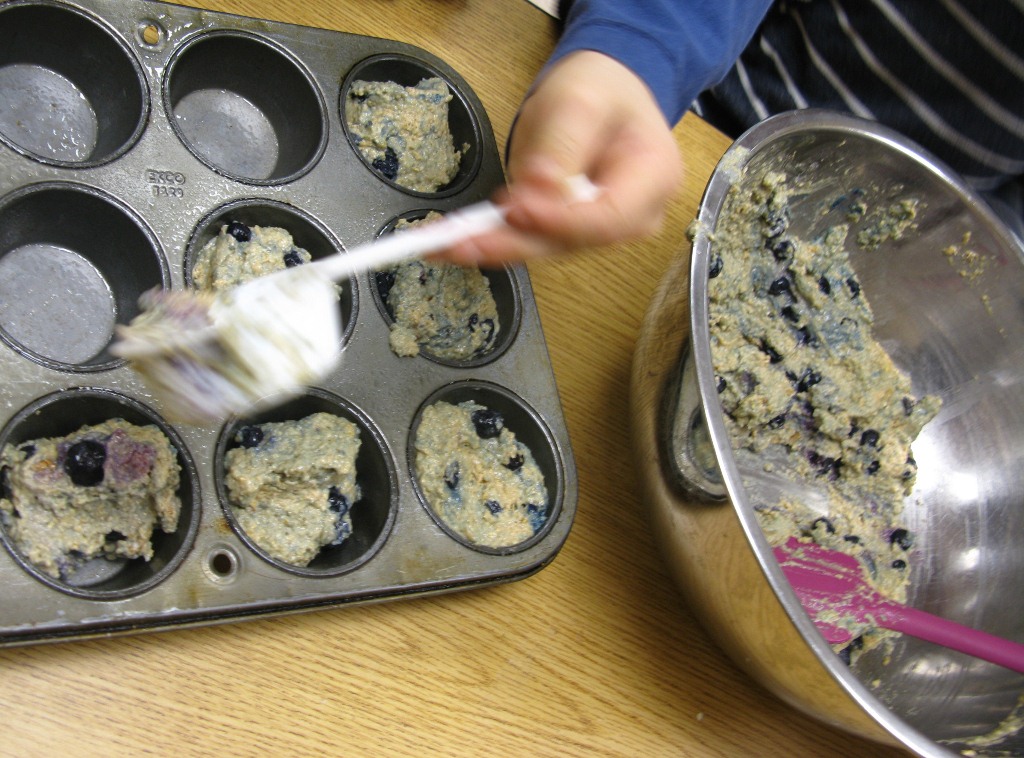
Pour the wet ingredients into the dry ingredients and mix together, scraping the sides and bottom of the bowl, just until everything is incorporated. Then fold in 1 1/4 cups blueberries.

Grease a standard muffin tin (we used cooking spray) and spoon in the batter. Scatter about 1/4 cup rolled oats over the tops of the muffins and give them a gentle pat. Then place the tin in a 400 degree oven for 18 minutes.

The finished muffins turn out light, moist and bursting with blueberries. Pour yourself a tall glass of cold buttermilk to wash it down.

Note: You can also add 1/2 cup coarsely chopped walnut pieces to the muffin batter for a bit of crunch.

Wednesday, April 27, 2011

What's for Breakfast: Cranberry Muffin

By Ed Bruske

aka The Slow Cook

Tuesday seems to be homemade muffin day at my daughter's elementary school. We see all different kinds of muffins--or "muffin squares," as Chartwells calls them--made by our kitchen manager. She's been working in cafeterias for 25 years, so I guess making a muffin is nothing new to her.

This particular muffin is made with cornmeal, flour, eggs, sugar and dried cranberries. I liked it--a bit sweeter than I'd make it for myself. But still, it was a good muffin. I could easily see it next to a cold glass of buttermilk.

But I don't think the kids liked the cranberries much. This is what I saw on quite a few trays: kids picking the cranberries out of the muffins.

"I don't like cranberries," one girl explained.

You can't really argue with that. Dried cranberries are definitely a matter of taste. And what kids don't like, they won't eat.

Wednesday, April 20, 2011

What's for Breakfast: Blueberry Muffin Square

By Ed Bruske

aka The Slow Cook


This "blueberry muffin square" is part of what has become "homemade" muffin Tuesdays at my daughter's elementary school here in the District of Columbia. Yes, our "lunch ladies," some of whom have worked 25 years or more in school cafeterias, do know how to cook things from scratch.


The "muffin" is made with corn meal, flour, sugar and frozen blueberries at the bottom of a stainless hotel pan, then cut into squares. I've tried it and it's pretty good. But just in case there wasn't enough starch on the breakfast tray, someone in the Chartwells home office decided to add "oven-baked hash browns"--or so said the online menu. As you can see, these became the ever-popular tater tots.


One other thing you might notice: although our school has a dish washing machine and normally serves meals on re-usable plastic trays, some meals are served on Styrofoam. Turns out there's a reason for that. Blueberries tend to stain the plastic, according to the kitchen manager, and kids won't eat off trays with blueberry stains.


The "Healthy Schools Act" approved by last year by the D.C. Council would have schools discontinue Styrofoam and adopt more eco-friendly trays at some point in the future.

Friday, March 18, 2011

What's for Breakfast: Cranberry Muffin & Tater Tots

By Ed Bruske
aka The Slow Cook


The lunch ladies at my daughter's school are making muffins from scratch on Tuesdays. That's a whole lot better than serving them Otis Spunkmeyer muffins heated in their plastic wrappers, no?


But really. Tater tots with muffins? Hello! Kids just don't need all this starch--and a sugary juice to wash it down.

Friday, February 18, 2011

Kids Bake Blueberry Oat Bran Muffins

Sweetness from fruit instead of sugar

Ed Bruske

aka The Slow Cook

When I told the kids in my fifth-grade food appreciation class we'd be making muffins sweetened with apple sauce and orange juice and blueberries instead of granulated sugar, they literally turned on their heels and ran out to the playground.

No kidding. I was left standing there alone with a dumb look on my face. I'd hoped to teach them that baked goods don't necessarily need sugar. Maybe I shouldn't have said anything.

The incident illustrates the lengths to which kids sometimes will go to avoid "healthy" foods. Still, we try to introduce healthier options. Sugar is probably the biggest villain in our current dietary woes, and most of us don't get enough whole grains--or fiber--in our diets. So don't be afraid to make these muffins at home, since they are rich in fiber and don't contain any granulated sugar at all.

In fact, I used to make these muffins all the time for my private clients who requested healthier meals. They will keep a long time in the freezer.

To make 12 standard muffins, stir together in a large mixing bowl 1 1/2 cups oat bran, 1 1/2 cups all-purpose flour, 2 teaspoons baking soda, 2 teaspoons baking powder, 1 teaspoon ground cinnamon and 1/2 teaspoon salt.

In a separate bowl, blend 2 eggs, 1/2 cup orange juice, 2 tablespoons canola oil and 1 teaspoon vanilla extract.

Pour the wet ingredients into the dry ingredients and mix until just incorporated, then fold in 1 1/4 fresh or frozen blueberries and 1/2 cup chopped walnuts. Scoop the batter into a greased muffin tin and sprinkle rolled oats over the batter, pressing lightly with your fingertips.

Place the muffin tin in a 400-degree oven and bake approximately 18 minutes, or until a toothpick inserted into the middle of a muffin comes our clean. Serve these warm, with a glass of first-class buttermilk.

Tuesday, October 26, 2010

What's for Breakfast: Muffin Square

By Ed Bruske
aka The Slow Cook

I thought the item pictured here was coffee cake--a square piece of pasty cut from a larger pan. But I was corrected. This, I was told, was a "fresh-baked muffin square," in this case dotted with blueberries. (I could not get Blogger to load this photo in the correct, horizontal orientation.) And, in fact, it was baked in the kitchen by our own school cooks.

I tasted it, expecting it to be very sweet, like coffee cake. But it wasn't. I was glad it didn't contain a lot of sugar. We've worked hard trying to get sugar out of our local school food.

Accompanying the "muffin square" is a "yogurt cup," meaning Stonyfield organic vanilla yogurt, as a container of canned peaches. I wondered why these were being served in plastic containers. In the past, the yogurt and fruit typically was just spooned directly onto the tray, saving the expense and waste of the plastic cups. Is it to make the food look better in the photos?


Here's the alternate breakfast: Kashi Heart to Heart cereal with a cup of cottage cheese and a cup of those canned peaches. The kids like to joke that the Kashi "looks like dog food." I have to admit, it does bear a strong resemblance to kibbles. "But it tastes good," says my daughter, who eats it with her fingers. (She's lactose intolerant.)

A one-ounce container of Kashi Heart to Heart contains 5 grams of sugar, much less than the Apple Jacks and Chocolate-Frosted Mini Wheats the schools were serving last year.

Monday, October 25, 2010

What's for Breakfast: Muffin & Apple Sauce

By Ed Bruske
aka The Slow Cook

Breakfast doesn't get much simpler than this: a muffine, apple sauce and orange juice.

Chartwells at its menu website called for "whole grain apple cinnamon breakfast bar," so I suppose the muffin was a substitution. I rarely look at the menu before we arrive at school, so I'm not expecting anything in particular. Still, the kitchen ladies usually tell me when they're "off menu." They're pretty flustered when that happens. Should they be?

My beef with school menus isn't that they don't match, exactly, what's being served. It's the hyperbole and gamesmanship that's deployed to make the food sound better than it is. Why not just call the food what it is, rather than try to make it sound like the schools are serving something they're not.

The lesson is, you can't judge school food by the menus. The only thing that counts is what actually shows up on kids' trays. Fortunately, the food in D.C. schools has gotten much better. Could it be better still? Absolutely. But what, exactly, is our measure for good school food?

Thursday, October 21, 2010

Whats for Breakfast: Lots of Canned Fruit

By Ed Bruske
aka The Slow Cook

And now, something totally different: canned pears with cheddar cheese on a biscuit. And on the side, canned peaches. Have you every eaten anything like this before? Sort of like a fruit shortcake without the whipped cream. Toss in the carton of orange juice and you have pretty much an all-fruit breakfast.

Is that a good thing? Maybe not, if the fruit is canned with a sugary syrup.


Meanwhile, this is the standing alternate breakfast for Wednesdays, featuring the granola and yogurt parfait that we like so much. Lots of peaches here.

Wednesday, October 13, 2010

What's for Breakfast: Egg Pita Pocket

By Ed Bruske
aka The Slow Cook


The scrambled eggs served at school used to arrive pre-cooked and frozen from a factory. This year, the cooks are making them from scratch. This seems like a genius idea, serving them inside a whole-wheat pita pocket.


This was the alternative: warm muffin (heated inside the plastic) and cottage cheese. Some days the cooks remove the muffin from the plastic, other days not. Cottage cheese is one of my personal favorites, but I'm not sure how much the kids like it. Maybe they need to learn. This is a much better source of the calcium everyone is so worried about than strawberry milk, no?

Saturday, May 22, 2010

What's for Breakfast: Sugar Wrapped in Plastic


By Ed Bruske
aka The Slow Cook

Originally I had planned to publish this as the alternate breakfast to the ball of oatmeal that was served at my daughter's elementary school this week. But it's just as well to focus on how much of the food offered in D.C. school cafeterias consists of processed package foods, especially at breakfast. Missing from this tray is the cereal, such as Apple Jacks, that comes in a sealed plastic tub and the ubiquitous strawberry or chocolate milk the kids pour on it.

The juice you see here is typically frozen, or at least partially frozen. It arrives that way at the school, then is moved into a walk-in refrigerator to defrost, but rarely spends enough time there to defrost completely.

What I want to focus on today is the Otis Spunkmeyer "Delicious Essential" apple cinnamon muffin. Otis Spunkmeyer was the creation of Kenneth B. Rawlings and his wife Linda, who began in the food business in 1977 with a fresh-baked cookie store in Oakland, CA. After expanding to a chain of cookie stores, they eventually left the retail business to sell frozen cookie dough nationwide, and later muffins and other baked goods.

The name "Otis Spunkmeyer" was the creation of the Rawlings' 12-year-old daughter.

After the company reached some $200 million in annual sales, the Rawlings sold it to a private investment group, and in 2006, the company passed to IAWS Group for $561 million. IAWS is described as an "international lifestyle food business" with operations in the United Kingdom, France, Canada and the U.S.

In 2008, IAWS merged with Hiestand Holding AG, a Swiss baked goods and convenience food company with operations in Switzerland, Germany, Austria, Poland, Malaysia, Japan and Australia. The new company is called ARYZTA AG, which reported combined revenues of $2.3 billion.

ARYZTA AG continues to operate Otis Spunkmeyer out of San Leandro, CA.

Otis Spunkmeyer continues to do a land office business selling frozen cookie dough for school and other types of fundraisers. The company advertises its "Delicious Essentials" muffins this way on its website:

Made with Whole Grain (1.8oz size only)
Fortified with 25% Daily Value of 10 nutrients
No more than 30% calories from fat
Less than 10% calories from saturated fat
0 grams trans fat
Less than 35% added sugar by weight
No partially hydrogenated oils
3.6 oz muffin size meets CN requirements for two bread servings
1.8 oz muffin size meets CN requirements for one bread serving

In other words, the muffins have been designed to meet standards for school meals set by the U.S. Department of Agriculture.
These muffins are engineered using a number of industrial food additives. Here are the ingredients for the apple cinnamon muffin, as listed on the company website:

Enriched Flour (Flour, Malted Barley Flour, Niacin, Reduced Iron, Thiamin Mononitrate, Riboflavin, Folic Acid), Sugar, Eggs, Invert Sugar, Apple Sauce, Brown Rice Flour, Soybean Oil, Water. Contains 2% or less of the following: Food Starch—Modified, Leavening (Sodium Aluminum Phosphate, Baking Soda, Monocalcium Phosphate), Corn Starch, Whey Protein Concentrate, Cinnamon, Salt, Potassium Sorbate as a preservative, Natural and Artificial Flavor, Propylene Glycol Monostearate, Monoglycerides, Sodium Stearoyl Lactylate, Xanthan Gum, Lecithin, Caramel Color. Nutrient Blend: Ascorbic Acid (Vitamin C), Vitamin E Acetate, Vitamin A Palmitate, Zinc Oxide, Calcium Sulfate, Reduced Iron, Niacin, Vitamin D-3, Calcium Pantothenate, Pyridoxine Hydrochloride, Folic Acid, Riboflavin, Thiamin Mononitrate, Biotin, Vitamin B-12.Contains: Milk, Wheat, Eggs

Oh, and each apple cinnamon muffin contains 15 grams of sugar, almost four teaspoons worth.

Saturday, May 1, 2010

Scrambled Eggs From Where?

By Ed Bruske
aka The Slow Cook

Here are the infamous scrambled eggs served in D.C. schools. Scrambled eggs are supposed to be simple, but in the world of industrially-processed school foods, they are anything but. These scrambled eggs are actually cooked by a company called Michael Foods in Minnetonka, MN. They are made with "whole eggs, skim milk, soybean oil, modified corn starch, xanthan gum, liquid pepper extract, citric acid, natural and artifical butter flavor, lipolized butter oil, medium chain triglycerides, natural and artificial flavors."

After the eggs are cooked, they are frozen and shipped 1,100 miles to the District of Columbia where they are simply dumped in a steamer, heated and served.

"One thing I'm not touching are those eggs!" my daughter declared.

"They don't have any flavor," said one of the other girls at the table. "They don't even use salt."

Most of the kids I saw ate their way around the eggs, starting with the potato patty (they also arrive pre-cooked and frozen), and the Otis Spunkmeyer Appel Cinnamon muffin. The muffin has malted barley flour and brown rice flour in it, which makes it look healthier than the typical muffin, but it also contains 15 grams--nearly four teaspoons--of sugar.

Some kids passed their muffins to friends, who ate two.