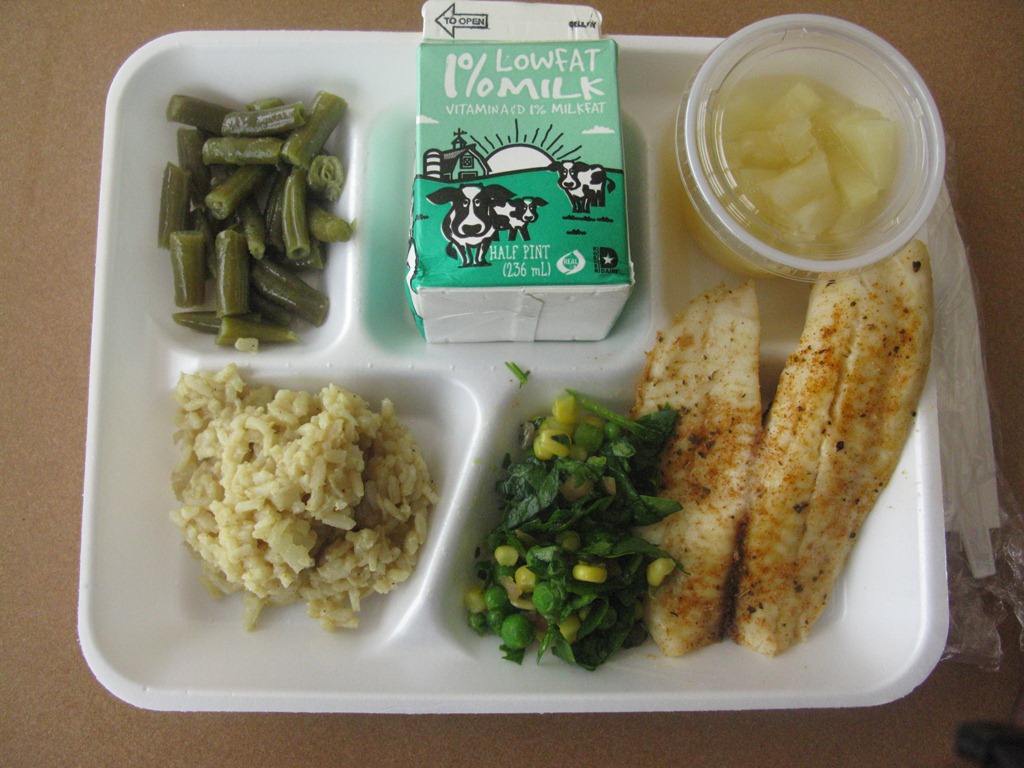
Thursday, April 14, 2011
What's for Lunch: Tilapia!
Thursday, March 31, 2011
What's for Lunch: Taco Salad
This was the preferred method of eating this meal: using the spork to spoon the ground turkey meat onto the chip. (That's me, as captured by my daughter. The kids did not eat the lettuce.)
According to the Chartwells website, there was supposed to be a choice of turkey meat or "southwest beans," but I didn't see any beans. Instead, kids were given this "Tex Mex corn," which was frozen corn mixed with canned salsa.
As my daughter observed, the corn was a bit on the cold side. But I'm not sure any of the kids in the lunchroom noticed, because I did not see them eating the corn at all. Mostly it went into the trash can untouched, as you see here.
Really, it can't be repeated often enough: if you're going to introduce new foods to kids, you really need to work with them to get them to eat it. Otherwise, it just gets trashed.
D.C. Public Schools serve some 36,000 lunches every day. Imagine all the corn that got thrown away.
Tuesday, August 31, 2010
Vegetarian Alternate: Taco Chips
aka The Slow Cook
This is the standing "cold" alternate lunch for Fridays in D.C. elementary schools, according to the menu posted on Chartwells website. Chartwells calls this, "western corn and black bean salad with whole grain tortilla shells and homemade BBQ ranch dressing."
To me, this looks like frozen corn tossed with canned black beans next to some corn tortilla scoops you usually see in the chips aisle at the grocery store. I don't see the "homemade BBQ ranch dressing." What would you put it on? The pear had been served with the main lunch the day before, and of course milk--either low-fat or non-fat--is always available for the kids to choose from.
How would you rate this meal? Is this a meal?
Friday, August 27, 2010
Is There Enough Corn on this Tray?
aka The Slow Cook
Chartwells listed "taco salad" with ground turkey meat and "baked whole grain tortilla shells" as the entree for this meal. So what was the thinking behind including still more corn in the form of corn on the cob as the vegetable?
The menus at Chartwells' website also called for a "locally grown nectarine" with this meal. But as you can see, the fruit is a banana. The nectarine would earn school food services an extra nickel from the D.C. treasury for being local. So if this is simply a matter of a delivery slip-up--or maybe a few schools getting bananas instead of local nectarines--how will the food services department account for that when it comes time to ask the city for its locally-inspired check?
Now that school is back in session, a number of wrinkles are starting to become apparent in the "Healthy Schools" law passed this year by the D.C. Council, such as a possible accounting nightmare where the local food component is concerned.
Meanwhile, my daughter was so taken with the idea of tacos for lunch that she decided not to bring a lunch from home. Tragically, she was one of the last kids in line and by then the kitchen had run out of tacos. The alternate was salad. She doesn't like salad. So this is what she got for her $1.25:
Fortunately, daughter really likes black beans, bananas and corn on the cob. Not so fortunately, this corn on the cob was obviously the frozen variety and cooked to death. It was mealy and dull. Most of the kids declined to eat it. They also shied away from the black beans, which Chartwells advertised as "Southwest beans." They looked straight out of the can to me.
Wednesday, April 21, 2010
What's for Lunch: Hot Dog & Starch
The only thing in this meal not loaded with starch or actual sugar is the hot dog. Potatoes actually count as a vegetable. The corn has almost as much starch. Then there's the bun.The 8-ounce serving of chocolate milk contains 26 grams of sugar--half of which occurs naturally as lactose--the same as Classic Coke. And there's more sugar in the ketchup.
But then any kind of potato and corn are among the things kids most like to eat at school.
The hot dog, from a company called West Creek, is all beef and contains 500 milligrams of sodium. That's 21 percent of the total recommended daily allowance of sodium for a diet of 2,000 calories. But children require far fewer calories than that.