Thursday, May 6, 2010

What's for Breakfast: Egg & Cheese

By Ed Bruske
aka The Slow Cook

Here's something I had not seen before: an egg patty, smeared with processed cheese, served alongside a bagel.

Presumably, the egg patty is supposed to be sandwiched between the bagel slices.

I wondered if the egg patty came from the same place as the scrambled eggs served at my daughter's elementary school. Those are cooked with about 11 other food industry ingredients in a factory in Minnesota and shipped frozen. Well, just about everything served in the school cafeterias in the District of Columbia is made in a factory somewhere and shipped frozen.

From what I saw, the kids approached this breakfast tentatively. They seemed more interested in the bagel than the egg. They just didn't like the looks of that cheese. Can you blame them?

Wednesday, May 5, 2010

What's for Lunch: Cheese Bread

By Ed Bruske
aka The Slow Cook

The marinara sauce (in the cup) was pretty weak, and it's not clear exactly how this is supposed to work. Are the kids supposed to pour the marinara sauce on the cheese bread? Or are they supposed to dip the oversized, rectangular bread into the round, plastic cup?

I saw mixed reactions. Some kids just sat and stared at it and didn't eat at all. Others ate it, although tentatively. They didn't care much for the canned green beans.


This was the alternate: curried turkey wrapped in a big, flour tortilla. This little girl brought her own soda from home, to go with the chocolate milk, I suppose.

What's for Breakfast: Pizza!

By Ed Bruske
aka The Slow Cook

Parents may hate to hear it, but pizza is the all time favorite food of kids at school. But pizza for breakfast? Is that a good idea?

Like most meal items served in District of Columbia schools, it arrives frozen from Schwan's Food Service, Inc., in Marshall, MN. Schwan's Food Service calls this product "Tony's Breakfast Bagel." It's not clear who Tony is, or why he insists on calling this product a "bagel" when the label says it's covered with "pizza" sauce and even to the untrained eye is clearly a pizza.

Is Tony embarassed to be serving pizza to children for breakfast? (I would print the ingredient list here, but it's too long, full of things like sodium citrate, and sodium aluminum phosphate and sodium tripolyphosphate and magnesium oxide, and ferric orthophosphate. So many sodiums and phosphates....)

But clearly this item is designed for children. Because right on the box label it says that one 2.6-ounce "breakfast bagel" provides one ounce "equivalent meat/meat alternate and 1 serving of bread alternate for the Child Nutrition Meal Pattern Requirements." For a nutrtionist back at a computer trying to figure out what to order for school breakfasts, this sort of information from a food processor in Minnesota makes the job much easier.

The instructions on the package advise cooking the "breakfast bagel" for eight to 10 minutes in a convection oven set to 375 degrees. But at our school, it's placed in a commercial steamer and heated while still inside its individual plastic package. It comes to the serving line piping hot. (The temperature in Washington hit 88 degrees the day this was served, a record.)


This is what it looks like after the wrapper's removed, to be washed down with chocolate milk and orange juice.

This little girl was using the plastic wrapper to hold the pizza. How else do you eat it?


But my daughter declared, "This stuff is nasty." She was referring to the turkey "sausage" topping on the pizza. "It tastes raw," she said. So she picked it all off. The other kids started removing their sausage, too.

Tuesday, May 4, 2010

What's for Breakfast: Raisin Bran "The Worst"?

By Ed Bruske
aka The Slow Cook

Raisin Bran is a "healthy" cereal, right?

Not according to a recent health column published on the Yahoo! site. Columnist David Zinczenko called Kellogg's Raisin Bran with the smiling little sunshine on the cover "the worst iconic cereal" of all. It's all about sugar. Here's what he had to say:

"It'll be hard to find a more sugar-loaded cereal than Raisin Bran. It’s sweeter than even Lucky Charms, Reese’s Puffs, or Cocoa Krispies. Some of that sugar can be attributed to the raisins’ natural blend of fructose and glucose, but the real culprit is the sticky white armor of sucrose that enrobes each piece of fruit. Both Kellogg’s and Post are guilty of this raisin mistreatment, so what should be a legitimately healthy bowl of fruit and grains pours out closer to a candy-coated dessert."

Fact is, giant food companies like Kellogg's give out huge sums in "discounts" (some people call them "kickbacks") to food service companies like Chartwells-Thompson--the one that provides food service for D.C. schools--to carry their products. And since Chartwells-Thompson serves millions of meals to kids all across the country, we can only imagine what those "discounts" add up to each year.

So there are corporate incentives to steer kids to sugary cereals like Raisin Bran, and also imprint the Kellogg's brand on them in the process.

In the breakfast above, this elementary school child had on her tray 11 grams of sugar in the Raisin Bran, 28 grams of sugar in the strawberry-flavored milk, 11 grams in the orange juice and six grams in the graham crackers. That's 56 total grams of sugar, or the equivalent of 14 teaspoons. (The American Heart Association recommends no more than six teaspoons of "added" sugar per day for an adult woman.)

But if you can't eat good ol' Raisin Bran, what can you eat? Zinczenko recommends another Kellogg's product: All Bran. Just add a few of your own raisins.

Monday, May 3, 2010

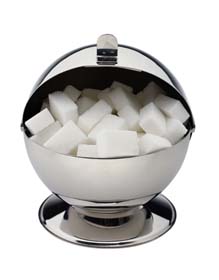
What to Do About the White Stuff: Sugar in Schools

By Susan Rubin, DMD

As a dentist fresh out of school in the late 1980’s, I was idealistic and passionate about my new profession. I gave lots of “tooth talks” at schools and childcare centers every February, during Children’s Dental Health month. It wasn’t until I started having kids of my own that I learned the truth about sugar: it damages more than just your teeth.

My wake up call came when my first daughter was 7. She arrived home bouncing off the walls, happy and proud to have earned four Skittles in a spelling bee. I also found fruit roll-up wrappers in her back pack. Apparently in addition to the teachers rewarding kids with candy, this sticky string was being sold in the cafeteria.

The more I looked into what was happening in the cafeteria and the classroom, the more shocked I was. Our school was swimming in sugar. While most teachers and parents could tell themselves that this was okay in moderation, somehow it never really sat right with me. I saw the damage with my own eyes every day as I drilled, filled and billed.

I wondered why anyone would let their kid have a series of sugar hits throughout the day. Despite anesthesia and laughing gas, having a cavity drilled and filled is no fun if you’re a child or an adult. The irony is that tooth decay is completely preventable.

At the end of 1999, I put down my dental drill and went back to school to study integrative nutrition and Chinese herbal medicine. I became a full time school food advocate and holistic nutritionist. In my new line of work, just like in dentistry, I deal with the damage done by refined sugar every day.

My education taught me that sugar doesn’t just rot your teeth and widen your waistline. Contrary to what the food industry likes to tell us, sugar is not just an empty calorie. Sugar is a serious anti-nutrient that creates a host of problems that extend beyond obesity and tooth decay. Let me just name a few:

Cardio-vascular disease: refined sugar consumption raises triglyceride levels, creates an inflammatory situation that promotes heart disease.

Refined sugar depletes minerals and vitamins B and C, resulting in lowered immunity, weaker bones.

Sugar impacts behavior

C. Keith Conners, author of Feeding the Brain, showed that children given a sugar rich breakfast became restless and hyperactive. All you really need to do is ask any teacher or parent, they have lots of first hand experience with this fact.

Sugar can be addictive. Serge Ahmed, PhD, a scientist who specializes in addiction research, clearly demonstrates that intense sweetness can surpass cocaine reward. His cocaine-addicted laboratory rats consistently chose sugar over cocaine (Lenoir, M., Serre, F., Cantin L. & Ahmed, S.H., 2007).

Cathleen DesMaisons,PhD, author of Potatoes Not Prozac and Little Sugar Addicts makes the case that up to 50% of the population is “sugar sensitive”, a nice way of saying addicted. According to Dr. DesMaisons, people who are sugar sensitive respond to sugar, white flour products and alcohol in a completely different way than regular or non-sugar sensitive folks. The biochemistry of a sugar sensitive person is unbalanced, leading to a whole host of problems and setting them up for sugar addiction, alcoholism, depression, obesity and more. I’ve seen this scenario myself in 10 years of private practice.

Juice is another sugar hit that impacts children’s health in a negative way. In my past life as a dentist, I worked to convince my local pediatricians not to start toddlers on juice. I saw loads of damaged teeth due to sippy cups and juice boxes. More recently, pediatric endocrinologist Robert Lustic MD gave a presentation on the health impacts of fructose found in HFCS and in fruit juice (Sugar: The Bitter Truth.)

Juice has been part of WIC and the National School Lunch Program since the Nixon Administration. I would like to see the USDA reconsider the inclusion of juice in these programs when they re-evaluate the Food Pyramid. Perhaps they should invite Dr. Lustig to testify. Unfortunately major juice manufacturers such as Tropicana (owned by Pepsi) and Minute Maid (Coca-Cola) have lots of clout and will work hard to make sure that it won’t happen.

Despite all the attention on school food reform in the past years, our kids continue to ingest hazardous amounts of sugar in schools. Some school districts pat themselves on the back because they sell Vitamin Water instead of Coca-Cola. Welch’s Fruit Chews may have replaced Fruit Roll Ups in some schools. These are, in my opinion, examples of rearranging deck chairs on the Titanic.

No doubt, your local dentist is busier than ever, drilling, filling and billing. Sports drinks are even more cariogenic than soda. "Healthy” granola bars are another great indirect revenue source for your dentist. In some areas of the country, Mountain Dew remains in school fairs and fundraisers. Mountain Dew is notorious to us dentists. Physicians in Maine are being trained how to extract teeth because there are not enough dentists to deal with the growing cases of "Mountain Dew mouth."

Chocolate milk and “flavored” milks are another source of refined sugar in schools. I was happy to see Jamie Oliver blast the flavored milks in his last episode of "Food Revolution." Sadly, it will take more than his outrage on TV to get those sugar sweetened beverages out of schools.

After more than a decade of school food advocacy, I’m well aware of how entrenched sugar is in schools. Perhaps it's time to take another approach. After all, schools are supposed to be teaching our kids. How about we raise the Food IQ about sugar? Not just in health class where most schools teach the Food Pyramid. Let’s put sugar education into the basic four: Math, English, Social Studies and Science.

Math: Here’s an elementary level math problem:

Calculate the number of teaspoons in 20 oz. bottles of Nestle’s Qwik , Coca-Cola and Minute Maid Lemonade .

First you’ve got to consider serving size: 20 oz. is 2.5 servings.

Next you’ve got to turn grams into teaspoons: 4 gm = 1 teaspoon.

Once you’re done with the math calculations, take some white sugar, count out those spoonfuls and fill up empty 20 oz. bottles.

Bonus: Calculate the number of teaspooons of sugar in a school year’s worth of chocolate milk.
English: Chew on This,by Eric Schlosser, and Omnivore's Dilemma (Young Reader’s Edition), by Michael Pollan, are two great books for young readers.

Older readers could check out a classic book, Sugar Blues by Willian Dufty.

Social Studies: Sugar has a colorful history. Studying sugar and the slave trade would be a good place to start.

Older students could read Seeds of Change: Six Plants that Transformed Mankind, which has a great segment on sugar.

Science: Learn about how sugar is made from sugarcane It takes 17 feet of sugarcane to make 1 cup of sugar. What happens to the nutrients in the process?

Learn about tooth decay. Do some experiments using soda, sports drinks and other liquids. Watch how fast baby teeth dissolve!

Once teachers and students start to learn more about refined sugar, this will help to pave the way for its reduction in school food.

Dr. Susan Rubin is a school food advocate, holistic nutritionist, and retired dentist. She is the founder of Better School Food. Her work was featured in the movie, Two Angry Moms.

www.betterschoolfood.org
www.drsusanrubin.com

Sunday, May 2, 2010

Will the Real Food Pyramid Please Step Forward

By Ed Bruske
aka The Slow Cook

This news is not exactly new but deserves a wider audience: The woman who originally developed the federal "food pyramid" says her team at the U.S. Department of Agriculture never intended for grains and starches to be at the bottom, meaning the foundation. That distinction was originally reserved for fruits and vegetables.

But somehow as the pyramid worked its way up the political chain of command, and became subject to corporate food lobbying, fruits and vegetables got replaced with cereals and other refined grains.

Originally, the pyramid recommended Americans consume a wide variety of fruits and vegetables, with five to nine servings daily, wrote Luise Light, the nutrition team leader and former director of Dietary Guidance and Nutrition Education at the USDA. Cereals and grains were only supposed to be eaten as two to four servings per day.

But all that got switched around. When the final pyramid came out, the federal government was recommending that Americans eat up to 11 servings daily. Cereals and grains are starches, which turn into sugar (glucose) when eaten. Sugar is identified as a prime mover in the nation's epidemic of obesity and diabetes.

Remember that point in Jamie Oliver's "Food Revolution" when he can't believe he's supposed to serve grains on top of grains? This is where that crazy USDA concept comes from.

Bottom line: don't trust the government standards. They were written by corporations trying to sell processed foods.

Saturday, May 1, 2010

Scrambled Eggs From Where?

By Ed Bruske
aka The Slow Cook

Here are the infamous scrambled eggs served in D.C. schools. Scrambled eggs are supposed to be simple, but in the world of industrially-processed school foods, they are anything but. These scrambled eggs are actually cooked by a company called Michael Foods in Minnetonka, MN. They are made with "whole eggs, skim milk, soybean oil, modified corn starch, xanthan gum, liquid pepper extract, citric acid, natural and artifical butter flavor, lipolized butter oil, medium chain triglycerides, natural and artificial flavors."

After the eggs are cooked, they are frozen and shipped 1,100 miles to the District of Columbia where they are simply dumped in a steamer, heated and served.

"One thing I'm not touching are those eggs!" my daughter declared.

"They don't have any flavor," said one of the other girls at the table. "They don't even use salt."

Most of the kids I saw ate their way around the eggs, starting with the potato patty (they also arrive pre-cooked and frozen), and the Otis Spunkmeyer Appel Cinnamon muffin. The muffin has malted barley flour and brown rice flour in it, which makes it look healthier than the typical muffin, but it also contains 15 grams--nearly four teaspoons--of sugar.

Some kids passed their muffins to friends, who ate two.