Showing posts with label Boulder. Show all posts

Saturday, November 27, 2010

Rocky Mountain Lunch Rescue: The Complete Series

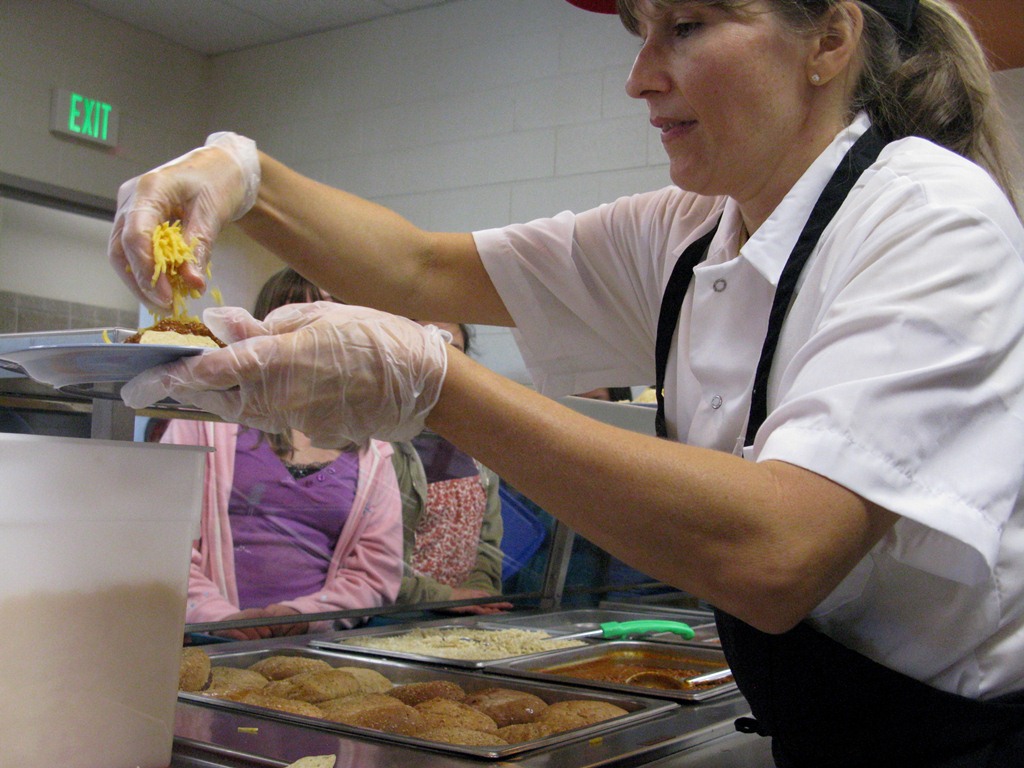
Kids love their nachos in Boulder

Over at The Slow Cook, our fabulous web designer, Keri Marion, has just finished adding a new feature to the front of the blog: Rocky Mountain Lunch Rescue, a quick portal to our recent series of articles detailing the efforts of parents, community leaders and "renegade lunch lady" Ann Cooper to ditch the junk food schools were serving in Boulder and replace it with real food made from whole ingredients.

To access the main stories in the series, you can click on any of the nine numbers. They are stored in chronological order, so number one is the first in the series, nine is the epilogue. But if you hover your mouse over the text in the box and click, you will be taken to a separate field listing those stories and all of the sidebars. Would you believe there are 16 stories in all? There was lots to tell, but even more incredibly, some people have actually read all of it and lived to tell.

Thanks to everyone who has supported this investigation of the big change in Boulder school food. This series takes its place with those written earlier this year about Berkeley, Calif., and the District of Columbia. Should we start a pool to guess where I end up next?

Tuesday, November 23, 2010

The School Food Revolution in Boulder: Epilogue

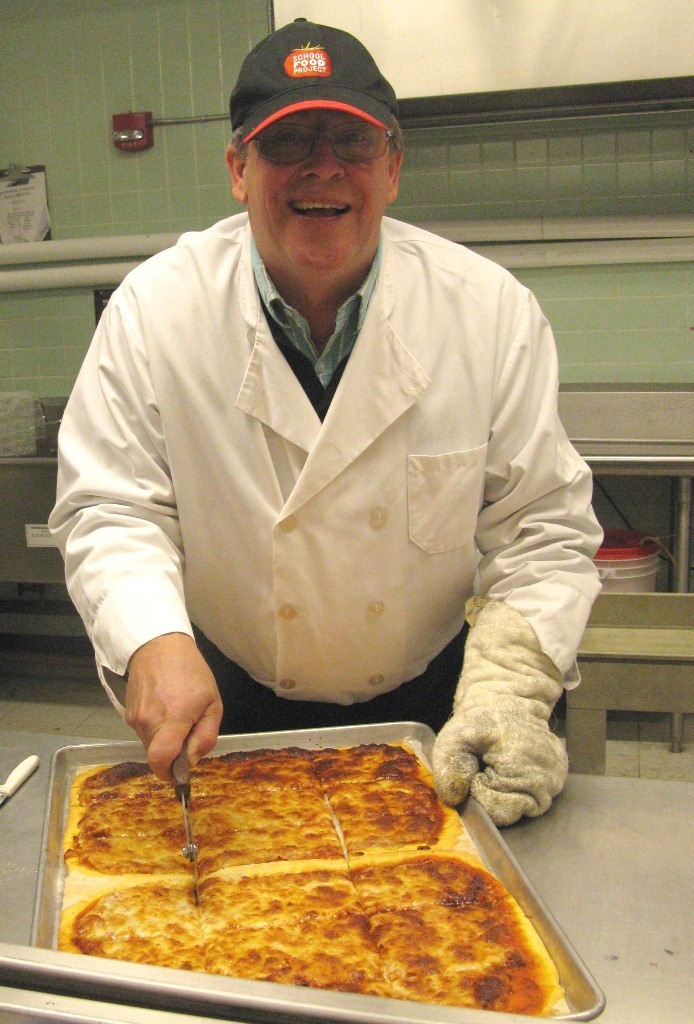
Me, slicing pizza, Columbine ES

By Ed Bruske
aka The Slow Cook

I depend on the kindness of strangers to pursue my quest for the cutting edge in the nation's school food. After settling on Boulder as my next stop, I had to wonder where I would stay. A self-funded journalist has to think about these things. To the rescue came my editor at Grist, Bonnie Azab Powell. "What, am I your travel agent now?" she queried. Bonnie connected me to fellow Grist writer Lou Bendrick.

Lou, her husband Hal and their two children live in a "New Urbanism" community on the north side of Boulder. I describe it as being kibbutz-like, with town homes tightly clustered around a green area the kids use as a play ground. There's also a "common house" with a commercial-size kitchen and entertainment area. The house also happens to have two guest rooms and laundry facilities. Lou checked the calendar for the guest rooms and I was in luck. I would be able to bunk there four of the nights I was scheduled to stay in Boulder. But that left three nights unaccounted for. I had visions of sleeping in my rental car.

A couple of readers suggested "couch surfing." I thought they were pulling my leg. But I would soon learn that while I apparently was looking elsewhere, an international organization had sprung up on the internet whereby travelers--or perhaps just people who dream of traveling--agree to host people like me on their couches or in their spare bedrooms. After I signed up, I was shocked to find that dozens of Boulder residents list themselves as potential hosts.

One of the first to reply to my request was Sue Detling, a software engineer for a non-profit group that studies tornadoes and thunderstorms. I found a note on the front door when I arrived, giving directions to a cozy room and the fridge. Sue has two kids in Boulder schools but wasn't keen on the school food ever since she saw hot dogs on the menu. But she also happened to be friends with one of the chefs I would later write about in my series: Brandy Dreibelbis, the former executive chef for the Boulder Whole Foods. My first night in Boulder, we all had dinner together at Sue's place and Brandy began to fill me in on the food revolution taking place in Boulder schools.

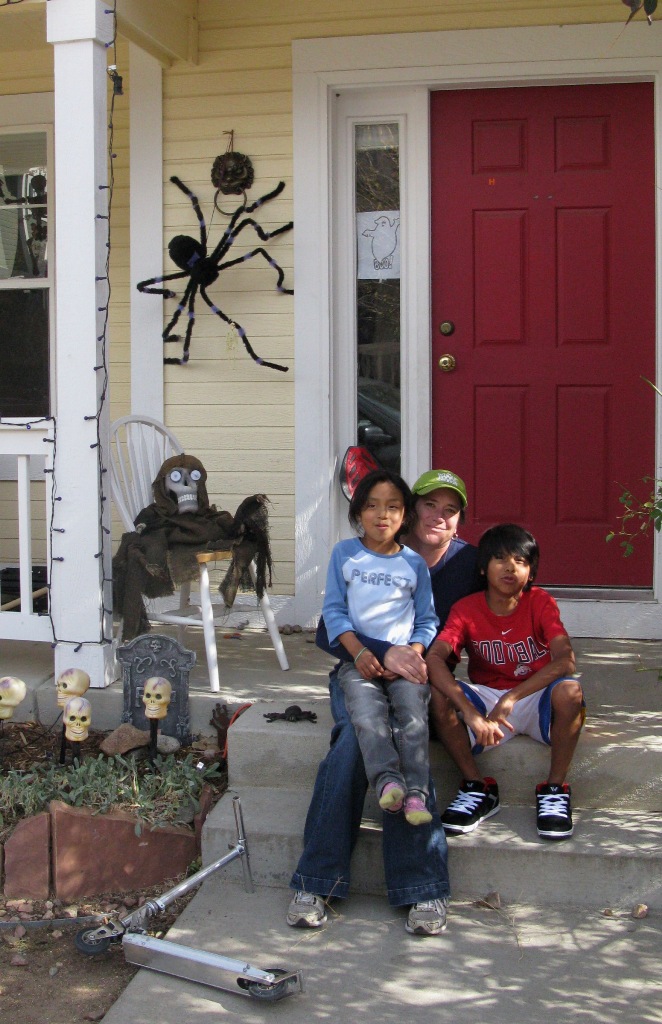
The Detlings, Halloween eve

The next day was Halloween. I spent the morning walking a trail along The Front Range where I stumbled upon a massive colony of prairie dogs. The trail normally leads to a lake, but the path was blocked by a helicopter involved in fighting a nearby forest fire and using the lake to load buckets of water.

Halloween traditionally is a crazy time in Boulder. I passed the afternoon on the Pearl Street Mall, a stretch of downtown that's been closed to traffic. Before long, it was mobbed with kids in wild customes, to go along with musicians of all sorts playing for coins.

Halloween crowd on Pearl Street

I spent the next two nights with "couch surfing" hosts Ben and Heather Ridge. In yet another remarkable coincidence, Heather is the horticulture instructor at Arapahoe Ridge High School next to the school district headquarters where I would spend considerable time. I helped chop celery for salad bars at Arapahoe Ridge and conducted a couple of important interviews there. Heather and I spent plenty of time talking gardening--she was still harvesting greens out of the food garden in her back yard--as well as her insider view of the local schools and especially the school food.

Ann Cooper was apprehensive about me visiting her food operation in Boulder because she was still in the middle of re-making it. I don't think she need have been concerned. From what I could see, things were well organized.

This was a rare snapshot of a school food system evolving in real time. Because I moved around between so many different schools from day to day--one elementary school, one middle school and two high schools--this series lacks the sense of intimacy that I was able to convey in the two previous series I wrote from D.C. and Berkeley, where I was confined to a single kitchen. Still, Cooper had given me unlimited access to explore the facilities and talk to her personnel. I was under no restrictions whatsoever, except that I did not photograph children's faces out of privacy concerns.

New kitchen, Casey Middle School

I have plenty of photos left to share, such as this one of the gleaming new kitchen at the refurbished Casey Middle School. Apparently, school districts often are on automatic pilot when it comes to building kitchens. Ann Cooper and her business partner Beth Collins, in conducting a study of the Boulder food operations, found that the district was continuing to install full-service kitchens even though there were no plans to use them as such.

In the case of Casey Middle School, Collins caught the kitchen rehab before it was finished and was able to change the design to include equipment that would turn the facility into one of the five production kitchens she and Cooper had in mind for the district. Here you see the 80-gallon kettle that Cooper envisions cooking the soup for Boulder schools this winter.

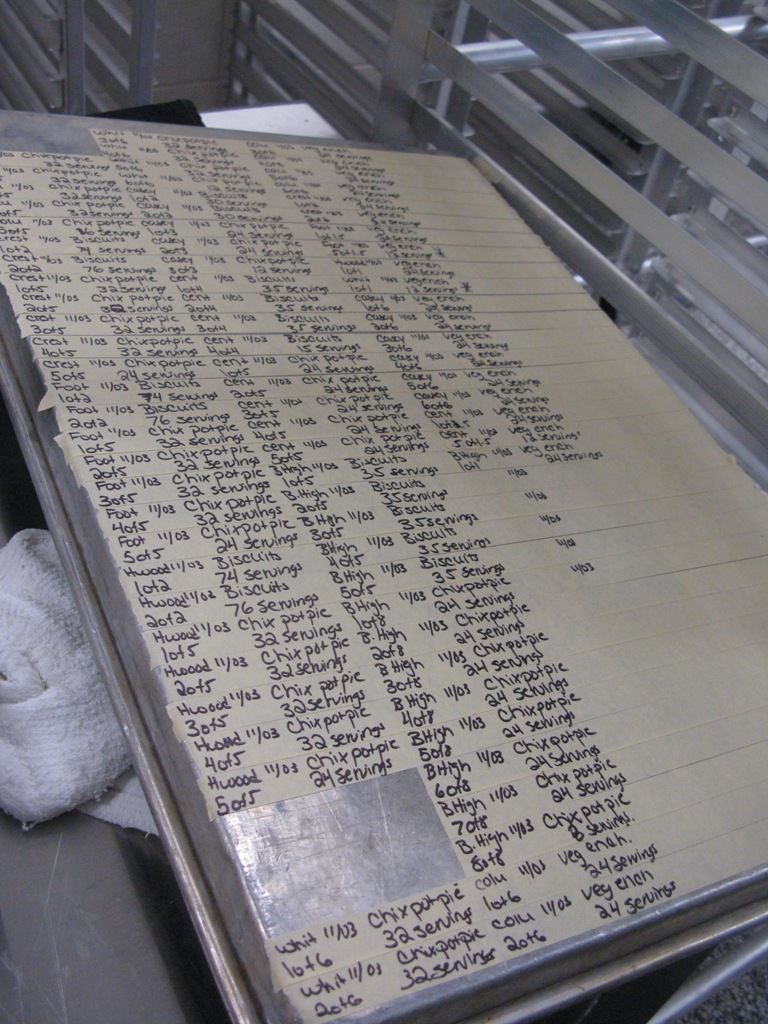
Food labels from masking tape

Each production kitchen serves eight or nine schools and together they prepare about 7,500 lunches daily. To keep track of all the food leaving the production sites, the chefs make labels using masking tape on the back of a sheet pan. Here's what it looks like before the chef scores the tape with a utility knife to create the individual labels.

Loading kitchen delivery truck

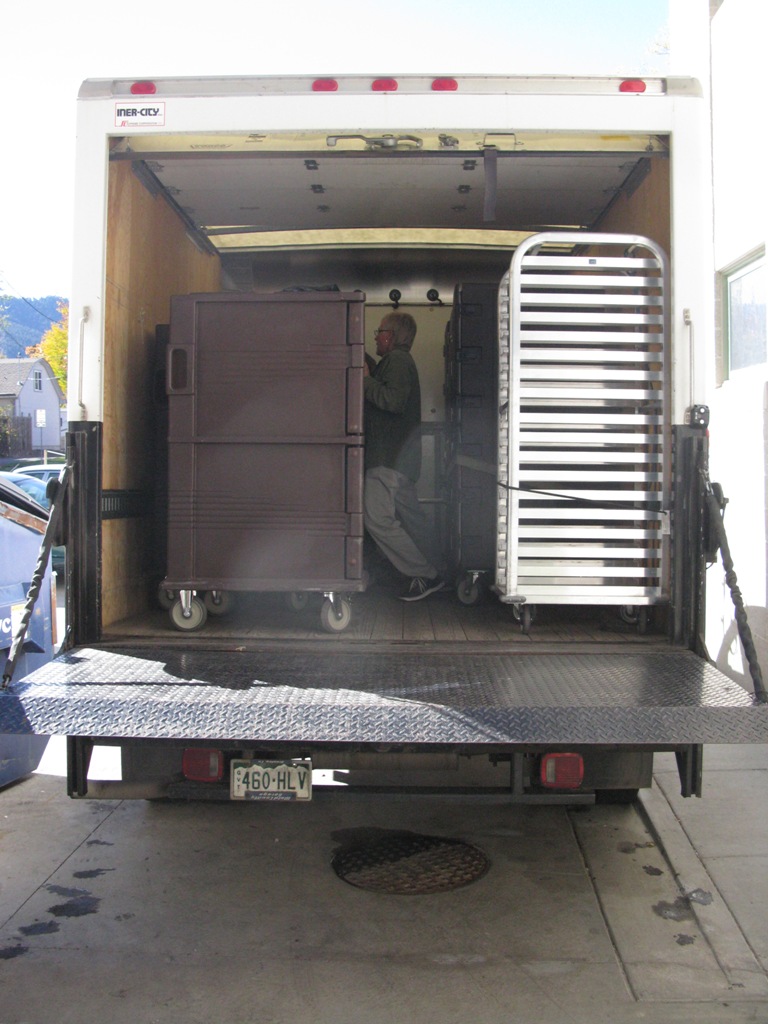
Food is loaded onto tall aluminum rolling racks or into insulated cabinets for shipment to outlying school "satellite kitchens," where it's usually reheated the next day and served to students. This was another innovation by Cooper and Collins. Previously, Boulder's school kitchens were totally dependent on drivers from the district's central warehouse for food deliveries. But the warehouse and kitchen schedules didn't align, and often the trucks drove empty after making a delivery. Now, the food services department manages its own fleet of six trucks to move food around the 500 square miles encompassing the Boulder Valley School District.

Cafeteria, Arapahoe Ridge High School

Try as I might, I could not find a logical place in the series to talk about food service in Boulder's high schools. High schools present their own issues, since most teenagers apparently would just as soon spend their lunch hours somewhere other than in a cafeteria. Of the seven high schools in Boulder, five are "open campus," meaning kids can leave school grounds at lunch time. Some hang out around campus, others drive off to the nearest fast-food joint for lunch.

Monarch High School cafeteria

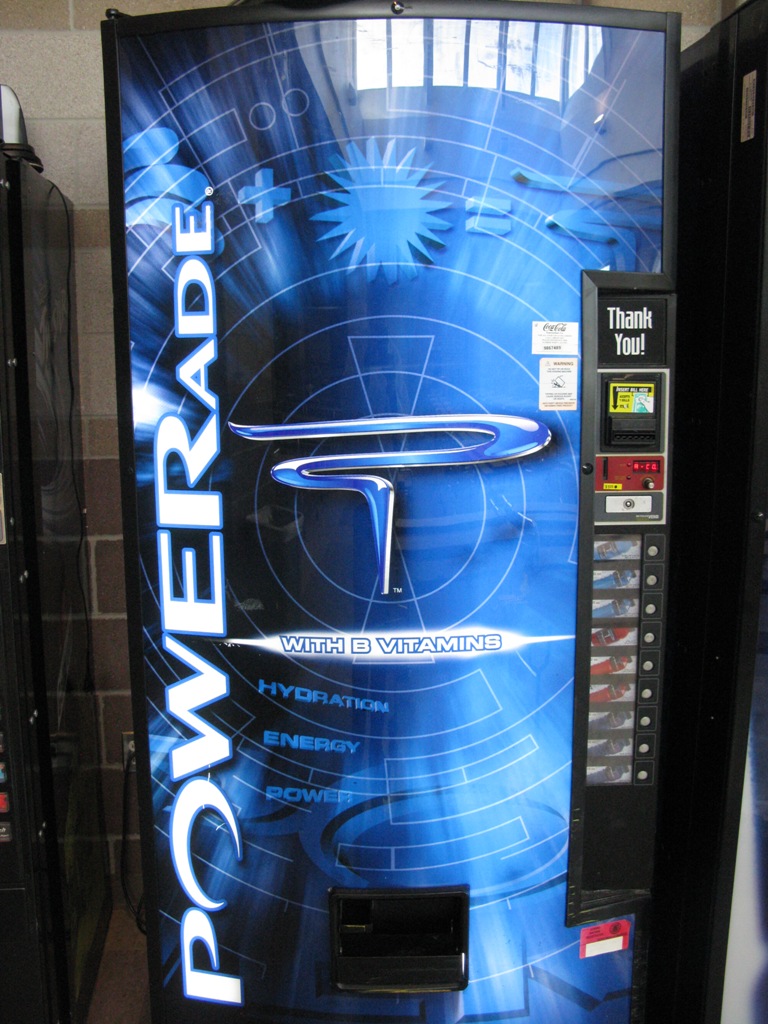
This was my first visit to a high school cafeteria since I was in high school, oh, about a century ago. I was impressed by the array of vending machines I found in the lunch room at Monarch High School, selling all kinds of snacks, fruit juices and sports drinks. Vending machines can occupy the same space as the federally-subsidized meal line as long as the proceeds accrue to the lunch program. Boulder adheres to a policy that the foods in vending machines may not contain more than 35 percent fat, or 10 percent trans fats, or 35 percent sugar by weight.

Sports drinks for sale

Ann Cooper has introduced a new wellness policy for the district that would eliminate food additives, colorings, growth hormones, irradiation, hydrogenated oils, high fructose corn syrup, and genetically modified foods. Vending machines in secondary schools would not only have to comply with the local wellness policy and state and federal guidelines, but would have to be approved and certified by the district's nutrition services department.

"Until Ann got here, nobody wanted to take on vending machines," said Deb McCormick, a nutritionist with the school district who is now one of five food services district managers.

Snacks, juices, water

Juice drink nutrition label

This particular juice contains more sugar, ounce-for-ounce, than Mountain Dew.

Paper "boats" instead of plates

There are other fascinating aspects of high school cafeteria life. For instance, high school students seem to regard real silverware and re-usable plates as disposable. Sometimes they take plates to their cars to eat and simply leave them in the parking lot. Or they will throw silverware in the trash. Consequently, in most high schools the food is served in paper "boats" with plastic utensils, as you see here at the salad bar at Monarch High School. The boats come in two sizes, small and large, so you can fit an entire meal in one. And students are welcome to come back to the salad bar for second or third helpings.

Cereal dispensers for breakfast

I also thought the cereal dispensers on display at the cash register for breakfast at Arapahoe Ridge High School were clever.

Breakfast in a drink glass

But for cleverness, you can't beat the students themselves. Look how they load a drink glass with cereal. They then cover it with cold, organic milk from a dispenser.

Loading milk into pitchers

Milk is delivered in five-gallon plastic bags. For kindergartners, its poured into pitchers and served at the table.

Loading milk into cooler

Otherwise the bags are loaded into an electric cooler for self-service.

Cooper doesn't believe in flavored milk because of the added sugar. "Kids were so disappointed when they couldn't have their chocolate milk. They died," said Margaret Trervarton, the "kitchen lead" at Columbine Elementary School.

Point of sale hardware

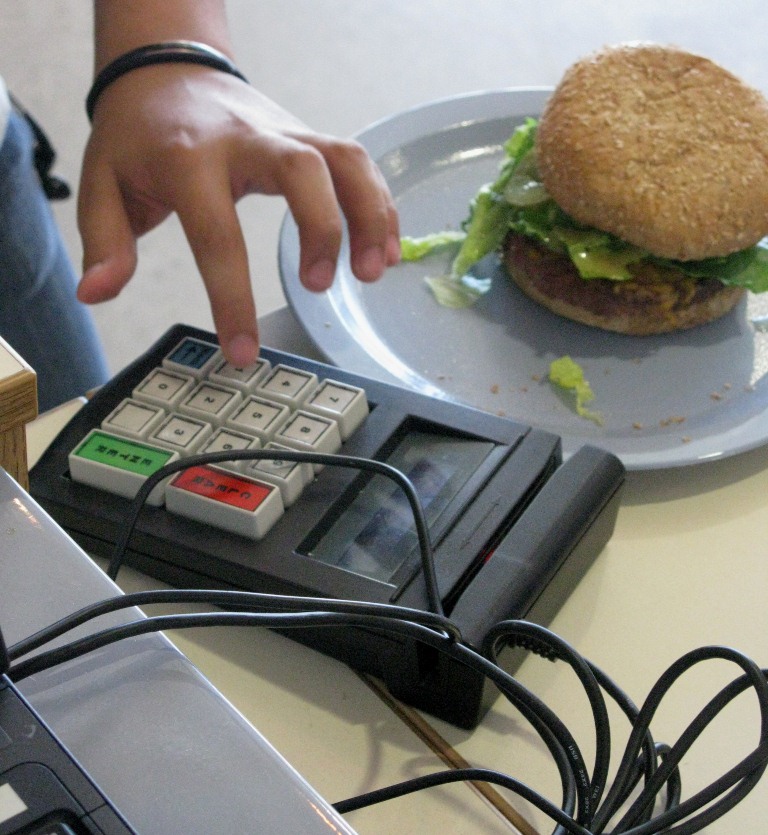
One point in the series needs to be clarified. On day two, I dealt with steps schools have taken to remove the stigma some students feel eating meals from the subsidized food line. The U.S. Department of Agriculture, which overseas the national lunch program, prohibits schools from operating separate food lines, one for subsidized meals, another for so-called a la carte food items. Many schools have also purchased point of sale hardware that allows students to enter a personal identification number when they exit the food line so that no cash changes hands. Computer software identifies the students who are entitled to free or reduced-price meals.

After I published this piece, a fellow food blogger contacted me in alarm, saying this could not be true because her school district--a very large one--operates separate food lines. I thought I had this regulation firmly implanted in my head. But when I went back through the USDA rules looking for it, I couldn't find it. I removed this passage from the article on the two blogs I manage as well as at Grist, where the series is being re-published.

Subsequently, I contacted the USDA civil rights division and was assured that, yes, my original version was correct. Schools may not operate separate lines for subsidized meals. Here is a link to the regulations in question [PDF], specifically section 245.8 on page 328.

Update: Nov. 23, a spokesperson for the USDA's Food and Nutrition Services division, which oversees school meals, said that schools may operate separate food lines, one for reimbursable meals, another for a la carte items.

Monday, November 22, 2010

Lesson from Boulder

Ann Cooper with some of her young salad bar fans

By Ed Bruske

aka The Slow Cook

Ann Cooper is conducting a clinic in Boulder on how to rescue school food. Is anyone paying attention?

In remaking the lunch line in Boulder schools, Cooper has revealed the federally-subsidized school meals program as living somewhere in the stone age. Not merely under-funded, school kitchens are woefully under-managed and under-equipped to function in a digital age. No wonder they constantly run in the red. Schools are incapable of serving real food any more because they are mired in lack of imagination, lack of will and above all lack of professional know-how when it comes to producing meals with recognizable whole ingredients.

In other words, Cooper has proven that serving better food in school is not just about getting a bigger handout from Uncle Sam. Turning out wholesome meals, as opposed to the re-heated junk so many school districts pass off as food, can be done on the current budget. But getting there takes guts, hard work and brains--hardly the qualities that win advancement in public school bureacracies.

Why do schools need a hired gun like Ann Cooper to get the job done? Why are school food service directors so often the greatest obstacle to progress? In case after case, school district after school district, it is the career school food functionary who digs in her heels and shouts, "It can't be done! Kids won't eat healthier food! We have to feed them junk to make our program work!"

It's not just about money: where better school food is concerned, leadership is in critically short supply.

Cooper explodes the myth embraced by so many school food service directors that they must offer cheesy soft pretzels, Subway sandwiches, corn dogs and Eskimo pies to make ends meet. One of her first acts after taking over in Boulder was to abolish the a la carte foods the schools were serving. And it wasn't just because the food was bad. Trying to operate cafeterias like convenience stores, she found, was a drain on resources that did not yield the bounty that is popularly assumed.

"When you really look into all the loss in product, the storage problems, the waste, the time needed for invoicing, the staffing requirements, we don't believe it's really profitable," said Cooper. "And it takes away from the core mission," which is, of course, nourishing children.

Removing a la carte took a big bite out of Cooper's cash flow. But here's the surprise: She's recovering by selling better food and more of it. Her success is all the more remarkable because kids in Boulder do not depend on federally-subsidized meals. Only 18 percent of them qualify as low income. Should Cooper realize her goal of making her reformed food service self-sufficient in Boulder, it will be because kids actually like her home-made enchiladas and salad bars and can get along without Otis Spunkmeyer cookies and Gatorade every day. By implication, modeling after Cooper would only be easier in urban school districts where enrollment of low-income children is much higher.

Revamping school food is not for sissies. To wring waste and inefficiency from Boulder cafeterias, Cooper pushed long-time "lunch ladies" into a purely supportive role, cut deeply into their work hours, and brought in a crew of professional chefs to do the actual cooking. In the process she tapped a potentially vast reservoir of trained kitchen talent who would gladly sign on to the school food revolution--if only there were a revolution to sign on to.

Not everyone agrees with this approach. Kate Adamick, a widely-traveled school food consultant who is a friend and occasional co-worker of Ann Cooper's, believes that lunch ladies--or "lunch teachers," as she prefers to call them--are the solution, not the problem. If we took the time to train them, and gave them the proper equipment, Adamick insists, they could serve meals cooked from scratch in schools coast-to-coast.

"The reality is that virtually no school district can afford the luxury of what the Boulder school district has," said Adamick. . "Ninety percent of this battle will be won if we can restore the pride and self respect of the lunch teachers. Our responsibility is to provide those people with the skills they need. "

Doing so, Adamick admits, would take much longer. Cooper chose not to wait.

Can the nation's school children afford to wait? If there's any one message that rings loud and clear from my travels through three very different school districts over the past year it is that waiting for a solution from the federal government is a fool's game. Congress has shown itself remarkably resistant to the idea of adding even a few pennies more to the school food budget. The U.S. Department of Agriculture, charged with administering the meals program, is a monument to bureaucratic inertia that seems better suited to enforcing its vast web of rules than pointing the way forward--unless that involves helping corporate interests put their brand of industrially processed foods on kids' cafeteria trays.

It would be hard to think of another government program so vital as school lunch that is subject to as much lip service and window dressing posing as reform. Michelle Obama's high-profile attack on childhood obesity, while generating lots of buzz around vegetables and school gardens, has driven white-jacketed chefs into paroxysms of grade-school cooking demonstrations, but thus far has failed to yield a political mandate for overhauling the nation's cafeterias. The School Nutrition Association, while ostensibly safeguarding the gustatory well-being of the nation's school children, is a relic of the last century, corrupted by industry influence, dishing out reheated chicken nuggets, pushing kids to drink more chocolate milk.

Indeed, in all three of the school districts that I have observed at close hand--the District of Columbia, Berkeley Calif., and now Boulder--change has not been handed down from Washington but has bubbled up from within outraged local communities. It takes parents, school administrators and local elected officials fed up with horrendous school food to turn things around. In the case of Berkeley and Boulder--communities primed for a school food uprising--Ann Cooper happened to be the catalyst who set radical change in motion. She not only knows how to do it, she has the charisma and leadership qualities to make it happen. In Boulder, parents were not only ready for Cooper, they had the deep pockets to make her vision a reality.

Unfortunately for the nation's other 15,000 school districts, there's only one Ann Cooper. Or maybe there's a solution we just haven't imagined yet.

Sunday, November 21, 2010

A Community Rallies Around School Food

Boulder newspaper ad

By Ed Bruske

aka The Slow Cook

"Dear Parents of the Boulder Valley School District," the appeal begins. "Things are going well, but we need your help. We need at least 30 more kids in each school to start eating lunch so we can sustain our program."

So a recent letter from Ann Cooper who is trying to close a $360,000 budget gap in her makeover of school meals in Boulder. She's upended the menu, replaced cheesy pretzels and Eskimo pies with chicken pot pie and pasta Bolognese, she's brought in a crew of professional cooks and aligned the kitchen's computer system with the 21st century. Now all she needs is about 1,000 more kids to open their wallets and start buying lunch instead of bringing it from home.

She wants an army of parents to help.

In response to that letter, 176 parents volunteered to join in the battle to convince kids to eat the new and healthier meals. That's in addition to more than 30 unpaid interns who visit the schools to conduct tastings and coach students on the new food.

Whether it's volunteering in the schools or writing checks to pay for kitchen equipment and training, Boulder residents have stepped up to make their school food revolution happen. Cooper couldn't have gotten this far without them. But she still has a ways to go.

School board member Virginia Belval, who says she used to be "secretly horrified" by the processed convenience foods Boulder schools served before Cooper arrived, represents a suburban area where participation in the meal program remains low. "Nobody wants to serve their kids unhealthy food," she says. Still, her constituents have concerns about the consistency of food quality in school cafeterias and also the expense. "I would take it a step beyond that, " she said. "How kid-friendly is this food?"

"It doesn’t sound like a lot to pay $2.75 or $3 for a lunch. But I might think, wow, I could make a peanut butter and jelly sandwich and some celery sticks and save some money over the course of a week."

Coordinating volunteers to push the case for the revamped menu is a recent college graduate and Cooper acolyte, Sunny Young. Originally from St. Louis, she saw Cooper speak at a sustainable food event and was moved to ask for a job. "She said, 'Well, I'm always taking interns,' and she handed me her business card. I carried that card around with me for almost two years," Young recalled. After a year abroad in Madagascar, she called Cooper looking for that internship and moved to Boulder, waiting tables to pay the rent, taking meals in school cafeterias to augment her food budget.

Sunny Young, volunteer coordinator

Now Young works out of an office near the maintenance shop at school district headquarters, her salary paid jointly by the schools and a $150,000 grant from the Colorado Health Foundation aimed at increasing participation in the federally-subsidized meal program in Boulder schools identified as having low participation rates.

Taste-testing new menu items, Young said, has been especially successful. "It's guaranteed: you get 15 more kids to eat lunch from every tasting," she said. At one elementary school in particular, Young has arranged three tastings for things like pasta in a garlicky cream sauce, burritos or taboulleh. "It's worked so well that we want to do it with every menu item. We're planning to do shepherd's pie next."

One of the interns involved is Erica Goodman, a graduate student in journalism at the University of Colorado, Boulder, who grew up on a dairy farm in upstate New York and is particularly interested in food issues. "I wanted to learn more about what they were doing here that might help me connect my family’s farm with schools," Goodman said. Her assignment is to target schools with low lunch participation rates, find the kids who are bringing lunches from home and offer them samples of the food being sold in the meal line.

She stalks the cafeteria with trays full of pasta or taboulleh in litle paper dispensers.

Taste-testing a new pasta dish in the cafeteria

"Kids who bring lunch, they remember the old menu items and didn’t like it and don’t want to try what we have to offer," Goodman said. "Some see a chicken thigh and what they want is a nugget.'

Overall, Goodman thinks the response to the new food so far has been positive. "There’s definitely enthusiasm when there are good items on the menu. I definitely get a good vibe, and especially with the younger kids. I think they’re more open to try new things than the older kids."

Sally Handy is a former school teacher from Vermont who moved to Boulder around the same time as Ann Cooper when her husband got a job teaching law in Denver. She'd been following Cooper for years and wrote a number of letters trying to get a job with the School Food Project to no avail. Then she got tapped to coordinate other parents who had volunteered to help conduct tastings and otherwise coach students about healthier food choices.

"In Boulder, everyone thinks they’re packing a much healthier lunch because they’re shopping at Whole Foods and they’re putting organic Cheddar Bunnies in their kid's lunch box," Handy said. "They’re essentially feeding their kids healthy junk food."

Handy and many other parents I spoke with said they welcome a chance not to pack a lunch if there's a healthy alternative at school. "I’ve been packing my kids lunch for years and I was thrilled when this came about," Handy said. "I really see my participation as a commitment to the community, a community service in a way. Because the more people who participate, the better the food can be."

Handy's own 12-year-old daughter is torn because she waits in the food line while her friends are already eating the lunches they brought from home. "I'm the one insisting she do it--wait in line for the lunch," Handy said. "But she's coming around. In middle school, it's a cultural-social issue."

Other parents have help by donating money. Cooper originally projected that Boulder's School Food Project would require between $750,000 and $1 million in private donations to pay for upgrades to kitchen equipment and staff training. For instance, she spent $45,000 to enroll her staff of more than 150 kitchen workers in a ServSafe food safety course. Another $100,000 was spent to retrofit five production kitchens. Refrigeration and heating equipment for the kitchens required an outlay of another $250,000, Cooper said.

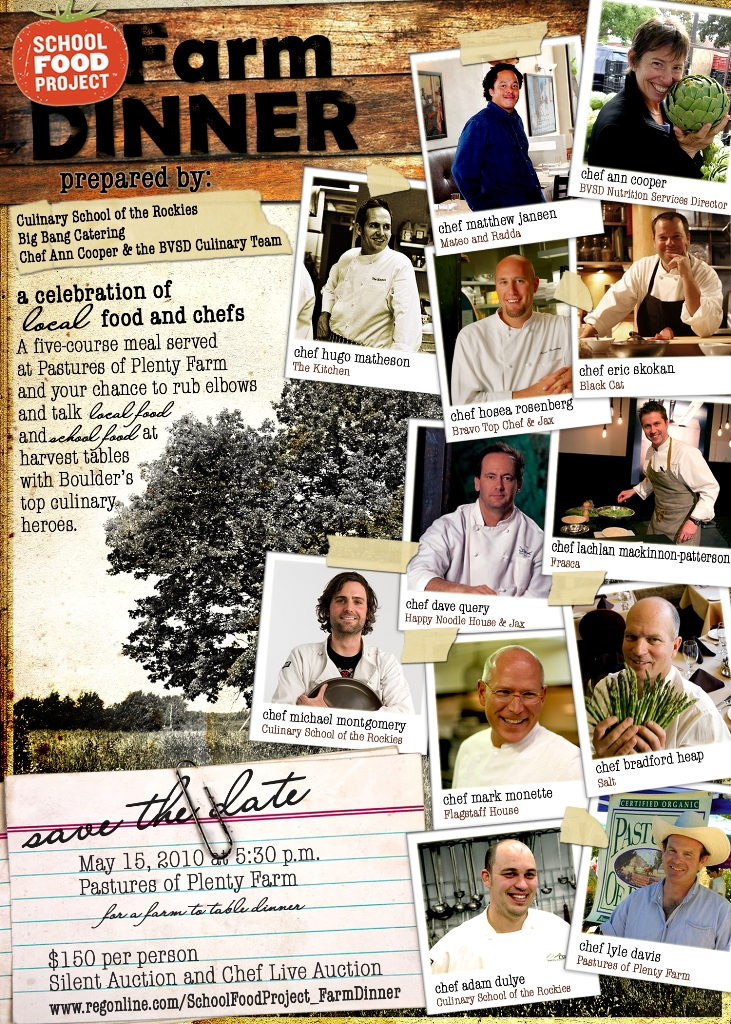
Ad for farm dinner and auction

Some of the money has come from local philanthropists. The regional Whole Foods contributed around $100,000. Fund raising events continue on a regular basis. A dinner at a local farm in December featured a menu groaning with items donated by Boulder's chefs: Colorado bison with a sasparilla reduction, farro and arugula with cumin-scented yogurt, local mushroom with roasted onion, scapes and ramps, wild blueberry and rhubard crisp.

One of the items at a live auction was a whole hog donated by a local farmer. In response, a local butcher auctioned a short course in how to turn that hog into roasts. The auction raised more than $10,000.

Boulder chefs are currently engaged in a series of fund-raising dinners where contributors get to sample cutting-edge culinary fare.

Hugo Matheson, The Kitchen

Hugo Matheson is the father of twin 7-year-old boys who attend Boulder schools and co-owner of a popular bistro called The Kitchen. He has actively supported school gardens in Boulder, and now has thrown his weight behind Ann Cooper's cafeteria re-design. On Mondays, The Kitchen holds "community nights," when 20 percent of sales from a fixed-price $35 menu go to the School Food Project and the Growe Foundation.

"There’s still a wee way to go, but I see more kids accepting the lunches," said Matheson. "That was the biggest challenge, getting kids and parents to believe that this food really is good. My kids complain that we don’t have the waffles and chicken nuggets any more. But we’ve definitely seen an increase in popularity and excitement around the food. There’s a sense of community when everybody sits and eats the same thing."

Sixty-five supporters attended one fundraiser at The Kitchen where Ann Cooper spoke. They dropped checks worth $65,000 in the School Food Project kitty that day.

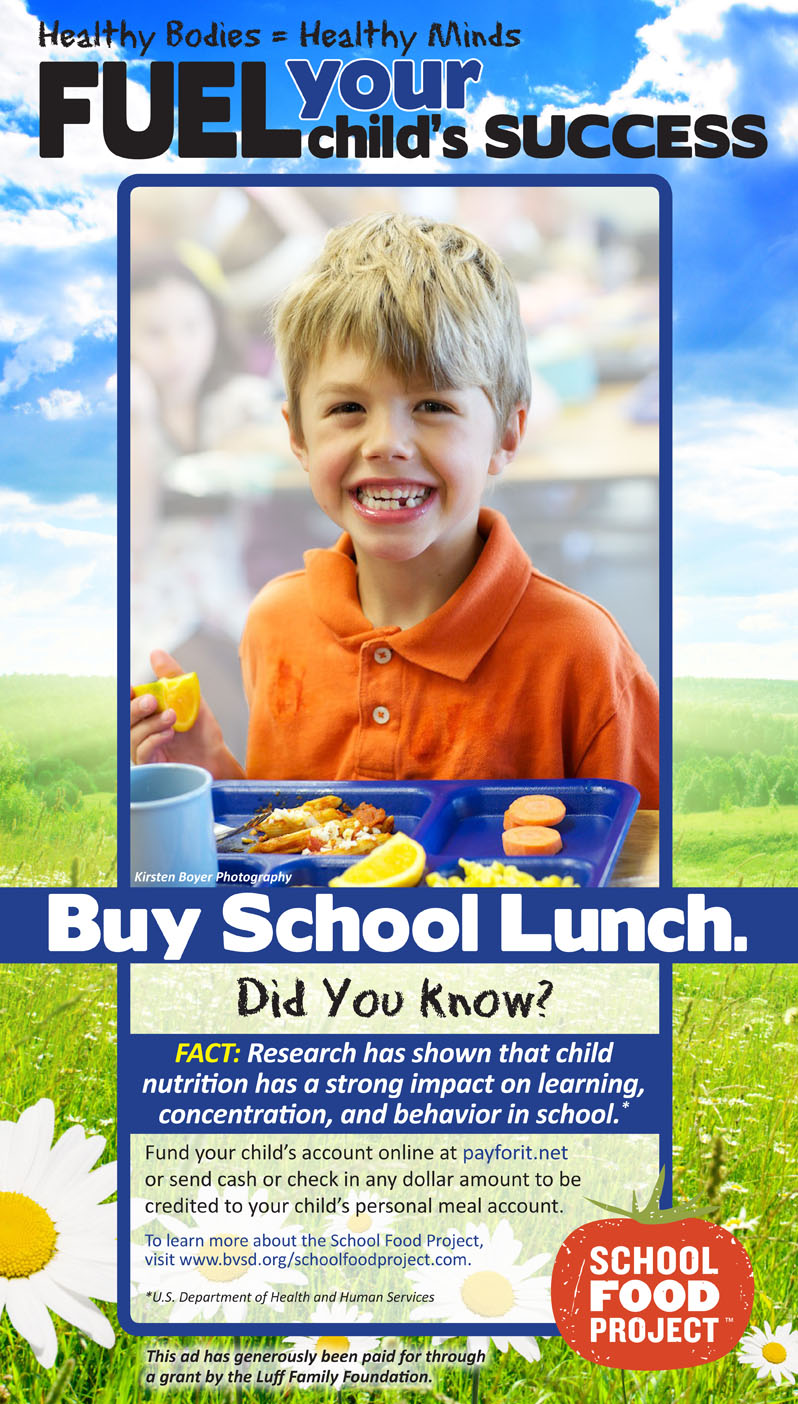
Meanwhile, Sylvia Tawse, one of the parent activists who originally convinced Ann Cooper to take on the school food challenge in Boulder, uses her public relations firm--Fresh Ideas Group--to promote the cause. Her staff is involved not only in promoting various fund raising events, but in designing and placing an ad campaign aimed at boosting meal participation. This fall, a four-week advertising blitz began airing during prime drive-time hours on the radio. The local daily newspaper agreed to publish two full-page ads for every one the food project purchased. "Fuel You Child's Success," the ad declares. "Buy School Lunch."

A private family foundation paid the nearly $14,000 cost of running 18 separate ads, Tawse said, in addition to thousands of dollars worth of hours she and her staff have donated to the cause.

"In the past few years we have only worked 100 percent pro bono for School Food Project, whether it be serving as the event manager for our School Food Project Farm Dinner, which was hosted out at our family’s farm, or our work on other fundraising efforts such as the chef dinners, which are ongoing." Tawse said. "I don’t know total hours over the years, but I’d guess it is in the hundreds of hours range annually. The farm dinner involved more than $15,000 in staff time."

Sylvia Tawse donates school food PR

They've also used the local newspaper to publish coupons for free lunches in the schools, paid for by an anonymous local donor. Coupons were also being distributed in elementary schools on Fridays. "I think we've redeemed 5,000 of those coupons already," Cooper said. Cooper's kitchen crews are even trying to make converts out of the district's athletes. They've been feeding Boulder's football teams at home games and when they travel. Students have signed up for "iron chef" competitions to develope recipes that can be served in the cafeterias. The winners so far: sloppy joes, jicama slaw and baked potatoes stuffed with cheese and broccoli.

So is it working? Are Boulder's kids buying the new and improved school food?

The day I visited Casey Middle School, where the a la carte line has been dismantled and the choices were re-designed nachos and hamburgers on whole wheat buns, the kitchen served 223 lunches, compared to 149 a year ealier. At Columbine Elementary School the following day, the lunch laides dished up 296 slices of freshly-made pizza, a new record.

"I've just had one school meal so far and I thought it was pretty good," said school board President Ken Roberge. "But my wife who is very picky about what she eats, and she's a substitute teacher, has told me she would never think of making her own lunch any more because the food is so good."

According to Cooper, who closely monitors meal participation district-wide, the numbers look good. She may manage to break even this year, ahead of schedule. It took her three years when she remade the food in Berkeley, Calif.

"It's still too early to tell," she says. "We have to make it through the holidays first."

Next: Lesson from Boulder

Friday, November 19, 2010

Breakfast in the Classroom

Margaret Trevarton, packing breakfast

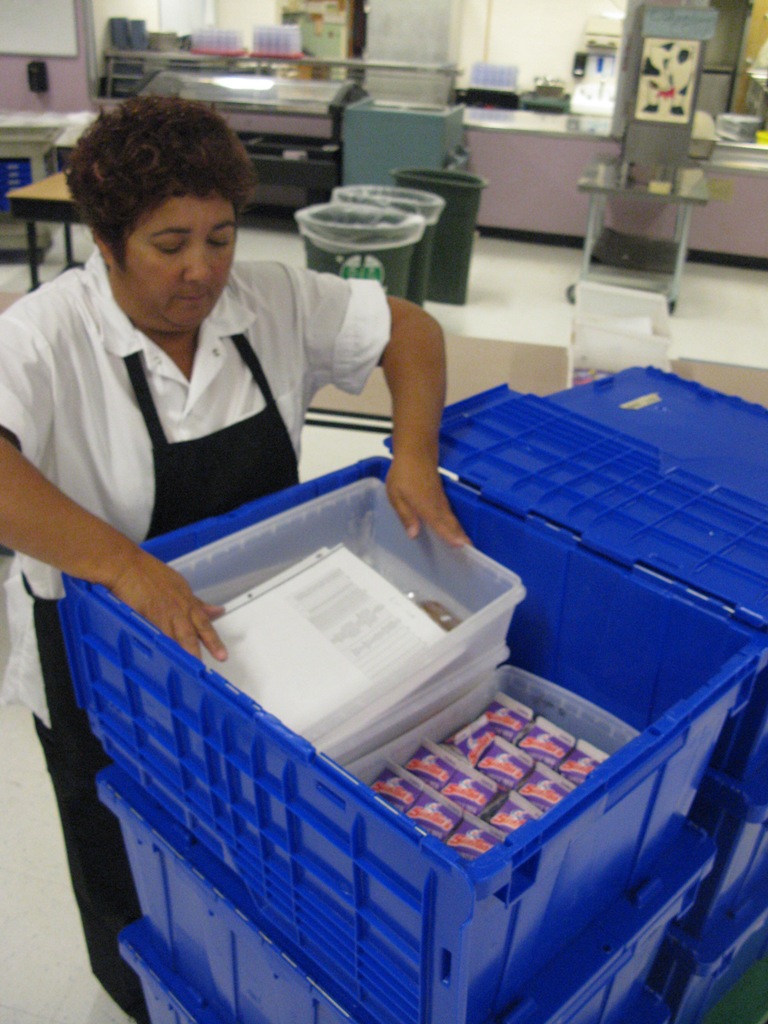
I arrived at Boulder's Columbine Elementary School at 7 a.m. sharp and Margaret Trevarton, the school's "kitchen satellite lead"--formerly known as kitchen manager--was already packing breakfast for the schools' 408 students.

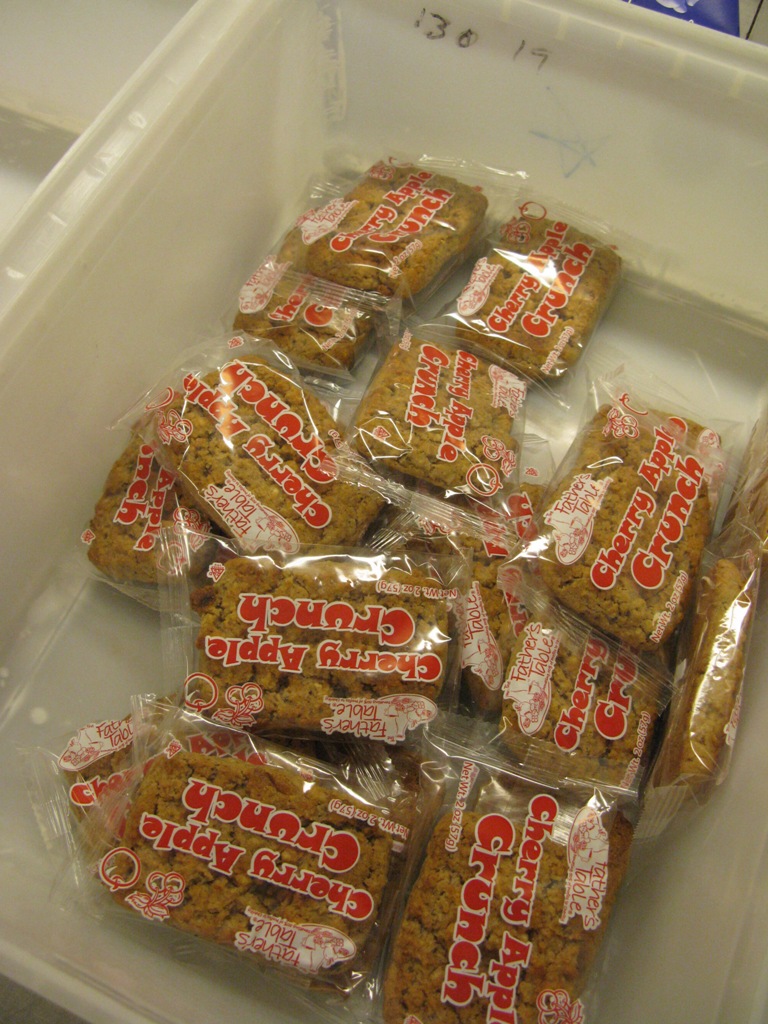
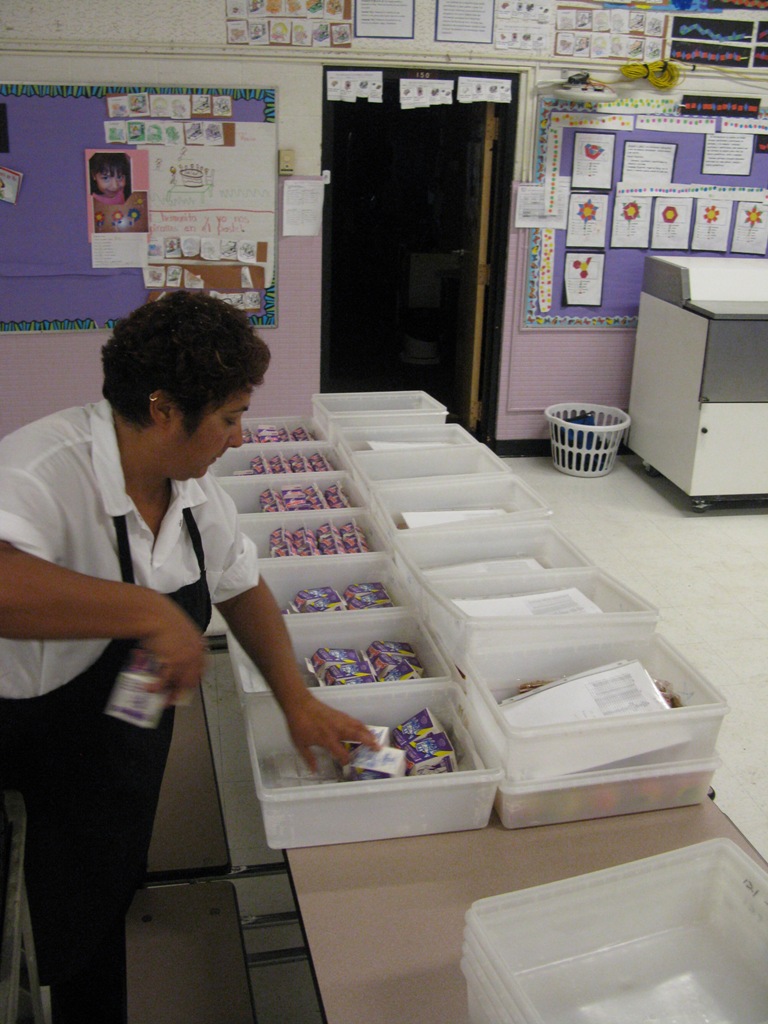
Columbine is one of five schools in Boulder where breakfast is universally free and served in the classroom. Twenty-two blue plastic packing boxes represent all of the school's classes. On this day, Traverton would be loading each with plastic containers filled with apples, cartons of low-fat milk, and a breakfast bar called "Cherry Apple Crunch."
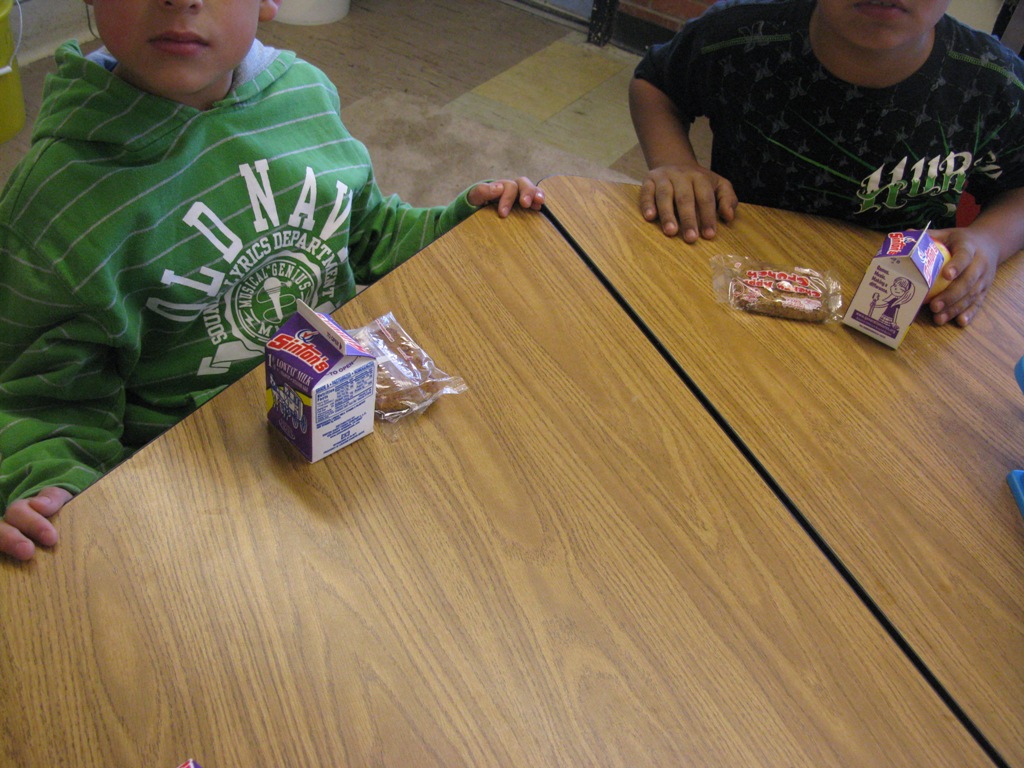
What's for breakfast: Cherry Apple Crunch

The federal government pays schools $1.76 for each breakfast they serve to a student who qualifies for a free meal based on family income, and $1.46 for each student who qualifies for a reduced-price breakfast. Schools with high enrollment of low-income children, such as Columbine, where nearly 80 percent of the children are Hispanic, thus bring in a high return of funds if breakfast is served to everyone, as they most assuredly are when breakfast is served in the classroom.

Increasingly, schools see breakfast in the classroom as a way of making sure that students are focusing on their studies, instead of a on rumbling in their empty stomachs. And as I wrote when I spent a week in Berkeley schools, breakfast in the classroom can help pay for lunch when a school district is populated by a high percentage of low-income students. In Boulder, only 18 percent of students qualify for free or reduced-price meals, which helps explain why breakfast is served in the classroom in only five of the district's 48 schools.

Preparing breakfast boxes

Still, I wanted to see how this was done. So I tagged along as Traverton went about her business, first covering several tables in the cafeteria with plastic containers and filling those with the milk, the apples, the breakfast bars, then loading these into the blue bins, then trucking the bins around the school on a flatbed trolley.

Traverton is a relative newcomer to the Boulder kitchens. Previously, she was home-schooling her teenage daughter when the daughter essentially pushed her out of the house. "She was taking courses online and didn't want me around," Traverton explains. She found a job as a "nutritional assistant" at Columbine, and quickly moved up to cook. An avid cook at home, she keeps some 800 family recipes on an Excel spreadsheet. "I knew this was something I could do."
Now she manages the kitchen, working five-and-a-half hours each day. "We're all part-time around here."

Filling breakfast bins for delivery

As I would soon learn, filling the breakfast bins involves a lot of stooping and lifting. Traverton makes fairly quick work of it. She has her system down.

Some parents have expressed concern about breakfast served in the classroom cutting into valuable instructional time. At Columbine, the start of the school day was moved up 15 minutes, from 8:30 to 8:15, to make extra time for the morning meal. Still, some teachers allow the children to eat while they proceed with their lessons. Many schools report that when breakfast is served in the classroom, children are less apt to act out, that absenteeism and visits to the school nurse drop.

"There's been a lot of positive feedback that the kids have better attention span and fewer behavioral problems," Traverton said.

Delivering bins to classrooms

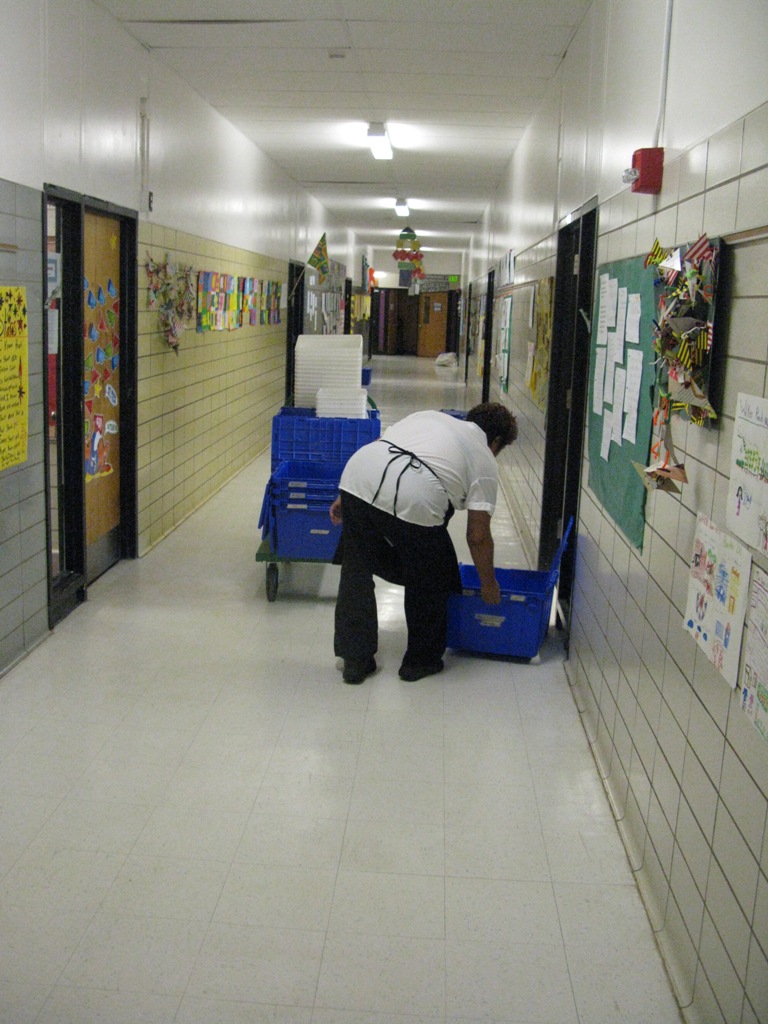
I followed Traverton as she rolled her cart through the school's hallways, depositing the blue bins outside the classroom doors. As the children arrived and settled into their classrooms, teachers brought the bins inside and distributed the milk, the apples, the breakfast bars.

Inside each bin is a sheet of paper listing the children assigned to that particular class. The teacher marks the children who take the meal, which usually means all of them. Later, Traverton or one of her kitchen assistants will enter the information in their computer, data that later will be sent to the U.S. Department of Agriculture as part of Boulder's request for reimbursement under the school meal program.

Breakfast in the classroom: simple

Inside the classrooms, I see the children contentedly eating their breakfast. Sometimes they don't finish the entire meal and save it for later.

Retrieving the blue bins

Teachers then deposit the empty blue bins back in the hallway. Traverton returns with her trolley and collects them.

Soon, it will be time to make lunch.

Thursday, November 18, 2010

Salad Bars: Bringing Fresh Produce to Boulder Schools

Salad bar in use, Monarch High School

By Ed Bruske

aka The Slow Cook

Every day U.S. school children throw tons of vegetables in the trash. The U.S. Department of Agriculture requires that schools participating in the national school lunch program offer a certain quantity of vegetables each week. But most schools serve primarily re-heated processed foods that arrive frozen. Vegetables typically land on student's cafeteria trays overcooked and unpalatable.

Ann Cooper puts her vegetable money in salad bars, where the lettuce is always crisp and the vegetables only lightly blanched or roasted, if cooked at all. Before Cooper arrived in Boulder to take over food services, the schools were gradually beginning to introduce what they called "Harvest Bars." One of Cooper's first acts was to install a salad bar in all 48 of the district's schools.

"When salad bars are set up correctly, they give kids choices and it's healthy, or certainly can be," says Cooper. "That's not to say there isn't waste from salad bars. And if I had the money, I would do both: serve vegetables in the food line and at the salad bar. But when you let kids actively choose what they want, the more likely it is that they will actively eat the food."

While in Boulder, Cooper met a parent activist--Mara Fleishman--who also happens to be national partnership director for Whole Foods. What followed was a salad bar campaign--the Great American Salad Bar Project--in which Whole Foods recently raised $1.4 million from customers nationwide, enough to install salad bars in 564 schools. Around 570 schools have applied. There are some indications the program might soon be expanded with involvement from the federal government and industry groups.

But while studies suggest that salad bars can help boost children's consumption of fruits and vegetables, some school districts decline to install salad bars claiming they are unsanitary, especially for small elementary school students with active hands and faces that often come up short of the barriers that are meant to keep coughs and sneezes out of food. In addition, a memo circulated by the U.S. Department of Agriculture in October encouraging the use of salad bars also indicated they might not comply with federal regulations if cafeteria cashiers are not checking to make sure students take the prescribed portions of fruits and vegetables when they serve themselves.

"Part of the difficulty of dealing with the USDA is they are trying to oversee 10,000 school districts so they have all these rules--rules and rules and rules and rules," Cooper said. "And it just doesn’t work on the ground. If you make kids pass by the cash register after they've been to the salad bar, it just slows everything down."

She acknowledges some uncertainly around the question of how local health inspectors might treat salad bars in schools scattered around the country. But she disputes the notion that salad bars pose a potential health hazard. "As far as I’ve found out, there are no documented disesase outbreaks from school salad bars. By and large, this is not a high risk area," she said. Still, she named several jurisdictions that, for one reason or another, will not allow salad bars, including Philadelphia, Austin, Tex., and Montgomery County, Md., just outside Washington and the White House where Michelle Obama is trying to get the nation's kids to eat more vegetables as a way of combating childhood obesity.

Montgomery County, otherwise considered one of the more progressive jurisdictions in the country, also does not permit food gardens on school grounds, claiming they might attract rodents and other vermin.

"We have salad bars at some of our high schools, although not many," said Dana Tofig of Montgomery County schools. "Since salad bars do not fit USDA guidelines (as pointed out in your columns) they are an a la carte item. So students who want to eat from the salad bar, including kids who receive free and reduced-price meals (FARMS), have to pay for them. In some schools, we have had to close down salad bars because they do not cover expenses and we end up wasting food"

Tofig added: "We do offer premade salads that meet USDA guidelines in all secondary schools. These salads do qualify for federal reimbursement for the 30 percent of our students who receive FARMS subsidies."

In the District of Columbia where my daughter attends school, meanwhile, officials have said they are anxious to install salad bars in local schools. Several D.C. schools have applied for grants from the Whole Foods campaign that Cooper is managing.

Weighing red pepper, Arapahoe Ridge High School

Others have said they don't have the sinks or dishwashing equipment to manage salad bars. But Cooper counters that lettuce and other vegetables can be purchased pre-cut and pre-washed, and that food dispensers in the salad bars can be equipped with disposable liners, or washed in bus tubs. "There's a way to work around those issues," Cooper said.

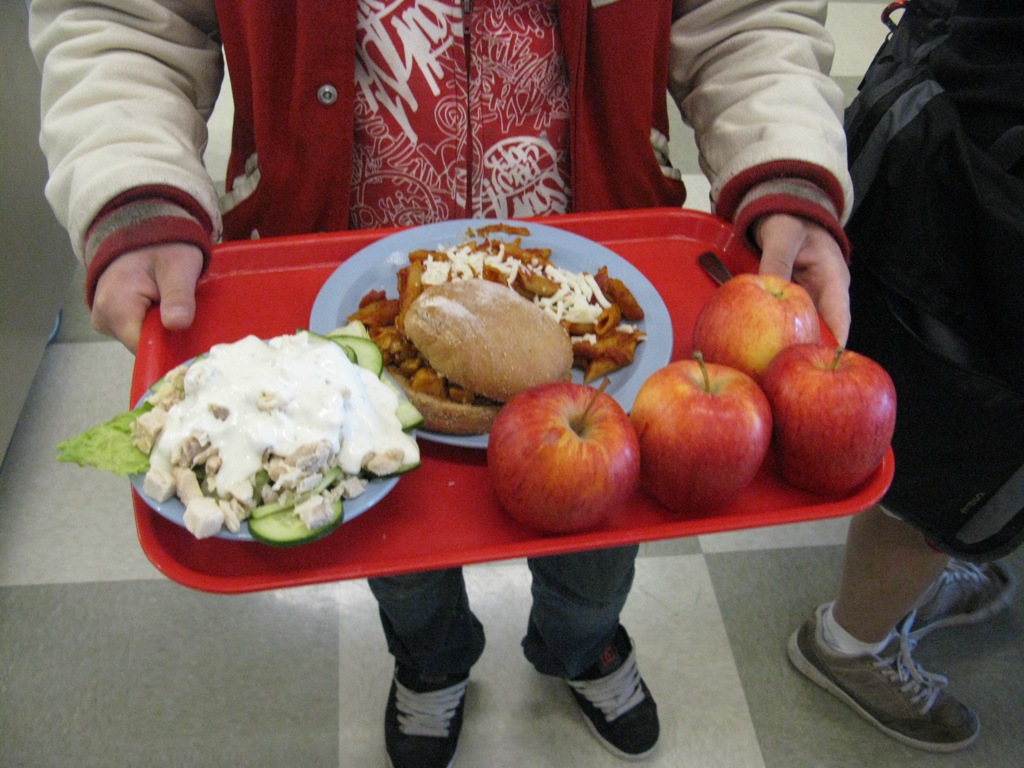
I wanted to make salad bars a major focus of my week in Boulder because they seem to be a logical way of encouraging children to eat more vegetables, as opposed to the cooked-to-death broccoli they're typically served. Farm to school programs have sprouted all over the country attempting to integrate local farm produce into schools. Salad bars are an obvious candidate for local fruits and vegetables. But it turns out there's really nothing very complicated about salad bars. In the Boulder school district's five production kitchens, cooks peel, slice and chop fresh vegetables such as celery, cucumbers, carrots, red pepper and jicama and ship them off in plastic containers called "fish tubs" to satellite kitchens in 48 schools. There, kitchen workers transfer them to in-house containers and label them with a date.
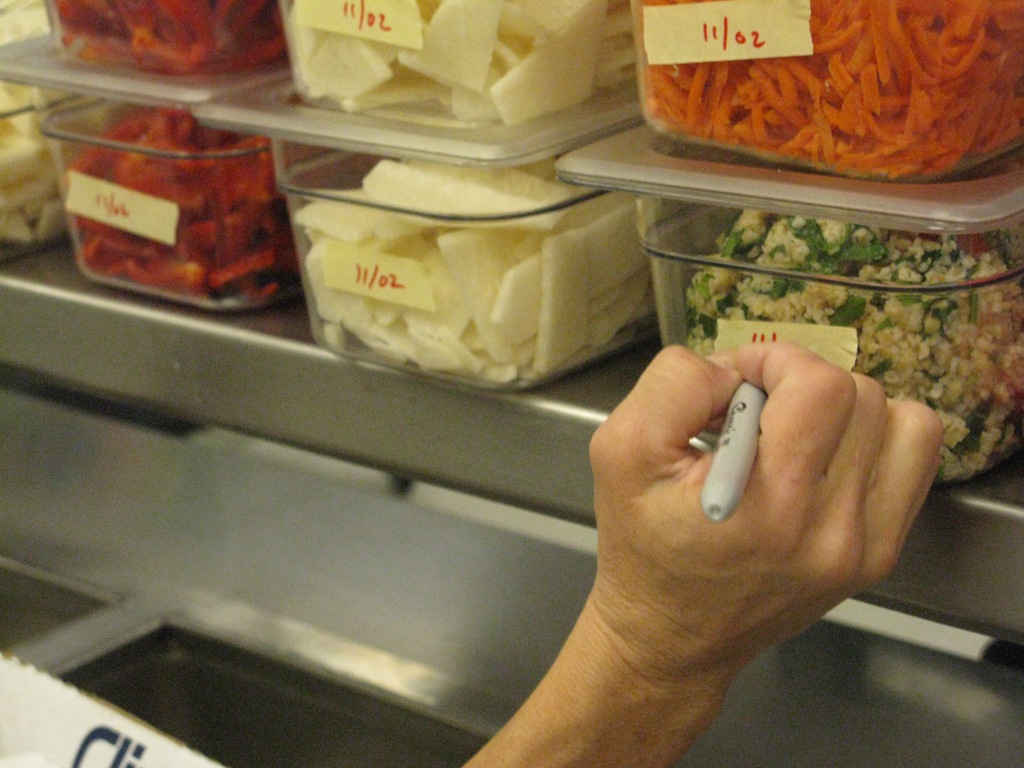
Labeling and dating salad bar ingredients

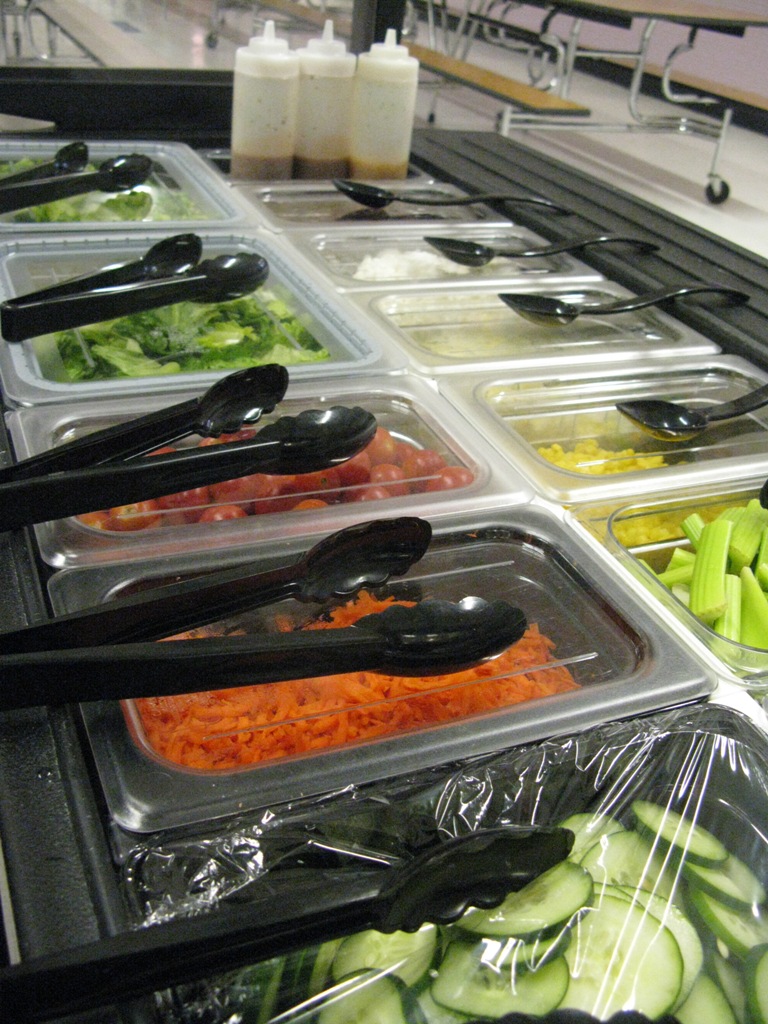
At the appropriate hour before lunch service, a kitchen worker begins assembling the salad bar using the fresh vegetables as well as any number of other food items: canned kidney beans, chickpeas, tuna salad, egg salad, hard-boiled eggs, pickled jalapeno, cherry tomatoes, diced chicken, lettuce and cottage cheese. While I was there, the kitchens were using packaged Romaine lettuce pre-washed and pre-chopped from Dole because the usual bulk "spring mix" from California had been sub-par lately, Cooper said. Frozen peas and frozen corn kernels, once thawed, also appear on the salad bar, along with three dressings displayed in squirt bottles, ranch being the hands-down favorite over Italian and balsamic. In theory, a student could compose a complete meal at the salad bar and that would be perfectly fine with the USDA--as long as a kitchen worker checked to make sure all the required components were in place before approving it as a reimbursable meal.

One recent salad bar innovation: taboulleh, a Middle Eastern salad of whole grain bulgar wheat and parsley. It appears on days when pizza is served because the commercial pizza crust Boulder kitchens currently use is not whole grain. "A kid asked me what it was. He didn't seem quite sure about it," said Yuri Sanow, sous chef at Monarch High School. "I explained to him what taboulleh was. A few days later, I see the same kid and one of his friends asks him, "What's that?' And the kids says, 'Oh, that's taboulleh. You should try it.' "

At Boulder's Columbine Elementary School I experienced for the first time the sight of kindergarteners serving themselves from the salad bar. They did so with relish. "They're really into it because it's new for them," said Columbine's "kitchen lead," Margaret Trevarton. "By the time they get to fifth grade, the bloom is off the rose." In fact, the older kids seemed to be less interested in the salad bar. "That's because we're out of ranch dressing," offered kitchen worker Tammy Steele, who was in charge of the salad bar that day. "When we have ranch dressing, there's four times as many kids at the salad bar."

Sometimes the kids get encouragement to try things they may not be used to. Erica Goodman, a graduate student in media studies at the University of Colorado, Boulder, volunteers in the local schools as part of a campaign to boost participation in the subsidized meal program. Sometimes at elementary schools she simply stands by the salad bar and challenges kids to fill their plates.

"I'll tell them, 'Today's challenge is to see who can make the most colorful salad,' or maybe, 'Who can make a salad with the most variety,' " Goodman said. "It really works. Until you get to the fifth grade and then the kids want to know what they get if they win the challenge."

Salad bar haul, Arapahoe Ridge High School

In the upper grades, not all kids take a salad, but from what I observed enough do to make the salad bars worthwhile. Lunch in the high schools appeared to be a busy time around the salad bars. Teenagers were not at all shy about loading their trays.

Under USDA rules, schools who use the so-called food based meal plan, as in Boulder, must offer students five lunch items covering basic food groups, plus milk. They are only required to take three to qualify as a "meal" for purposes of federal reimbursements. For instance, nachos with chips, a scoop of taco filling and a topping of grated cheese would qualify. But then students can pour their own milk if they choose from a dispenser, and help themselves to unlimited amounts from the salad bar, where whole fruit also is displayed.

"Hey, do you have any of that egg salad?" asked one teenaged girl in the food line at Monarch High School. "That stuff is awesome. You should have it more often."

Beth Collins, Cooper's business partner, has been in charge of procurement for the school kitchens and says she knows the kids are eating more fruits and vegetables. "We're spending $40,000 a month on produce, mostly for the salad bars," Collins siad. "Before, they were spending $70,000 for the entire year."

"My kids are now eating at the schools five days a week and I can be assured they are going to eat fresh vegetables every day because of the salad bar," said Mara Fleishman. "They love the choice. They love the empowerment."

How to Build a Salad Bar

Laying a sheet of ice

By Ed Bruske

aka The Slow Cook

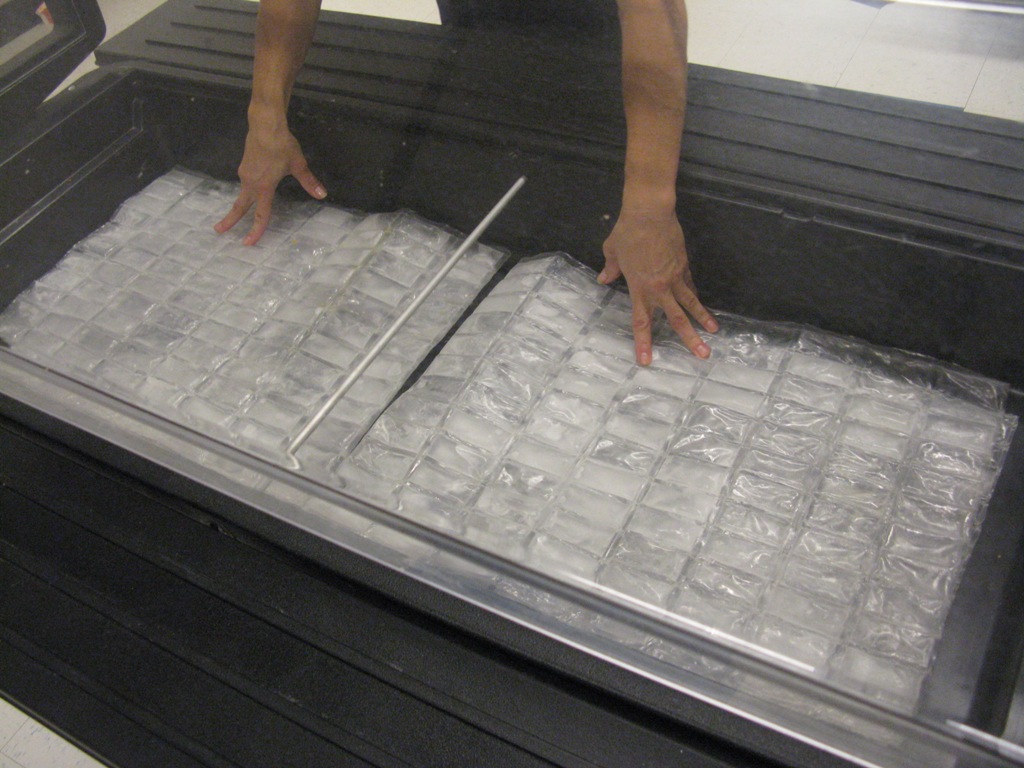
The Boulder school district owns two kinds of salad bars: a stainless model with plug-in refrigeration costs upwards of $6,000. A simpler, polyethylene model costs around $2,500. At Columbine Elementary School, I watched kitchen assistant Tammy Steele assemble a salad bar for lunch service. The first thing she did was lay a plastic quilt of ice at the bottom of the bar's well to keep the foods chilled.

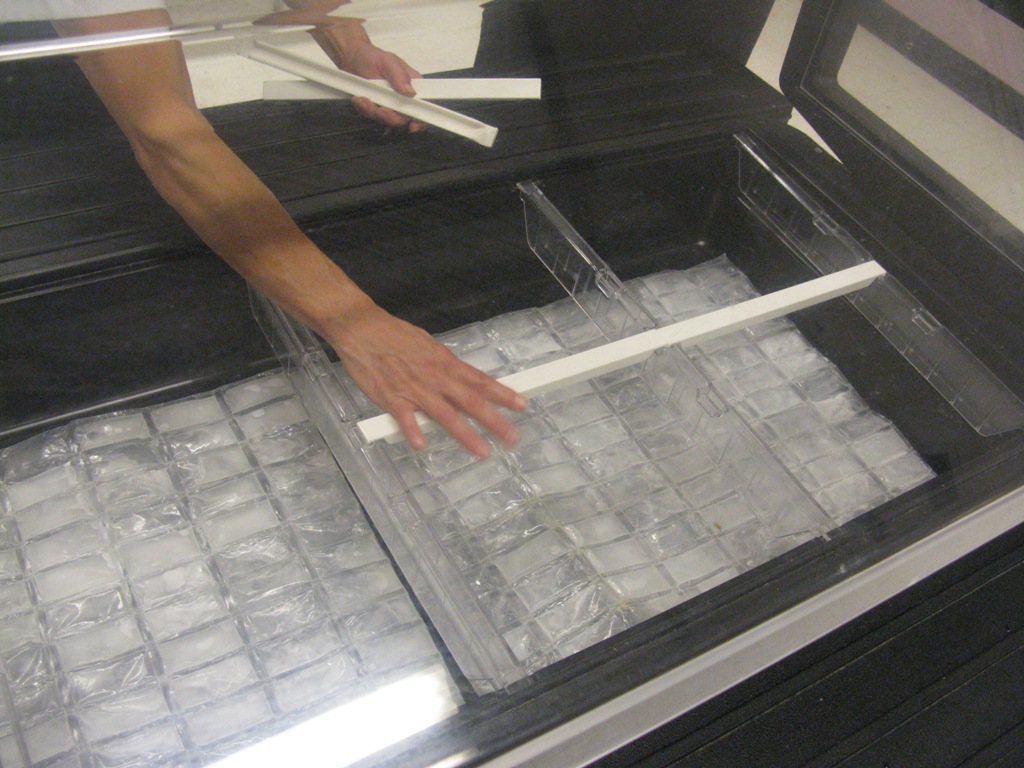
Installing plastic cross-members

Plastic cross-members form the structure in which the food trays will rest.

Inserting food trays

Steele places food trays filled with an assortment of vegetables prepared by a production kitchen, as well as items like hard-boiled egg, pickled jalapeno, diced chicken and tuna salad.

Placing serving utensils

Each item gets a separate serving piece, such as tongs or plastic spoon.

Finished salad bar with dressings

Finally, Steel loads the dressings, typically Itlaian, ranch and balsamic.

Kids Serve Themselves

Kids seem perfectly capable of serving themselves without much adult supervision.

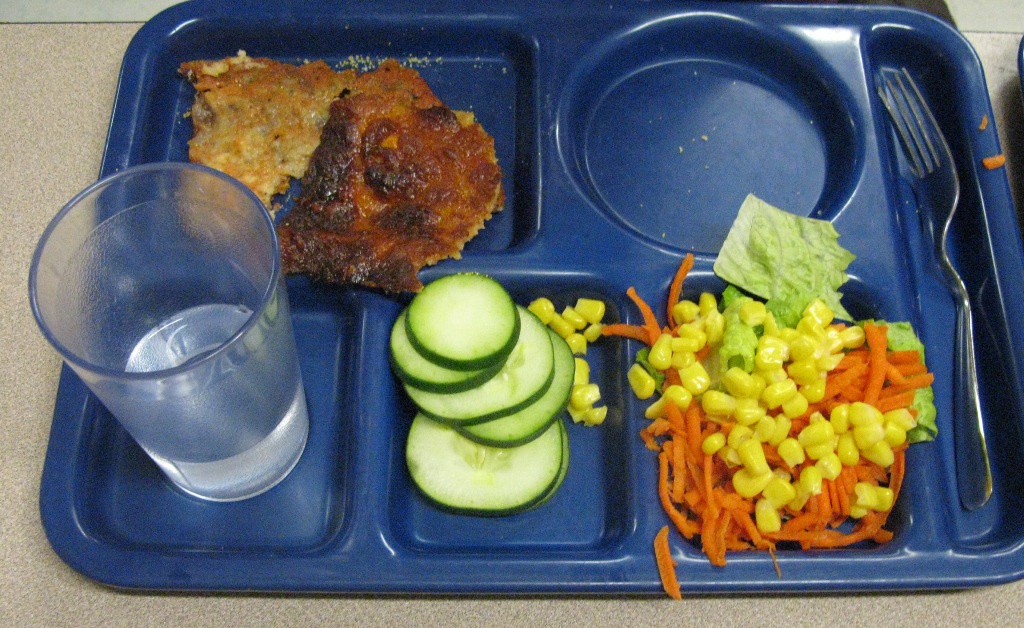
Finished tray, with pizza and water

Salad bars give kids the ability to choose their own foods. You never know what they'll do with it.

Wednesday, November 17, 2010

Dragging School Food into the Computer Age

Modern technology meets school food

By Ed Bruske

aka The Slow Cook

When she arrived in Boulder in May 2008 to investigate food service in the schools, Beth Collins found that the cooks had to send paper purchase orders to the school system's central warehouse to get the ingredients they needed to cook meals. The nutrition services department and the warehouse had computer systems, but they didn't talk to each other. A nutritionist who wrote menus for the schools entered them by hand on an Excel spreadsheet.

For Collins, who eventually would be tasked with turning Boulder's neglected food service infrastructure into a smooth-running machine, what she first saw there was like stepping into another era. But that's hardly unusual for U.S. schools and especially school food operations. They are at the end of the line when it comes to adopting modern technology. And that helps account for why they have trouble making ends meet under the federally-funded school meals program.

The U.S. Department of Agriculture requires all school districts to maintain meticulous records of all the purchases they make as a way of proving that they have actually made the meals for which they claim federal reimbursements. Collins said she was in a school district in Misssissippi recently where they kept something they called "The Red Book," meaning a ledger in which they recorded all of their purchases with pen and ink.

Boulder schools had installed a food service computer software program called VBOSS but were hardly using it to its full potential, Collins said. In quick order, she began to integrate various meal service functions into the software system, everything from writing menus and processing procurement, to sending work instructions to production kitchens, managing warehouse purchases, keeping inventory and archiving those records required by the USDA. Laborious paper submissions to the federal government turned into streamlined electronic ones.

Computers manage the cafeteria hardware that allows students to pay for their meals using a touchpad instead of cash, identifies and records those who qualify for free and reduced-price meals and keeps a record of everything they purchase. It allows parents to pay for meals with a credit card online. VBOSS can take simple menus and "explode" them into recipes that will feed thousands of children.

"The best thing it does is take orders from 48 school kitchen sites and consolidate those into something the central office can work with," Collins said. "They're big time savers. Otherwise, you'd be shoveling e-mails and paperwork all day. And there's accountability across the board."

Still, Collins said the VBOSS system, for which the Boulder school district pays a $17,000 annual licensing fee, "is something of an antique." But the new and improved version, called OneSource, from Horizon Software in Duluth, Ga., is something the district simply can't afford, she said.

Amy Huff, vice-president of marketing for Horizon, said the upgrade to OneSource is free to existing customers, but often requires an expensive change in computer hardware. The latest features include food safety monitoring that records the temperatures in refrigerators and freezers and will send electronic alerts if a mechanical failure sends temperatures into dangerous territory. An even newer innovation places digital signage in cafeteria lunch lines and gives students nutritional information on the food being served.

The OneSource system can cost less than $2,000 for a single private school, or more than $1 million in the case of Los Angeles, Horizon's biggest customer with some 900 schools. The costs for other large school districts runs in the hundreds of thousands of dollars, Huff said.

Horizon counts 720 school districts encompassing some 12,000 individual schools as clients nationwide. Huff said Boulder is in the vanguard of those embracing modern softerware capabilities to improve their food service operations. Most are not even close to being up to speed with current technology. "School districts are slow anyway, and they're even slower in the back of the house behind food services," Huff said.

Ann Cooper, with her insistence on professional management and maximum use of technology, stands out among food service directors, Huff said. "Most schools hire from within. The food services director is a longtime employee, maybe from another department. They don't have nearly the background that Ann Cooper does. She's not at all typical."

In August, Cooper paid to have a Horizon representative teach her new kitchen production crew how to use the system.

"As school food transitions from processed food to scratch cooking whole foods, we need to harness technology to help us control our costs," Cooper said. "From menus and recipes to purchasing and inventoring and from email to spreadsheets, we need to become as efficient as possible. Computer systems are part of the support sytem that will make success a reality."

Photo by Barbara Ann McMonigal

Tuesday, November 16, 2010

Boulder's New Deep-Dish Vegetarian Enchilada: The Recipe

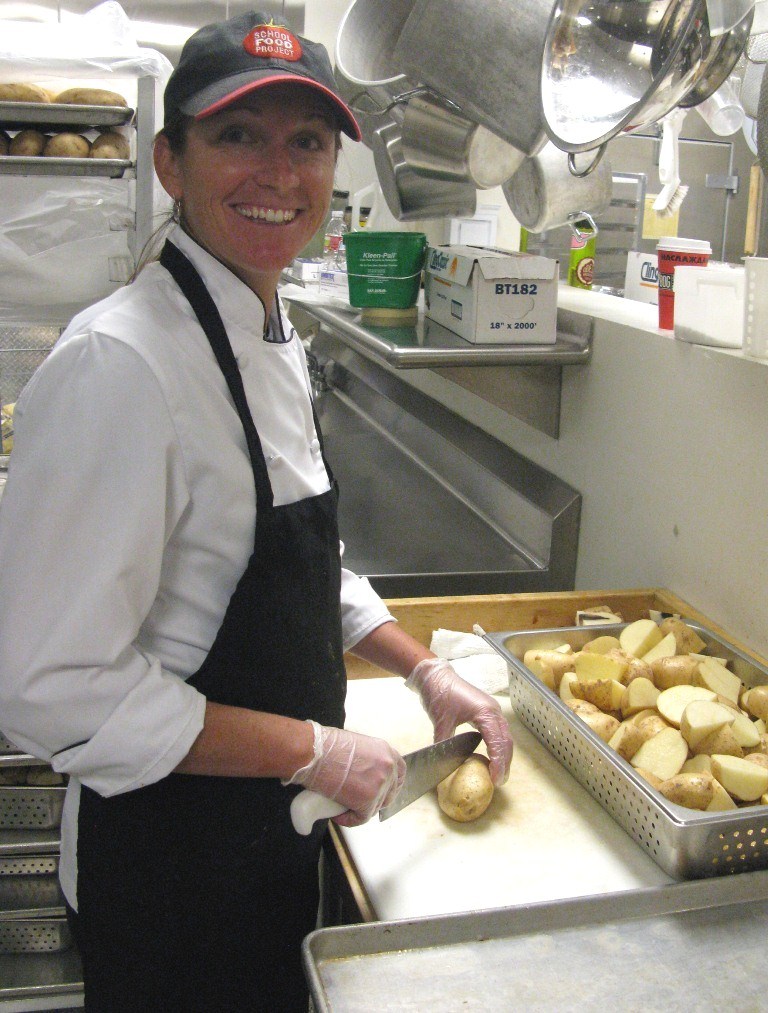
Brady Dreibelbis, cutting potatoes

By Ed Bruske

aka The Slow Cook

Most U.S. schools don't worry about recipes for the food they serve: it arrives pre-cooked and frozen from industrial factories. All they have to do is re-heat it and put it out on a steam table.

Under their newly re-constituted meal service, schools in Boulder are serving food that fits the description "home made." Recipes come from a variety of sources: some originated in Berkeley, Calif.,where Ann Cooper and her business partner Beth Collins had their first experience replacing the standard re-heat scheme with meals cooked from scratch in a central kitchen. (They post numerous recipes on their website, Lunchbox.) Other new dishes are suggested by Cooper's staff of professional production chefs. And some of the new items appearing this year in Boulder cafeterias--sloppy joes, jicama slaw, baked potatoes stuffed with cheese and broccoli--were developed by students in a series of "iron chef" competitions.

Brandy Dreibelbis, formerly executive chef for Whole Foods in Boulder, now one of five district managers on the schools food service team, takes the lead in developing new recipes. She typically invites the food service staff to lunch to sample dishes under construction and then conducts tastings with the ultimate judges--the kids themselves. Lately she's been gearing up for the winter season with dishes incorporating hard squashes, such as delicate, butternut and spaghetti squash. She also plans to introduce lightly blanched broccoli and roasted potatoes to the system's salad bars. And last week she began working on a series of soups to take some of the chill off Boulder's snowy days ahead: butternut squash, broccoli-cheese, vegetable-rice, tortilla.

One of Dreibelbis' creations that was being served while I was in Boulder was a deep-dish vegetarian enchilada. It's one thing to come up with a recipe you can serve to a family or a group of friends. It's quite another to translate your culinary musings into a meal for thousands of kids that hits all the right notes. I thought the enchilada was inspired. And Dreibelbis, being a professional chef, also had a number of practical considerations she incorporated into this particular dish.

"We wanted to appeal to our Hispanic population and try something vegetarian other than tofu," said Dreibelbis. "I liked this recipe because it enables us to use several commodity products, such as corn, pinto beans, cheddar cheese, enchilada sauce, and diced tomatoes."

Note that it makes "one hotel pan," meaning enough to feed you and 50 of your friends.

Baked Veggie Enchiladas

2 T Veg Oil

10 oz Yellow Onion, diced

1 lb 6 oz Zucchini, diced

92 oz Pinto Beans

28 oz Diced Tomatoes

32 oz Corn

3 t Cumin

1 T Oregano

1 t Salt

36 Corn Tortillas (6”)

24 oz Enchilada Sauce

26 oz Salsa

1.25 lb Cheddar Cheese, Shredded

6 Cloves Garlic, minced

Preheat oven to 400 degrees. Heat oil in skillet over med-high heat. Add onion and garlic. Cook, stirring often until starting to brown, about 5 minutes.

Stir in zucchini, beans, tomatoes, corn, cumin, oregano and salt and cook, stirring occasionally until the veggies are heated through.

Combine enchilada sauce and salsa together and set aside. Reserve 8 fl oz sauce for top layer.

Combine vegetable mix with cheese. Reserve 1 cup cheese for top layer.

The enchilada bake should be layer like lasagna:

Place 12 tortillas in pan. Top with half the vegetable/cheese mix and half the sauce. Repeat with one more layer of 12 tortillas, vegetable/cheese mix and sauce. Add final layer of 12 tortillas, top with remaining 8 fl oz sauce and then the 1 cup cheese. Cover with parchment and foil.

Bake casserole for about 30 minutes.

Remove foil and continue baking until casserole is bubbling around the edges and cheese is melted, about 10 more minutes

Monday, November 15, 2010

Not Quite Cooked from Scratch...Yet

Lunch: Penne pasta with salad, cottage cheese

By Ed Bruske

aka The Slow Cook

Ann Cooper warned me that I might see some unusual things in the school kitchens on my visit to Boulder. I did.

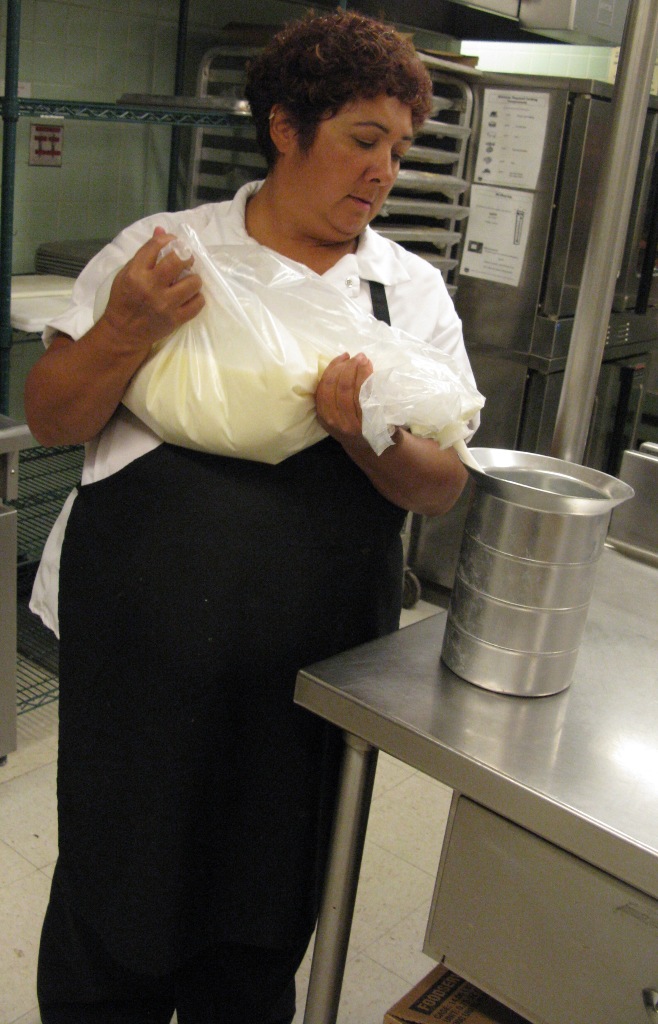
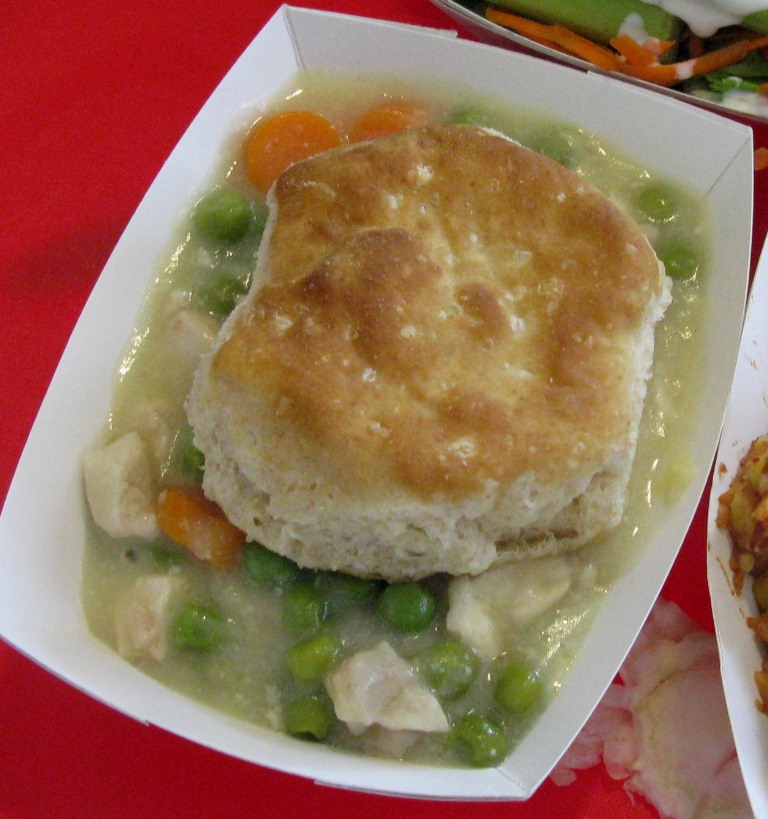
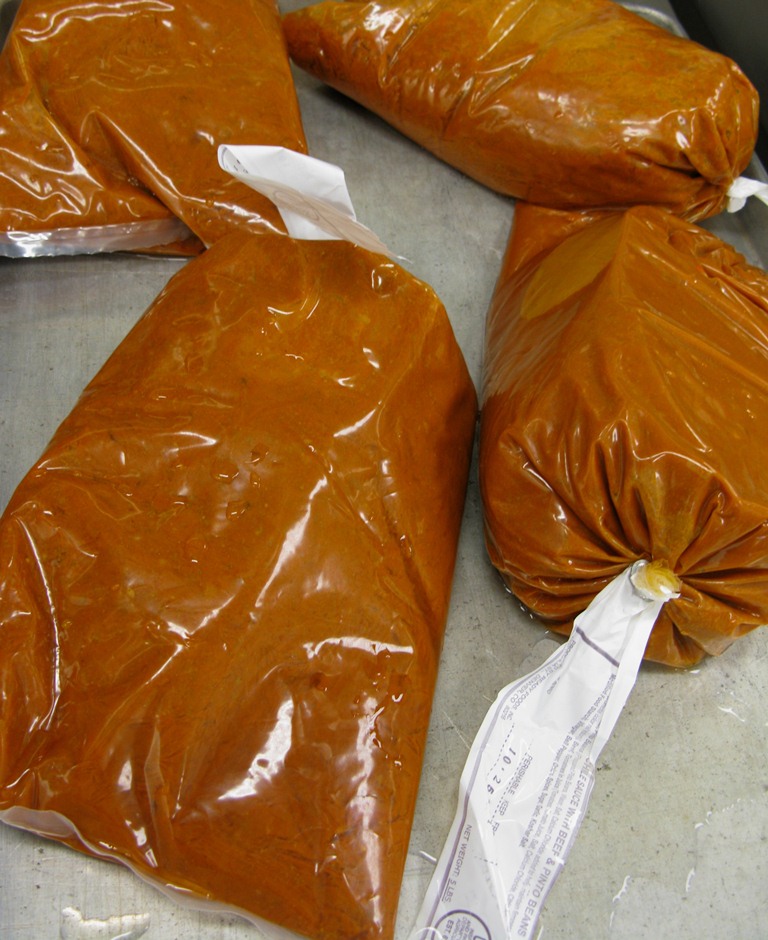
One morning at Casey Middle School, five-pound bags of what looked like frozen cookie dough lay on a stainless work table. In fact, labels described the contents as chicken gravy. Not your typical institutional gravy, processed in some distant factory with 50 industrial additives, however. No, this chicken gravy—destined to make hundreds of portions of chicken pot pie for Boulder school children--came from a family-owned company less than an hour away in Denver and was made according to Ann Cooper’s precise instructions.

Ready Foods, established in 1972 with Mexican cuisine in mind, now specializes in custom-formulated “kettle” products for restaurant chains, meaning just about anything that can be cooked in a 200-gallon commercial kettle. Chinese, Italian, Mexican—Ready Foods covers it all, says owner Marco Abarca. Yet until Ann Cooper came along, he had never considered schools as a potential customer.

“I always thought school business was something I would never go after because it’s so heavily bureacratic,” Abarca said. “It seems to be all about low quality, low price. And that’s not something I want to be in.”

But for Cooper, who is all about cooking school food from whole ingredients without the additives, Ready Foods was a perfect fit. She could tell Abarca exactly what she wanted in her chicken gravy--known as veloute in chef circles--meaning none of those emulsifiers, stabilizers, flavor-enhancers and preservatives whose names you can't pronounce. After visiting the factory with her business partner, Beth Collins, Cooper now sends Abarca the government commodity beef she earns selling meals in the national school lunch program to turn into chili and taco filling. In his 85,000-square-foot food factory, Abarca makes the béchamel sauce for Boulder schools’ macaroni and cheese.

What’s happening in Boulder offers a rare glimpse into the carefully choreographed steps that must be taken to accomplish radical change in a large school district's food service. Cooper has unveiled an all-new menu and hired a new staff of professional chefs and kitchen managers to cook meals in five newly outfitted production kitchens. While the cooks get their legs in the new digs, Cooper devises ways to remain true to her belief in unadulterated food.

It's a work in progress, and the details are almost unfathomably complex.

Defrosting 5-pound bags of chicken gravy...

Yields chicken pot pie for lunch

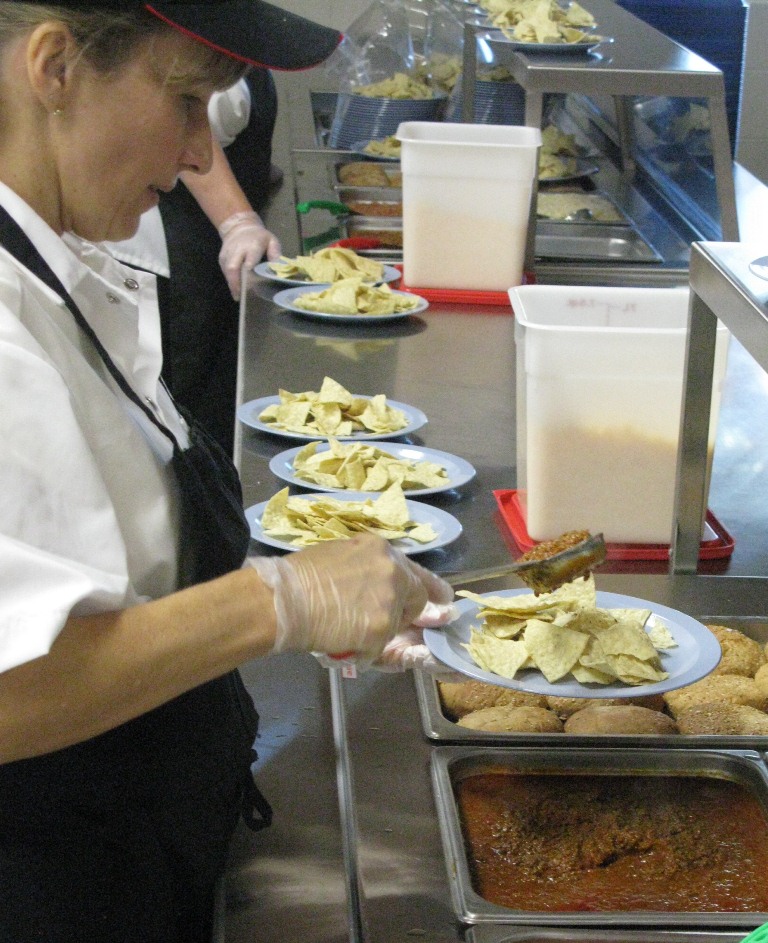
Frozen taco filling...

Becomes Monday's nachos

Cooper writes her school menu for the entire year months in advance. The commodity food products she uses--beef, chicken, pasta, cheese, beans--must be ordered from the federal government a year ahead of time. To coordinate ingredients, menus and production details, Cooper and Collins create a giant Excel spreadsheet listing menu items and recipes Collins has devised that can "explode" from a basic formula into servings for thousands of kids.

They then examine each day's menu and calculate how the meals will be assembled, the staffing needs, the equipment required. For instance, a roast chicken thigh on the menu means the production kitchens will need sheet pans on which to cook the thighs and ship them to outlying schools. How many thighs fit on a sheet pan? How many sheet pans are needed? How many sheet pans fit on the rolling racks the kitchens use to transport the roasted thighs? And how many rolling racks will fit on one of Cooper's delivery trucks?

All of that might affect the next day's menu selection as well: there could be a problem if sheet pans were needed again and they had not been returned from the schools to the production kitchens.

"Sometimes a menu choice might change depending upon what equipment is needed and whether you have the refrigerator space and the capacity to ship it," said Cooper. "And where are we going to store all the sheet pans when we aren’t using them?"

Cooper continued: "There’s a lot of complexity to it because it’s not just about how to cook the chicken. Without some kind of owners manual, it’s really hard to figure out how to do it. Unless you have a very strong background, it’s very hard to get your arms around all these pieces."

One of Cooper's district managers, Brandy Dreibelbis, scans the menus and the recipes and writes the "prep lists"--the work that needs to be done on any given day--for an entire month and for all five of the system's production kitchens. Cooper wants to know that all of her production cooks are doing the same thing on any given day. Anything she can do streamline and economize potentially saves money that can be used to improve the quality of the meals she serves. It also takes pressure off her employees, who are still getting used to the new system in Boulder.

In Berkeley, where Cooper also revamped the school meal service, the central kitchen makes something I call “epic chicken,” meaning the 1,400 pounds of chicken parts that arrive courtesy of the federal government frozen in 40-pound blocks. They require days--and quite a bit of room in the central kitchen facility--to defrost, marinate, sort, roast, package and ship to the district's schools.

To eliminate some of the hassle, Cooper in Boulder buys commercially prepared chicken thighs that are quick-frozen individually so they can easily be poured out of a bag and placed on a roasting pan, a method she wishes the U.S. Department of Agriculture would adopt.

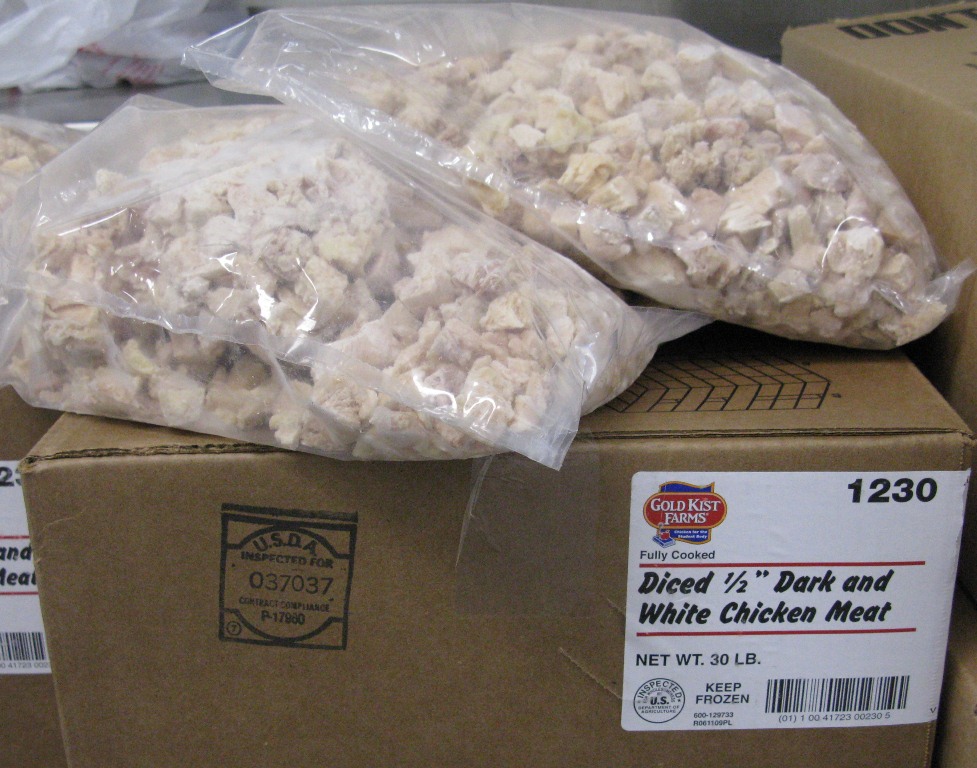
Those chicken thighs taste awfully good next to a side of freshly mashed potatoes. I was also taken with a barbecued chicken sandwich made with diced chicken that arrives cooked and frozen from Gold Kist Farms. In fact, frozen foods show up in some surprising places. The frozen corn on the salad bar is nothing new, nor are the frozen peas. But would you believe frozen hard-boiled eggs to spoon over your salad? If one of the cooks hadn't told me, I would never have known.

Cooper puts out 10,000 meals a day--2,500 breakfasts and 7,500 lunches--and despite the difficulties of implementing so many changes in a relatively short period of time, and the many products she's out-sourced rather than cooking from scratch, she's managed to keep ingredient costs to $1.13 per meal, not terribly higher than the national average of around $1.

"That's a testament to Beth’s ability at procurement, but also testament to our ability to manage waste and product," Cooper said. "It’s a big, big job. People say, 'God, you have so many managers!' But you have to have managers to manage all your costs. We’re spending a couple million dollars on food, so we have to manage it correctly."

Bags of frozen diced chicken...

Turns into a yummy barbecue sandwich

Kids, meanwhile, don't care about management, and they may still need some convincing where healthier foods are concerned. They're nostalgic for the good old days of processed convenience foods. They miss their chicken nuggets and Subway sandwiches and even the miniature pancakes that were served re-heated inside their plastic packaging. A Boulder lunch menu from April 2005 lists macaroni and cheese, hamburgers, hot dogs, mini-pancakes with sausage and the ever-popular pizza. There were chicken nuggets, nachos, a beef rib sandwich, cheese sticks and a soft pretzel with cheese sauce. They still talk about the "French toast sicks" that were served as a lunch item.

"On Friday I saw 10 kids with microwavable meals in the cafeteria," said Michelle Hancock, a production cook at Casey Middle School. And since the schools serve only plain, low-fat organic milk from dispensers under Cooper--no more cartons of chocolate or strawberry--some kids bring their own chocolate syrup from home to squeeze into the milk, Hancock said.

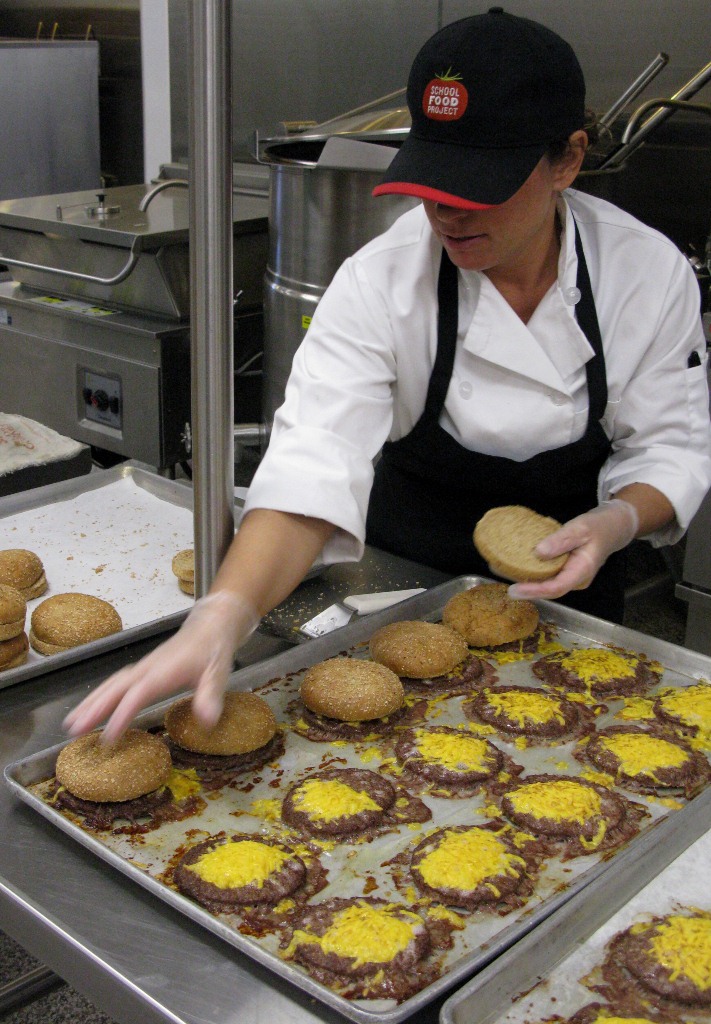
Cooper's menu contains many kid-friendly items that sound very similar to those on the old menu. But they've all been redesigned to be healthier. Hamburgers, for instance, are served on a whole wheat bun. Pizzas are made in-house using a frozen, commercial crust with fresh-made sauce. Nachos are made with grated real cheese, not the canned, DayGlo stuff full of industrial additives. Some kids have complained the new food doesn't have enough flavor. Coopers chefs continually tweak the recipes.

"Last year we cheated," said Margaret Trevarton, the head "lunch lady"--or "kitchen satellite lead"--at Columbine Elementary School. "I was adding spices to the food, like garlic in the macaroni and cheese."

Cheeseburgers get whole wheat buns

One morning my assignment was to help stuff 800 cheese quesadillas at Monarch High School. They couldn't have been simpler. Whole-wheat flour tortillas were laid out on a metal surface. A filling of grated cheddar cheese mixed with tomato salsa had already been mixed in a huge plastic tub, or Lexan. A cook laid a firm scoop of filling on each tortilla and I followed, spreading the cheese over half the tortilla with my fingers, folding the tortilla in half to cover the cheese. It was pleasant, meditative work. No one was having a heart attack--no barking in this kitchen.

For November, the Boulder menu called for nachos, pizza, chicken pot pie, pasta Bolognese, roast chicken, tacos, hots dogs and a shepherd's pie that so far has failed to light a spark in the student population. As the staff settles in, Cooper plans to cook more of the food from scratch. And as cold weather approaches, something new will appear in Boulder's cafeterias: hot soup.

Making cheese quesadillas

Cooper needs an additional 1,000 kids, approximately, to eat the meals district-wide to balance a $360,000 deficit in her food service operation. About 5,000 of the kids who regularly participate in the meal program eat free or at a reduced price based on family income. That means Cooper so far is reaching only 15 percent of kids who can afford to buy their own lunch. Here's the good news: Cooper still has 85 percent of the full-price student population from which to draw the customers she needs. So far this year, Cooper says she's on target.

Next: Why Ann Cooper believes every school cafeteria should have a salad bar.